
 100% FREE ACCESS
10th Standard CBSE Syllabus & Materials
10th Standard CBSE
CBSE 10th Social Science ECO - Globalisation and the Indian Economy - New Model Questions Papers Study Material - QB365 Set A
NEW10th Standard CBSE
CBSE 10th Social Science ECO - Money and Credit - New Model Questions Papers Study Material - QB365 Set A
NEW10th Standard CBSE
CBSE 10th Social Science ECO - Sectors of the Indian Economy - New Model Questions Papers Study Material - QB365 Set A
NEW10th Standard CBSE
CBSE 10th Social Science ECO - Development - New Model Questions Papers Study Material - QB365 Set A
NEW10th Standard CBSE
CBSE 10th Social Science PS - Outcomes of Democracy - New Model Questions Papers Study Material - QB365 Set A
NEW10th Standard CBSE
CBSE 10th Social Science PS - Gender, Religion and Caste - New Model Questions Papers Study Material - QB365 Set A

Published on: 18/09/2019
Our Environment
Download CBSE Class 10th Standard CBSE Science question papers, sample papers, important questions, and previous year solved papers in PDF format. Get free study materials, NCERT solutions, and exam preparation resources for Class 10th Standard CBSE Science
Questions + Answers key
Take MCQ Science Test
1.
In the food chain given below:
Grass\(\longrightarrow\)Grasshopper\(\longrightarrow\)Frog\(\longrightarrow\)Snake\(\longrightarrow\)Peacock
What will happen if all the frogs are removed?
2.
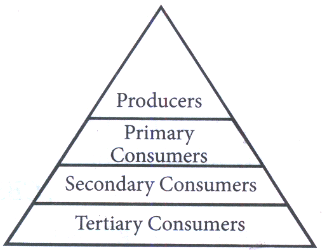
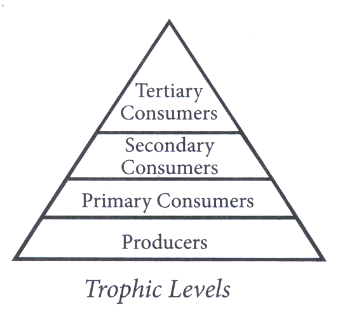
Give the correct sequence of various trophic levels in a food chain
3.
Is it necessary to conserve our environment? Why?
4.
Explain the different trophic level in an ecosystem by giving examples in pond and grassland.
5.
Define food web.
6.
Why some substances are degraded and others not?
7.
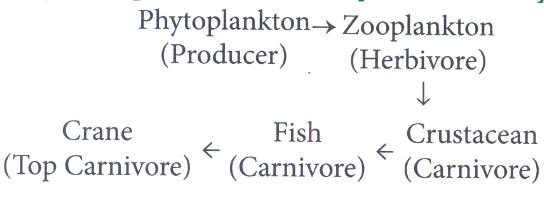
Construct an aquatic food chain showing four trophic levels.
8.
Aquarium requires regular cleaning whereas lakes normally do not. Why?
9.
Why energy of herbivores never come back to the autotrophs?
10.
We do not clean ponds or lakes, but an aquarium needs to be cleaned. Why?
11.
If all the waste we generate is biodegradable, will this have no impact on the environment?
12.
What are the problems caused by the non-biodegradable wastes that we generate?
1.
(a) Increase in the population of grasshopper.
(b) Migration or death of snakes due to food scarcity.
(c) The ecological balance is distributed.
(d) Decrease in the production of grass.
2.
3.
It is necessary to conserve our environment to prevent depletion of natural resources and environmental damage, thereby sustaining life.
4.
Grassland ecosystem:
Grass \(\longrightarrow \) Grasshopper\(\longrightarrow \)Frog\(\longrightarrow \) Snake
Pond ecosystem:
Algae \(\longrightarrow \) Small Fish/shrimp\(\longrightarrow \) Medium Fish \(\longrightarrow \)Large fish/crane/duck
5.
It is a complex web of many interconnected food chains, involving many organisms. There is more than one organism at a particular trophic level. Food web is real life situation.
6.
Different components of food are changed to simpler substances by digestive enzymes and these enzymes are very much specific in nature and action. Similarly substances are broken down by bacteria and saprophytes. They are also very specific in action and break down of the particular substance. Therefore, some substances are biodegradable and other are non-biodegradable.
7.
8.
Normally a lake has more diverse forms of life and hence a larger number of food chains. This leads to natural cleaning. Thus, the ecosystem is more stable. The aquarium has a very limited number of food chains and unable to sustain itself. But, sometimes there is excessive growth of algae in lake. Then it also needs to be cleaned.
9.
Energy of herbivorous never comes back to autotrophs as flow of energy is always unidirectional. So once it passes the trophic level it is no longer available to the previous level.
10.
A pond or a lake has its own natural systems to maintain its ecosystem. Due to this, ponds or lakes normally do not need to be cleaned. An aquarium is a man-made ecosystem which has a very small space. The abiotic components are not supplied naturally to the aquarium. So, an aquarium needs frequent cleaning so that the living beings in it can survive.
11.
If all the waste is biodegradable, then there will be no accumulation of waste and the Earth would be a cleaner place to live. But if, this biodegradable waste is too large in amount then its slow degradation may lead to air pollution (due to release of gases) as well as water and land pollution.
12.
The following are the issues caused by non-biodegradable waste:
Non-biodegradable waste does not decompose. They accumulate in the environment and cause biomagnification; as a result of this accumulation, they pollute soil and water; they pollute the environment.
If such wastes are burned, they pollute the air.
Non-biodegradable wastes, such as pesticides, deplete soil fertility as they penetrate it. The soil's pH level becomes unsuitable for plant growth. Some substances contaminate the environment, causing harm to living organisms.

10th Standard CBSE Syllabus & Materials
10th Standard CBSE
CBSE 10th Social Science PS - Federalism - New Model Questions Papers Study Material - QB365 Set A
NEW10th Standard CBSE
CBSE 10th Social Science PS - Power Sharing - New Model Questions Papers Study Material - QB365 Set A
NEW10th Standard CBSE
CBSE 10th Social Science GEO - Manufacturing Industries - New Model Questions Papers Study Material - QB365 Set A
NEW10th Standard CBSE
CBSE 10th Social Science GEO - Minerals and Energy Resources - New Model Questions Papers Study Material - QB365 Set A



CBSE 10th Standard CBSE Subjects
CBSE Standards





