
 100% FREE ACCESS
10th Standard CBSE Syllabus & Materials
10th Standard CBSE
CBSE 10th Social Science ECO - Globalisation and the Indian Economy - New Model Questions Papers Study Material - QB365 Set A
NEW10th Standard CBSE
CBSE 10th Social Science ECO - Money and Credit - New Model Questions Papers Study Material - QB365 Set A
NEW10th Standard CBSE
CBSE 10th Social Science ECO - Sectors of the Indian Economy - New Model Questions Papers Study Material - QB365 Set A
NEW10th Standard CBSE
CBSE 10th Social Science ECO - Development - New Model Questions Papers Study Material - QB365 Set A
NEW10th Standard CBSE
CBSE 10th Social Science PS - Outcomes of Democracy - New Model Questions Papers Study Material - QB365 Set A
NEW10th Standard CBSE
CBSE 10th Social Science PS - Gender, Religion and Caste - New Model Questions Papers Study Material - QB365 Set A

Published on: 29/12/2018
Class X Model Question
Download CBSE Class 10th Standard CBSE Science question papers, sample papers, important questions, and previous year solved papers in PDF format. Get free study materials, NCERT solutions, and exam preparation resources for Class 10th Standard CBSE Science
Questions + Answers key
Take MCQ Science Test
1.
The molecular formula of 'A'. is C10H18 and 'B' is C18H36 Name the homologous series to which they belong
2.
Choose from the following: 4Be, 9F, 19K, 20Ca
(a) The element having one electron in the outermost shell.
(b) Two elements of the same group.
3.
What happens to the image distance in the eye when we increase the distance of an object from the eye?
4.
If a woman is using a copper-T, will it help in protecting her from sexually transmitted diseases?
5.
What are two types of reducing agents used to reduce metal oxide?
6.
Ferrous sulphate decomposes with the evolution of a gas having a characteristic odour of burning sulphur. Write the chemical reaction involved and identify the type of reaction.
7.
A student wants to project the image of candle flame on the walls of school laboratory by using a lens:
(a) Which type of lens should he use any why?
(b) At what distance in terms of focal length 'F' of the lens should he place the candle flame so as to get
(i) a magnified, and
(ii) a diminished image respectively on the wall?
(c) Draw ray diagram to show the formation of the image in each case.
8.
Find out from table given below, the medium having highest optical density. Also, find the medium with lowest optical density.
Absolute Refractive Index of Some Material Media
| Material Medium |
Refractive Index |
Material Medium |
Refractive Index |
| Air | 1.0003 | canada Balsam |
1.53 |
| Ice | 1.31 | Rock salt | 1.54 |
| Water | 1.33 | Carbon disulphide |
1.63 |
| Alcohol | 1.36 | Dense flint glass |
1.65 |
| Kerosene | 1.44 | Ruby | 1.71 |
| Fused quartz |
1.46 | Sapphire | 1.77 |
| Turpentine oil |
1.47 | Diamond | 2.42 |
| Benzene | 1.50 | ||
| Crown glass | 1.52 |
9.
List in tabular form three physical and two chemical properties on the basis of which ethanol and ethanoic acid can be differentiated.
10.
Describe the activity that shows that a current-carrying conductor experiences a force perpendicular to its length and the external magnetic field. How does Fleming's left-hand rule help us to find the direction of the force acting on the current carrying conductor?
11.
Explain the mechanism of photosymthesis.
12.
Give reasons :
(a) Platinum, gold and silver are used to make jewellery.
(b) Sodium, potassium and lithium are stored under oil.
(c) Aluminium is a highly reactive metal. Yet it is used to make utensils for cooking.
(d) Carbonate and sulphide ores are usually converted into oxide during the process of extraction.
13.
A sulphate salt of Group 2 element of the Periodic Table is a white, soft substance. Which can be moulded into different shapes by making its dough. When this compound is left in open for sometime, it becomes a solid mass and cannot be used for moulding purposes. Identify the sulphate salt and why does it show such a behaviour? Give the reaction involved.
14.
Mention the products produced when an acid reacts with a base. Give equation of an example of the reaction involved. What is this kind of reaction known as?
15.
After drinking an excess of cold drink, a person suffered from acidity. Explain
16.
Define the term decomposition reaction. Give one example each of thermal decomposition and electrolytic decomposition.
17.
Give any two ways in which biodegradable substances would affect the environment.
18.
Name two metals which react violently with cold water. Write any three observation you would make when such a metal is dropped into water. How would you identify the gas evolved, if any during the reaction?
19.
Distinguish between an electric motor and generator?
20.
What is 'translocation'? Why is it essential for plants?Where in plants are the following synthesized:
(i)Sugar (ii)Hormones
21.
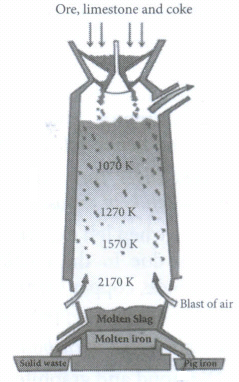
Name a major ore from which iron is extracted. Write chemical equations for the reactions that take place in the blast furnace for the extraction of iron from this ore.
22.
(a) Why is the Solar Cooker box covered with a plane glass plate?
(b) Why is energy of water flowering in a river considered to be an indirect form of solar energy?
(c) How is the fission of nucleus brought about?
23.
Describe the central nervous system in human being under the following heads:
(i) Regions included
(ii) Three functions of any one region
24.
(a) State Ohm's Law.
(b) Draw a schematic diagram of the circuit for studying Ohm's Law.
25.
(a) What is meant by 'Electric Resistance' of a conductor?
(b) A wire of length 'L' and resistance 'R' is stretched so that its length is doubled and the area of cross-section is halved. How will its:
(i) resistance change
(ii) resistivity change
26.
(i) An aqueous solution has a pH value of 7.0. Is this solution acidic, basic or neutral?
(ii) If H+ concentration of a solution is \(1\times 10^{-2}\ mol\ L^{-1},\) what is the pH value for it?
(iii) Which has a higher pH value, 1 M HCl or 1 M NaOH solution?
27.
a) How can solar energy be harnessed?
b) Mention any two limitations in using solar energy.
c) How are these limitations overcome?
1.
'A' belongs to alkyne as general formula of alkyne is C2H2n−2
'B' belongs to alkene as general formula of alkene is C2H2n
2.
19K has one valence electron.
4Be and 20Ca belong to the same group.
3.
The image distance remains the same because the focal length of the eye lens gradually changes to maintain the position of image on the retina of the eye.
4.
No, copper-T does not prevent the transmission of sexually transmitted diseases. Copper-T only prevents implantation. The only safe method that can be used to prevent the transmission of sexually transmitted diseases is condoms.
5.
Carbon and highly reactive metals such as sodium, calcium, aluminium are used as reducing agents to reduce metal into metal.
6.
\(\underset{Ferrous\ sulphate}{2FeSO_4(s)}\xrightarrow{Heat/Decompostion}\underset{Ferric\ oxide}{Fe_2O_3}+\underset{sulphur\ dioxide}{SO_2(g)}+\underset{sulphur\ trioxide}{SO_3}\)
Sulphur dioxide evolves in this smells like burning of sulphur. This reaction is a thermal decomposition reaction.
7.
(a) A convex lens should be used. This is because it can produce a real image of the candle flame on the wall as it is a converging lens where refracted rays actually meet.
(b)&(c)
(i) A real magnified image is formed when the candle flame is placed between F and 2F from the convex lens on the other side of the wall.
-S.png)
(ii) A real diminished image is formed when the candle flame is placed beyond 2F from the convex lens on the other side of the wall.
-S.png)
8.
The medium with the highest refractive index will have the highest optical density. So, diamond has the highest optical density. The medium with the lowest refractive index will have the lowest optical density. So, air has the lowest optical density.
9.
Physical properties:
| Ethanol | Ethanoic acid |
| 1. It has specific smell. | 1. It has vinegar like smell. |
| 2. It has burning taste. | 2. It is sour in taste. |
| 3. It does not freeze in winter. | 3. It freezes in winters. |
Chemical properties:
| Ethanol | Ethanoic acid |
| 1. It does not react with NaHCO3. | 1. It gives CO2 with NaHCO3 |
| 2. It burns with blue flame. | 2. It does not burn with blue flame. |
| 3. It does not affect blue litmus. | 3. It turns blue litmus red. |
10.
Activity:
To show the effect of magnetic field on current -carrying conductor
Materials Required:
A small aluminium rod, a horse-shoe magnet, battery, plug key, wires and a stand.
Procedure:
The aluminium rod is suspended horizontally from the stand and tied to two wires at its ends. The wires are attached to rheostat, battery and a plug key to make the circuit.
The horse-shoe magnet is positioned in a way that the aluminium rod lies between the two poles of the magnet. If the South Pole is above the aluminium rod and the North Pole is below it. The plug key is inserted to initiate current supply to the rod.
It is observed that the aluminium rod deflects towards left.
When the direction of the current is reversed the aluminium rod deflects towards right.
Conclusion:
When a current carrying conductor is placed within a magnetic field, the conductor experiences deflection. Fleming's Left Hand Rule explains the direction of displacement in this case. Let us assume that the current is moving in anti-clockwise direction in the loop. In that case, the magnetic field would be in clockwise direction; at the top of the loop. Moreover, it would be in anticlockwise direction at the bottom of the loop.
11.
Food is prepared in the green leaves of the plant by combining carbon dioxide and water in presence of sunlight and chlorophyll. The carbon dioxide required for photosynthesis is taken by the plants from air. The carbon dioxide enters the leaves through tiny pores called stomata. The water required is taken from soil. The sunlight provides the energy required to carry out the preparation of food. The green pigment called chlorophyll present in green leaves help to absorb energy from sunlight. The oxygen produced as a by-product goes into the air.
The food prepared by the green leaves is in the form of glucose. This glucose is sent to different parts of the plant. The excess glucose is changed into starch and is stored in the leaves of the plant. The food prepared by photosynthesis provides all the energy to a plant which it needs to grow. Thus, it is clear that the green plants convert sunlight energy into chemical energy. by making food. When we eat plant foods such as fruits, vegetables, food grains etc., the chemical energy stored in them is released in our body during respiration.
During the process of photosynthesis, the following three steps take place:
(i) Absorption of sunlight energy by chlorophyll.
(ii) Conversion of sunlight energy into chemical energy and splitting of water into hydrogen and oxygen using sunlight energy.
(iii) Reduction of carbon dioxide to form carbohydrates using the chemical energy.
12.
(i) Platinum, gold and silver are highly malleable, lustrous and least reactive, i.e. noble metals, so they are not corroded by air and water easily.
(ii) Sodium, potassium and lithium are very reactive, so these metals react vigorously with atmospheric oxygen to form oxides. Storing them in oil prevents their oxidation.
(iii) A thin layer of aluminium oxide formed on the surface of aluminium prevents it from corrosion. Thus, aluminium vessels do not react with any ingredient of food and are suitable for cooking.
(iv) It is easier to obtain metal from its oxide rather than its carbonates and sulphides. Therefore, these ores are first converted to oxide and then reduced to metal.
13.
The Substance which is used for making different shapes is Plaster of Paris. Its chemical name is calcium sulphate hemihydrate \([CaSO_4.1/2H_2O].\) The two formula unit of \(CaSO_4\) share one molecule of water. As a result, it is soft. When it is left open for some time, it absorbs moisture from the atmosphere and forms gypsum, which is a hard solid mass.
\(\underset{Plaster\ of\ Paris}{CaSO_4.{1\over 2}H_2O}+1{1\over2}{H_2O}\rightarrow \underset{Gypsum}{CaSO_4.2H_2O}\)
14.
The reaction between an acid and a base that gives a salt and water is known as a neutralisation reaction.
Base + Acid ➝ Salt + Water
NaOH(aq) + HCI(aq) ➝ NaCl(aq) + H2O(I)
15.
Cold drinks contain carbon dioxide dissolved in them under pressure. Some amount of the gas escapes when a bottle of cold drink is opened while a portion of it remains dissolved. Carbon dioxide dissolved in water forms a weak acid, carbonic acid. Consumption of excess of cold drink causes accumulation of carbonic acid in the stomach which is responsible for the development of acidity.
16.
Reaction in which a single reactant breaks down to give simpler products.
Thermal decomposition-
\(CaCO_{ 2 }\overset { \triangle }{ \longrightarrow } CaO+C{ O }_{ 2 }\)
(Or any other)
Electrolytic decomposition-
2H2O\(\overset { Electric\quad current }{ \rightarrow } \) 2H2+O2
(or)
In a decomposition reaction, a single reactant breaks down into two or more simpler products.
When a decomposition reaction is carried out by heating, it is called thermal decomposition reaction.
\(\underset { (Calucium\quad carbonate) }{ CaCO_{ 3 }(s) } \overset { Heat }{ \rightarrow } \underset { Calcium\quad oxide) }{ CaO(s) } +\underset { (Carbon\quad dioxide) }{ { CO }_{ 2 }(g) } \)
When a decomposition reaction is carried out with the help of electric current, the process is called electrolysis.
\(\underset { Water }{ 2{ H }_{ 2 }O(I) } \overset { Electric\quad current }{ \longrightarrow } \underset { (Hydrogen\quad gas) }{ 2{ H }_{ 2 }(g) } +\underset { (Oxygen\quad gas) }{ { O }_{ 2 }(g) } \)
17.
The two ways in which biodegradable substances would affect the environment are
(i) Their degradation may release certain gases in the atmosphere thereby, polluting the environment.
(ii) They may become breeding places of flies and many other pests, thus causing diseases.
18.
Sodium and potassium react vigorously with cold water.
When these metals are dropped in water, bubbles will be evolved due to evolution of hydrogen gas, large amount of heat is produced and the solution will change red litmus blue.
Hydrogen gas is formed. Bring burning splinter near the mouth of the test tube where gas is evolved, the splinter bums with a pop sound.
19.
The major differences between an electric motor and generator are stated below:
Electric Motor:
1. It converts electrical energy into mechanical energy.
2. It needs electrical energy for its works.
3. They are used as water pumps, marble grinders etc.
Generator:
1. It converts mechanical energy into electrical energy
2. It needs mechanical energy for its working.
3. They are used as water pumps, marble grinders etc.
4. diesel generator, hydro-electric generator are the examples of it.
20.
The transport of soluble products of photosynthesis is known as translocation. Translocation in plants occurs by means of the vascular tissue known as phloem. Translocation is necessary because without it, the food prepared by the leaves cannot reach other parts of the plant.
(i)In plants, the synthesis of sugars takes place in the leaves by the process of photosynthesis.
(ii)Hormones are synthesised away from their targrt site.
21.
Haematite (Fe2O3) is an important ore of iron.
In the upper part of the blast furnace, carbon monoxide reduces iron (III) oxide to iron metal.
\(\underset { Iron(III)oxide }{ { Fe }_{ 2 }{ O }_{ 3 } } +\underset { Carbonmonoxide }{ 3CO(g) } \rightarrow \underset { Ironmetal }{ 2Fe(I) } +\underset { Carbondioxide }{ { 3CO }_{ 2 }(g) } \)
Following reactions are involved in the blast furnace:
(i) Formation of carbon monoxide
\(\underset { Carbon }{ C(s) } +\underset { Oxygen }{ { O }_{ 2 }(g) } \rightarrow \underset { Carbondioxide }{ { CO }_{ 2 }(g) } +Heat\\ \underset { Carbondioxide }{ { CO }_{ 2 }(g) } +\underset { Coke }{ C(s) } \rightarrow \underset { Carbonmonoxide }{ 2CO(g) } \)
(ii) Reduction of iron (III) oxide or haematite to iron
\(\underset { Iron(III)oxide }{ { Fe }_{ 2 }{ O }_{ 3 } } +\underset { Carbonmonoxide }{ 3CO(g) } \rightarrow \underset { Ironmetal }{ 2Fe(I) } +\underset { Carbondioxide }{ { 3CO }_{ 2 }(g) } \)
22.
(a) The solar cooker box is covered with a plane glass plate so as to prevent heat from escaping.
(b) Sun is said to be the ultimate and the original source for most of the energy present on the earth. When sun rays fall on oceans and other water bodies, the water present in the water bodies gets evaporated and rises up in the atmosphere. In the upper part of the atmosphere, this water vapour gets condensed and forms douds, which give rain on the high lands. Therefore, the rain water runs over the Sand surface towards the large water bodies. This running water over the land surfaces is called river. Therefore, the energy of running water actually originates from the solar energy. This is why solar energy of water flowing in a river is considered to be an indirect form of solar energy.
(c) The fission of nucleus is brought about by splitting the nucleus of heavy atoms, such as uranium or plutonium, with low-energy neutron bombardment.
23.
(i) Regions included in central nervous system are the brain and the spinal cord. The brain and the spinal cord. The brain is further divided into three parts - forebrain, midbrain, and hindbrain.
(ii) Three of the functions of the brain are:
Forebrain controls intelligence, learning, memory, thinking, speech, etc.
Midbrain is associated with the sense of sight and hearing.
Hindbrain controls all involuntary actions such as breathing, peristalsis, etc.
24.
(a) Ohm's Law states that at constant temperature, current flowing through a conductor is directly proportional to the potential difference across its ends.
-s.png)
25.
(a) Resistance is defined as the property of a conductor due to which it opposes the flow of current through it. The S.I. unit of resistance is Ohm \(\left( \Omega \right) \).
(b) (i) The resistance (R) of a conductor is related to its length (l) and area of cross section (A) as
\(R=\frac { p\times l }{ A } \) Where \(\rho \) is the resistivity of the conducting material.
Let R1= Resistance of the original wire
R2= Resistance of the wire when its length is doubled
I1= Length of original wire
l2= Length of original wire when doubled
A1= Area of the original wire
A2= Area when it is halved
Therefore,
\({ R }_{ 1 }=\frac { P\times { l }_{ 1 } }{ { A }_{ 1 } } \quad \quad ---\quad (1)\\ { R }_{ 2 }=\frac { P\times { l }_{ 2 } }{ { A }_{ 2 } } \quad \quad ---\quad (2)\)
Dividing equation (1) and (2) by equation (1), we obtain
\(\frac { { R }_{ 1 } }{ { R }_{ 2 } } =\frac { { l }_{ 1 } }{ { l }_{ 2 } } \times \frac { { A }_{ 1 } }{ { A }_{ 2 } } \quad ---\quad (3)\)
It is given that:
\({ l }_{ 1 }=2l_{ 1 }\quad and\quad { A }_{ 2 }=\frac { 1 }{ 2 } { A }_{ 1 }\\ \)
Putting these values in equation (3), we obtain
R2=4R1
Hence, the resistance of the wire will be 4 times of the original value.
(ii) The resistivity will not change on stretching the wire. Resistivity is the property of the conducting material. It does not depend on the dimension of the wire. As materials of both the wires are the same, the resistivity will not change.
26.
(i) An aqueous solution with pH value 7.0 is neutral in nature.
(ii) The pH value is given by the formula:
\(pH=-log[H^+]\)
\(pH+-(-2)\ log\ 10\)
or, pH = 2
(iii) 1 M NaOH solution has a higher pH value. This because \(pH=-log[H^+]\ NaOH\) dissociates to give hydroxyl ion, not hydrogen ions. On the other hand, HCl is a strong acid and dissociates to give hydrogen ions.
27.
a) Solar energy can be harnessed by using solar energy devices. These devices either use solar energy directly as heat or convert it into solar energy directly as heat or convert it into electricity. One of the devices is solar cooker.
b) Limitations of solar energy:
i) It is not evenly distributed on the Earth.
ii) It requires costly equipment and infrastructure.
c) Using of solar cells.

10th Standard CBSE Syllabus & Materials
10th Standard CBSE
CBSE 10th Social Science PS - Federalism - New Model Questions Papers Study Material - QB365 Set A
NEW10th Standard CBSE
CBSE 10th Social Science PS - Power Sharing - New Model Questions Papers Study Material - QB365 Set A
NEW10th Standard CBSE
CBSE 10th Social Science GEO - Manufacturing Industries - New Model Questions Papers Study Material - QB365 Set A
NEW10th Standard CBSE
CBSE 10th Social Science GEO - Minerals and Energy Resources - New Model Questions Papers Study Material - QB365 Set A



CBSE 10th Standard CBSE Subjects
CBSE Standards





