
 100% FREE ACCESS
10th Standard CBSE Syllabus & Materials
10th Standard CBSE
CBSE 10th Social Science ECO - Globalisation and the Indian Economy - New Model Questions Papers Study Material - QB365 Set A
NEW10th Standard CBSE
CBSE 10th Social Science ECO - Money and Credit - New Model Questions Papers Study Material - QB365 Set A
NEW10th Standard CBSE
CBSE 10th Social Science ECO - Sectors of the Indian Economy - New Model Questions Papers Study Material - QB365 Set A
NEW10th Standard CBSE
CBSE 10th Social Science ECO - Development - New Model Questions Papers Study Material - QB365 Set A
NEW10th Standard CBSE
CBSE 10th Social Science PS - Outcomes of Democracy - New Model Questions Papers Study Material - QB365 Set A
NEW10th Standard CBSE
CBSE 10th Social Science PS - Gender, Religion and Caste - New Model Questions Papers Study Material - QB365 Set A

Published on: 13/02/2020
10th Standard CBSE Science Public Model Question Paper III 2019 - 2020
Download CBSE Class 10th Standard CBSE Science question papers, sample papers, important questions, and previous year solved papers in PDF format. Get free study materials, NCERT solutions, and exam preparation resources for Class 10th Standard CBSE Science
Questions + Answers key
Take MCQ Science Test
1.
The image formed by a spherical mirror is real, inverted and is of magnification -2. If the image is at a distance of 30 cm from the mirror, where is the object place? Find the focal length of the mirror. List two characteristics of the image formed if the object is moved 10 cm towards the mirror.
2.
What is meant by speciation? List four factors which could lead to speciation. Which of these cannot be a major factor in the speciation of a self-pollinating plant species. Give reason to justify your answer.
3.
Indicate the flow of energy in an ecosystem. Why is it unidirectional? Justify.
4.
State the reason why carbon can neither form C4+ cations for C4- anions, but forms covalent compounds. Also state reasons to explain why covalent compounds:
(a) are bad conductors of electricity?
(b) have low melting and boiling points
5.
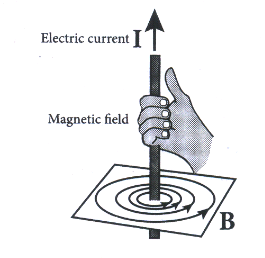
With the help of a labelled circuit diagram illustrate the pattern of field lines of the magnetic field around a current carrying straight long conducting wire. How is the right hand thumb rule useful to find direction of magnetic field associated with a current carrying conductor?
6.
State Ohm's law? How can it be verified experimentally? Does it hold good under all conditions? Comment
7.
A metal carbonate X on reacting with an acid gives a gas which when passed through a solution Y gives the carbonate back. On the other hand, a gas G that is obtained at anode during electrolysis of brine is passed on dry Y; it gives a compound Z, used for disinfecting drinking water. Identity X, Y, G and Z.
8.
Classify the following salts into acidic, basic and neutral- Potassium sulphate, ammonium chloride, sodium carbonate, sodium chloride.
9.
A person can comfortably read a book, but finds difficult to read the number on a bus parked 5m away from him. Name the type of defect of vision he is suffering from. Which type of lens should he use in his spectacle to correct his vision?
10.
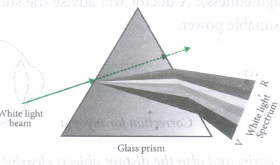
Draw a ray diagram showing through a prism when a narrow beam of white light is incident on one of its refracting surfaces. Also indicate the order of the colours of the spectrum obtained.
11.
In evolutionary terms, can we say which among bacteria, spiders, fish and chimpanzees have a better body design? Why or why not?
12.
The yeast cells fail to multiply in water, but multiply rapidly in sugar solution. Why?
13.
Name the hormone secreted by thyroid gland.
14.
Name the different forms of energy required for breaking down the reactants in decomposition reaction.
15.
(a) Give Arrhenius definition of an acid and a base.
(b) Choose strong acid and strong base from the following:
\(CH_3COOH,\ NH_4OH,\ KOH,\ HCl\)
16.
What is biological magnification? Will the levels of this magnification be different at different levels of the ecosystem?
17.
Distinguish between permanent magnet and electromagnet.
18.
How are oxygen and carbon dioxide transported in human beings? How are lungs designed to maximize the area for exchange of gases?
19.
(a) Name the chief ore of iron. Write its formula.
(b) How is an iron ore concentrated? Describe it briefly.
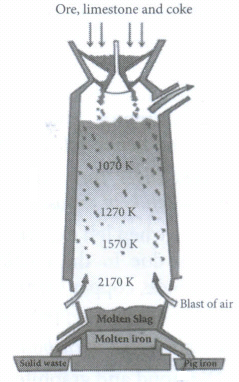
(c) Draw a labelled diagram of the blast furnace used in the extraction of iron from its concentrated ore.
20.
(a) What is a 'solar cell'?
(b) Why is biogas considered an ideal fuel for domestic use?
(c) Name a device in which controlled chain reaction is used.
21.
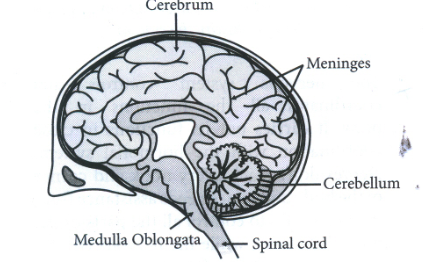
Draw a diagram of human brain and label on it the following of its parts:
(i) Cerebrum
(ii) Meninges
(iii) Medulla Oblongata
(iv) Cerebellum
22.
Why should biodegradable wastes be discarded in two separate dustbins?
23.
Chlorine, bromine and iodine form a Dobereiner's triad. The atomic masses of chlorine and iodine are 35.5 and 126.9 respectively. Predict the atomic mass of bromine.
24.
What is meant by the 'calorific value' of a fuel? How is it determined? Arrange the following fuels in a decreasing order of their calorific values: Kerosene, Coal, LPG.
25.
What is the importance of forest as a resource?
26.
Give an account of the process adopted by Mendeleev for the classification of elements. How did he arrive at "Periodic Law"?
1.
Nature of image formed by spherical mirror = Real, inverted
Magnification, m = -2
Object distance, u=?
f=?
Image distance, v = -30 cm (-ve sign is for real image)
\(m=\frac { -v }{ u } \)
\(\Rightarrow \frac { -v }{ u } =-2\)
\(\Rightarrow \frac { -30 }{ u } =2\)
2u=-30
∴ u=-15 cm
According to the mirror formula,
\(\frac { 1 }{ f } =\frac { 1 }{ v } +\frac { 1 }{ u } \)
\(\frac { 1 }{ f } =\frac { 1 }{ -30 } +\frac { 1 }{ -15 } \)
\(\Rightarrow \frac { 1 }{ f } =\frac { 1 }{ -30 } -\frac { 1 }{ 15 } =\frac { -1-2 }{ 30 } =\frac { -3 }{ 30 } \)
\(\frac { 1 }{ f } =\frac { -1 }{ 10 } \)
∴ f=-10cm
If the object is shifted 10 cm towards the mirror
then, u = 15-10-5 cm
In this case the object is placed between pole and focus of the spherical mirror. Therefore, the image formed is virtual, erect, magnified and behind the mirror.
2.
The process by which new species develop from the existing species is known as speciation.
Factors leading to speciation:
(i)Geographical isolation of a population caused by various types of barriers like mountain ranges, rivers, sea etc. The geographical isolation leads to reproductive solation due to which there is no flow of genes between separated groups of population.
(ii)Genetic drift caused by drastic changes in the frequencies of particular genes by chance alone.
(iii)Variations caused in individuals due to natural selection.
(iv)Drastic change in the genes or DNA called mutation is also a cause of speciation. Reproductive isolation cannot be major factor in the speciation of a self-pollinating
plant species. This is because, it does not depend on any other plant for its reproduction process.
3.
The flow of energy in an ecosystem happens in following sequence:
Producer\(\rightarrow \) Primary Consumer\(\rightarrow \) Secondary Consumer\(\rightarrow \) Tertiary Consumer
The flow of energy is unidirectional in the food chain due to two reasons. A predator always eats its prey but other way round is not possible. Moreover, out of the total energy consumed by an organism at a particular trophic level; 90% is utilised for its own need and just 10% is left for the organism of next trophic level. Thus, the availability of energy gets reduced at subsequent trophic level. Due to this, the flow of energy is unidirectional in a food chain.
4.
Carbon atoms have 4 electrons in their outcomes shell. So need to gain or lose electrons to attain noble gas configuration.
(i) It could gain four electrons forming c4- anion. But it would be difficult for the nucleus with six protons to hold on to ten electrons.
(ii) It could lose four electrons forming C4+ cations. But it would require a large amount energy to remove four electrons from its outermost shell.
Because of these reasons, carbon shares its valence electrons to complete its octet with other atoms to form covalent bonds.
(a) Covalent compounds are bad conductors of electricity because they do not contain ions.
(b) Covalent compounds have usually low melting and boiling because they are made up of electronically neutral molecule. So the force of attraction between the molecules of a covalent compound is very weak. Only a small amount of heat energy is required to break these weak molecular forces, due to which covalent compounds have low melting and boiling points.
5.
The following diagram depicts the pattern and direction of magnetic field lines around a straight current-carrying conductor.
Right Hand Thumb Rule: If a current carrying conductor is held by right hand, keeping the thumb straight and if the direction of electric current is in the direction of thumb, then the direction of wrapping of other fingers will show the direction of magnetic field.
6.
At constant temperature, the current flowing through a conductor is directly proportional to the potential difference across its ends.
Onh's law does not hold good under all conditions as it is not a fundamental law of nature like Newton's laws. It is obeyed by metallic conductors only when physical condition like temperature etc., are kept unchanged. It is not obeyed by a lamp filament.
7.
The gas evolved at anode during electrolysis of brine is chlorine (G) When chlorine gas is passed through dry \(Ca(OH)_2\ (Y)\) produces bleaching powder (Z) used for disinfecting drinking water.
\(Ca(OH)_2+Cl_2\rightarrow CaOCl_2+H_2O\)
Since Y and Z are calcium salts, therefore X is also a calcium salt and is calcium carbonate.
\(CaCO_3+2HCl\rightarrow CaCl_2+CO_2+H_2O\)
\(Ca(OH)_2+CO_2 \rightarrow CaCO_3+H_2O\)
8.
Neutral Salts : Potassium sulphate, sodium chloride
Basic Salts: Sodium carbonate
Acidic Salts: Ammonium chloride
9.
Defect-Myopia or short-sightedness Correction-Concave lens
10.
11.
Evolution shows that body design changed from simple to complex. Hence, bacteria has the simplest body design and chimpanzee has the most complex and better body design.
12.
This is because, water does not provide energy to multiply whereas sugar provides energy for the yeast to undergo multiplication.
13.
Thyroxine is the hormone secreted by the thyroid gland. This hormone regulates the metabolism of carbohydrates, fats and proteins. By regulating the metabolism it helps in optimum growth and development of the body.
14.
Heat, light and electricity.
15.
(a) According to Arrhenius theory, acids are substances that produce H+ ions when mixed with water. On the other hand, based are substances that produce OH- ions when mixed with water.
(b) NH4OH is a weak base and HCl is a strong acid.
16.
Biological magnification refers to the increase in the concentration of certain toxicants at each successive trophic level.
No, the levels of magnification will not be same in all trophic levels. When the chemicals do not get degraded and get accumulated progressively at each trophic level, it leads to biomagnification. It is more in organisms of higher trophic levels.
17.
| Electromagnet | Permanent Magnet |
| 1. It is temporary magnet and can be demagnetized | 1. It is a permanent magnet and cannot be demagnetized |
| 2. Magnetic strength can be changed. | 2. its strength is fixed. |
| 3. Its polarity can also be changed. | 3. Its polarity is fixed. |
| 4. It is prepared from soft iron. | 4. It is prepared from hard steel. |
18.
(i) Oxygen enters the human body through the nasal passage and reaches the lungs.
(ii) Numerous alveoli are present in the lungs. These alveoli are surrounded by many blood capillaries. From the alveoli, 02 is taken up by the red blood cells present in the blood capillaries.
(iii) Similarly, the CO2 from the various tissues is transported to the alveoli.
(iv) This CO2 is then released through the nasal passage during exhalation. Alveoli are the sites of exchange of gases. Each lung contains 300- 350 million alveoli.
These alveoli increase the surface area for gaseous exchange, making the process of respiration more efficient.
19.
Haematite (Fe2O3) is an important ore of iron.
In the upper part of the blast furnace, carbon monoxide reduces iron (III) oxide to iron metal.
\(\underset { Iron(III)oxide }{ { Fe }_{ 2 }{ O }_{ 3 } } +\underset { Carbonmonoxide }{ 3CO(g) } \rightarrow \underset { Ironmetal }{ 2Fe(I) } +\underset { Carbondioxide }{ { 3CO }_{ 2 }(g) } \)
Following reactions are involved in the blast furnace:
(i) Formation of carbon monoxide
\(\underset { Carbon }{ C(s) } +\underset { Oxygen }{ { O }_{ 2 }(g) } \rightarrow \underset { Carbondioxide }{ { CO }_{ 2 }(g) } +Heat\\ \underset { Carbondioxide }{ { CO }_{ 2 }(g) } +\underset { Coke }{ C(s) } \rightarrow \underset { Carbonmonoxide }{ 2CO(g) } \)
(ii) Reduction of iron (III) oxide or haematite to iron
\(\underset { Iron(III)oxide }{ { Fe }_{ 2 }{ O }_{ 3 } } +\underset { Carbonmonoxide }{ 3CO(g) } \rightarrow \underset { Ironmetal }{ 2Fe(I) } +\underset { Carbondioxide }{ { 3CO }_{ 2 }(g) } \)
20.
(a) A solar cell is a device which converts solar energy into electricity. It is a sandwich of a silicon-boron layer and a silicon-arsenic layer.
(b) Biogas is an ideal fuel for domestic use because it is a cheap and clean fuel, which does not leave behind any residue.
(c) A nuclear power plant is a device in which controlled chain reaction is used.
21.
22.
()
Biodegradable and non-biodegradable wastes should be discarded in two separate dust-bins because biodegradable waste is decomposed by the micro-organisms to form simple harmless substances which can be used as manures for the plants (e.g. in the potted plants in our garden/terrace garden). Non-biodegradable waste cannot be broken down naturally.
23.
()
Atomic mass of Br = 35.5 + 126.9 / 2
= 162.4 / 2 = 81.2
24.
()
The amount of heat produced in burning the unit mass of a fuel completely is known as the calorific value of that fuel. It is determined with the help of Bomb Calorimeter.
Arrangement of the fuels in a decreasing order of their calorific values.
LPG > Kerosene > Coal
25.
(a) Habitat, food, protection to wild life.
(b) Help in balancing CO2 and O2 of atmosphere.
(c) Improves water holding capacity of soil.
(d) Regulates water cycle
(e) For human being, they are the source for all essential commodities like, fuel wood, timber pulp and paper etc.
(f) It provides useful products like fruits, resins, gums, essential oils, bidi wrapper etc.
26.
When the various elements were arranged in order of their increasing atomic masses, elements having similar properties fell under on another in the same vertical column called the group. He further observed that repetition of elements with similar physical and chemical properties occurred after certain regular intervals. On the basis of these observations, Mendeleev proposed his periodic law which states that the physical and chemical properties of elements are a periodic function of their atomic masses.

10th Standard CBSE Syllabus & Materials
10th Standard CBSE
CBSE 10th Social Science PS - Federalism - New Model Questions Papers Study Material - QB365 Set A
NEW10th Standard CBSE
CBSE 10th Social Science PS - Power Sharing - New Model Questions Papers Study Material - QB365 Set A
NEW10th Standard CBSE
CBSE 10th Social Science GEO - Manufacturing Industries - New Model Questions Papers Study Material - QB365 Set A
NEW10th Standard CBSE
CBSE 10th Social Science GEO - Minerals and Energy Resources - New Model Questions Papers Study Material - QB365 Set A



CBSE 10th Standard CBSE Subjects
CBSE Standards





