
 100% FREE ACCESS
10th Standard CBSE Syllabus & Materials
10th Standard CBSE
CBSE 10th Social Science ECO - Globalisation and the Indian Economy - New Model Questions Papers Study Material - QB365 Set A
NEW10th Standard CBSE
CBSE 10th Social Science ECO - Money and Credit - New Model Questions Papers Study Material - QB365 Set A
NEW10th Standard CBSE
CBSE 10th Social Science ECO - Sectors of the Indian Economy - New Model Questions Papers Study Material - QB365 Set A
NEW10th Standard CBSE
CBSE 10th Social Science ECO - Development - New Model Questions Papers Study Material - QB365 Set A
NEW10th Standard CBSE
CBSE 10th Social Science PS - Outcomes of Democracy - New Model Questions Papers Study Material - QB365 Set A
NEW10th Standard CBSE
CBSE 10th Social Science PS - Gender, Religion and Caste - New Model Questions Papers Study Material - QB365 Set A

Published on: 13/02/2020
10th Standard CBSE Science Public Model Question Paper III 2020
Download CBSE Class 10th Standard CBSE Science question papers, sample papers, important questions, and previous year solved papers in PDF format. Get free study materials, NCERT solutions, and exam preparation resources for Class 10th Standard CBSE Science
Questions + Answers key
Take MCQ Science Test
1.
The decomposition of vegetable matter in to compost is an example of what type of reaction?
2.
Name the type of particles which act as prism in the formation of rainbow in the sky
3.
Why energy of herbivores never come back to the autotrophs?
4.
Select two non-biodegradable substances from the following waste generated in a kitchen: spoilt food, paper bags, milk bags, vegetable peels, tin cans, used tea leaves.
5.
A normal pea plant bearing coloured flowers suddenly start producing white flowers. What could be the possible cause?
6.
If a normal human cell has 46 chromosomes, then how many chromosomes will be there in a human zygote?
7.
Differentiate between an artery and vein.
8.
The magnetic field in a given region is uniform. Draw a diagram to represent it.
9.
Give the names of two energy sources that you consider to be exhaustible. Give reason for your choices.
10.
What are gustatory receptors?
11.
What is the common name of the compound CaOCI2?
12.
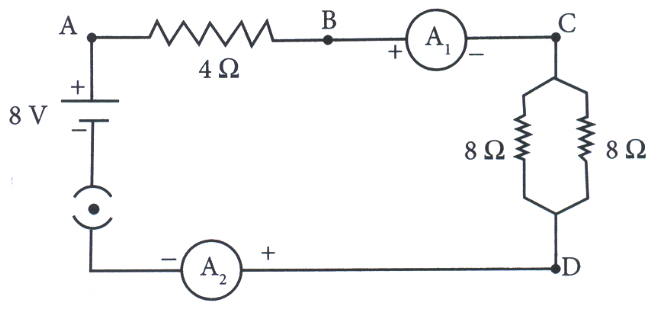
Find out the following in the electric circuit given in Figure
(a) Effective resistance of two 8 \(\Omega\) resistors in the combination
(b)Current flowing through 4 \(\Omega\) resistor
(c) Potential difference across 8 \(\Omega\) resistance
(d) Power dissipated in 4 \(\Omega\) resistor
(e) Difference in ammeter readings, if any.
13.
An object 5 cm in length is held 25 cm away from a converging lens of focal length 10 cm. Draw the ray diagram and find the position, size and the nature of the image formed.
14.
(a) What is an ecosystem? List its two main components.
(b) We do not clean ponds or lakes, but an aquarium needs to be cleaned regularly. Explain.
15.
Define evolution. How does it occur? Describe how fossils provide us evidences in support of evolution.
16.
Explain why carbon forms compounds mainly by covalent bond. Explain in brief two main reasons for carbon forming a large number of compounds. Why does carbon form strong bonds with most other elements?
17.
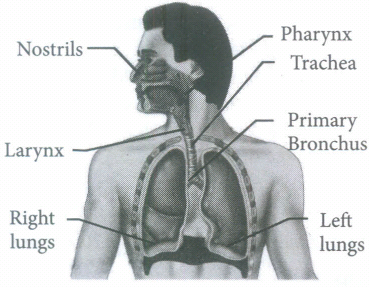
(a)Draw the respiratory system of human beings.
(b)Label the following on the diagram drawn: Larynx, Trachea, Primary Bronchus, Lungs
(c)What happens to the carbon dioxide which collects in human tissues?
18.
(a) What is meant by a magnetic field?
(b) How is the direction of magnetic field at a point determined?
(c) Describe an activity to demonstrate the direction of the magnetic field generated around a current carrying conductor.
(d) What is the direction of magnetic field at the centre of a current carrying circular loop?
19.
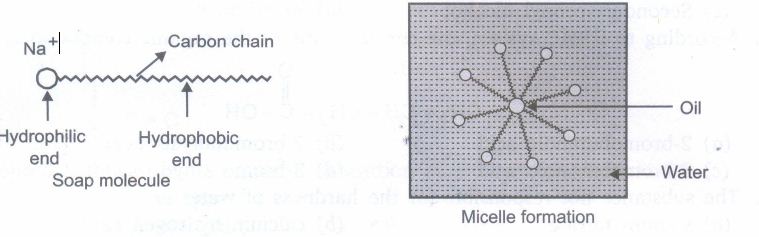
Explain the mechanism of the cleaning action of soaps.
20.
Name various plant hormones. Also give their physiological effects on plant growth and development.
21.
A dry pellet of a common base B, when kept in open absorbs moisture and turns sticky. The compound is also a by-product of chlor-alkali process. Identify B. What type of reaction occurs when B is treated with an acidic oxide? Write a balanced chemical equation for one such solution.
22.
(i) A non-metal X exists in two different forms Y and Z. Y is the hardest natural substance whereas Z is a good conductor of electricity. Identity X, Y, Z.
(ii) A element, X, on reaction with oxygen forms an oxide XO2. The oxide when dissolved in water turns blue litmus red. State whether element X is a metal or a non-metal.
(iii) Name the metal which is alloyed with copper to make bronze.
23.
Distinguish between an electric motor and generator?
24.
Name the constituents of blood.Why white blood corpuscles are called 'soldiers of the body'?
25.
(a) State one limitation of solar energy available from solar cells.
(b) What is the minimum wind velocity required to obtain useful energy with a windmill?
(c) Define the term 'nuclear fission'.
26.
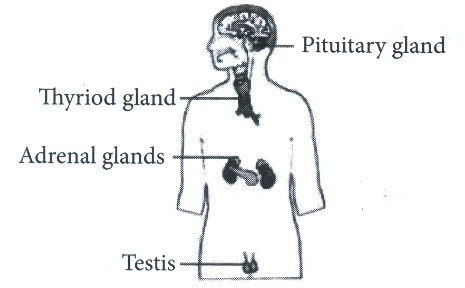
Draw a diagram showing endocrine glands in a male body. Label the following glands on it:
(i) Pituitary
(ii) Thyroid
(iii) Adrenal
(iv) Testes
27.
Write an advantage of giving the control of water management to the residents of the area?
28.
How many vertical columns are there in the modern periodic table and what are they called?
29.
What are fossil fuels?
30.
Prepare a list of five activities that you perform daily in which natural resources can be conserved or energy utilisation can be minimised.
31.
An element X of group 15 exists as diatomic molecule and combines with hydrogen at 773 K in presence of the catalyst to form a compound, ammonia which has a characteristic pungent smell.
(a) Identify the element X. How many valence electrons does it have?
(b) Draw the electron dot structure of the diatomic molecule of X. What type of bond is formed in it?
(c) Draw the electron dot structure for ammonia and what type of bond is formed in it?
1.
Exothermic reaction.
2.
The rain drops in the atmosphere act like many small prisms by splitting g the white light entering into it.
3.
Energy of herbivorous never comes back to autotrophs as flow of energy is always unidirectional. So once it passes the trophic level it is no longer available to the previous level.
4.
Milk bags and tin cans.
5.
It is caused due to mutation.
6.
46 chromosomes.
7.
| S.No | Arteries | Veins |
|---|---|---|
| 1 | Have thick elastic, muscular walls. | Have thin, non-elastic walls. |
| 2 | Lumen is narrow | Lumen is wide |
| 3 | Carry blood from heart to all body parts. | Carry blood from all body parts to heart |
| 4 | Carry oxygenated blood (except pulmonary artery) | Carry deoxygenated blood (except pulmonary vein) |
8.
In a uniform magnetic field, the magnetic field lines of force are parallel and equidistant from each other as shown in the diagram.
9.
Petroleum and natural gas. This is because both these sources are present only in limited amounts and will be exhausted soon if we continue to use them at the present rate.
10.
The receptors present in our tongue which detect the taste are called gustatory receptors.
11.
Bleaching powder.
12.
(a) Since two \(8\Omega \) resistors are in parallel, their effective resistance (\({ R }_{ P }\)) is given by,
\(\frac { 1 }{ { R }_{ P } } =\frac { 1 }{ 8 } +\frac { 1 }{ 8 } +\frac { 1 }{ 4 } \) or \({ R }_{ P }=4\Omega \)
(b) Total resistance in the circuit
\(R=4\Omega +{ R }_{ P }=4\Omega +4\Omega =84\Omega \)
Current through the electric circuit
\(I=\frac { V }{ R } =\frac { 8V }{ 8\Omega } =1A\)
(c) The potential difference \(4\Omega \) resistor V
I \(=IR=1\times 4=4V\)
(d) Power dissipated in \(4\Omega \) resistor P=\({ (I) }^{ 2 }\)
\(R={ (1) }^{ 2 }(4)=4W\)
(e) There is no difference in the readings of ammeters \({ A }_{ 1 }\) and \({ A }_{ 2 }\) as same current flows through all elements in a series circuit.
13.
Object distance, u = -25 cm, Object height, h = 5 cm, Focal length, f = +10 cm Substituting the values in the lens formula,
\(\frac { 1 }{ u } +\frac { 1 }{ v } =\frac { 1 }{ f } \)
We get v = 16.66 cm
The positive value of v shows that the image is formed at the other side of the lens.
Magnification =\(\frac { h' }{ h } =-\frac { v }{ u } \) =-16.66/25=-0.66
The negative sign shows that the image is real and formed behind the lens.
Magnification m=\(\frac { h' }{ h } \)
h' =-3.3 cm
The negative value of image height indicates that the image formed is inverted. The position, size, and nature of image are shown in the following ray diagram.
-S.png)
14.
(a) An ecosystem is a self-contained unit of living things (plants, animals and decomposers) and their non-living environment (soil, air and water). An ecosystem needs only the input of sunlight energy for its functioning. The two main components of an ecosystem are,:
(i) Abiotic components it includes all non-living components like soil, water, air temperature, light, pressure, etc.
(ii) Biotic component, it includes all living components like plants, animals, decomposers, etc.
(b) A pond is a self sufficient or independent unit in nature. It contains all the components of the ecosystem. In this ecosystem, producers (hydrophytes) trap the solar energy and then provide the basic food or energy for all other life in the pond. When the producers and consumers die, the decomposers present in the pond act on their dead bodies to return the various elements back to the nutrient pool. On the other hand, in an aquarium there are not any producers and nutrient pool to trap solar energy, therefore the fishes living in an aquarium need to be nourished.
Moreover due to absence of decomposers the excreta of the fishes cannot be decomposed. Therefore the aquarium needs to be cleaned regularly.
15.
Evolution is the sequence of gradual changes which take place in the primitive organisms over millions of years in which new species are produced.
(a)It is through the constant process of evolution taking place in the organisms since the origin of life that such an enormous variety of plants and animals have come to exist on this earth at present.
(b)There is an inbuilt tendency to variation during reproduction due to errors in DNA copying and as a result of sexual reproduction.
(c) Fossils are the remains of impressions of dead plants or animals which died millions of
years ago. They study of fossils helps us to know about the evolution of species. Fossils tell us how new species are developed from the old. Fossils provide evidence of evolution by revealing characteristics of past organisms and the changes that have occurred these organisms to give rise to present organisms. Therefore, fossils have an importance in deciding evolutionary relationship.
16.
The atomic number of carbon is 6 which means that a neutral atom of carbon retains 6 electrons. So, the electronic configuration of carbon is KL. Since carbon has 4 electrons in its outermost shell so, it should either loss or gain 4 electrons to achieve the inert gas configuration and become stable.
(1) It could gain four electrons forming C4- anion. But it would be difficult for the nucleus with six protons to hold on to ten electrons due to inter electronic repulsion.
(2) It could lose 4 electrons froming C4+ cation. But it would require a large amount of energy to remove four electrons from its outermost shell. Thus, it forms compounds mainly by covalent bonds.
Two properties of carbon which lead to huge number of carbon compounds are:
(1) Catenation: Catenation is the unique property of carbon atoms to form bonds with other atoms of carbon giving rise to large molecules.
(2)Tetravalency: Since carbon has a valency of 4, it is capable of bonding with 4 other atoms of carbon or atoms of some other monovalent element.
The reason for the formation of strong bonds by the carbon atoms is their small atomic size. Due to the small size of carbon atoms their nuclei hold the shared pairs of electrons between atoms strongly, leading to the formation of strong covalent bonds. The carbon atoms also form strong covalent bonds with the atoms of other elements such as hydrogen, oxygen, nitrogen, sulphur, chlorine and other elements.
17.
(a) and (b)
(c) The carbon dioxide which gets collected in the human tissues dissolves in the blood and is transported back to the lungs to be expelled out.
18.
(a) Magnetic field is the region around a magnet in which a magnetic material experiences a force because of that magnet.
(b) The direction of magnetic field at a point is determined by using a magnetic compass. The direction along which the needle of a magnetic compass gets aligned indicates the direction of the magnetic field.
(c) A straight thick conducting wire is inserted normally through centre of a plane paper. Now, electric current is passed through the wire. When a small magnetic compass is placed on the paper, the magnetic needle of the compass gets aligned along a particular direction. The positions of the North Pole and South Pole are marked on the paper. Now, the magnetic needle is shifted to a new position such that its South Pole occupies the position previously occupied by its North Pole. Again, the positions of the North Pole and South Pole are marked. These steps are repeated over and over again and the marked points are joined to obtain the direction of the magnetic field generated by the current-carrying straight wire.
(d) The direction of magnetic field at the centre of a current of a current carrying loop is normal to the plane formed by the loop.
19.
Soap molecule has two ends, the charged end that gets attracted towards water is called hydrophilic and the long carbon chain that repels water is called hydrophobic tail. When soap is dissolved in water, the carbon chain i.e., hydrophobic end gets attracted towards the oil, dirt and grease. The hydrophilic end stays away from this. ' The micelle formation takes place. The tail entangles dirt, oil or grease, if required, the agitation is done. Lot of rinsing is done with water so that water molecules attract charged (Na+) end and carries the soap molecules with dirt attached to it and clean the clothes, utensils, etc:
20.
Various plant hormones and their effects are as follows:
(i) Auxin : Promotes cell elongation and thus promotes growth of a plant part.
(ii) Gibberellins : Promotes growth.
(iii) Cytokinin : Promotes cell division and thus promotes growth.
(iv) Abscissic acid : Inhibits growth and is responsible for shedding or older parts.
21.
Sodium hydroxide (NaOH) is a commonly used base and is hygroscopic, that is, it absorbs moisture from the atmosphere and becomes sticky. The acidic oxides react with base to give salt and water. The reaction between NaOH and \(CO_2\) can be given as \(2NaOH+CO_2\rightarrow Na_2CO_3+H_2O\)
22.
(i) X - Carbon, Y - Diamond, Z - Graphite
(ii) Non-metal
(iii) Tin.
23.
The major differences between an electric motor and generator are stated below:
Electric Motor:
1. It converts electrical energy into mechanical energy.
2. It needs electrical energy for its works.
3. They are used as water pumps, marble grinders etc.
Generator:
1. It converts mechanical energy into electrical energy
2. It needs mechanical energy for its working.
3. They are used as water pumps, marble grinders etc.
4. diesel generator, hydro-electric generator are the examples of it.
24.
The different constituents of blood are plasma (the fluid part of the bloo(d) and blood corpuscles consisting of RBCs, WBCs, and platelets)
WBCs are known as the soldiers of the body because they fight against the pathogenes that invade our body, thus preventing the occurence of diseases.
25.
(a) The solar cells are costly and hence the energy available from them expensive.
(b) 15 km/h is the minimum wind velocity required to obtain useful energy with a windmill.
(c) Nuclear fission is the process in which a radioactive atom splits up into smaller nuclei when struck with low energy neutrons.
26.
27.
()
By giving the control of water management to the residents of the area ensures mismanagement and over exploitation is reduced.
28.
()
There are 18 vertical columns in the modern periodic table and they are called groups.
29.
()
Fuels which are formed from the fossil remains of plants and animals and are obtained from under the earth's crust are called fossil fuels. Example coal, petroleum and natural gas.
30.
(a) Unused water in the water bottle may be used for watering plant
(b) Close all the taps before you go to sleep.
(c) Avoid using a hose pipe for watering plants
(d) Wash vehicles only when they are dirty
(e) Use fan and light only when required
(f) Use solar water heating devices
(g) Use CFL in place of conventional bulbs/tubes.
31.
(a) Since the element X of group 15 exists as a diatomic molecule, combines with hydrogen at 773 K in presence of a catalyst to form ammonia which has a characteristic smell, therefore the element X is nitrogen (N).
\(\underset { \quad Nitrogen\\ (diatomicmolecule) }{ { N }_{ 2 } } +\underset { Hydrogen }{ { 3H }_{ 2 } } \underrightarrow { 773k/Catalyst } \underset { Ammonia\\ (pungentsmell) }{ { 2NH }_{ 3 } } \)
The atomic number of element X is 7, so its electronic configuration i 2,5. Thus it has five valence electrons.
(b) Nitrogen has 5 valence electrons. Therefore, it needs 3 more electrons to complete its octet. To do so, it shares three of its electrons with three electrons of the other nitrogen atom to form a diatomic molecule of N2 gas. Thus, three covalent bonds are formed between two nitrogen atoms and each nitrogen atom is left with one
lone pair of electrons.
 image.png)
(c) Nitrogen atom has 5 valence electrons. Therefore it needs 3 more electrons to complete its octet. To do so, it shares three of its electrons with one electron each of three hydrogen atoms to form a molecule of ammonia .
 image.png)
In NH3 molecule, there are three N - H single covalent bond and one lone pair of electrons on the nitrogen atom.

10th Standard CBSE Syllabus & Materials
10th Standard CBSE
CBSE 10th Social Science PS - Federalism - New Model Questions Papers Study Material - QB365 Set A
NEW10th Standard CBSE
CBSE 10th Social Science PS - Power Sharing - New Model Questions Papers Study Material - QB365 Set A
NEW10th Standard CBSE
CBSE 10th Social Science GEO - Manufacturing Industries - New Model Questions Papers Study Material - QB365 Set A
NEW10th Standard CBSE
CBSE 10th Social Science GEO - Minerals and Energy Resources - New Model Questions Papers Study Material - QB365 Set A



CBSE 10th Standard CBSE Subjects
CBSE Standards





