
 100% FREE ACCESS
10th Standard CBSE Syllabus & Materials
10th Standard CBSE
CBSE 10th Social Science ECO - Globalisation and the Indian Economy - New Model Questions Papers Study Material - QB365 Set A
NEW10th Standard CBSE
CBSE 10th Social Science ECO - Money and Credit - New Model Questions Papers Study Material - QB365 Set A
NEW10th Standard CBSE
CBSE 10th Social Science ECO - Sectors of the Indian Economy - New Model Questions Papers Study Material - QB365 Set A
NEW10th Standard CBSE
CBSE 10th Social Science ECO - Development - New Model Questions Papers Study Material - QB365 Set A
NEW10th Standard CBSE
CBSE 10th Social Science PS - Outcomes of Democracy - New Model Questions Papers Study Material - QB365 Set A
NEW10th Standard CBSE
CBSE 10th Social Science PS - Gender, Religion and Caste - New Model Questions Papers Study Material - QB365 Set A

Published on: 13/02/2020
10th Standard CBSE Science Public Model Question Paper IV 2020
Download CBSE Class 10th Standard CBSE Science question papers, sample papers, important questions, and previous year solved papers in PDF format. Get free study materials, NCERT solutions, and exam preparation resources for Class 10th Standard CBSE Science
Questions + Answers key
Take MCQ Science Test
1.
In the food chain given below:
Grass\(\longrightarrow\)Grasshopper\(\longrightarrow\)Frog\(\longrightarrow\)Snake\(\longrightarrow\)Peacock
What will happen if all the frogs are removed?
2.
Which phenomenon is responsible for making the path of light visible?
3.
Why is a normal eye not able to see clearly the objects placed closer than 25 cm?
4.
Which compound are responsible for the depletion of ozone layer?
5.
Is it true that when a new species is emerged, the old species will be eliminated? Why?
6.
Mala is four-month pregnant and is worried whether the child is male or female. One day she reads an advertisement regarding a medicine which of taken for 3 months results in birth of male child. What should she do?
(a) Get the medicine and take it regularly.
(b) Visit a doctor and discuss the problem with him/her.
(c) What, in your opinion, are the chances of having a male child?
7.
What is synapse?
8.
Use the data in Table and Answer the following -
| Material | Resistivity (\(\Omega\) m) | |
| Conductors | Silver | 1.60 × 10⁻⁸ |
| Copper | 1.62 × 10⁻⁸ | |
| Aluminium | 2.63 × 10⁻⁸ | |
| Tungsten | 5.20 × 10⁻⁸ | |
| Nickel | 6.84 × 10⁻⁸ | |
| Iron | 10.0 × 10⁻⁸ | |
| Chromium | 12.9 × 10⁻⁸ | |
| Mercury | 94.0 × 10⁻⁸ | |
| Manganese | 1.84 × 10⁻⁶ | |
| Alloys | Constantan (alloy of Cu and Ni) |
49 × 10–6 |
| Manganin (alloy of Cu, Mn and Ni) |
44 × 10–6 | |
| Nichrome | 100 × 10–6 | |
| (alloy of Ni, Cr, Mn and Fe) | ||
| Insulators | Glass | 1010 – 1014 |
| Hard rubber | 1013 – 1016 | |
| Ebonite | 1015 – 1017 | |
| Diamond | 1012 - 1013 | |
| Paper (dry) | 1012 |
a) Which among iron and mercury is a better conductor?
b) Which material is the best conductor?
9.
Give an example of a metal which
(i) is a liquid at room temperature.
(ii) can be easily cut with a knife.
(iii) is the best conductor of heat.
(iv) is a poor conductor of heat.
10.
What is the role of a catalyst in a chemical
11.
Dry ammonia gas has no action on litmus paper, but a solution of a ammonia in water turns red litmus paper blue, why is it so?
12.
(i) Define pH scale. Draw a figure showing a variation of pH with the change in concentration of H+(aq) and OH- (aq) ions.
(ii) Mention the range of pH of the acidic solution, basic solution, and neutral solution respectively.
13.
Mention the characteristics of food chain.
14.
(a) Why did Mendel choose garden pea for his experiment? Write two reasons.
(b) List two contrasting visible characters of garden pea Mendel used for his experiment.
(c) Explain in brief how Mendel interpreted his results to show that the traits may be dominant or recessive.
15.
What is the difference between the chemical composition of soaps and detergents? State in brief in action of soaps in removing an oily spot from a shirt. Why are soaps not considered suitable for washing where water is hard?
16.
Describe the process of urine formation in kidneys.
17.
State Ohm's law? How can it be verified experimentally? Does it hold good under all conditions? Comment
18.
Name various plant hormones. Also give their physiological effects on plant growth and development.
19.
What are the differences between aerobic and anaerobic respiration? Name some organisms that use the anaerobic mode of respiration.
20.
(i) A non-metal X exists in two different forms Y and Z. Y is the hardest natural substance whereas Z is a good conductor of electricity. Identity X, Y, Z.
(ii) A element, X, on reaction with oxygen forms an oxide XO2. The oxide when dissolved in water turns blue litmus red. State whether element X is a metal or a non-metal.
(iii) Name the metal which is alloyed with copper to make bronze.
21.
The magnification produced by a plane mirror is +1. What does it mean?
22.
Why does menstruation occur?
23.
What is 'translocation'? Why is it essential for plants?Where in plants are the following synthesized:
(i)Sugar (ii)Hormones
24.
(a) State one limitation of solar energy available from solar cells.
(b) What is the minimum wind velocity required to obtain useful energy with a windmill?
(c) Define the term 'nuclear fission'.
25.
State the rule to determine the direction of a
(i) Magnetic field produced around a straight conductor carrying current
(ii) Force experienced by a current carrying straight conductor placed in a magnetic field which is perpendicular to it.
(iii) current induced in a coil due to its rotation in a magnetic field.
26.
Write an advantage of giving the control of water management to the residents of the area?
27.
Chlorine, bromine and iodine form a Dobereiner's triad. The atomic masses of chlorine and iodine are 35.5 and 126.9 respectively. Predict the atomic mass of bromine.
28.
What are fossil fuels?
29.
Explain giving example where active involvement of local people lead to efficient management of forest.
30.
The Position of three elements A,B and C in the Periodic Table is shown below:
| Group\(\rightarrow \) | I | II | III | IV | V | VI | VII |
| Period\(\downarrow \) | |||||||
| 1 | B | ||||||
| 2 | A | ||||||
| 3 | C |
Giving reasons, explain the following :
(a)Element A is a non-metal.
(b)Element B has a larger atomic size than element C.
(c) Element C has a Valency of 1
1.
(a) Increase in the population of grasshopper.
(b) Migration or death of snakes due to food scarcity.
(c) The ecological balance is distributed.
(d) Decrease in the production of grass.
2.
Tyndall effect
3.
As our eye cannot focus the objects placed closer than 25 cm on the retina. we are unable to see the objects clearly.
4.
The depletion of ozone layer is due to the use of chemicals called chlorofluorocarbons.
5.
No this is because when there is a change in any species, there is change only in a part or a few members of the species population.
6.
(a) No, she should not take the medicine.
(b) Of course she should visit a doctor to get information.
(c) She is having 50% chances of having a male child as 50% sperms carry Y chromosome and 50% X chromosome.
7.
The functional junction between two neurons is called synapse.
8.
The substance which has less resistivity is a better conductor.
(i) Iron is a better conductor than mercury.
(ii) Silver is the best conductor as it has the least resistivity.
9.
(i) Mercury
ii) Sodium
(iii) Silver
(iv) Lead
10.
A catalyst changes the rate of reaction without taking part in the reaction itself.
11.
A solution of ammonia in water results in the formation of ammonium hydroxide (NH4OH). Ammonium hydroxide is basic in nature and turns red litmus blue.
12.
(i) Scale for measuring [H+] concentration in a solution is called pH scale.
(ii) pH of Neutral solution is 7
pH of Acidic solution is 0 to below 7
pH of Basic solution is 7 to 14
13.
(a) A food chain involves interaction between the living organisms of an ecosystem.
(b) A food chain is always straight.
(c) A food chain has a unidirectional flow of energy from sun to producers and then to consumers.
(d) A food chain has three or four or five trophic levels.
(e) According to law of thermodynamics, 80 - 90% of energy is lost as heat.
14.
(a) Mendel choose garden pea for his experiment because pea plants was self fertilising and have short life cycle.
(b) Mendel performed experiments on a garden pea (Pisumsativum) with different visible contrasting characters. He selected seven contrasting pairs of characters such as tall / short plants, purple / white flower colour etc.
(c) Mendel performed his experiment on tall and dwarf plant and interpreted his results to show that the traits may be dominant or recessive. Parent plants: True breeding tall pea plant was crossed with true breeding dwarf pea plant. Production of F1 plants: All F1 plants were found to be tall. Results of self-pollination ofF1 plants or F2plants: Mendel found that on self-pollination of F1 plants, the progenies obtained in F2 generations were not all tall plants. Instead, one- fourth of F2plants were found to be dwarf.
Mendel's explanation for the reappearance of the short trait: From this experiment, Mendel concluded that the F1 tall plants were not true breeding. They were carrying
both the traits. They appeared tall, because the tall trait was dominant over the dwarf trait.
15.
Soaps are sodium or potassium salts of fatty acids having -COONa group. Detergents are sodium or potassium salts of sulphonic acids have -S02Na and -so4Na group.
Cleansing action of soap.
Soap molecules consists of a large hydrocarbon tail which is hydrophobic (water-hating or water repelling) with a negatively charged head which is hydrophilic (water-loving) as show in figure.
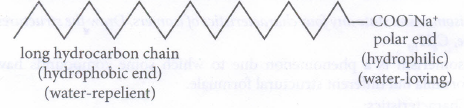
When a soap is dissolved in water, the molecules associate together as clusters called micelles in which water molecules, being polar in nature. surround the ions and the hydrocarbon part of the molecule attracts grease, oil and dirt.
The tails stick inwards and the heads outwards. In cleansing, the hydrocarbon tail attaches itself to oily dirt. When water is agitated (shaken vigorously), the oily dirt tends
. to lift off from the dirty surface and dissociate into fragments.
This gives opportunity to other tails to stick to oil. The solution now contains small globules of oil surrounded by soap molecules.
The negatively charged heads present in water prevent the small globules from coming together and form aggregates. Thus, the oily dirtis removed
Hard water has Ca2+ and Mg2+ ions. When it reacts with soap, it forms insoluble compound and the soap goes waste.
16.
The mechanism of urine formation includes three steps namely,
(i) Glomerular ultra-filtration
(ii) Tubular reabsorption
(iii) Tubular secretion
(i)Glomerular Ultrafiltration:
Ultrafiltration of blood takes place inthe Malphighian body which acts as a biological filter. A Malphighian body comprises of Bowman's capsule and glomeruli.
The blood from the kidney flows through the capillaries of glomerulus where the blood pressure, is comparatively high and so brings about effective filtration. The hydrostatic pressure of the blood is always greater than the opposing pressures existing in the plasma protein and renal capillaries. Thus, the available net filtering force is chiefly responsible for glomerular filtration. The fluid in the capsule which is obtained by this process is termed glomerular filtrate. In man it is about 125ml/min. In 24 hours, the total volume of glomerular filtrate is 170 to 180 litres.
(ii) Tubular Reabsorption: Reabsorption takes place in the 'uriniferous tubules. Reabsorption of useful substances is a differential or selective process. The glomerular filtrate contains many useful substances such as glucose, amino acids, mineral salts and vitamins dissolved in large amount of water. Substances such as glucose, sodium and calcium, are actively reabsorbed in large quantities. Substances like urea and uric acid etc are reabsorbed in small quantities by a simple diffusion process or passive reabsorption. Substances like creatinine are not reabsorbed. They are completely eliminated.
Proximal convoluted tubule is responsible for the reabsorption of water, glucose, sodium phosphate and bicarbonates. On entering the distal convoluted tubule, the urine becomes nearly isotonic to the surrounding tissue fluid due to the active transport of sodium and passive transport of water. As urine (isotonic) passes into the collecting tubule it becomes once again hypertonic by the osmotic reabsorption of water under the influence of the hormone ADH. Thus the urine formed contains 96% of water, 2% urea and 2% of the metabolic products.
(iii) Tubular Secretion: This is the final step in the formation of urine during which the walls of tubule actively remove additional waste substances which are harmful to the body from the blood that have escaped filtration.
17.
At constant temperature, the current flowing through a conductor is directly proportional to the potential difference across its ends.
Onh's law does not hold good under all conditions as it is not a fundamental law of nature like Newton's laws. It is obeyed by metallic conductors only when physical condition like temperature etc., are kept unchanged. It is not obeyed by a lamp filament.
18.
Various plant hormones and their effects are as follows:
(i) Auxin : Promotes cell elongation and thus promotes growth of a plant part.
(ii) Gibberellins : Promotes growth.
(iii) Cytokinin : Promotes cell division and thus promotes growth.
(iv) Abscissic acid : Inhibits growth and is responsible for shedding or older parts.
19.
(a)
| S.No | Aerobic Respiration | Anaerobic Respiration |
|---|---|---|
| 1. | Occurs in the presence of Oxygen, releases large amount of energy. | Occurs in the absence of Oxygen, releases relatively small amount of energy |
| 2. | Each glucose molecule produces 38 molecules of ATP | Each glucose molecule produces 2 molecules of ATP. |
| 3 | Begins in the cytoplasm and continues in the mitochondria, e.g. most of plants and animals | Occurs only in the cytoplasm, e.g. anaerobic bacteria, yeast. |
Organismns using anaerobic mode of respiration are anaerobes. e.g. yeast, bacteria, etc.
20.
(i) X - Carbon, Y - Diamond, Z - Graphite
(ii) Non-metal
(iii) Tin.
21.
If magnification is 1, the image size is same as that of object size.
Since, magnification is positive, the image is erect and virtual.
22.
Menstruation occurs when the egg is not fertilised. Every month, uterus prepares itself to receive a fertilised egg. To nourish the embryo, its lining becomes thick and spongy. In case, egg is not fertilised, this lining breaks and discharges out of the body through the vagina in the form of blood. This is referred to as menstruation.
23.
The transport of soluble products of photosynthesis is known as translocation. Translocation in plants occurs by means of the vascular tissue known as phloem. Translocation is necessary because without it, the food prepared by the leaves cannot reach other parts of the plant.
(i)In plants, the synthesis of sugars takes place in the leaves by the process of photosynthesis.
(ii)Hormones are synthesised away from their targrt site.
24.
(a) The solar cells are costly and hence the energy available from them expensive.
(b) 15 km/h is the minimum wind velocity required to obtain useful energy with a windmill.
(c) Nuclear fission is the process in which a radioactive atom splits up into smaller nuclei when struck with low energy neutrons.
25.
(i) Maxwell's right hand thumb rule:
It's a convenient way of finding the direction of magnetic field associated with a current carrying conductor. It states that, if you hold the current carrying straight wire in the grip of your right hand in such a way that the stretched thumb points in the direction of current, then the direction of the curl of the fingers will give the direction of the magnetic field. This rule is also called Maxwell's corkscrew rule.
(ii) Fleming's left hand rule:
The direction of force which acts on a current carrying conductor placed in a magnetic field is given by Fleming's left hand rule.
It states that, if the forefinger, thumb and middle finger of left hand are stretched mutually perpendicular to each other, such that the forefinger points along the direction of external magnetic field, middle finger indicates the direction of current, then the thumb points towards the direction of force acting on the conductor.
(iii) Fleming's right hand rule gives the direction of induced current in a coil due to it's rotation in a magnetic field. If the forefinger points in the directions of magnetic field, thumb in the direction of motion of the conductor, then the central finger points in the direction of current induced in the conductor.
26.
()
By giving the control of water management to the residents of the area ensures mismanagement and over exploitation is reduced.
27.
()
Atomic mass of Br = 35.5 + 126.9 / 2
= 162.4 / 2 = 81.2
28.
()
Fuels which are formed from the fossil remains of plants and animals and are obtained from under the earth's crust are called fossil fuels. Example coal, petroleum and natural gas.
29.
(1) People participation in the management of forests can help in increasingly forest produces as well as in their conservation.
(2) in 1972, the West Bengal Forest Department formulated a novel scheme to revive the degraded Sal forests by involving the local people.
(3) A far-sighted forest officer A.K. Banerjee involved the villages of the area around the forest in the protection of 1272 hectares of badly degraded Sal forest.
(4) In return for help in protecting the forest, the villagers were given employment in both silviculture and harvesting operations of the forest, 25% of the final harvest produce, and were allowed to collect firewood and fodder from the forest area on nominal payment.
(5) With the active and willing participation of local people living around the forest, the degraded Sal forest of Arabari became thick and green within ten years.
30.
(a) Element 'A' is non-metal because it belongs to Group VII therefore it has 7 electrons in its outermost shell. It needs one electron to acquire nearest inert gas configuration and form a monovalent -ve ion.
(b) Atom of element C has a larger size than that of element A because C belongs to the 3rd period therefore it has three shells whereas A belongs to the 2nd period thus it has two shells.
(c) Element B has a valency of 1 because it belongs to Group I and has one valence electron. To complete its outermost shell or to acquire nearest noble gas configuration it loses one electron and forms a monovalent +ve ion.

10th Standard CBSE Syllabus & Materials
10th Standard CBSE
CBSE 10th Social Science PS - Federalism - New Model Questions Papers Study Material - QB365 Set A
NEW10th Standard CBSE
CBSE 10th Social Science PS - Power Sharing - New Model Questions Papers Study Material - QB365 Set A
NEW10th Standard CBSE
CBSE 10th Social Science GEO - Manufacturing Industries - New Model Questions Papers Study Material - QB365 Set A
NEW10th Standard CBSE
CBSE 10th Social Science GEO - Minerals and Energy Resources - New Model Questions Papers Study Material - QB365 Set A



CBSE 10th Standard CBSE Subjects
CBSE Standards





