
 100% FREE ACCESS
10th Standard CBSE Syllabus & Materials
10th Standard CBSE
CBSE 10th Social Science ECO - Globalisation and the Indian Economy - New Model Questions Papers Study Material - QB365 Set A
NEW10th Standard CBSE
CBSE 10th Social Science ECO - Money and Credit - New Model Questions Papers Study Material - QB365 Set A
NEW10th Standard CBSE
CBSE 10th Social Science ECO - Sectors of the Indian Economy - New Model Questions Papers Study Material - QB365 Set A
NEW10th Standard CBSE
CBSE 10th Social Science ECO - Development - New Model Questions Papers Study Material - QB365 Set A
NEW10th Standard CBSE
CBSE 10th Social Science PS - Outcomes of Democracy - New Model Questions Papers Study Material - QB365 Set A
NEW10th Standard CBSE
CBSE 10th Social Science PS - Gender, Religion and Caste - New Model Questions Papers Study Material - QB365 Set A

Published on: 13/02/2020
10th Standard CBSE Science Public Model Question Paper V 2019 - 2020
Download CBSE Class 10th Standard CBSE Science question papers, sample papers, important questions, and previous year solved papers in PDF format. Get free study materials, NCERT solutions, and exam preparation resources for Class 10th Standard CBSE Science
Questions + Answers key
Take MCQ Science Test
1.
(a) What is 'environmental pollution'?
(b) Distinguish between biodegradable and non-biodegradable pollutants.
(c) Choose the biodegradable pollutants from the list given below:
Sewage, DDT, radioactive waste, agricultural waste.
2.
Define evolution. How does it occur? Describe how fossils provide us evidences in support of evolution.
3.
How will you conclude that the same potential difference exist across three resistors connected in a parallel arrangement to a battery?
4.
Name various plant hormones. Also give their physiological effects on plant growth and development.
5.
A dry pellet of a common base B, when kept in open absorbs moisture and turns sticky. The compound is also a by-product of chlor-alkali process. Identify B. What type of reaction occurs when B is treated with an acidic oxide? Write a balanced chemical equation for one such solution.
6.
When is a drop of orange juice added to pure water, how the pH value will vary for water? If a drop of lemon juice is also added, will there be any more change in the pH value?
7.
Name any four categories of people who depend on the forest resources, mentioning major needs of each category.
8.
A person can comfortably read a book, but finds difficult to read the number on a bus parked 5m away from him. Name the type of defect of vision he is suffering from. Which type of lens should he use in his spectacle to correct his vision?
9.
How will accumulation of bio degradable waste effect our environment?
10.
Why are the small numbers of surviving tigers a cause of worry from the point of view of genetics?
11.
(i)What is fertilisation? Distinguish between external fertilisation and internal fertilisation
(ii)What is the site of fertilisation in human beings?
12.
What is ethanoic acid? Write the formula of the functional group present in this acid. What special name is given to its 5-8% solution in water? How does ethanoic acid react with sodium carbonate? Write a chemical equation of the reaction and common name of the salt produced.
13.
Only variations that confer an advantage to an individual organism will survive in a population. Do you agree with this statement? Why or why not?
14.
Can away source energy be pollution free? Why or why not?
15.
What is synapse?
16.
Give the formula for quicklime.
17.
How 'respiration' different from 'breathing'? Explain the processes of 'aerobic' respiration and 'anaerobic' respiration.
18.
(a) State one limitation of solar energy available from solar cells.
(b) What is the minimum wind velocity required to obtain useful energy with a windmill?
(c) Define the term 'nuclear fission'.
19.
Describe the central nervous system in human being under the following heads:
(i) Regions included
(ii) Three functions of any one region
20.
What are the two kinds of natural resources?
21.
Lithium, sodium and potassium form a Dobereiner's triad. The atomic masses of lithium and potassium are 7 and 39 respectively. Predict the atomic mass of sodium.
22.
What is meant by the 'calorific value' of a fuel? How is it determined? Arrange the following fuels in a decreasing order of their calorific values: Kerosene, Coal, LPG.
23.
(a) In this ladder (Figure) symbols of elements are jumbled up. Rearrange these symbols of elements in the increasing order of their atomic number in the Periodic Table.
(b) Arrange them in the order of their group also.
-q.png)
24.
In the context of conservation of natural resources, explain the terms reduce, recycle and reuse. From among the materials that we use in daily life, identify two materials for each category.
1.
(a) Environmental pollution is an undesirable change in the physical, chemical or biological characteristics of the natural environment, brought about by man's activities. This pollution may affect the soil, rivers, seas or the atmosphere.
| Bio-degradable pollutants | Non-biodegradable pollutants |
| (i) These pollutants can broken down into non-poisonous substances in nature by the action of microorganisms. |
(i) These pollutants cannot be broken down into non-poisonous substances by microorganisms. |
| (ii) They get recycled thus, do not need any dumping sites. | (ii) They cannot be recycled thus, require dumping sites. |
| (iii) These are generally obtained from living things. | (iii) These are generally obtained from non-living things. |
| (iv) They cause minimum environmental pollution. | (iv) They cause environmental pollution. |
(c) Biodegradable pollutants are sewage and agricultural waste.
2.
Evolution is the sequence of gradual changes which take place in the primitive organisms over millions of years in which new species are produced.
(a)It is through the constant process of evolution taking place in the organisms since the origin of life that such an enormous variety of plants and animals have come to exist on this earth at present.
(b)There is an inbuilt tendency to variation during reproduction due to errors in DNA copying and as a result of sexual reproduction.
(c) Fossils are the remains of impressions of dead plants or animals which died millions of
years ago. They study of fossils helps us to know about the evolution of species. Fossils tell us how new species are developed from the old. Fossils provide evidence of evolution by revealing characteristics of past organisms and the changes that have occurred these organisms to give rise to present organisms. Therefore, fossils have an importance in deciding evolutionary relationship.
3.
A number of resistors are said to be connected in parallel if one end of each is connected to one point and the other end is connected to another point so that the potantial difference across each resistor is the same and is equal to the applied potential difference between the two points. If we connect a voltmeter first across R1, then across R2 ad lastly across R3, it will show same voltage.
4.
Various plant hormones and their effects are as follows:
(i) Auxin : Promotes cell elongation and thus promotes growth of a plant part.
(ii) Gibberellins : Promotes growth.
(iii) Cytokinin : Promotes cell division and thus promotes growth.
(iv) Abscissic acid : Inhibits growth and is responsible for shedding or older parts.
5.
Sodium hydroxide (NaOH) is a commonly used base and is hygroscopic, that is, it absorbs moisture from the atmosphere and becomes sticky. The acidic oxides react with base to give salt and water. The reaction between NaOH and \(CO_2\) can be given as \(2NaOH+CO_2\rightarrow Na_2CO_3+H_2O\)
6.
Orange and lemon are citrus fruits which contain citric acid in their juices.
When these juices are added to pure water the acid will release H+ ions on dissociation and the pH value will decrease from 7 as the acidity increases.
7.
(1) Local people who live around forests: They use forests for grazing their cattle, collecting fruits, firewood, bamboo and thatch.
(2) Industrialists: They collect raw, materials from forests for their industries.
(3) Tourists: They visit forests for recreation.
(4) Forest department of Government: They control the resources of forest.
8.
Defect-Myopia or short-sightedness Correction-Concave lens
9.
(a) not let minerals return to mineral pool
(b) become site of pest breeding.
10.
The small number of tigers are causing a worry for the genetics because if they become extinct then the genes of this species will be lost forever. There will be no scope of again getting this species back to life without their genes.
11.
| External Fertilisation | Internal Fertilisation |
| l. The fusion of male gamete (sperm) and female gamete (ovum) occurs the body. | l. The fusion of gametes occurs inside outside the body. |
| 2. Both individuals discharge their gametes outside the body. | 2. Only the male discharges sperms into female genital tract. |
| 3. Development occurs outside the body. | 3. Development occurs inside the body. |
| 4. Example: Frog | 4. Examples : Human, Birds, Cattle,etc. |
(ii) The site of fertilisation in human beings is in the fallopian tube of female reproductive system.
12.
CH3OOH is ethanoic acid.-COOH is the formula of the function a 'group present in ethanoic acid.
Its 5 to 8% solution in water is called vinegar.
Sodium ethanoate and brisk effervescence due to carbon dioxide gas are formed on reaction of ethanoic acid with sodium carbonate.
\(\underset{Ethanol\ acid}{CH_3CH_2OH}\xrightarrow[heat]{Conc. H_2SO_4}\underset{Ethane}{CH_2=CH_2+H_2O}\)
13.
No, depending on the nature of variations different individuals have different kinds of advantages. However, when a drastic 'Change occurs in environment only those organism in the population will survive which have an advantageous variation in that population to survive in changed environment.
14.
When burning of biomass is not involved in production of energy, then there is no chance of pollution. Wind energy, hydel energy, solar energy, etc. are pollution free.
15.
The functional junction between two neurons is called synapse.
16.
Calcium oxide (CaO), commonly known as quicklime
17.
Breathing is the process by which oxygen is taken in (inhalation) and carbon dioxide is released out (exhalation). Respiration involves the oxidation of the food we eat to release energy. Carbon dioxide produced as a result of this is released out during exhalation.
Aerobic respiration: During aerobic respiration, the oxidation of food takes place in the presence of oxygen. Aerobic respiration can be summarised by the given equation:
\({ C }_{ 6 }{ H }_{ 12 }{ O }_{ 6 }+{ 6O }_{ 2 }\longrightarrow { 6CO }_{ 2 }+{ 6H }_{ 2 }O+Energy\)
Anaerobic respiration: During anaerobic respiration, food is broken down in the absence of oxygen. It is also known as fermentation and is more common in microorganisms such as yeast.
Sometimes pyruvate gets converted into lactic acid in muscles by the process of anaerobic respiration.
\({ C }_{ 6 }{ H }_{ 12 }{ O }_{ 6 }\xrightarrow [ ]{ Absenceofoxygen } Alcohol+{ CO }_{ 2 }+{ H }_{ 2 }O+Energy\)
18.
(a) The solar cells are costly and hence the energy available from them expensive.
(b) 15 km/h is the minimum wind velocity required to obtain useful energy with a windmill.
(c) Nuclear fission is the process in which a radioactive atom splits up into smaller nuclei when struck with low energy neutrons.
19.
(i) Regions included in central nervous system are the brain and the spinal cord. The brain and the spinal cord. The brain is further divided into three parts - forebrain, midbrain, and hindbrain.
(ii) Three of the functions of the brain are:
Forebrain controls intelligence, learning, memory, thinking, speech, etc.
Midbrain is associated with the sense of sight and hearing.
Hindbrain controls all involuntary actions such as breathing, peristalsis, etc.
20.
()
Water and forest
21.
()
Atomic mass of Na = 7+39 / 2 = 46 / 2 = 23
22.
()
The amount of heat produced in burning the unit mass of a fuel completely is known as the calorific value of that fuel. It is determined with the help of Bomb Calorimeter.
Arrangement of the fuels in a decreasing order of their calorific values.
LPG > Kerosene > Coal
23.
(i) The symbols of elements are arranged in increasing order of their atomic number as shown in the below figure
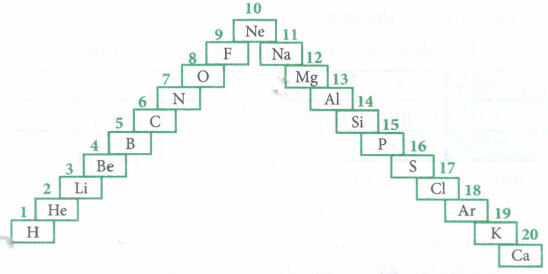
(ii) The symbols of elements are arranged in increasing order of their group numbers as follows:
| 1 | 2 | 13 | 14 | 15 | 16 | 17 | 18 |
| H | He | ||||||
| Li | Be | B | C | N | O | F | Ne |
| Na | Mg | A1 | Si | P | S | C1 | Ne |
| K | Ca |
24.
Reduce means to use a material/commodity in lesser quantity, e.g electricity and water. Reduce means a material that is used once is collected and sent back to a manufacturer so that they can make some other useful material from it. e.g., plastic cups and buckets, glass tumbler, paper, metal objects.
Reuse means using a thing over and over again instead of throwing it away. It does not involve the process of recycling either in small or large scale: e.g., used envelopes, plastic carry bags, bottles of jam.

10th Standard CBSE Syllabus & Materials
10th Standard CBSE
CBSE 10th Social Science PS - Federalism - New Model Questions Papers Study Material - QB365 Set A
NEW10th Standard CBSE
CBSE 10th Social Science PS - Power Sharing - New Model Questions Papers Study Material - QB365 Set A
NEW10th Standard CBSE
CBSE 10th Social Science GEO - Manufacturing Industries - New Model Questions Papers Study Material - QB365 Set A
NEW10th Standard CBSE
CBSE 10th Social Science GEO - Minerals and Energy Resources - New Model Questions Papers Study Material - QB365 Set A



CBSE 10th Standard CBSE Subjects
CBSE Standards





