
 100% FREE ACCESS
10th Standard CBSE Syllabus & Materials
10th Standard CBSE
CBSE 10th Social Science ECO - Globalisation and the Indian Economy - New Model Questions Papers Study Material - QB365 Set A
NEW10th Standard CBSE
CBSE 10th Social Science ECO - Money and Credit - New Model Questions Papers Study Material - QB365 Set A
NEW10th Standard CBSE
CBSE 10th Social Science ECO - Sectors of the Indian Economy - New Model Questions Papers Study Material - QB365 Set A
NEW10th Standard CBSE
CBSE 10th Social Science ECO - Development - New Model Questions Papers Study Material - QB365 Set A
NEW10th Standard CBSE
CBSE 10th Social Science PS - Outcomes of Democracy - New Model Questions Papers Study Material - QB365 Set A
NEW10th Standard CBSE
CBSE 10th Social Science PS - Gender, Religion and Caste - New Model Questions Papers Study Material - QB365 Set A

Published on: 14/02/2020
10th Standard CBSE Science Public Model Question Paper V 2020
Download CBSE Class 10th Standard CBSE Science question papers, sample papers, important questions, and previous year solved papers in PDF format. Get free study materials, NCERT solutions, and exam preparation resources for Class 10th Standard CBSE Science
Questions + Answers key
Take MCQ Science Test
1.
Name the three products of 'chlor-alkali' process. Write one commercially or industrially important material each that can be prepared from each of these products
2.
When a copper wire was left in silver nitrate solution for sometime, it was observed that the solution turned bluish green.
(i) Explain the observation.
(ii) Write the balanced chemical equation to represent the change taking place.
3.
Write the steps for balancing the chemical equation for the formation of ammonia by the combination of nitrogen and hydrogen.
4.
What is meant by the water of crystallization? How many molecules of water are present in hydrated copper sulphate? Write its formula. What colour change do you observe when it is heated?
5.
Give reasons for the following:
(i) Aluminium is a reactive metal but is still used for packing food articles.
(ii) Calcium starts floating when water is added to it.
6.
Why do covalent compounds have low melting point?
7.
Distinguish between permanent magnet and electromagnet.
8.
How 'respiration' different from 'breathing'? Explain the processes of 'aerobic' respiration and 'anaerobic' respiration.
9.
What is 'translocation'? Why is it essential for plants?Where in plants are the following synthesized:
(i)Sugar (ii)Hormones
10.
(a) Why is the Solar Cooker box covered with a plane glass plate?
(b) Why is energy of water flowering in a river considered to be an indirect form of solar energy?
(c) How is the fission of nucleus brought about?
11.
(a) What is a 'solar cell'?
(b) Why is biogas considered an ideal fuel for domestic use?
(c) Name a device in which controlled chain reaction is used.
12.
Write down three main differences between auxin and cytokinin.
13.
Describe the central nervous system in human being under the following heads:
(i) Regions included
(ii) Three functions of any one region
14.
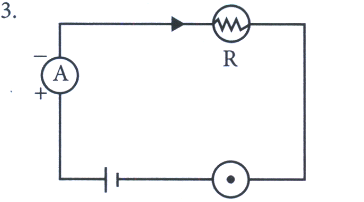
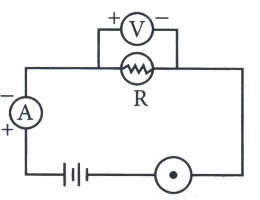
Differentiate between ammeter and voltmeter.
15.
A touch bulb is rated 2.5 V and 750 mA. Calculate (i) its power, (ii) its resistance and (iii) the energy consumed if this bulb is lighted for four hours.
16.
What is a balanced chemical equation? Why should chemical equations be balanced?
17.
Account for the following:
(i) State the relation between hydrogen ion concentration of an aqueous solution and its pH.
(ii) An aqueous solution has a pH value of 7.0. Is this solution acidic, basic or neutral?
(iii) Which has a higher pH value, 1MHCl or 1MNaOH solution?
(iv) Tooth enamel is one of the hardest substances in our body. How does it undergo damage due to eating chocolates and sweets? What should we do to prevent it?
(v)How do [H+] ions exist in water?
18.
State the reason why carbon can neither form C4+ cations for C4- anions, but forms covalent compounds. Also state reasons to explain why covalent compounds:
(a) are bad conductors of electricity?
(b) have low melting and boiling points
19.
Explain with the help of a labelled diagram the distribution of magnetic field due to a current through a circular loop. Why is it that if a current carrying coil has 'n' turns the field produced at any point is n times as large as that produced by a single turn?
20.
An element A burns with golden flame in air. It reacts with another element B, atomic number 17 to give a product C. An aqueous solution of product C on electrolysis gives a compound D and liberates hydrogen. Identify A, B, C and D. Also write down the equations for the reactions involved.
21.
Describe the process of urine formation in kidneys.
22.
How will you conclude that the same potential difference exist across three resistors connected in a parallel arrangement to a battery?
23.
Give the characteristic tests for the following gases:
(a) CO2
(b) SO2
(c) O2
(d) H2
24.
Silver articles develop black coating and copper articles develop green coating. Which chemical phenomenon is responsible for this coating?
25.
What happens to idli dough when it is kept at room temperature on a summer day?
26.
Name the process by which unsaturated fats are changed to saturated fats.
27.
What is the difference between two consecutive members in a homologous series in alkanes in terms of:
(i) Molecular mass,
(ii) Number of atoms of elements.
28.
You might have seen lemon or tamarind juice being used to clean tarnished surface of copper vessels. Explain why these sour substances are effective in cleaning the vessels?
29.
Which gas is liberated when a metal reacts with an acid? How will you test the presence of this gas?
30.
Name the carbon compound which on heating with excess of concentrated sulphuric acid at 443 K gives ethene.
31.
Which of the following hydrocarbons undergo addition reactions:
C2H6, C3H8, C3H6, C2H2 and CH4.
32.
How is solenoid different from a coil?
33.
Which product are formed during respiration in our muscles when there is less supply of oxygen?
34.
What is the impact of leakage or loss of blood upon the pressure?
35.
Name an enzyme secreted by salivary glands as well as pancreas.
36.
What is electric generator?
37.
What is meant by overloading.
38.
Name two allotropes of carbon.
39.
What are ionic bonds?
40.
What is the cause of release of unusually large energies in nuclear fusion reactions?
41.
What are photoreceptors?
42.
Which part of the brain is concerned with memory?
43.
What is reflex action?
44.
What happens at the synapse between two neurons?
45.
Which has a higher resistance: a 50 W lamp bulb or a 25 W lamp bulb and how many times?
46.
Give the unit of power.
47.
How is power related to current and voltage?
48.
Name the gas which burns with pop sound.
49.
Given below are the pH values of four different liquids : 7.0, 14.0, 4.0, 2.0
Which of these could be that of
(i) lemon juice,
(ii) distilled water,
(iii) 1 M sodium hydroxide solution,
(iv) tomato juice
50.
What are the differences between autotrophic nutrition and heterotrophic nutrition?
51.
The pH value of three solutions A, B, and C having equal molar concentration are respectively 2.0, 7.0, and 13.0 at 298 K. Which of the three solutions represents an acid solution?
52.
The nature of calcium phosphate is present in tooth enamel is
Basic
Amphoteric
Acidic
Neutral
53.
Which information is not conveyed by a balanced chemical equation?
Physical states of reactants and products
Symbols and formulae of all the substances involved in a particular reaction
Number of atoms/molecules of the reactants and products formed
Whether a particular reaction is actually feasible or not
54.
A cell, a resistor, a key and ammeter are arranged as shown in the circuit diagrams. The current recorded in the ammeter will be
maximum in
-q.png)
maximum in
-q.png)
maximum in
-q.png)
the same in all the cases
55.
Where would you locate the element with electronic configuration 2,8 in the Modern Periodic Table?
Group 8
Group 2
Gropu 18
Group 10
56.
Ethane, with the molecular formula C2H6 has
6 covalent bonds
7 covalent bonds
8 covalent bonds
9 covalent bonds
57.
Choose the incorrect statement
We are encouraged to plant more trees so as to ensure clean environment and also provide biomass fuel.
Gobar-gas is produced when crops. vegetable wastes etc., decomposes in the absence of oxygen.
The main ingredient of biogas is ethane and it gives a lot of smoke and also produces a lot of residual ash.
Biomass is a renewable source of energy
58.
The phenomenon of electromagnetic induction is
the process of charging a body.
the process of generating magnetic field due to a current passing through a coil.
producing induced current in a coil due to relative motion between a magnet and the coil.
the process of rotating a coil of an electric motor.
59.
The correct sequence of anaerobic reactions in yeast is
Glucose \(\overset { Cytoptasm }{ \longrightarrow } \) Pyruvate \(\overset { mitochondria }{ \longrightarrow } \) Ethanol+Carbon dioxide
Glucose \(\overset { Cytoptasm }{ \longrightarrow } \)Pyruvate \(\overset { Cytoplasm }{ \longrightarrow } \)
Glucose \(\overset { Cytoptasm }{ \longrightarrow } \)Pyruvate \(\overset { mitochondria }{ \longrightarrow } \) Lactic acid
Glucose \(\overset { Cytoptasm }{ \longrightarrow } \) Pyruvate \(\overset { Cytoplasm }{ \longrightarrow } \) Ethanol+ Carbon dioxide
60.
An alloy is
An element
A compound
A homogeneous mixture
A heterogeneous mixture
61.
Which of the following statements are true?
(i) Sudden action in response to something in the environment is called reflex action
(ii) Sensory neurons carry signals from spinal cord to muscles
(iii) Motor neurons carry signals from receptors to spinal cord
(iv) Impulse from a receptor to a muscle or a gland is called reflex arc
(i) and (ii)
(i) and (iii)
(i) and (iv)
(i), (ii) and (iii)
62.
How many vertical columns are there in the modern periodic table and what are they called?
63.
State modern periodic law of classification of elements.
64.
Chlorine, bromine and iodine form a Dobereiner's triad. The atomic masses of chlorine and iodine are 35.5 and 126.9 respectively. Predict the atomic mass of bromine.
65.
Which is the ultimate source of energy?
66.
What is energy?
67.
What is meant by the 'calorific value' of a fuel? How is it determined? Arrange the following fuels in a decreasing order of their calorific values: Kerosene, Coal, LPG.
68.
(a) Why do we classify elements?
(b) What were the two criteria used by Mendeleev in creating his Periodic Table?
(c) Why did Mendeleev leave some gaps in his Periodic Table?
(d) In Mendeleev's Periodic Table, why was there no mention of Noble gases like Helium, Neon and Argon?
(e) Would you place the two isotopes of chlorine, Cl-35 and Cl-37 in different slots because of their different atomic masses or in the same slot because their chemical properties are the same? Justify your answer.
1.
The three products are:
Sodium hydroxide (NaOH), Chlorine (CI2) and Hydrogen (H2).
NaOH - for soaps and detergents and paper making or artificial fibers.
Cl2- PVC, pesticides, CFCs.
H2- fuels, margarine, NH3 for fertilizers.
2.
(i) Copper is more reactive than silver. Hence, when copper wire is dipped in silver nitrate solution, it displaces silver from AgNO3 solution forming copper nitrate which is bluish green in colour.
\((ii)\quad Cu+2AgN{ O }_{ 3 }\longrightarrow \underset { Copperr\quad (II)\quad nitrate\\ bluish\quad green }{ Cu{ (N{ O }_{ 3 }) }_{ 2 } } +\underset { Silver }{ 2Ag } \)
3.
N2 + H2 \(\rightarrow \) NH3 (Unbalanced equation).
(i) Examine the number of atoms of different elements present in the unbalanced equation.
(ii) In the above reaction, left hand N2 and H2 of both the sides are unbalanced.
(iii) To balance hydrogen, H2 is multiplied by 3 on side. It makes 6H-atoms on the left hand side.
(iv) Now to balance hydrogen atoms on the right hand side, NH3 should be multiplied by 2. It makes 6H-atoms on this side.
(v) Now to balance nitrogen atoms, they are counted separately for both the sides and we will find that, nitrogen atoms are 2 on both the sides.
(vi) Balanced chemical equation will be :
N2 + H2 \(\rightarrow \) NH3.
4.
(i) Five molecules of water.
(ii) Formula - CuSO4.5H2O
[iii) When heated, its colour changes from blue to white.
5.
(i) Because it forms a protective oxide layer around itself preventing complete reaction and also does not affect the food at all.
(ii) Calcium floats over water because the bubbles of hydrogen gas formed sticks on the surface of the metal.
6.
Covalent compounds are made up of covalent bonds which are not strong enough and needs less heat energy to melt.
7.
| Electromagnet | Permanent Magnet |
| 1. It is temporary magnet and can be demagnetized | 1. It is a permanent magnet and cannot be demagnetized |
| 2. Magnetic strength can be changed. | 2. its strength is fixed. |
| 3. Its polarity can also be changed. | 3. Its polarity is fixed. |
| 4. It is prepared from soft iron. | 4. It is prepared from hard steel. |
8.
Breathing is the process by which oxygen is taken in (inhalation) and carbon dioxide is released out (exhalation). Respiration involves the oxidation of the food we eat to release energy. Carbon dioxide produced as a result of this is released out during exhalation.
Aerobic respiration: During aerobic respiration, the oxidation of food takes place in the presence of oxygen. Aerobic respiration can be summarised by the given equation:
\({ C }_{ 6 }{ H }_{ 12 }{ O }_{ 6 }+{ 6O }_{ 2 }\longrightarrow { 6CO }_{ 2 }+{ 6H }_{ 2 }O+Energy\)
Anaerobic respiration: During anaerobic respiration, food is broken down in the absence of oxygen. It is also known as fermentation and is more common in microorganisms such as yeast.
Sometimes pyruvate gets converted into lactic acid in muscles by the process of anaerobic respiration.
\({ C }_{ 6 }{ H }_{ 12 }{ O }_{ 6 }\xrightarrow [ ]{ Absenceofoxygen } Alcohol+{ CO }_{ 2 }+{ H }_{ 2 }O+Energy\)
9.
The transport of soluble products of photosynthesis is known as translocation. Translocation in plants occurs by means of the vascular tissue known as phloem. Translocation is necessary because without it, the food prepared by the leaves cannot reach other parts of the plant.
(i)In plants, the synthesis of sugars takes place in the leaves by the process of photosynthesis.
(ii)Hormones are synthesised away from their targrt site.
10.
(a) The solar cooker box is covered with a plane glass plate so as to prevent heat from escaping.
(b) Sun is said to be the ultimate and the original source for most of the energy present on the earth. When sun rays fall on oceans and other water bodies, the water present in the water bodies gets evaporated and rises up in the atmosphere. In the upper part of the atmosphere, this water vapour gets condensed and forms douds, which give rain on the high lands. Therefore, the rain water runs over the Sand surface towards the large water bodies. This running water over the land surfaces is called river. Therefore, the energy of running water actually originates from the solar energy. This is why solar energy of water flowing in a river is considered to be an indirect form of solar energy.
(c) The fission of nucleus is brought about by splitting the nucleus of heavy atoms, such as uranium or plutonium, with low-energy neutron bombardment.
11.
(a) A solar cell is a device which converts solar energy into electricity. It is a sandwich of a silicon-boron layer and a silicon-arsenic layer.
(b) Biogas is an ideal fuel for domestic use because it is a cheap and clean fuel, which does not leave behind any residue.
(c) A nuclear power plant is a device in which controlled chain reaction is used.
12.
| Auxin | Cytokinin |
| 1. It promotes cell elongation. | It promotes cell division. |
| 2. It promotes the growth of stem and roots. | It promotes the growth of lateral buds. |
| 3. It can cause formation of seedless fruits. | It can retard ageing of plants. |
13.
(i) Regions included in central nervous system are the brain and the spinal cord. The brain and the spinal cord. The brain is further divided into three parts - forebrain, midbrain, and hindbrain.
(ii) Three of the functions of the brain are:
Forebrain controls intelligence, learning, memory, thinking, speech, etc.
Midbrain is associated with the sense of sight and hearing.
Hindbrain controls all involuntary actions such as breathing, peristalsis, etc.
14.
| Ammeter | Voltmeter |
| 1. Ammeter is an instrument used to measure current in a circuit. | Voltmeter is used to measure potential difference between two points. |
| 2. It is connected in series in a circuit. | It is connected in parallel in a circuit. |
 |
 |
15.
It is given that: Voltage (V) = 2.50 V
Current (I) = 750 mA = 0.75 A
The bulb is lighted for 4 hours.
Thus,
(i) Power generated (P) = VI = 2.50\(\times\) 0.75 = 1.87 W
(ii) Resistance (R) = \(\frac { V }{ I } =\frac { 2.5 }{ 0.75 } =3.33\Omega \)
(iii) Energy consumed in 4 hours = Power\(\times\)Time = P\(\times\)t =1.87\(\times\)4 = 7.48 Wh
16.
A chemical change is represented by a chemical equation. When the number of atoms of different elements on reactant and product side are equal, then the chemical equation is called a balanced chemical equation.
It is important to balance a chemical equation because
(i) to validate the law of conservation of mass which states that the mass of reactants should be equal to the mass of the products. The total mass of a system is thus conserved.
This law holds true only if number of atoms of reactants reacting together is equal to number of product atoms formed.
(ii) a balanced chemical equation tells us about the physical state of the reactants and products whether they are solid (s), liquid (l) or gas (g) or aqueous(aq).
(iii) it tells us about heat changes that can take place in a chemical reaction. \(\Delta\) is the symbol of heat. Hence, it is endothermic or exothermic can be deduced from a balanced chemical equations.
17.
(i) If H+ ion concentration is more, pH will be less and vice versa or pH of a solution is inversely proportional to H+ ion concentration or pH 52 log (H+).
(ii) This solution is neutral.
(iii) 1MNaOH solution.
(iv) When the pH in the mouth is below 5.5, bacteria present in the mouth produce acids by degradation of sugar and corrode the tooth enamel. It can be prevented by using tooth pastes which are generally basic.
(v) As hydronium [H3O]+ ion.
18.
Carbon atoms have 4 electrons in their outcomes shell. So need to gain or lose electrons to attain noble gas configuration.
(i) It could gain four electrons forming c4- anion. But it would be difficult for the nucleus with six protons to hold on to ten electrons.
(ii) It could lose four electrons forming C4+ cations. But it would require a large amount energy to remove four electrons from its outermost shell.
Because of these reasons, carbon shares its valence electrons to complete its octet with other atoms to form covalent bonds.
(a) Covalent compounds are bad conductors of electricity because they do not contain ions.
(b) Covalent compounds have usually low melting and boiling because they are made up of electronically neutral molecule. So the force of attraction between the molecules of a covalent compound is very weak. Only a small amount of heat energy is required to break these weak molecular forces, due to which covalent compounds have low melting and boiling points.
19.
Magnetic Field Due to Circular Loop Current-Carrying Conductor:
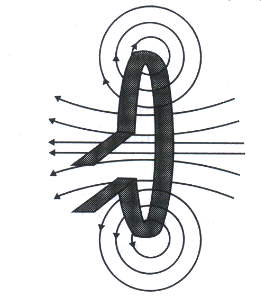
In case of a circular current carrying conductor, the magnetic field lines would be in the form of concentric circles around every part of the periphery of the conductor. Since, magnetic field lines tend to remain closer when near the conductor, so the magnetic field would be stronger near the periphery of the loop. On the other hand, the magnetic field lines would be distant from each other when we move towards the centre of the current carrying loop. Finally, at the centre, the arcs of big circles would appear as a straight lines.
Magnetic field and number of turns of coil: Magnitude of magnetic field gets summed up with increase in the number of turns of coil. If there are 'n' turns of coil, magnitude of magnetic field will be 'n' times of magnetic field in case of a single turn of coil.
20.
Since the element B belongs to atomic number 17, it must be chlorine.
The element which burns golden flame in air is sodium. Therefore, the element A must be sodium.
When element sodium and chlorine reacts, it forms sodium chloride, the compound C. The compound C on electrolysis gives sodium hydroxide and hydrogen gas.
Thus, A = Na; B = CI2; C = NaCI; D = NaOH.
Chemical Reactions involved:
\(2Na+{ CI }_{ 2 }\rightarrow 2NaCI\)
\(2NaCI(aq)+{ 2H }_{ 2 }O(I)\rightarrow 2NaOH(aq)+{ CI }_{ 2 }(g)+{ H }_{ 2 }(g)\)
21.
The mechanism of urine formation includes three steps namely,
(i) Glomerular ultra-filtration
(ii) Tubular reabsorption
(iii) Tubular secretion
(i)Glomerular Ultrafiltration:
Ultrafiltration of blood takes place inthe Malphighian body which acts as a biological filter. A Malphighian body comprises of Bowman's capsule and glomeruli.
The blood from the kidney flows through the capillaries of glomerulus where the blood pressure, is comparatively high and so brings about effective filtration. The hydrostatic pressure of the blood is always greater than the opposing pressures existing in the plasma protein and renal capillaries. Thus, the available net filtering force is chiefly responsible for glomerular filtration. The fluid in the capsule which is obtained by this process is termed glomerular filtrate. In man it is about 125ml/min. In 24 hours, the total volume of glomerular filtrate is 170 to 180 litres.
(ii) Tubular Reabsorption: Reabsorption takes place in the 'uriniferous tubules. Reabsorption of useful substances is a differential or selective process. The glomerular filtrate contains many useful substances such as glucose, amino acids, mineral salts and vitamins dissolved in large amount of water. Substances such as glucose, sodium and calcium, are actively reabsorbed in large quantities. Substances like urea and uric acid etc are reabsorbed in small quantities by a simple diffusion process or passive reabsorption. Substances like creatinine are not reabsorbed. They are completely eliminated.
Proximal convoluted tubule is responsible for the reabsorption of water, glucose, sodium phosphate and bicarbonates. On entering the distal convoluted tubule, the urine becomes nearly isotonic to the surrounding tissue fluid due to the active transport of sodium and passive transport of water. As urine (isotonic) passes into the collecting tubule it becomes once again hypertonic by the osmotic reabsorption of water under the influence of the hormone ADH. Thus the urine formed contains 96% of water, 2% urea and 2% of the metabolic products.
(iii) Tubular Secretion: This is the final step in the formation of urine during which the walls of tubule actively remove additional waste substances which are harmful to the body from the blood that have escaped filtration.
22.
A number of resistors are said to be connected in parallel if one end of each is connected to one point and the other end is connected to another point so that the potantial difference across each resistor is the same and is equal to the applied potential difference between the two points. If we connect a voltmeter first across R1, then across R2 ad lastly across R3, it will show same voltage.
23.
(a) Carbon dioxide turns lime water milky as it forms calcium carbonate with lime water. This is the characteristics test for carbon dioxide.
Ca(OH)2 + CO2 --> CaCO3 + H2O
(b) The smell of sulphur dioxide gas is like burning of sulphur, which is the characteristics test for sulphur dioxide. Sulphur dioxide turns moist litmus paper from blue to red.
(c) When a burnt candle or match stick is brought near the oxygen gas, it starts burning brightly. This is the characteristic test for oxygen gas.
(d) When a burnt candle or match stick is brought near the hydrogen gas, it burns with pop sound, which is the characteristic test for hydrogen gas.
24.
Silver coin with atmospheric sulphur and green coating is of copper carbonate which is formed due to the reaction of copper with moist carbon dioxide from the air.
25.
Anaerobic respiration
26.
Hydrogenation.
27.
Difference in :
(i) Molecular mass = 14 a.m.u.
(ii) Number of atoms of elements = CH2
28.
Lemon juice contains citric acid and tamarind contains tartaric acid. These acids react with a basic layer of copper carbonate on the surface to form soluble salts which are easily removed and surface shines.
29.
Hydrogen gas is formed. Bring a burning matchstick near to it, H2 will burn explosively with 'pop' sound.
30.
CH3CH2OH, ethanol
31.
Unsaturated hydrocarbons like alkenes and alkynes (containing double and triple bond respectively) undergo addition reactions and their general formula are CnH2n and CnH2n-2 respectively.
Thus, C3H6 and C2H2 will undergo addition reactions.
32.
Solenoid is different from a circular coil in the sense that the length of the solenoid is much greater than its diameter.
33.
The end product of anaerobic respiration is lactic acid instead of carbon dioxide and water. This process occurs in oxygen debt. Hence, the amount of oxygen required to oxidize lactic acid to carbon dioxide and water is not present.
34.
Blood flow will increase upon the pressure of blood in the blood vessels. The oxygenated blood flowing through the artery doesnot have any impact as the arteries are thick walled, highly elastic blood vessels having narrow lumen and no valves.
35.
Enzymes produced by salivary glands:
There are three major parts of salivary glands that secrete saliva with the digestive enzyme such as parotid, submandibular and sublingual glands.
They secrete saliva in the oral cavity which contains some enzymes like amylase, lysozyme, and lingual lipase.
Amylase works on carbohydrates like starch and converts them into maltose.
Lysozyme kills bacteria present in the mouth by destroying their cell walls.
36.
It is a device that converts mechanical energy into electrical energy.
37.
When the total current drawn by all the appliances at a particular time exceeds the bearing capacity of that wire, the wires of the domestic wiring gets heated. This is called overloading.
38.
Diamond and graphite
39.
Bonds formed between a metal and a non-metal by the transfer of electrons are known as ionic bonds.
e.g., Na++Cl−→NaCl
40.
Nuclear fission is a nuclear reaction where nucleus of a heavy atom splits into two lighter nuclei. In this process, some nuclear mass gets destroyed and converted into energy. According to Einstein's mass-energy relation, when a mass is destroyed, it gets converted into a huge amount of energy. It is the destruction of mass that is responsible for the release of unusually large energies in nuclear fission reactions.
41.
The receptors present in our eyes are called photoreceptors, as they are light sensitive.
42.
Fore brain
43.
It is a spontaneous, involuntary and unconscious response to a stimulus.
44.
Synapse is the small gap between two neurons. At the end of axon, the electrical impulse sets the release of some chemicals, which cross the gap (synapse) and start a similar electrical impulse in the dendrite of the next neuron. Synapse actually acts like a one way valve because the chemical substance is present only at one side of the gap.
45.
The resistance of 25 W lamp bulb has a higher value as compound to that of 50 W lamp bulb. Resistance of the 25 W lamp bulb. Resistance of the 25 W lamp bulb will be double of that of the 50 W lamp bulb.
46.
Watt
47.
Power (P) = Potential difference (V) \(\times\) Current (I)
48.
Hydrogen gas.
49.
| pH | Liquid |
| 7.0 | Distilled Water |
| 14.0 | 1 M sodium hydroxide solution |
| 4.0 | Tomato juice |
| 2.0 | Lemon juice |
50.
The differences between autotrophic and heterotrophic nutrition are as follows
| Features | Autotrophic Nutrition | Heterotrophic Nutrition |
| Food | In this mode of nutrition, food is prepared by organism itself. | In this mode of nutrition food is obtained from other organisms (autotrophs). |
| Inorganic substances | The raw materials are required by autotrophs. | The raw materials are not required by heterotrophs. |
| Digestion | This process is absent. | This process is required for the conversion of complex molecules into simpler and more soluble ones. |
| Chlorophyll | It is present in autotrophs for trapping light. | It is absent |
| Status | They are known as producers. | They are known as Consumers |
51.
A represents an acid solution. This is because the pH value of A is 2.0 and the pH value of an acids lies between 1 and 6.
52.
(a)
Basic
53.
(d)
Whether a particular reaction is actually feasible or not
54.
(d)
the same in all the cases
55.
(c)
Gropu 18
56.
(b)
7 covalent bonds
57.
(c)
The main ingredient of biogas is ethane and it gives a lot of smoke and also produces a lot of residual ash.
58.
(c)
producing induced current in a coil due to relative motion between a magnet and the coil.
59.
(d)
Glucose \(\overset { Cytoptasm }{ \longrightarrow } \) Pyruvate \(\overset { Cytoplasm }{ \longrightarrow } \) Ethanol+ Carbon dioxide
60.
(c)
A homogeneous mixture
61.
(c)
(i) and (iv)
62.
()
There are 18 vertical columns in the modern periodic table and they are called groups.
63.
()
Modern periodic law states "that the properties of elements are a period function of the atomic numbers"
64.
()
Atomic mass of Br = 35.5 + 126.9 / 2
= 162.4 / 2 = 81.2
65.
()
Sun is the ultimate source of energy.
66.
()
Energy is the capability to do work.
67.
()
The amount of heat produced in burning the unit mass of a fuel completely is known as the calorific value of that fuel. It is determined with the help of Bomb Calorimeter.
Arrangement of the fuels in a decreasing order of their calorific values.
LPG > Kerosene > Coal
68.
(a) As different elements were being discovered, scientists gathered more information about the properties of these elements. It was observed that it was difficult to organise all the information or properties of these elements. So scientists started discovering some pattern in their properties to classify all the known elements to make their study easier.
(b) Atomic mass and similarity of chemical properties (compounds formed by elements with oxygen and hydrogen) were the two criteria used by Mendeleev in his Periodic Table.
(c) Mendeleev left some gaps in his Periodic Table as he predicted the existence of some elements that had not been discovered at that time.
(d) Noble gases like helium, neon, argon etc. were not mentioned in Mendeleevs Periodic Table because these gases were discovered later as they are very inert and present in extremely low concentrations in our atmosphere. After the discovery of noble gases they could be placed in a new group without disturbing the existing order of the Periodic Table.
(e) The two isotopes of chlorine CI-35 and CI-37 would be placed in different slots of Mendeleevs Periodic Table as both have different atomic masses. But the two isotopes have same chemical properties so would also be placed in the same slot. This is a contradiction. Thus position of isotopes of an element is not defined in Mendeleevs Periodic Table.

10th Standard CBSE Syllabus & Materials
10th Standard CBSE
CBSE 10th Social Science PS - Federalism - New Model Questions Papers Study Material - QB365 Set A
NEW10th Standard CBSE
CBSE 10th Social Science PS - Power Sharing - New Model Questions Papers Study Material - QB365 Set A
NEW10th Standard CBSE
CBSE 10th Social Science GEO - Manufacturing Industries - New Model Questions Papers Study Material - QB365 Set A
NEW10th Standard CBSE
CBSE 10th Social Science GEO - Minerals and Energy Resources - New Model Questions Papers Study Material - QB365 Set A



CBSE 10th Standard CBSE Subjects
CBSE Standards





