
 100% FREE ACCESS
10th Standard CBSE Syllabus & Materials
10th Standard CBSE
CBSE 10th Social Science ECO - Globalisation and the Indian Economy - New Model Questions Papers Study Material - QB365 Set A
NEW10th Standard CBSE
CBSE 10th Social Science ECO - Money and Credit - New Model Questions Papers Study Material - QB365 Set A
NEW10th Standard CBSE
CBSE 10th Social Science ECO - Sectors of the Indian Economy - New Model Questions Papers Study Material - QB365 Set A
NEW10th Standard CBSE
CBSE 10th Social Science ECO - Development - New Model Questions Papers Study Material - QB365 Set A
NEW10th Standard CBSE
CBSE 10th Social Science PS - Outcomes of Democracy - New Model Questions Papers Study Material - QB365 Set A
NEW10th Standard CBSE
CBSE 10th Social Science PS - Gender, Religion and Caste - New Model Questions Papers Study Material - QB365 Set A

Published on: 03/09/2019
Life Process
Download CBSE Class 10th Standard CBSE Science question papers, sample papers, important questions, and previous year solved papers in PDF format. Get free study materials, NCERT solutions, and exam preparation resources for Class 10th Standard CBSE Science
Questions + Answers key
Take MCQ Science Test
1.
What would be the consequences of a deficiency of haemoglobin in our bodies?
2.
How is the amount of urine produced regulated?
3.
What processes would you consider essential for maintaining life?
4.
How is the small intestine designed to absorb digested food?
5.
Which of the following is most appropriate for aerobic respiration?
Glucose \(\overset { mitochondria }{ \longrightarrow } \) pyruvate \(\overset { Cytoptasm }{ \longrightarrow } \) CO2+H2O+Energy
Glucose \(\overset { Cytoptasm }{ \longrightarrow } \) pyruvate \(\overset { mitochondria }{ \longrightarrow } \) CO2+H2O+Energy
Glucose \(\overset { Cytoptasm }{ \longrightarrow } \) pyruvate+energy \(\overset { mitochondria }{ \longrightarrow } \) CO2+H2O
Glucose \(\overset { Cytoptasm }{ \longrightarrow } \) pyruate+energy \(\overset { mitochondria }{ \longrightarrow } \) CO2+H2O+Energy
6.
When air is blown from mouth into a test-tube containing lime water, the lime water turned milky due to the presence of
oxygen
carbon dioxide
nitrogen
water vapour
7.
Choose the function of the pancreatic juice from the following
trypsin digests proteins and lipase carbohydrates
trypsin digests emulsified fats and lipase proteins
trypsin and lipase digest food
trypsin digests proteins and lipase emulsified fats
8.
In salivary amylase is lacking in the saliva which of the following events in the mouth cavity will be affected?
Proteins breaking down into amino acids
Starch breaking down into sugars
Fats breaking down into fatty acids and glycerol
Absorption of vitamins
9.
Which is the correct sequence of parts in human alimentary canal?
Mouth \(\longrightarrow\)Stomach\(\longrightarrow\)Small intestine \(\longrightarrow\) Oesophagus \(\longrightarrow\) large intestine
Mouth \(\longrightarrow\) oesophagus \(\longrightarrow\) stomach \(\longrightarrow\) large intestine \(\longrightarrow\) small intestine
Mouth \(\longrightarrow\) stomach \(\longrightarrow\) oesophagus \(\longrightarrow\) small intestine \(\longrightarrow\) large intestine
Mouth \(\longrightarrow\) oesophagus \(\longrightarrow\) stomach \(\longrightarrow\)small intestine \(\longrightarrow\) large intestine
10.
In which of the following groups of organisms, food material is broken down outside the body and absorbed?
Mushroom, green plants, Amoeba
Yeast, mushroom, bread mould
Paramecium, Amoeba, Cuscuta
Cuscuta, lice, tapeworm
11.
The autotrophic mode of nutrition requires
Carbon dioxide and water
Chlorophyll
Sunlight
All of the above
12.
The kidneys in human beings are a part of the system for
Nutrition
Respiration
Excretion
Transportation
13.
(a) Name two different ways in which glucose is oxidised to provide energy in various organisms.
(b) Write any two differences between the two ways of oxidation of glucose in organisms.
14.
Explain the important of soil for plant growth.
1.
Haemoglobin efficiently binds with oxygen and transports it to various parts of the body. Deficiency of haemoglobin is referred to as anaemia. The consequence of such condiion is that the blood is unable to carry sufficient amount of oxygen as required by the body and would cause less respiration.
Also, less energy would be liberated. In anaemia, the person feels weak, skin becomes pale, person feel lethargic and is unable to perform heavy physical tasks.
2.
The amount of urine produced is regulated by the selective reabsorption in the tubule of nephron as urine flows along the tube. The amount of water reabsorbed (or urine formed) depends on how much excess of water is there in the body and on how much of dissolved wastes is there which is to be excreted.
3.
Four basic processes that are essential for maintaining life are
(i) Nutrition It is the process of transferring source of energy from outside to the body of an organism.
(ii) Respiration It is the process of acquiring oxygen from outside into the body and using it for the breakdown of food sources to release energy for cellular needs.
(iii) Transportation It is the process of carrying food and oxygen from one place to another in the body.
(iv) Excretion It is the process of removing byproducts and waste products from body which are formed during energy generating reactions.
4.
The small intestine is the main region for the absorption of digested food. The inner lining of the small intestine is covered by millions of tiny finger-like projections called villi. The presence of villi gives the inner walls of the small intestine a very large surface area for the absorption of digestad food.
5.
(d)
Glucose \(\overset { Cytoptasm }{ \longrightarrow } \) pyruate+energy \(\overset { mitochondria }{ \longrightarrow } \) CO2+H2O+Energy
6.
(b)
carbon dioxide
7.
(d)
trypsin digests proteins and lipase emulsified fats
8.
(b)
Starch breaking down into sugars
9.
(d)
Mouth \(\longrightarrow\) oesophagus \(\longrightarrow\) stomach \(\longrightarrow\)small intestine \(\longrightarrow\) large intestine
10.
(b)
Yeast, mushroom, bread mould
11.
(d)
All of the above
12.
(c)
Excretion
13.
(a) Breakdown of glucose by various pathways for different organisms are:
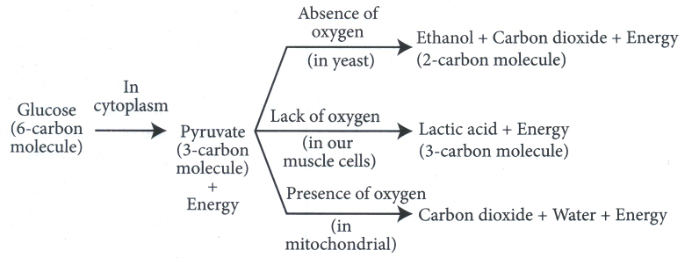
(b) Difference in oxidation of glucose
| Aerobic | AnDerobic |
| 1.Glucose is oxidised in presence of O2 2.End products are CO2 + Hp + Energy 3.Large amount of energy is released |
Oxidised in absence of O2 End products are Ethanol + CO2 + Energy Less amount of energy is released. |
14.
(i)Anchoring the plant
(ii)Source of water and minerals
(iii)Availability of oxygen for respiration of root cells
(iv)Symbiotic association with microbes.

10th Standard CBSE Syllabus & Materials
10th Standard CBSE
CBSE 10th Social Science PS - Federalism - New Model Questions Papers Study Material - QB365 Set A
NEW10th Standard CBSE
CBSE 10th Social Science PS - Power Sharing - New Model Questions Papers Study Material - QB365 Set A
NEW10th Standard CBSE
CBSE 10th Social Science GEO - Manufacturing Industries - New Model Questions Papers Study Material - QB365 Set A
NEW10th Standard CBSE
CBSE 10th Social Science GEO - Minerals and Energy Resources - New Model Questions Papers Study Material - QB365 Set A



CBSE 10th Standard CBSE Subjects
CBSE Standards





