
 100% FREE ACCESS
10th Standard CBSE Syllabus & Materials
10th Standard CBSE
CBSE 10th Social Science ECO - Globalisation and the Indian Economy - New Model Questions Papers Study Material - QB365 Set A
NEW10th Standard CBSE
CBSE 10th Social Science ECO - Money and Credit - New Model Questions Papers Study Material - QB365 Set A
NEW10th Standard CBSE
CBSE 10th Social Science ECO - Sectors of the Indian Economy - New Model Questions Papers Study Material - QB365 Set A
NEW10th Standard CBSE
CBSE 10th Social Science ECO - Development - New Model Questions Papers Study Material - QB365 Set A
NEW10th Standard CBSE
CBSE 10th Social Science PS - Outcomes of Democracy - New Model Questions Papers Study Material - QB365 Set A
NEW10th Standard CBSE
CBSE 10th Social Science PS - Gender, Religion and Caste - New Model Questions Papers Study Material - QB365 Set A

Published on: 04/09/2019
Electricity
Download CBSE Class 10th Standard CBSE Science question papers, sample papers, important questions, and previous year solved papers in PDF format. Get free study materials, NCERT solutions, and exam preparation resources for Class 10th Standard CBSE Science
Questions + Answers key
Take MCQ Science Test
1.
Should the resistance of an ammeter below or high? Give reason.
2.
What determines the rate at which energy is delivered by a current?
3.
What are the advantages of connecting electrical devices in parallel with the battery instead of connecting them in series?
4.
On what factors do the resistance of a conductor depend?
5.
What is meant by saying that the potential difference between two points is 1 V?
6.
Define the unit of current.
7.
What does an electric current mean?
8.
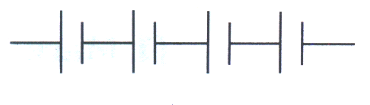
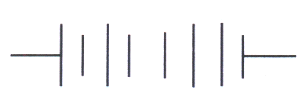
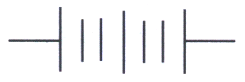
The proper representation of series combination of cells obtaining maximum potential is

9.
Identify the circuit in which the electrical components have been properly connected.
-q.png)
-q.png)
-q.png)
-q.png)
10.
In the following circuits, heat produced in the resistor or combination of resistors connected to a 12 V battery will be
-q.png)
-q.png)
-q.png)
same in all the cases
maximum in case
maximum in case
minimum in case
11.
Two conducting wires of the same material and of equal lengths and equal diameters are first connected in series and then parallel in a circuit across the same potential difference. The ratio of heat produced in series and parallel combination would be
1:2
2:1
1:4
4:1
12.
Which of the following terms does not represent electrical power in a circuit?
I2R
IR2
VI
V2/R
13.
A piece of wire of resistance R is cut into five equal parts. These parts are then connected in parallel. If the equivalent resistance of this combination is R' then the ratio R/R' is
1/25
1/5
5
25
14.
Unit of electric power may also be expressed as
volt ampere
kilowatt hour
watt second
joule second
15.
An electric kettle consumes 1 Kw of electric power when operated at 220 V. A fuse wire of what rating must be used for it?
1A
2A
4A
5A
16.
In an electrical circuit two resistors of 2\(\Omega \) and 4\(\Omega \) respectively are connected in series to a 6 V battery. The heat dissipated by the 4\(\Omega \) resistor in 5s will be
5 J
10 J
20 J
30 J
17.
If the current through a resistor is increased by 100% (assume that temperature remains unchanged), the increase in power dissipated will be
100%
200%
300%
400%
18.
Electrical resistivity of a given metallic wire depends upon
its length
its thickness
its shape
nature of the material
19.
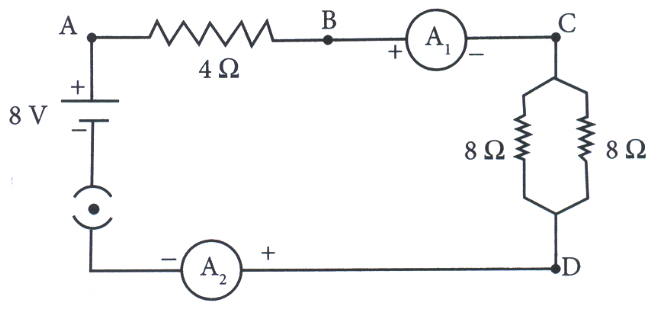
Find out the following in the electric circuit given in Figure
(a) Effective resistance of two 8 \(\Omega\) resistors in the combination
(b)Current flowing through 4 \(\Omega\) resistor
(c) Potential difference across 8 \(\Omega\) resistance
(d) Power dissipated in 4 \(\Omega\) resistor
(e) Difference in ammeter readings, if any.
20.
How will you conclude that the same potential difference exist across three resistors connected in a parallel arrangement to a battery?
21.
How will you infer with the help of an experiment that the same current flows through every part of the circuit containing three resistances in series connected to a battery?
22.
State Ohm's law? How can it be verified experimentally? Does it hold good under all conditions? Comment
1.
The resistance of an ammeter should be low. An ammeter has to be connected in series with the circuit to measure current. In case, its resistance is not very low, its inclusion in the circuit will reduce the current to be measured. In fact, an ideal ammeter is one which has zero resistance.
2.
Electrical power determines the rate at which the energy is delivered by a current
3.
Following are the advantages of connecting electrical devices in parallel with the battery:
(i) Parallel circuits divides the current among the electrical devices, so that they can have necessary amount of current to operate properly.
(ii) If one of the devices in a parallel combination fuses or fails, then the other devices keep working without being affected.
4.
The resistance of a conductor depends on following factors:
(i) Length of the conductor.
(ii) Area of cross-section of the conductor.
(iii) Nature of material of the conductor.
5.
The potential difference between two points is said to be 1 V if 1 J of work is done in moving 1 Coulomb of electric charge from one point to other point.
6.
The SI unit of electric current is ampere (A).
The current flowing through a conductor is said to be 1A, if a charge of 1coulomb (C) flows through it in 1second (s)
or \(1 A=\frac{1 C}{1 s}\)
7.
The flow of electric charge is known as electric current. Electric current is carried by moving electrons through a conductor. Electric current flows in opposite direction to the movement of electrons.
8.
(a)
9.
(b)
10.
(c)
maximum in case
11.
(c)
1:4
12.
(b)
IR2
13.
(d)
25
14.
(a)
volt ampere
15.
(d)
5A
16.
(c)
20 J
17.
(c)
300%
18.
(d)
nature of the material
19.
(a) Since two \(8\Omega \) resistors are in parallel, their effective resistance (\({ R }_{ P }\)) is given by,
\(\frac { 1 }{ { R }_{ P } } =\frac { 1 }{ 8 } +\frac { 1 }{ 8 } +\frac { 1 }{ 4 } \) or \({ R }_{ P }=4\Omega \)
(b) Total resistance in the circuit
\(R=4\Omega +{ R }_{ P }=4\Omega +4\Omega =84\Omega \)
Current through the electric circuit
\(I=\frac { V }{ R } =\frac { 8V }{ 8\Omega } =1A\)
(c) The potential difference \(4\Omega \) resistor V
I \(=IR=1\times 4=4V\)
(d) Power dissipated in \(4\Omega \) resistor P=\({ (I) }^{ 2 }\)
\(R={ (1) }^{ 2 }(4)=4W\)
(e) There is no difference in the readings of ammeters \({ A }_{ 1 }\) and \({ A }_{ 2 }\) as same current flows through all elements in a series circuit.
20.
A number of resistors are said to be connected in parallel if one end of each is connected to one point and the other end is connected to another point so that the potantial difference across each resistor is the same and is equal to the applied potential difference between the two points. If we connect a voltmeter first across R1, then across R2 ad lastly across R3, it will show same voltage.
21.
A number of resistors are said to be connected in series, if these are joined end to end and the same, current flows through each one of them when a potential difference is applied across the combination. If we connect ammeter first between the point A and R1, then between R1 and R2:R2 and R3 and lastly between R3 and the point B; it is same as current.
22.
At constant temperature, the current flowing through a conductor is directly proportional to the potential difference across its ends.
Onh's law does not hold good under all conditions as it is not a fundamental law of nature like Newton's laws. It is obeyed by metallic conductors only when physical condition like temperature etc., are kept unchanged. It is not obeyed by a lamp filament.

10th Standard CBSE Syllabus & Materials
10th Standard CBSE
CBSE 10th Social Science PS - Federalism - New Model Questions Papers Study Material - QB365 Set A
NEW10th Standard CBSE
CBSE 10th Social Science PS - Power Sharing - New Model Questions Papers Study Material - QB365 Set A
NEW10th Standard CBSE
CBSE 10th Social Science GEO - Manufacturing Industries - New Model Questions Papers Study Material - QB365 Set A
NEW10th Standard CBSE
CBSE 10th Social Science GEO - Minerals and Energy Resources - New Model Questions Papers Study Material - QB365 Set A



CBSE 10th Standard CBSE Subjects
CBSE Standards





