
 100% FREE ACCESS
10th Standard CBSE Syllabus & Materials
10th Standard CBSE
CBSE 10th Social Science ECO - Globalisation and the Indian Economy - New Model Questions Papers Study Material - QB365 Set A
NEW10th Standard CBSE
CBSE 10th Social Science ECO - Money and Credit - New Model Questions Papers Study Material - QB365 Set A
NEW10th Standard CBSE
CBSE 10th Social Science ECO - Sectors of the Indian Economy - New Model Questions Papers Study Material - QB365 Set A
NEW10th Standard CBSE
CBSE 10th Social Science ECO - Development - New Model Questions Papers Study Material - QB365 Set A
NEW10th Standard CBSE
CBSE 10th Social Science PS - Outcomes of Democracy - New Model Questions Papers Study Material - QB365 Set A
NEW10th Standard CBSE
CBSE 10th Social Science PS - Gender, Religion and Caste - New Model Questions Papers Study Material - QB365 Set A

Published on: 14/02/2020
10th Standard CBSE Social Science board Exam Model Question Paper I 2019-2020
Download CBSE Class 10th Standard CBSE Social Science question papers, sample papers, important questions, and previous year solved papers in PDF format. Get free study materials, NCERT solutions, and exam preparation resources for Class 10th Standard CBSE Social Science
Questions + Answers key
Take MCQ Social Science Test
1.
By 1931, who became the third largest producer of rice in the world?
2.
How did culture play important role to develop the national feelings among the people in Europe?
3.
Describe the cultural process through which nationalism captured people's imagination.
4.
Why did Mahatma Gandhi find in 'salt' a powerful symbol that could unite the nation? Explain
5.
How can solar energy solve the energy problem to some extent in India? Give your opinion.
6.
State any two reasons for the success of the IT industry in India.
7.
Why did Mahatma Gandhi lay emphasize on spinning yarn and weaving khadi?
8.
What were the aims of 'Movement'?
9.
What is a mineral?
10.
11.
What were the difference of opinions between the two groups in Vietnam regarding the introduction of French education System?
12.
Define Plebiscite.
13.
Mention any two uses of Manganese Ore.
14.
Who maintain the district roads?
15.
Name the second most important metallurgical industry in India.
16.
Who presided over the Lahore congress?
17.
How did French territory undergo changes due to the Treaty of Vienna in 1815?
18.
'Indian road transportation is confronted with problems'. Describe any four.
19.
Describe the importance of Pipelines in India.
20.
Why did Mahatma Gandhi relaunched the Civil Disobedience Movement with great apprehension? Explain.
21.
Give a brief account on information technology and the electronics in India.
22.
"The civil disobedience movement was different from the non-cooperation movement". Support the statement with examples.
23.
Why is it necessary to conserve mineral resources? Suggest any four way to conserve mineral resources.
24.
Describe the process of unification of Germany.
25.
Where was the first textile mill established?
Kolkata
Mumbai
Gujarat
Lucknow
26.
Whcih of the following formed the Khilafat Commitee in Bombay?
Muhammad Ali Jinnah
Ali Brothers
Abdul Ghaffar Khan
Surendra Nath Banerjee
27.
When was the long established monarchy in China overthrown?
1910
1909
1911
1912
28.
Villages are connected to a major town through which scheme of roads?
MNREGA
PMGSY
SJGRY
AAY
29.
Which out of the following minerals is formed by the decomposition of surface rocks, and leaves a residual mass of weathered material?
Gold
Bauxite
Zinc
Coal
30.
Who said these words, "When France sneeze the rest of the Europe catches a cold"?
Bismark
Mazzini
Metternich
Garibaldi
31.
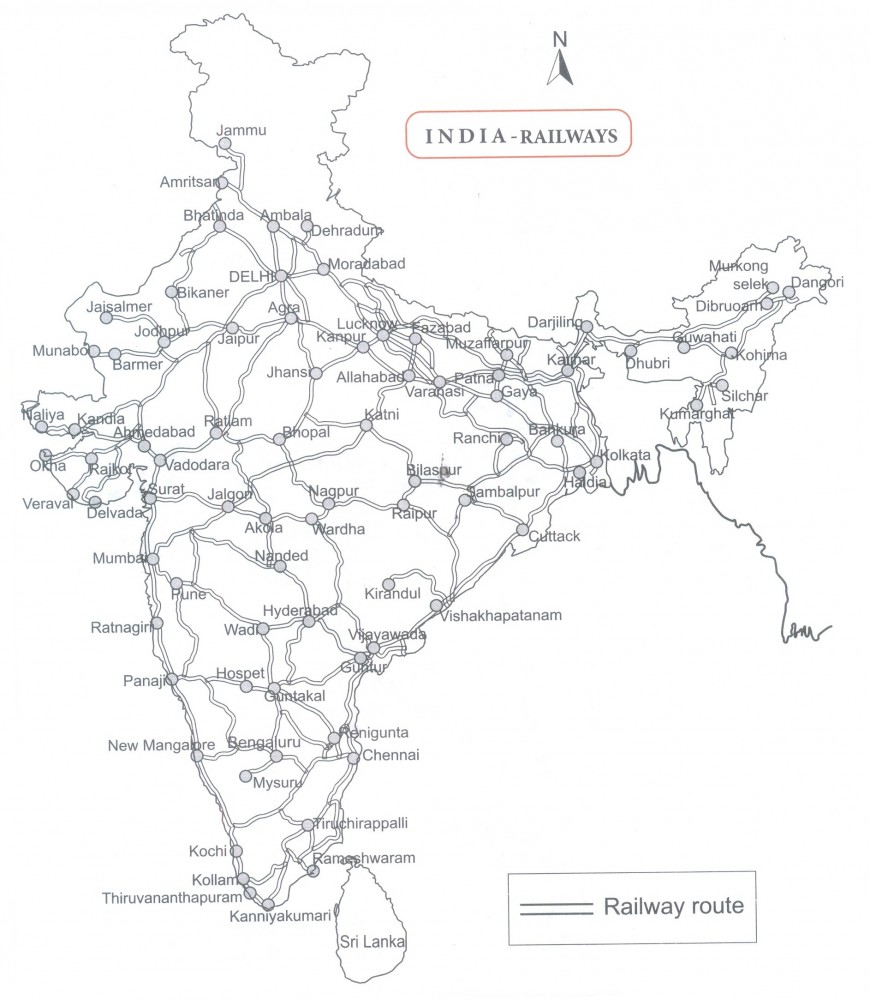
Study the railways network in India.
32.
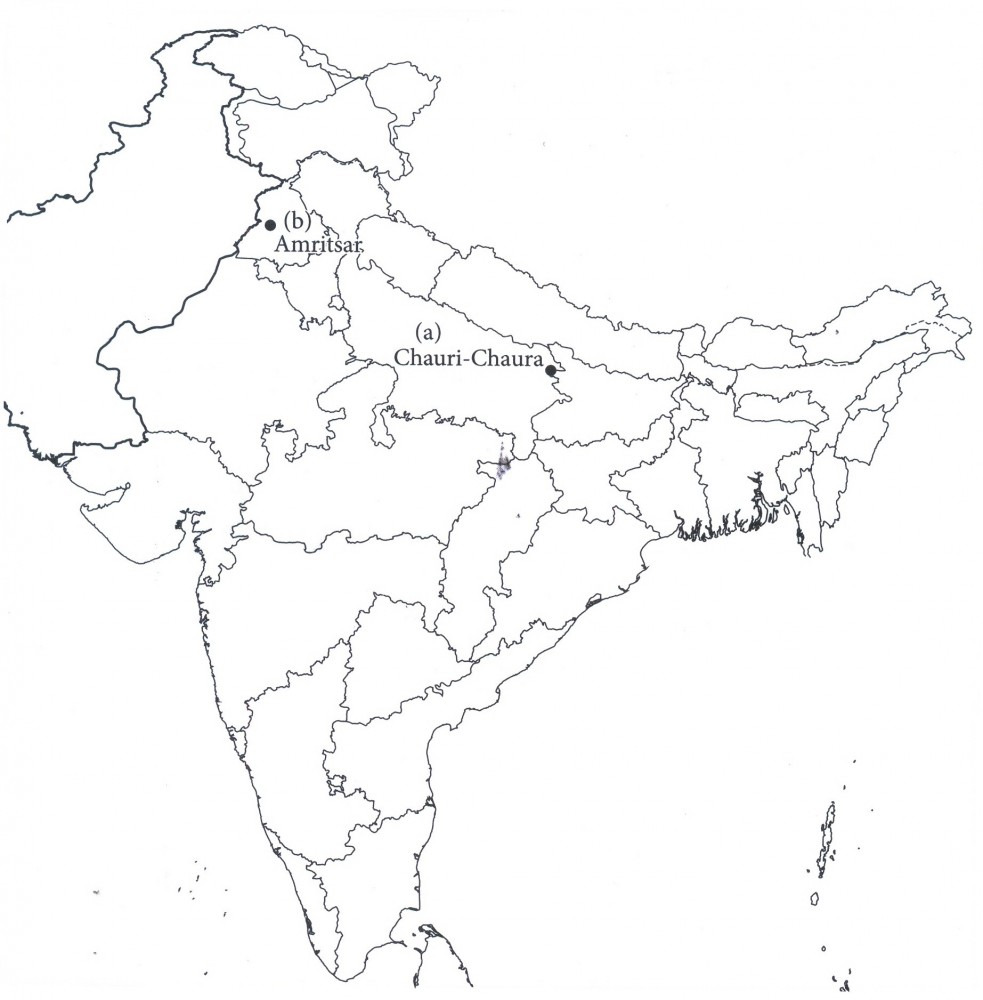
Locate and label the following items with appropriate symbols on the same map:
(a) Chauri-Chaura-The place of calling off the Non-Cooperation Movement (N.C.M.)
(b) Amritsar-The place where Jallianwalla Bagh incident took place.
33.
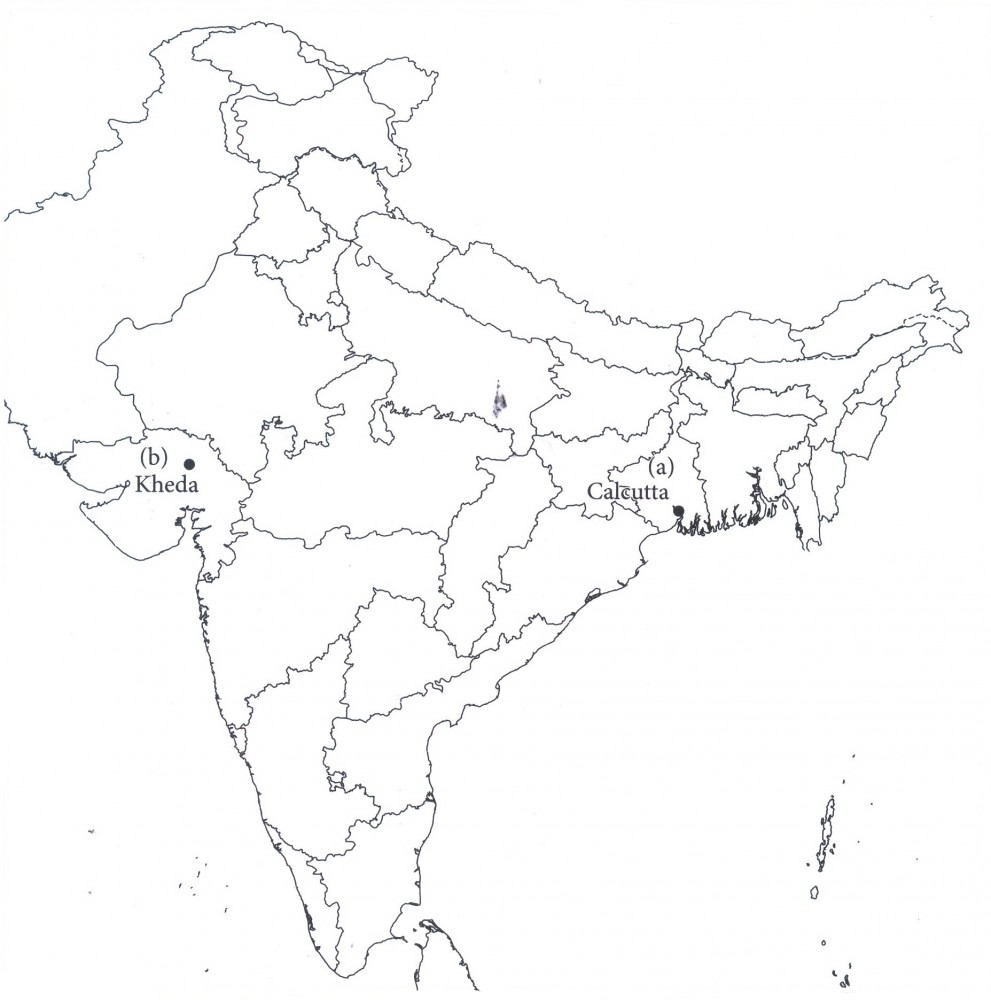
Two features - A and B are marked in the given political outline map of India. Identify these features with the help of the following information and write their correct names on the lines marked in the map:
(a) The place where Indian national Congress Session was held in September 1920.
(b) The place where the Peasant Satyagraha was help in Gujarat.
34.
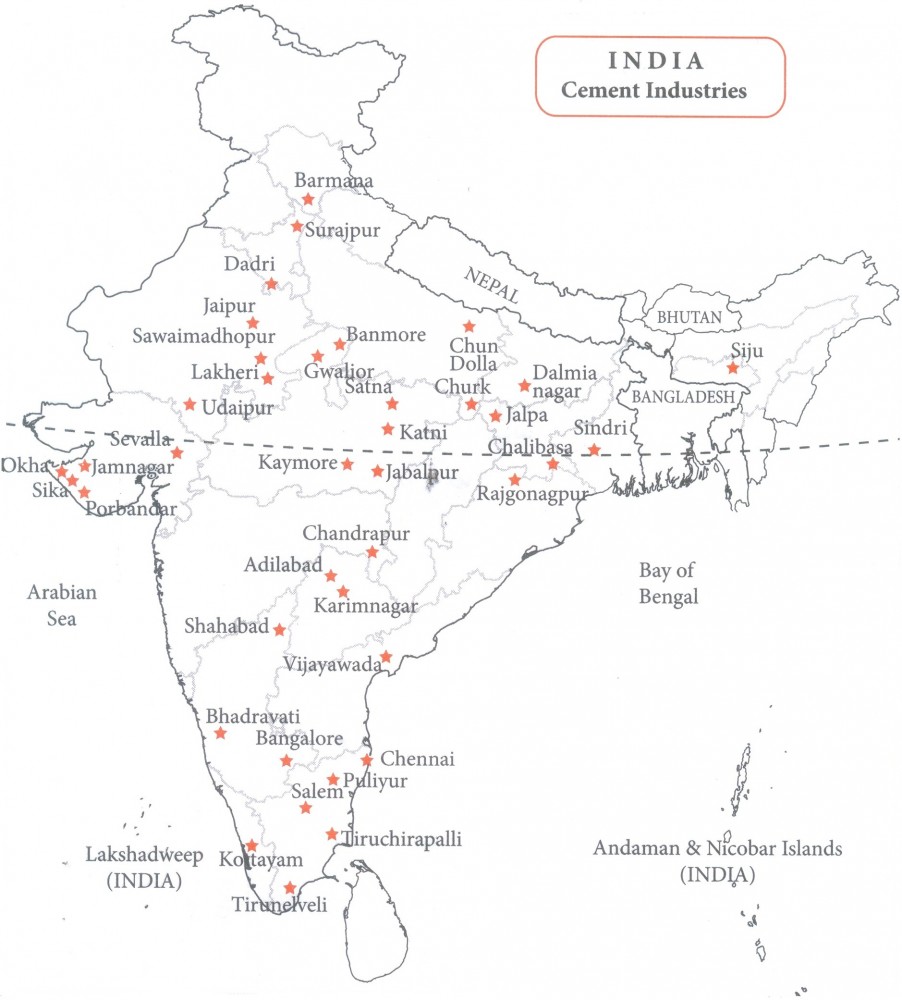
Study the given outline map of India showing the Cement Industries in India.
35.
Study and Observe the following map of conventional source of energy. Write the names of coal mines and oil fields with respective states.
36.
How did nationalism in Vietnam emerge through the efforts of different sections of the society to fight against the French? Explain.
37.
How did Vietnamese differ on the question of modernisation and nationalism?
1.
()
Vietnam.
2.
Language , music , drama , dance folklore etc
3.
The sense of collective belongingness among the Indians came from a united struggle of the people against the colonisers under whom they suffered oppression, suppression and cruelty. A variety of other cultural processes that helped in building the sense of collective belongings are as follows.
(a) Personification of Bharat Mata: The image of country India was transformed as Bharat Mata first by Bankim Chandra Chattopadhyay. Later, other artists like Abanindranath Tagore too painted the image of Bharat Mata portraying her as a calm, composed, divine and spiritual figure. People began to pledge their devotion to her as a proof of nationalism.
(b) National Song 'Vande Mataram': Bankim Chandra wrote 'Vande Mataram' as a 'hymn to the motherland in his novel Anandamath. This song became so popular that it began to be sung widely in the nationalist movements.
(c) Folklore:Nationalist leaders made every possible effort to collect folk songs and legends. Rabindranath Tagore himself began to revive folk songs, dances, folk tales, cultures, etc. Natesa Sastri published a four volume collection of Tamil folktales The Folklore of Southern India.
(d) Use of Icons and Symbols:During the Swadeshi movement, a tricolour was designed depicting signs and symbols used by both Hindus and Muslims. Gandhiji designed a Swaraj flag. Carrying and holding the flag during marches became a symbol of opposition.
(e) Rediscovery of India's Past. British colonisers portrayed Indians as backward and primitive. Nationalists thought it necessary to discover India's glorious past. They wrote about the achievements made by the Indians in the field of art, science, mathematics, etc. and urged Indians also to take pride in India's great glory.
4.
Mahatma Gandhi found in salt a powerful symbol that could unite the nation because
(i) Salt is consumed by everyone and is regarded as one of the most essential items of food. By levying tax on salt and establishing monopoly over its production, the communal power revealed the most oppressive face of them.
(ii) Gandhiji thought if any movement could be arranged against this oppression which affected people from all strata, it could unite the nation. He believed 'salt' had this power. So, he gave an ultimatum to the British Government, but Irwin was reluctant to negotiate.
(iii) Gandhiji started his famous Salt March with his trusted 78 followers from the Sabarmati ashram towards Dandi, the coastal town of Gujarat. This marked the beginning of the Civil Disobedience Movement allover India.
In this way, 'salt' inspired the nation to rebel against the British.
5.
The western parts of India, especially the Thar Desert region, receives undisturbed sunshine for the most part of the year. This area has great potential for development of energy and can be utilised as the largest solar power house of India.
Solar energy is becoming fast popular in different parts of the country, especially in rural and remote areas. It can be used for cooking, heating of water, pumping, refrigeration, street lighting and room heating in cold areas. The largest solar plant of India is located at Madhapur near Bhuj in Gujarat. The solar energy is used to sterilize milk cans.
6.
(i) The continuing growth in the hardware and software is the key to the success of IT industry in India.
(ii) This industry has been a major foreign exchange earner because of the Business Processes Outsourcing sector.
7.
(i) It supported millions of cotton textile workers and through this Gandhiji wanted to remove their poverty.
(ii) It was a powerful tool to protest against the British since he advocated boycotting foreign clothes.
8.
(i) 'Go East Movement' became popular with first decade of the twentieth century.
(ii) It aimed at aquring modern education from Japan mainly to drive out the French from Vietnam, overthrow the puppet emperor and re-establish the Nguyen dynasty. The Nationalist looked for foreign arms and help.
(iii) Vietnamese students established a branch of the Restoration Society in Tokyo. But after 1908, the Japanese Ministry clamped down on them.
(iv) As a result including Phan Bor Chau, many were deported and sought exile in China and Thailand.
9.
A mineral is a homogenous, naturally occurring substance. It has definite chemical composition comprising of one or more elements.
10.
11.
(i) The elites in Vietnam were powerfully influenced by Chinese culture. To consolidate their power, the French had to counter the Chinese influence. So they systematically dismantled the traditional educational system.
(ii) french schools were established for the Vietnamese.
(iii) One group emphasised the need to use the French language as the medium of instruction. Through this the Vietnamese would be introduced to the French culture and civilisation. This would help to create an 'Asiatic France solidly tied to European France.'
(iv) The educated people in Vietnam would respect the Frech sentiments and ideals.
(v) Other group was opposed to French being the only medium of instruction. The Vietnamese should be taught in lower classes and French in the higher classes.
(vi) The few who learnt French and acquired Frech culture were to be rewarded with French citizenship.
12.
Plebiscite is a system of direct vote by which the people of a region. themselves decide to accept or reject a proposal.
13.
Two uses of Manganese ore are:
(a) For the making of iron and steel and preparing alloys.
(b) To manufacture bleaching powder, insecticides, paints and batteries.
14.
These roads are maintained by the Zila Parishad.
15.
Aluminium smelting.
16.
Jawaharlal Nehru
17.
Representatives of European powers-Austria, Britain, Russia and Prussia-after defeating Napoleon drew the Treaty of Vienna of 1815 to undo the changes initiated by him in Europe. The objective was to restore the monarchies overthrown by Napoleon and create a new conservative order in Europe.
(a) The Bourbon dynasty deposed during the French Revolution was put back in power.
(b) The territories annexed by Napoleon were taken back from France.
(c) To prevent any future expansion of France, a series of states were set up on French boundaries. Kingdom of Netherlands including Belgium came up in the north, while Genoa along with Piedmont placed in the south.
(d) Along with Saxony some new territories were given to Prussia on its western frontiers. Austria got the control of northern Italy.
(e) Russia got the control of Poland.
18.
Road transportation is economical in transportation of smaller amount of goods and few passengers over short and medium distances. Though they are relatively cheap and easy to construct and maintain, road transportation in India is confronted with a number of problems.
(a) On account of its large population, India has large volumes of traffic and passengers which require a large number of vehicles. But the road network is not adequate to meet the requirement of handling heavy traffic.
(b) As most roads are kuccha or unmetalled, their usage is limited during the rainy season. The potholes on roads form muddy pools in the monsoon season and cause accidents.
(c) There are still more national highways to be built to connect the different parts of the country.
(d) The roads in the cities are highly congested and traffic jams are a constant problem. Most of the bridges and culverts are also old and narrow aggravating the problem.
(e) Roadside amenities like emergency medical facilities, telephone booths etc., are lacking. (f) Police patrolling on the highways in not adequate, so goods and passengers are not safe all the time.
19.
(i) They are used for transporting crude oil, petroleum products and natural gas from oil fields and natural gas field to refineries, fertilizer factories and big thermal power plants.
(ii) Solids can also be transported through a pipeline when converted into slurry.
(iii) Because of pipelines, refineries at Barauni, Mathura, Panipat and gas based fertilizer Plants, could be located in the interiors of India.
(iv) Initial cost of laying pipelines is high but subsequent running costs are minimal.
(v) Pipelines rules out trans-shipment (during transportation) losses or delays.
20.
Mahatma Gandhi entered into a pact with Irwin on 5 March, 1931.
(i) By this Gandhi - Irwin Pact, Gandhiji committed to participate in a Round Table Conference in London and the government agreed to release the political prisoners.
(ii) In December 1931, Gandhiji went to London for the conference, but the negotiations broke down and he returned disappointed.
(iii) Back in India, he discovered that the government had begun a new cycle of repressive measures.
(iv) Abdul Ghaffar Khan and Jawaharlal Nehru were both in jail and the Congress had been declared illegal.
(v) A series of measures has been imposed to prevent meetings, demonstrations, and boycotts. Thus, with great apprehension, Gandhiji relaunched the Civil Disobedience Movement.
21.
(1) India produces a wide range of electronics ranging from a small transistor set to television sets.
(2) India produces telephone exchanges, cellular phones, pagers, computers and various other equipments, which are used in various fields of life.
Importance:
(1) This industry looks after the needs of defence equipments, railways, airways, space and meteorological equipments.
(2) The IT industry provided employment to one million persons by March 2005 out of which 30 % are women.
(3) It has revolutionized the life of people and changed country's economy and the quality of human life.
(4) The electronic goods bring a fair amount of foreign exchange to India.
22.
The Civil Disobedience Movement was different from the Non-Cooperation Movement. The main differences between these two movements are
| Civil Disobedience Movement | Non-cooperation Movement |
| Civil Disobedience Movement was launched in 1930. | The Non-Cooperation Movement was launched in 1921 by Gandhiji. |
| The Civil Disobedience Movement was first supported by the Industrialists like GD Birla, Purshottamdas Thakur. | The Non-Cooperation Movement started with middle class participation. |
| The growing proximity of the Congress party and Hindu Mahasabha prevented the Muslims to participate in Civil Disobedience Movement. | Due to Khalifa issues Muslim community participated in Non-Cooperation on large scale |
| The Civil Disobedience Movement was withdrawn in 1931, when Gandhi signed 'Gandhi-Irwin' pact. | The Non-Cooperation Movement was withdrawn by Gandhiji due to violent incident at Chauri Chaura. |
| Large scale participation of women is one of the most significant features of the Civil Disobedience Movement. | In Non-Cooperation Movement, women did not participate in large scale. |
23.
(a) Conservation of minerals resources is essential because:
(i) The formation of minerals takes a long geological period of millions of years.
(ii) They are finite, i.e. limited in nature.
(iii) Many of them are non-renewable and exhaustible.
(iv) The rate of replenishment of minerals is infinitely small in comparison to rate of consumption.
(v) They have to be preserved for our future generations because they are very important for industrial development of the nation.
(b) Methods of conserving mineral resources.
(i) We should use minerals in a planned and sustainable manner.
(ii) Improved technologies need to be evolved to allow use of low grade ores at low cost.
(iii) Recycling of metals.
(iv) Using scrap metals and other substitutes.
(v) Wastages in mining, processing and distribution should be minimized.
(vi) Controlled export of minerals.
24.
The German people did not exist as a united nation. Men and women of middle classes combined their demands for constitution with national unification. In 1848, the popular effort was failure to succeed in forming constitution (Frankfurt Parliament) in Germany due to the combined forces of the monarchy and the military, supported by the large landowners (Junkers) of Prussia. Prussia took on the leadership of the movement for national unification with its chief minister as Otto Von Bismarck. He reached his goal with the help of Prussian army and bureaucracy. The process of unification was ended with three wars over 7 years with Austria, Denmark and France. In Jan 1871, an assembly consisting of the princes of German states, representatives of the army, important Prussian ministers including Otto von Bismarck gathered in the Hall of Mirrors in the Palace of Versailles to proclaim the new German head as Kaiser William I of Prussia. The new state placed a strong prominence on modernizing the currency, banking, legal and judicial systems in Germany. Prussian measures and practices became a model for the rest of Germany.
25.
(b)
Mumbai
26.
(b)
Ali Brothers
27.
(c)
1911
28.
(b)
PMGSY
29.
(b)
Bauxite
30.
(c)
Metternich
31.
32.
33.
34.
35.
Coal fields
(a) Bokaro, Jharia: Jharkhand
(b) Talcher: Odisha
(c) Neyveli: Tamil Nadu
Oil fields
(a) Ankaleshwar: Gujarat
(b) Digboi: Assam
(c) Mumbai high, Bassein: Maharashtra
36.
Nationalism in Vietnam emerged through the effort of different sections of the society to fight the French due to following reasons.
(a) Teachers were very active in resisting the French influence in Vietnam. They openly opposed the curriculum.
(b) Students too resisted the French efforts to prevent the Vietnamese from qualifying for white-collar jobs. They even formed political like Party of Young Annan and published nationalist like Annamese Student.
(c) In the early 20th century students initiated the 'Go East Movement'. They went to Japan for higher education with an objective to overthrow the puppet emperor and re-establish Nguyen Dynasty opposed to the French.
(d) The religious elite in Vietnam were hostile to western presence. They led a movement against French control and the spread of Christianity, popularly known as the Scholars Revolt in 1868.
(e) Phan Boi Chau resisted the French domination and became a major figure of anti-colonial resistance. He formed a Revolutionary Society.
37.
Both Phan Boi Chau and Chu Trinh were nationalists. Both of them wanted to free Vietnam from colonial occupation but in different ways.
Difference:
PHAN BOI CHAU
(a) He accepted monarchy.
(b) He did not want to revolt against monarchy.
(c) He wanted to get the help of monarchy to oppose French rule.
(d) He supported Vietnamese culture and opposed western ideas.
(e) He wanted to establish a constitutional monarchy.
PHAN CHU TRINH
(a) He wishes to overthrow monarchy.
(b) He planned an uprising against monarchy.
(c) He did not want to take the help of monarchy.
(d) He supported modern ideas like liberty, fraternity and equality.
(e) He wanted to establish a democratic republic.

10th Standard CBSE Syllabus & Materials
10th Standard CBSE
CBSE 10th Social Science PS - Federalism - New Model Questions Papers Study Material - QB365 Set A
NEW10th Standard CBSE
CBSE 10th Social Science PS - Power Sharing - New Model Questions Papers Study Material - QB365 Set A
NEW10th Standard CBSE
CBSE 10th Social Science GEO - Manufacturing Industries - New Model Questions Papers Study Material - QB365 Set A
NEW10th Standard CBSE
CBSE 10th Social Science GEO - Minerals and Energy Resources - New Model Questions Papers Study Material - QB365 Set A



CBSE 10th Standard CBSE Subjects
CBSE Standards





