
 100% FREE ACCESS
10th Standard CBSE Syllabus & Materials
10th Standard CBSE
CBSE 10th Social Science ECO - Globalisation and the Indian Economy - New Model Questions Papers Study Material - QB365 Set A
NEW10th Standard CBSE
CBSE 10th Social Science ECO - Money and Credit - New Model Questions Papers Study Material - QB365 Set A
NEW10th Standard CBSE
CBSE 10th Social Science ECO - Sectors of the Indian Economy - New Model Questions Papers Study Material - QB365 Set A
NEW10th Standard CBSE
CBSE 10th Social Science ECO - Development - New Model Questions Papers Study Material - QB365 Set A
NEW10th Standard CBSE
CBSE 10th Social Science PS - Outcomes of Democracy - New Model Questions Papers Study Material - QB365 Set A
NEW10th Standard CBSE
CBSE 10th Social Science PS - Gender, Religion and Caste - New Model Questions Papers Study Material - QB365 Set A

Published on: 14/02/2020
10th Standard CBSE Social Science board Exam Model Question Paper III 2020
Download CBSE Class 10th Standard CBSE Social Science question papers, sample papers, important questions, and previous year solved papers in PDF format. Get free study materials, NCERT solutions, and exam preparation resources for Class 10th Standard CBSE Social Science
Questions + Answers key
Take MCQ Social Science Test
1.
Who was Paul Bernard?
2.
"Method of reinterpretation of history was followed to encourage a feeling of nationalism." Give any five arguments to support this statement.
3.
Name the means of communication.
4.
How did the development programmes undertaken by the French indirectly help the Vietnamese people?
5.
What are border roads? Give its importance.
6.
Why is iron and steel industry called the basic industry? Explain any three reasons.
7.
Mention two prime factors that determine the location of Aluminium industry.
8.
What are the major properties of mica? Mention any three.
9.
"Culture Played an important role in creating the idea of the nation in Europe". Support the statement with examples.
10.
Examine the main features of the process of German unification under the leadership of Otto Von Bismarck.
11.
The Ho Chi Minh trail became advantageous to Vietnamese in the war against US ." Support the statement with arguments.
12.
Which country is the largest producer and consumer of steel in the world?
China
Japan
India
United States
13.
Why was the Round Table Conference held in England?
To discuss the provisions of future Indian Constitution.
To discuss the steps to be taken to check Indian National Movement
To give concessions to Indians
To make plans for improvement of agriculture in India.
14.
Which one of the following state has the highest road density?
Goa
Kerala
Karnataka
Gujarat
15.
Nagarcoil and Jaisalmer are well-known for the effective use of
tidal energy
geothermal energy
wind energy
biogas
16.
What does a blind-folded woman carrying a pair of weighing scales symbolizes?
Equality
Liberty
Justice
Harmony
17.
In which year did French troops land in Vietnam?
1859
1858
1865
1864
18.
Explain any three problems faced by Iron and Steel Industry in India.
19.
Discuss the reasons for the emergence of nationalist tensions in the Balkans.
20.
How did the growth of industrialisation change the social and political equation of Europe.
21.
Name the following ports:
(a) A tidal port on the west coast
(b) A port exporting iron one on the west coast
(c) A port at the entrance of a lagoon, in the south-west of India.
(d) An inland riverine port.
(e) The oldest artificial port
22.
Explain any four reasons why a dense and efficient network of transport and communication is a pre-requisite for trade of today.
23.
Explain the attitude of the Indian merchants and the industrialists towards the 'Civil Disobedience Movement'.
24.
How did the tribals of Gudem hills of Andhra Pradesh interpret swaraj? What were the difference between the belief and practices of their leader Alluri Sitaram Raju?
25.
Explain:
(a) Why growth of nationalism in the colonies is linked to an anti-colonial movement?
(b) How the first World War helped in the growth of the national Movement in India.
(c) Why Indians were outraged by the Rowlatt Act?
(d) Why Gandhiji decided to withdraw the Non-Cooperation Movement?
26.
Describe the distribution of coal in India.
27.
How did Lord Byron contribute to the Greek war of Independence?
28.
Which two factors were responsible for the expansion of trade and transport?
29.
Which mineral is largely derived from the ocean water?
30.
Name two industries causing water pollution.
31.
When was Rowlatt Act passed?
32.
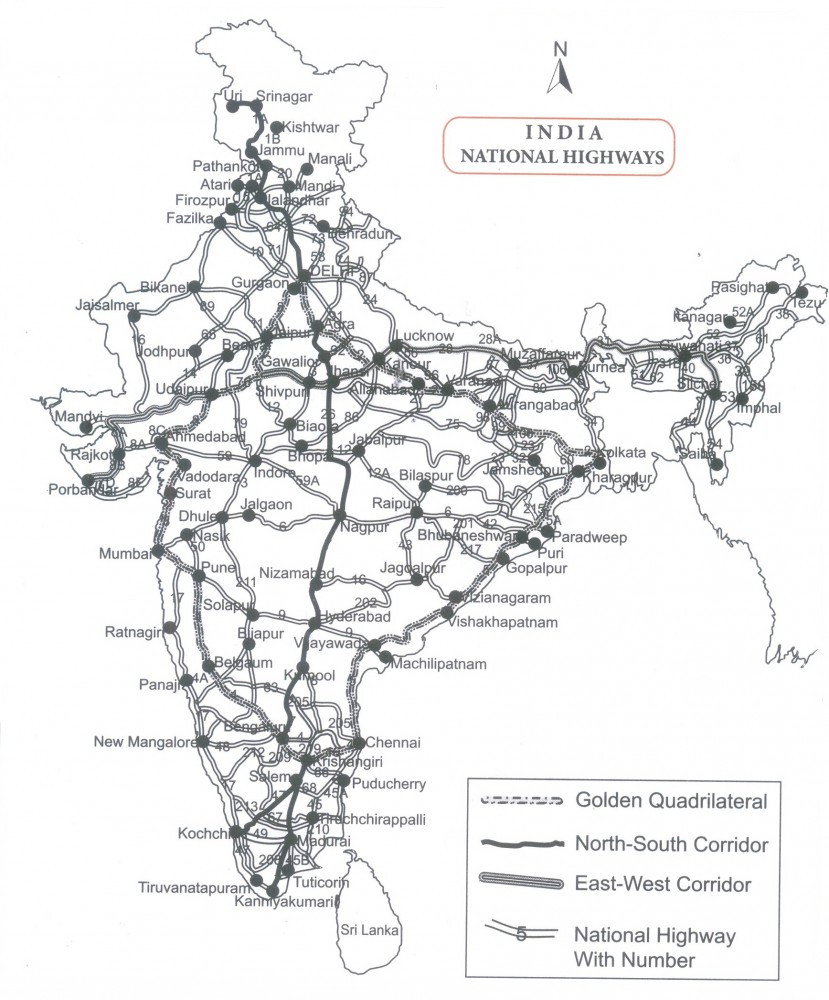
Locate and label the following on the political outline map of India:
(a) Two terminal cities of north-south corridor
(b) terminal station of east - west corridor.
33.
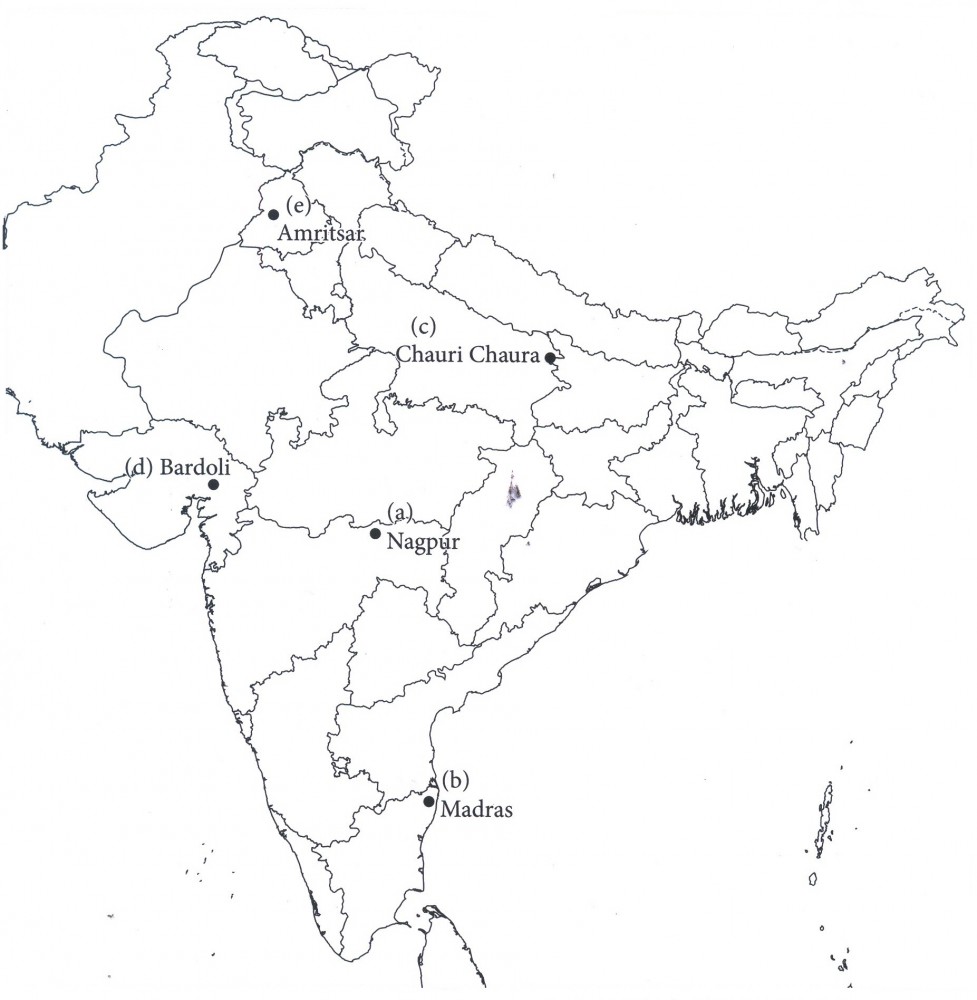
Five features with serial nos. (i) to (v) are marked in the given outline political map of India. Identify these features with the help of the following information and write their correct names on the lines marked in the map:
(a) A place where Indian National Congress Session was held in Dec. 1920.
(b) A place where Indian National Congress Session was held in 1927.
(c) A place where violence occurred due to which Mahatma Gandhi suddenly called off the Non-cooperation Movement.
(d) A place of peasants' Satyagraha in Gujarat.
(e) A place associated with Jallianwalla Bagh massacre.
34.
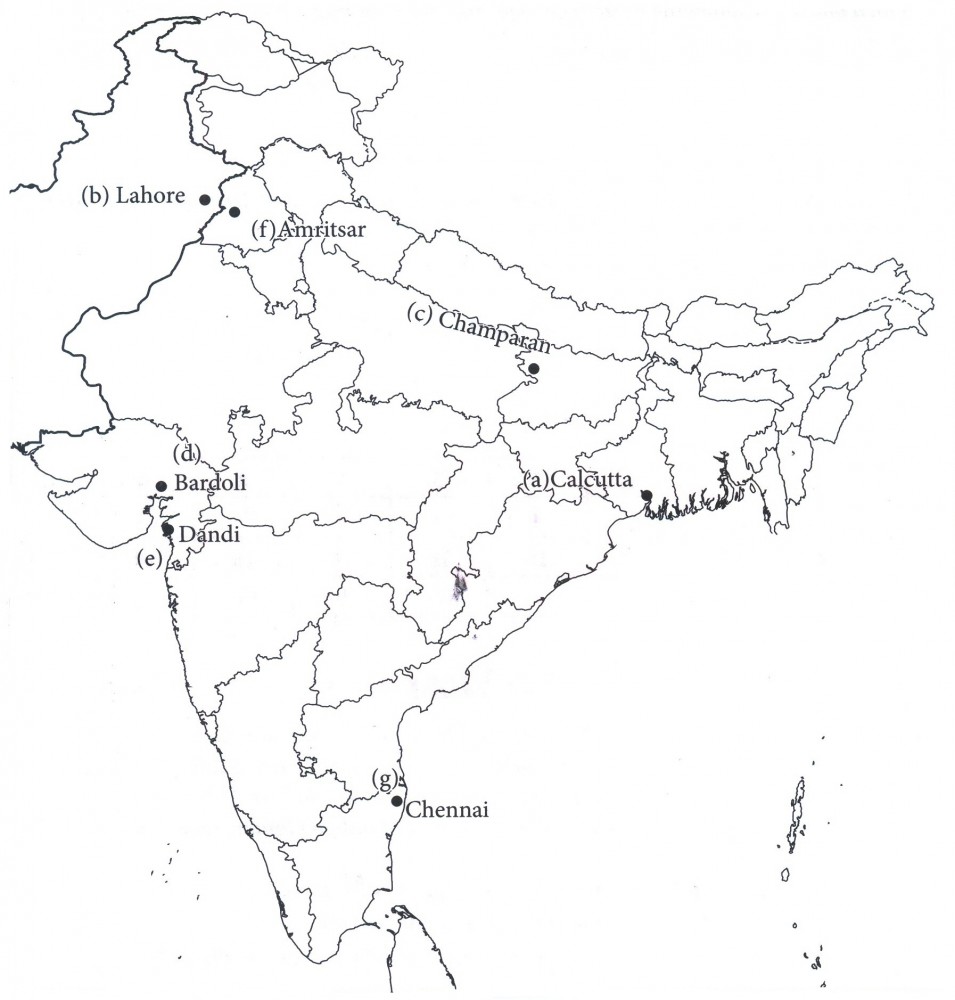
Locate and label the following on the given political outline map of India:
(a) A place where session of Indian National Congress was held in September 1920.
(b) A place where session of Indian National Congress was held in 1929.
(c) A place in Bihar where Satyagraha Movement of indigo planters took place.
(d) Baradoli, the place, from where No tax campaign was started.
(e) A place in Gujarat where Gandhiji violated the Salt law.
(f) a place in Punjab where Jalianwalla Bagh incident took place (or) Amritsar
(g) Chennai (Madras)
35.
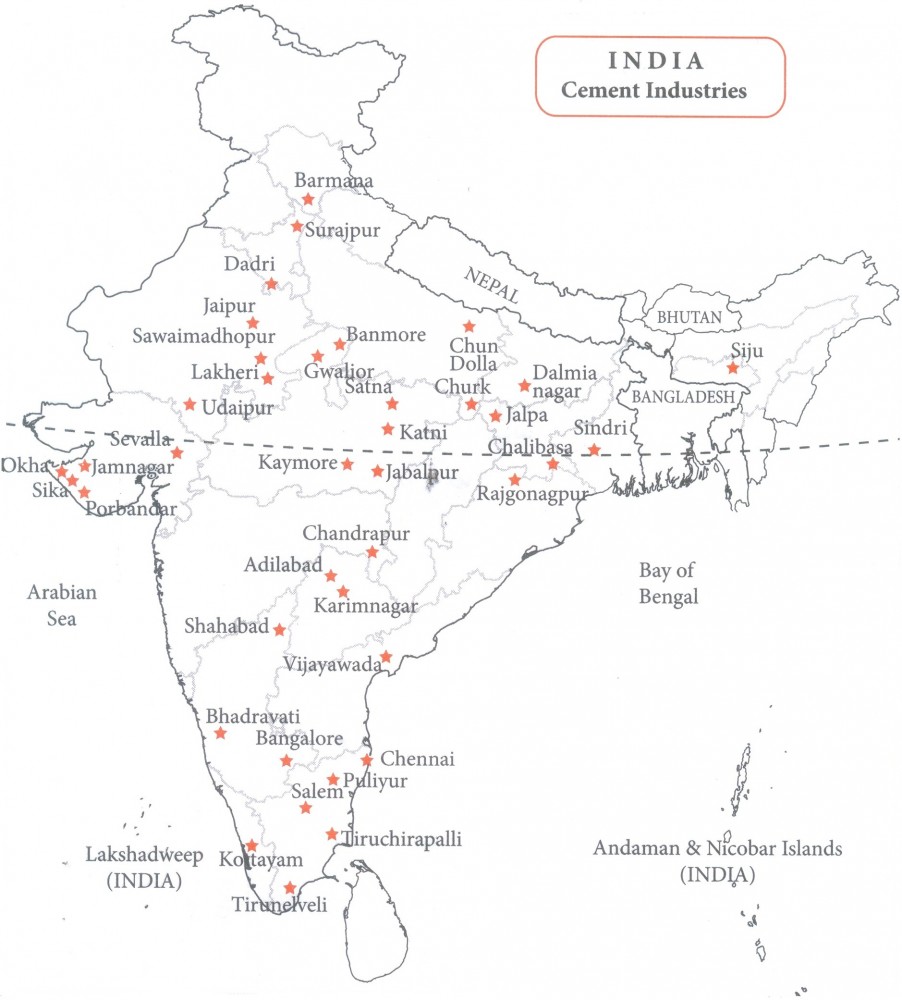
Study the given outline map of India showing the Cement Industries in India.
36.
Study the given outline map of India showing major Iron and Steel Plants in India.
37.
Study and Observe the following map of conventional source of energy. Write the names of coal mines and oil fields with respective states.
38.
Observe and study the following map showing iron ore belts. Write the names of iron mines and where are they located?
39.
What were the developmental projects undertaken by France in Vietnam?
40.
Explain any five objectives of Vietnamese students who had gone to Japan for higher education during 1907-08.
1.
()
He was an influential writer and policy-marker.
2.
Reinterpretation of History created a feeling of nationalism in India in the following ways.
(a) By the end of nineteenth century, there developed a feeling of sense of pride in the nation and this could be done through interpreting Indian History in a different way.
(b) The British considered Indians as backwards and primitive, incapable of governing themselves. Indians responded by looking into the past to discover India's great achievements.
(c) Glorious developments in ancient times when art and architecture, science and mathematics, religion and culture, law and philosophy, crafts and trade had flourished began to be re-written.
(d) It was felt that Indian glorious past was neglected with the coming of foreign powers.
(e) The readers were urged to read history and take pride in India's great achievements in the past and struggle to change the miserable conditions of life under the British.
3.
Four means of communication are:
(a) Personal communications like postal network and telecom network.
(b) Mass communication like Press (newspapers) and Media (TV, Radio, Film)
4.
The development programmes undertaken by the French indirectly helped the Vietnamese people in the following ways.
(a) Development works like canal construction provided employment to many people.
(b) With the increased agricultural production, farmers got surplus output to export.
(c) Education brought modern ideas to Vietnam.
(d) Standard of living of the people improved.
5.
Strategically important roads in the bordering areas of the country are called border roads. These roads are in the northern and northeastern border areas.
Importance of Border roads: -
(1) Border roads have improved accessibility in areas of difficult terrain.
(2) They have helped in the economic development of border areas.
(3) Used to supply military equipments to the borders of our country.
6.
(1) Since all the other industries - heavy, medium and light, depend on it for their machinery.
(2) Steel is needed to manufacture a variety of engineering goods.
(3) Steel is needed for construction material, defence and medical equipments.
(3) Steel is needed for telephonic, scientific equipment and a variety of consumer goods.
(4) Production and consumption of steel is often regarded as the index of a country's development. (any three)
7.
(i) Assured source of raw material, bauxite, at minimum cost as it is a bulky material at 4 to 6 tones of bauxite are requried to manufacture 1 tonne of aluminium.
(ii) 18600 KWh of electricity is required per ton of ore for smelting of aluminium. Hence, regular supply of power is another important factor for location of the industry.
8.
a) Mica a mineral made up of a series of plates or leaves.
b) It splits easily into thin sheets. These sheets can be so thin that a thousand can be layered into a mica sheet of a few centimetres high.
c) Mica can be clear, black, green, red yellow or brown.
d) It has excellent di-electric strength, low power loss factor, insulating properties and resistance to high voltage.any three]
9.
The growth of nationalism did not come only through wars but also through the different forms of culture such as art, poetry, dance, music tic contributed to the growth of nationalism. The following three examples will show the contribution of culture to the growth of nationalism in Europe: -
Example 1 - Romanticism - It is a cultural movement which developed nationalist sentiment through creative works like painting, poetry, literature, folk songs, dances etc. It focused on emotions, intuition and mystical feelings. They aimed to create a sense of collective heritage as the basis of a nation.
Example 2 - Emphasis on Vernacular Language - It carried the modern nationalist message to people who were illiterate. Though Poland is no longer existed as an independent nation, national feelings were kept alive through music and language. Karol Kurpinski celebrated the national struggle through music, folk dances into nationalist symbols.
Example 3 - Johann Gottfried Herder - According to him, German culture was inculcated to the common people through folk songs, folk poetry and folk dances. So collecting and recording these forms of folk culture was essential to the nation - building.
10.
The German people did not exists as a united nation. Men and women of middle classes combined their demands for constitution with national unification. In 1848, the popular effort was failure to succeed in forming constitution (Frankfurt Parliament) in Germany due to the combined forces of the monarchy and the military, supported by the large landowners (Junkers) of Prussia. Prussia took on the leadership of the movement for national unification with its chief minister as Otto Von Bismarck. He reached his goal with the help of Prussian army and bureaucracy.
The process of unification was ended with three wars over 7 years with Austria Denmark and France. In Jan 1871, an assembly consisting of the princes of German states, representatives of the army, important Prussian ministers including Otto von Bismarck gathered in the Hall of Mirrors in the Palace of Versailles to proclaim the new German head as Kaiser William I of Prussia. The new state placed a strong prominence on modernizing the currency, banking, legal and judicial system in Germany. Prussian measures and practices became a model for the rest of Germany.
11.
(i) The trail symbolises how the Vietnamese used their limited resources to great advantage.
(ii) The trail, an immense network of footpaths and roads was used to transport men and material from North to South.
(iii) It was improved in late1950s and from 1967 about 20,000 North Vietnamese troops came south each month. The trail had support bases and hospitals along the way.
(iv) Mostly supplies were carried by women porters on their backs or on their bicycles.
(v) The U.S. regularly bo0mbed this trail to disrupt supplies but efforts to destroy this important supply line by intensive bombing failed because they were rebuilt very quickly.
12.
(a)
China
13.
(a)
To discuss the provisions of future Indian Constitution.
14.
(b)
Kerala
15.
(c)
wind energy
16.
(c)
Justice
17.
(b)
1858
18.
(i) Integrated steel plants are different from mini steel plants in many aspects.
(a) An integrated steel plant is large and handles everything in one complex from integrating raw materials to steel making, rolling and shaping.
(b) On the other hand, a mini steel plant is smaller, has electric furnaces, uses steel scrap and sponge iron, and has re-rollers that use steel ingots as well. It produces mild and alloy steel of given specifications.
The problems faced by this industry are:
(a) high production costs and limited availability of coking coal
(b) lower productivity of labour
(c) irregular supply of energy
(d) poor infrastructure. Recent developments that have led to a rise in the production capacity of this industry are liberalisation and Foreign Direct Investment, with help from private entrepreneurs.
(ii) Industrial pollution of the environment is of four types: air, water, land and noise. Air pollution is caused by smoke released by chemical and paper factories, brick kilns, refineries and smelting plants, and burning of fossil fuels in factories ignoring pollution norms. Water pollution is caused by the discharging of organic and inorganic industrial wastes and effluents into rivers. This form of pollution is caused by paper, pulp, chemical, textile, dyeing, petroleum refineries, tanneries and electroplating industries. The major solid wastes released into rivers in India are fly ash, phospo - gypsum, and iron and steel slags. Thermal pollution of water is another form of water pollution, caused by the emission of hot water from factories and thermal plants into rivers and ponds. Dumping of solid wastes renders the soil infertile and useless too. Lastly, noise pollution results from industrial and construction activities, machinery, generators, and saws, pneumatic and electric drills.
(iii) The steps to be taken to minimise environmental degradation by industry are as follows:
(a) To control water pollution, industrial effluents need to be treated on all three levels (primary, secondary and tertiary); the use of water for processing should be minimised via reuse and recycling; rainwater can be harvested to meet water requirements, and ground water usage should be regulated by law.
(b) For the minimisation of air pollution, smoke stacks should be fitted to factories with electrostatic precipitators, fabric filters, scrubbers and inertial separators. Also, smoke can be reduced by using oil or gas instead of coal.
(c) Noise pollution can be controlled by fitting generators with silencers, redesigning machinery to reduce noise, and using earplugs and earphones besides other noise absorbing material.
19.
The Balkan region during 1871 comprised modern-day states like Romania, Bulgaria, Albania, Greece, Macedonia, Croatia, Bosnia-Herzegovina, Slovenia, Serbia and Montenegro. Its inhabitants were known as Slavs.
(a) This region had various ethnic and geographical diversities and was under the Ottoman Empire for a long period. As the ideas of romantic nationalism spread in this region, it resulted in breaking up of the Ottoman Empire which made the situation even more serious.
(b) The Ottoman Empire could not do much to integrate these regions. As a result, most of the European subject nationalities broke away from the Ottoman Empire's control and declared their independence.
(c) The Balkan people based their claim to be independent on the basis of nationality. They referred to the examples from history as a proof that they were once independent and were subjugated by foreign powers. Therefore, they thought of their struggles as attempts to win back their long-lost independence.
(d) Because of this development, various other Slavic nationalities also struggled to define their identity and independence which made the Balkan a region of severe conflicts. At the same time they were jealous, of each other and wanted to gain more territory at the expense of the others.
(e) European powers like Russia, Germany, England, Austro-Hungary too fought with each other to control more colonies and establish their naval and military might. They were also keen to grab more of the Balkan region for expanding their trade. This made the situation more serious which ended up with the waging of the First World War.
20.
Industrialisation began in Europe during the 19th century and brought with it growth of towns and cities inhabited by strong commercial class which produced goods for domestic markets.
Along with it a class of people emerged called the new working class. It included professionals, businessmen and industrialists.
Though they were small in number, educated, liberal minded and believed in national unification. They strongly condemned aristocratic set up in the society. It was because of these ideals they gained popularity and emerged as a new social class. They stood for equality and freedom and stressed the formation of constitution given preference to representative from of government rather than established autocratic regimes.
21.
(a) Kandla
(b) Marmagao
(c) Kochchi
(d) Kolkata
(e)Chennai
22.
(a) They help in increasing cooperation and assistance between countries by easy movement of goods and material between countries.
(b) They help in trade and commerce within country.
(c) They have reduced distances thus bringing the world closer.
(d) They help in both production and distribution of goods and movement of large number of people and over long distance.
(e) They provide important links between producers and consumers of goods.
(f) They bring people very close to an another by promoting interdependence among people.
23.
(i) Merchants reacted against colonial policies that restricted business activities.
(ii) They wanted protection against import of foreign goods and wanted a rupee-sterling exchange ratio that would discourage imports.
(iii) Industrialists formed the Indian Industrial and commercial Congress in 1920.
(iv) They formed the Federation of the Indian Chamber of Commerce and Industries in 1927.
(v) They refused to sell or buy imported goods. They gave financial assistance and supported the Civil Disobedience Movement.
(vi) Industrialists like G.D. Birla and Purshottamdas Thakurdas attacked colonial control over the Indian economy.
24.
In the Gudem Hills of Andhra Pradesh, a militant guerrilla movement spread against the colonial government who had closed large forest areas, preventing people from entering the forests to graze their cattle, or to collect fuel wood and fruits. The enraged the hill people. Their livelihoods were affected and their traditional rights were being denied. When the government began forcing them to contribute beggar for road building, the hill people revolted.
Later a person named Alluri Sitaram Raju claimed that he had a variety of special powers: he could make correct astrological predictions and heal people. Captivated by Raju, the rebels proclaimed that he was an incarnation of God. Raju talked of the greatness of Mahatma Gandhi, but he asserted that India could be liberated only by the use of force,
The Gudem rebels attacked police stations, attempted to kill British officials and carried on guerrilla warfare for achieving swaraj. Raju was captured and executed in 1924, and over time became a folk hero.
25.
(a) The European Powers considered their culture more civilized, modern and superior. They forcefully started imposing their culture on the colonies. This also aroused the feeling of nationalism. The colonial powers exploit the people of their colonies so much that all sections of the people decide to throw off the foreign rulers.
In India, the growing anger against the colonial government brought together various groups and classes into a common struggle for freedom. Moreover, the oppressed people realised that it was necessary to fight colonial rule to restore their glorious past and their freedom. Thus, what started as Anti-Colonial Movement, turned into Nationalist Movement. Everybody had his own interpretation of anti-colonialism, but the ultimate aim was to get rid of them. This single point was the unifying factor for diverse mass of India. Finally, the idea of India as a nation started to emerge.
(b) The First World War created a new economic and political situation which led to increase in defence expenditure. This expenditure increase was financed by war loans and by increasing taxes. Moreover
• Price hike during the war years (1914-1918) led to extreme hardship for the commoners.
• Villagers and farmers were forcefully recruited in the British army, this caused widespread anger.
• Incidents such as implementation of Rowlatt Act, Jallianwala Bagh Massacre, Martial law in Punjab, disintegration of the Ottoman empire, further aggravated the situation, resulting in the emergence of the National Movement.
(c) Indians were outraged by the Rowlatt Act for the following reasons
(i) Rowlatt Act was introduced in 1919. This act had been hurriedly passed through the Imperial Legislative Council despite the opposition from Indian members.
(ii) Under this Act, the police could arrest anybody and put in prison without trial for two years. The provisions of this Act outraged Indians and hurt their nationalist sentiments and dignity.
(iii) Meetings were held everywhere and processions taken out. It was the first time when the Indians unitedly opposed the Britishers.
(d) Gandhiji decided to withdraw Non-Cooperation Movement because the movement took a violent turn at Chauri Chaura, Uttar Pradesh where the people set on fire a Police Station in which 22-23 policemen were burnt alive in 1922. Gandhiji wanted to stop violence at any cost.
26.
(a) In India, coal is the most abundantly available fossil fuel. Coal is found in a variety of forms depending on the degress of compression and the depth and time of burial. As per these basis, coal deposits are found mainly of two geological ages. These are
(i) Gondwana Coal Deposits These are about 200 million years old. The major coal deposit in India are Gondwana coal which are high quality metallurgical coal.
These coal deposits are located in Damodar Valley (West Bengal-Jharkhand). Jharia, Raniganj and Bokaro are important coal deposit fields. Besides, the Godavari, Mahanadi, Son and Wardha valleys also contain such coal deposits.
(ii) Tertiary Coal Deposits These are around 55 million years old. Tertiary coal deposits are found in the North-Eastern states of Meghalaya, Assam, Arunachal Pradesh and Nagaland. This coal is of lower quality than the Gondwana coal.
27.
Lord Byron, an English poet, organised funds for the Greek struggle against the Ottoman Empire and also participated in the war.
28.
Science and technology
29.
Magnesium is largely derived from the ocean water.
30.
Tannery, textile, industry, electroplating industry.
31.
Rowlatt Act was passed in the year 1919.
32.
33.
34.
35.
36.
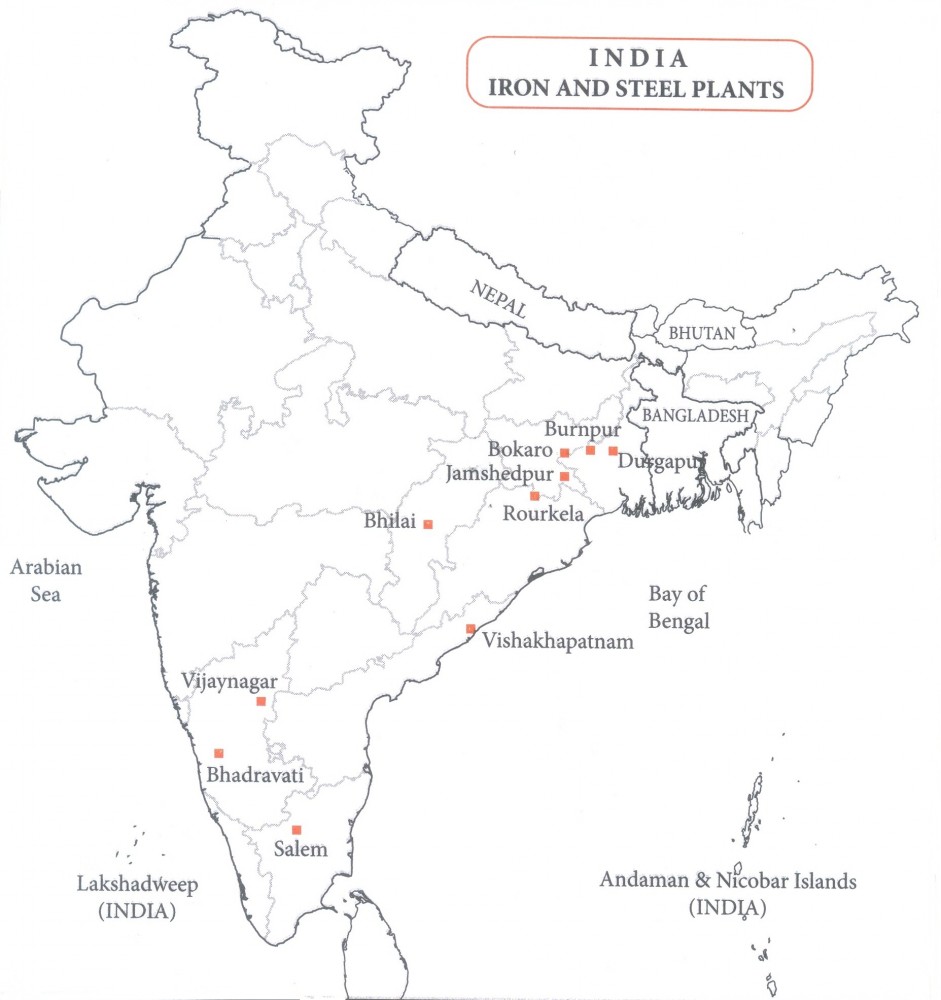
37.
Coal fields
(a) Bokaro, Jharia: Jharkhand
(b) Talcher: Odisha
(c) Neyveli: Tamil Nadu
Oil fields
(a) Ankaleshwar: Gujarat
(b) Digboi: Assam
(c) Mumbai high, Bassein: Maharashtra
38.
(i) Gua : Jharkhand
(ii) Mayurbhanj, Kendujhar: Odisha
(iii) Durg, Bailadila: Chhattisgarh
(iv) Ratnagiri, Chandrapur: Maharashtra
(v) Goa: Goa
(vi) Tumkur, Bellary, Chitradurga, Chikmanglur, Kudremukh: Karnataka
39.
The following were the developmental projects undertaken by the French in Vietnam.
(a) The French built irrigation canals. They drained the Mekong delta and encouraged rice cultivation.
(b) Roads and railways lines were laid for easy movement of goods and garrison. For example: trans-Indo-China railway route.
(c) The French introduced rubber plantation in Vietnam.
(d) Land reform measures were undertaken to increase production.
(e) Modern education based on french ideology was introduced.
40.
Vietnamese students went to Japan with following objectives.
(a) Their primary objective was to gain support and arms to drive French from Vietnam, to remove the puppet emperor and to establish Nguyen Dynasty.
(b) Japan provided them with a confidence in modernising themselves and resisting colonisation through military capabilities.
(c) Japan inspired the Vietnamese nationalists as a modern nation which signified change. Vietnamese students were sent there to acquire modern education.
(d) Japan also provided a refuge to those who escaped French police.
(e) Japan provided a location from where a wider network of revolutionaries could be established.

10th Standard CBSE Syllabus & Materials
10th Standard CBSE
CBSE 10th Social Science PS - Federalism - New Model Questions Papers Study Material - QB365 Set A
NEW10th Standard CBSE
CBSE 10th Social Science PS - Power Sharing - New Model Questions Papers Study Material - QB365 Set A
NEW10th Standard CBSE
CBSE 10th Social Science GEO - Manufacturing Industries - New Model Questions Papers Study Material - QB365 Set A
NEW10th Standard CBSE
CBSE 10th Social Science GEO - Minerals and Energy Resources - New Model Questions Papers Study Material - QB365 Set A



CBSE 10th Standard CBSE Subjects
CBSE Standards





