
 100% FREE ACCESS
10th Standard CBSE Syllabus & Materials
10th Standard CBSE
CBSE 10th Social Science ECO - Globalisation and the Indian Economy - New Model Questions Papers Study Material - QB365 Set A
NEW10th Standard CBSE
CBSE 10th Social Science ECO - Money and Credit - New Model Questions Papers Study Material - QB365 Set A
NEW10th Standard CBSE
CBSE 10th Social Science ECO - Sectors of the Indian Economy - New Model Questions Papers Study Material - QB365 Set A
NEW10th Standard CBSE
CBSE 10th Social Science ECO - Development - New Model Questions Papers Study Material - QB365 Set A
NEW10th Standard CBSE
CBSE 10th Social Science PS - Outcomes of Democracy - New Model Questions Papers Study Material - QB365 Set A
NEW10th Standard CBSE
CBSE 10th Social Science PS - Gender, Religion and Caste - New Model Questions Papers Study Material - QB365 Set A

Published on: 24/09/2019
Challenges to Democracy
Download CBSE Class 10th Standard CBSE Social Science question papers, sample papers, important questions, and previous year solved papers in PDF format. Get free study materials, NCERT solutions, and exam preparation resources for Class 10th Standard CBSE Social Science
Questions + Answers key
Take MCQ Social Science Test
1.
Explain the challenge of deepening of democracy by stating three points.
2.
Write about the challenge of deepening of democracy.
3.
Explain any three aspects of challenge of expansion of democracy.
4.
"The challenge of expansion is very common which an established democracy faces". Comment.
5.
Explain three foundational challenges faced by democracies.
6.
What are the differences between democracy and dictatorship in the decision making process
7.
How is deepening of democracy a major challenge to modern democracies?
8.
What is the lacuna in legal means of political reform?
9.
What are the forms of challenges faced by different countries in respect to democracy?
10.
What do you mean by foundational challenge in democracy? What values can help to overcome this challenge?
11.
How would you like to expand the definition of Democracy? Explain.
12.
"Challenge of expansion is very common which an established Democracy faces". Comment.
13.
Here are some challenges that require political reforms. Discuss these challenges in detail and study the reform options offered here and give your preferred solutions with reasons. Remember that none of the options offered here and give your preferred solution with reasons. Remember that none of the options offered here is 'right' or 'wrong'. You can opt for a mix for more than one option, or come up with something that is not offered here. But you must give your solution in detail and offer reasons for your choice.
1.
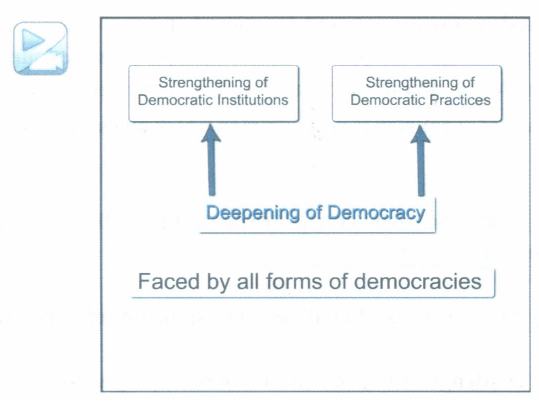
The challenge of deepening of democracy is faced by every democracy in one way or the other. This challenge ensures:
(a) strengthening of democratic institutions and principles.
(b) to check the influence of the wealthy and powerful people in the democratic decisions.
(c) empowering the general section of people through democratic institutions
2.
The challenge of deepening of democracy is faced by every democracy in one way or the other. This challenge ensures:
(a) strengthening of democratic institutions and principles.
(b) to check the influence of the wealthy and powerful people in the democratic decisions.
(c) empowering the general section of people through democratic institutions
3.
The challenge of expansion is very common challenge faced by an established democracy.
(a) The challenge of expansion involves applying the basic principles of democracy across all the regions, different social groups and various institutions.
(b) It involves ensuring greater power to local governments, extension of federal principle to all the units of the federation and inclusion of women and minority groups.
(c) It also implies that less and less decisions should remain outside the arena of democratic control. Most countries including India and other democracies, like the United States, face this challenge.
4.
The challenge of expansion is very common challenge faced by an established democracy.
(a) The challenge of expansion involves applying the basic principles of democracy across all the regions, different social groups and various institutions.
(b) It involves ensuring greater power to local governments, extension of federal principle to all the units of the federation and inclusion of women and minority groups.
(c) It also implies that less and less decisions should remain outside the arena of democratic control. Most countries including India and other democracies, like the United States, face this challenge.
5.
The foundational challenge of democracy consists of making the transition to democracy and then instituting a democratic government.
This challenge involves three main areas of change.
(a) It brings down the existing non-democratic regime.
(b) It keeps the military away from controlling governement .
(c) It establishes a sovereign and functional state.
The example of struggle for democracy in Nepal justifies the foundational challenge People demanded abolition of monarchy and establishment of democratic institutions.
6.
| Democracy | Dictatorship |
| (i) Based on the idea of deliberation and negotiation. Thus the necessary delay in implementation. | (i) Do not have to bother about majorities and/or public opinion, thus can be quicj and efficient in decision-making. |
| (ii) Decisions are acceptable to people and are more effective. | (ii) May take decisions not accepted by the people. |
| (iii) A citizen has the right and the means to examine the process of decision making. There is transparency. | (iii) Transparency is missing from a non-democratic form of government. There is no accountability of the government to the people. |
| (iv) Democratic government is legitimate government, people's own government. | (iv) In a dictatorship there is rule of monarch or military or religious leader. There is no participation by the people. |
7.
The challenge of deepening of Democracy is applied to every Democracy in one or the other way.
This challenge ensures
(i) Strengthening of democratic institutions and democratic principles.
(ii) It also ensures, to check the influence of the wealthy and powerful people in the democratic decisions.
(iii) The challenge deepening thus, tries to empower the general section of people through democratic institutions.
8.
Any legal change must carefully look at what result it will have on politics. Sometimes, the results may be counter-productive. Generally, laws that seek to ban something are not very successful in politics. The best laws are those which empower people to carry out democratic reforms.
9.
(i) Countries which are not yet democratic face a foundational challenge - making a transition to democracy and establishing democratic governments.
(ii) Many countries face the challenge of expansion. This means applying principles of democracy to all the state, local and regional levels. It means including all social and economic groups including women empowerment.
(iii) All the democracies face the challenge of deepening of democracy. They have to improve and strengthen all institutions of democracy and curb all anti-democratic activities.
10.
Transition to democratic institutions from non-democratic regimes, separation of military from governing authority, establishing a sovereign and a functional state can be some of the foundational challenges in democracies.
The values that may help overcome them are:
(i) honesty
(ii) equality
(iii) freedom
11.
In the modern society, Democracy is not limited to its very common definition but its area or scope has been widened under the influence of global concepts and some socio-economic changes.
(i) Democratic rights are not limited to the right to vote, to stand in elections and firm political organisation. A Democracy should grant same social and economic rights to its citizens.
(ii) The very spirit of power sharing in Democracy is extended to the "power sharing between governments and the social groups".
(iii) Modern Democracy cannot value only the voice of majority but it respects the voice of minority as well.
(iv) Now, the Democracy has extended its scope from government and its activities to eliminating discrimination based on caste, religion and gender.
12.
The challenge of expansion is mostly faced by the 'Established Democracy'. This challenge signifies:
(a) Extension of democratic power to local governments.
(b) Expansion of federal principles to the federal units.
(c) Political empowerment to women and the minorities.
13.
| Doctors' absenteeism Challenge | Political funding Challenge |
| The Uttar Pradesh government got a survey done and found most of the doctors posted in the rural primary health centers are simply not there. They live in a town, carry out private practice and visit the village where they are posted only once or twice in the entire month. Villagers have to travel to towns and pay a very high fee to private doctors even for the most common ailments. | On an average, every candidate who contested the last Lok Sabha elections owned property of more than one crore. There is a fear that only wealthy people or those with their support can afford to fight elections. Most of the political parties depend on money given by big business houses. The worry is that the role of money in politics will reduce whatever little voice the poor have in our democracy. |
| Reform Proposals: | Reform proposals: |
| The government should make it compulsory for the doctors to live in the village, where they are posted, otherwise their service should be terminated. | The financial accounts of every political party should be made public. These accounts should be examined by government auditors District administration and police should carry out surprise raids to check the attendance of the doctors. |
| There should be state funding of elections Parties should be given some money by the government to meet their election expenditure. | |
| Village panchayat should be given the power to write the annual report of the doctor, which should be read out in the Gram Sabha meeting. | Citizens should be encouraged to give more donations to parties and political workers. Such donations should be exempt from income tax. |
| Problems like this can be solved only if Uttar Pradesh is split into several smaller states which can be administered more efficiently. |

10th Standard CBSE Syllabus & Materials
10th Standard CBSE
CBSE 10th Social Science PS - Federalism - New Model Questions Papers Study Material - QB365 Set A
NEW10th Standard CBSE
CBSE 10th Social Science PS - Power Sharing - New Model Questions Papers Study Material - QB365 Set A
NEW10th Standard CBSE
CBSE 10th Social Science GEO - Manufacturing Industries - New Model Questions Papers Study Material - QB365 Set A
NEW10th Standard CBSE
CBSE 10th Social Science GEO - Minerals and Energy Resources - New Model Questions Papers Study Material - QB365 Set A



CBSE 10th Standard CBSE Subjects
CBSE Standards





