
 100% FREE ACCESS
10th Standard CBSE Syllabus & Materials
10th Standard CBSE
CBSE 10th Social Science ECO - Globalisation and the Indian Economy - New Model Questions Papers Study Material - QB365 Set A
NEW10th Standard CBSE
CBSE 10th Social Science ECO - Money and Credit - New Model Questions Papers Study Material - QB365 Set A
NEW10th Standard CBSE
CBSE 10th Social Science ECO - Sectors of the Indian Economy - New Model Questions Papers Study Material - QB365 Set A
NEW10th Standard CBSE
CBSE 10th Social Science ECO - Development - New Model Questions Papers Study Material - QB365 Set A
NEW10th Standard CBSE
CBSE 10th Social Science PS - Outcomes of Democracy - New Model Questions Papers Study Material - QB365 Set A
NEW10th Standard CBSE
CBSE 10th Social Science PS - Gender, Religion and Caste - New Model Questions Papers Study Material - QB365 Set A

Published on: 28/09/2019
Federalism
Download CBSE Class 10th Standard CBSE Social Science question papers, sample papers, important questions, and previous year solved papers in PDF format. Get free study materials, NCERT solutions, and exam preparation resources for Class 10th Standard CBSE Social Science
Questions + Answers key
Take MCQ Social Science Test
1.
Under what circumstances a coalition government was formed in India?
2.
Explain the language policy of India
3.
Mention the key feature of the federation.
4.
State any two differences between the local governments before and after the Constitutional Amendment in 1992.
5.
What are the difficulties faced by local government bodies?
6.
Examine the following pairs that give the level of government in India and the powers of the government at that level to make laws on the subjects mentioned against each. Which of the following pairs is not correctly matched?
| (a) | State government | State List |
| (b) | Central government | Union List |
| (c) | Central and State governments | Concurrent List |
| (d) | Local governments | Residuary powers |
7.
A few subjects in various Lists of the Indian constitution are given here. Group them under the Union, State and Concurrent Lists as provided in the table below.
A. Defence
B. Police
C. Agriculture
D. Education
E. Banking
F. Forests
G. Communications
H. Trade
(i) Marriages
| Union list | Defence, Banking, Communications |
| State list | Police, Agriculture |
| Concurrent list |
8.
The distinguishing feature of a federal government is:
(a)National government gives some powers to the provincial governments.
(b)Power is distributed among the legislature, executive, and judiciary.
(c)Elected officials exercise supreme power in the government
(d)Governmental power is divided between different levels of government
9.
Here are three reactions to the language policy followed in India.
Give an argument and an example to support any of these positions.
Sangeeta: The policy of accommodation has strengthened national unity.
Arman: Language-based States have divided us by making everyone conscious of their language.
Harish:This policy has only helped to consolidate the dominance of English over all other languages.
10.
State any two different between the local government before and after the constitutional amendment in 1992.
11.
What is the main difference between a federal form of government and a unitary one? Explain with an example.
12.
Point out one feature in the practice of federalism in India that is similar to and one feature that is different from that of Belgium.
13.
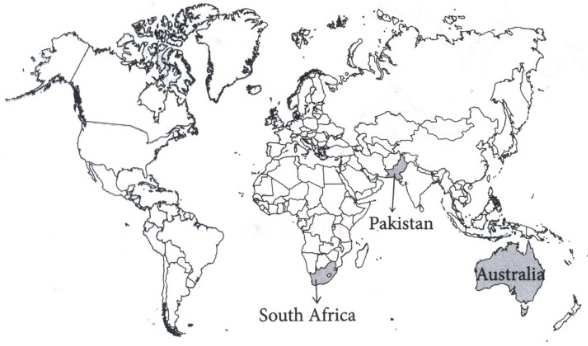
Identify ans Shade three federal countries (Other than India) on a blank outline political map of the world.
14.
Since the United States is a ___________________ type of federation, all the constituent States have equal powers and States are ______________vis-a-vis the federal government. But India is a _____________________ type of federation and some States have more power than others. In India, the ____________ government has more powers.
1.
(i) After 1990. there of coalition governments started at the centre.
(ii) Since no single party got a clear majority in the Lok Sabha, the major national parties had to enter into an alliance with many parties including several regional parties had to form a government at the centre.
(iii) This led to a new culture of power sharing and respect for the autonomy of state Governments.
(iv) This trend was supported by a major judgement of the Supreme Court
(v) In a coalition government the partners form a political alliance and adopt a common programme.
2.
(i) Our constitution did not give the status of national language to any one language.
(ii) Hindi was identified as the official language
(iii) But Hindi is the mother tongue of only about 40 percent Indians. Therefore there was many safeguards to protect other languages.
(iv) Besides Hindi, there are 21 languages recognised as scheduled languages by the constitution.
(v) States to have their own official languages
(vi) Much of the government work takes place in the official language of the concerned state.
(vii) Our country adopted a very cautious attitude in spreading the use of Hindi.
(viii) Use of the English language along with Hindi continues for official purpose.
(ix) Promotion of Hindi continues to be the official policy of the Government of India.
(x) The promotion does not force Hindi language on states where people speak a different language.
(xi) The flexibility shown by Indian political leaders helped our country avoid the kind of situation that Sri Lanka finds itself in.
3.
(i) There are two or more levels of government
(ii) Different tiers of government govern the same citizens, but each tier has its own jurisdiction in specific matters of legislation, taxation and administration.
(iii) The jurisdictions of the respective levels or tiers of government are specified in the constitution. So the existence and authority of each tier of government is constitutionally guaranteed.
(iv) The fundamental provisions of the constitution cannot be unilaterally changed by one level of government. Such changes require the consent of both the levels of government.
(v) Courts have the power to interpret the constitution and the powers of different levels of government.
(vi) Sources of revenue for each level of government are clearly specified to ensure its financial autonomy.
(vii) The federal system thus has dual objectives to safeguard and promote unity of the country, while at the same time accommodate regional diversity.
4.
The differences between the Local governments before and after the Constitutional Amendment in 1992 are
| Local Government before 1992 | Local Government after 1992 |
| Local governments were directly under the control of the State Government. | Local governments have got some powers of their own. |
| Elections were controlled by the State Governments. | An independent State Election Commission (SEC) is responsible to conduct the elections. |
5.
While elections are held regularly and enthusiastically, 'gram sabhas' are not held regularly. Most state governments have not transferred significant powers to the local governments. Nor have they given adequate resources. We are thus still a long way from realising the ideal of self-government.
6.
(d) Local Government - Residuary Powers
7.
| Union List | Defence, Banking, Communications |
| State List | Police, Agriculture, Trade |
| Concurrent List | Forests, Education, Marriages |
8.
Governmental power is divided between different levels of government
9.
The position held by Sangeeta is the correct one. In reality, the policy of accommodation has strengthened national unity.
An example is the case of the English language. According to the Constitution, the use of English for official purposes was to stop in 1965. But many non-Hindi speaking states demanded that the use of English should continue.
The Central Government agreed to continue the use of English along with Hindi for official purposes.
10.
The differences between the Local governments before and after the Constitutional Amendment in 1992 are
| S.No | Local goverments before 1992 | Local governments after 1992 |
|---|---|---|
| 1. | Local governments did not have any powers or resources of their own. |
The State governments are required to share some powers and revenue with local government bodies. |
| 2. | Elections were not held regularly. | It is mandatory to hold regular elections to local government bodies. |
11.
The main difference between a federal form of government and a unitary are
(i) In the federal form of government like in India, the powers are divided between the Central Government and State Governments. Both levels have their areas of jurisdiction. On the other hand, in a unitary form of government, the National Government has all the powers. Any constitutional power given to the states or regions of the country is dependent on the National Government, which can be withdrawn at any time. Sri Lanka is one such example.
(ii) In a federal system, a State Government has powers of its own for which it is not answerable to the Central Government. On the other hand, in a unitary system, the State Government does not have power of its own.
12.
One similar feature of federalism between India and Belgium is that both are holding together federations, where the Central Government tends to be more powerful vis-a-vis the states or regions. One different feature of federalism between India and Belgium is that in Belgium, there are three kinds of government
(i) Government at the Centre
(ii) Government at the State level
(iii) The Community Government
The Community Government has powers regarding cultural, educational and language related issues. But in India, the third kind of government is not a Community Government. It is the local self-government (Municipalities or Panchayats).
13.
Three federal countries other than India are:
(1) South Africa (2) Australia (3) Pakistan
14.
(i) coming together
(ii) stronger
(iii) holding together
(iv) Central

10th Standard CBSE Syllabus & Materials
10th Standard CBSE
CBSE 10th Social Science PS - Federalism - New Model Questions Papers Study Material - QB365 Set A
NEW10th Standard CBSE
CBSE 10th Social Science PS - Power Sharing - New Model Questions Papers Study Material - QB365 Set A
NEW10th Standard CBSE
CBSE 10th Social Science GEO - Manufacturing Industries - New Model Questions Papers Study Material - QB365 Set A
NEW10th Standard CBSE
CBSE 10th Social Science GEO - Minerals and Energy Resources - New Model Questions Papers Study Material - QB365 Set A



CBSE 10th Standard CBSE Subjects
CBSE Standards





