
 100% FREE ACCESS
10th Standard CBSE Syllabus & Materials
10th Standard CBSE
CBSE 10th Social Science ECO - Globalisation and the Indian Economy - New Model Questions Papers Study Material - QB365 Set A
NEW10th Standard CBSE
CBSE 10th Social Science ECO - Money and Credit - New Model Questions Papers Study Material - QB365 Set A
NEW10th Standard CBSE
CBSE 10th Social Science ECO - Sectors of the Indian Economy - New Model Questions Papers Study Material - QB365 Set A
NEW10th Standard CBSE
CBSE 10th Social Science ECO - Development - New Model Questions Papers Study Material - QB365 Set A
NEW10th Standard CBSE
CBSE 10th Social Science PS - Outcomes of Democracy - New Model Questions Papers Study Material - QB365 Set A
NEW10th Standard CBSE
CBSE 10th Social Science PS - Gender, Religion and Caste - New Model Questions Papers Study Material - QB365 Set A

Published on: 27/09/2019
Money and Credit
Download CBSE Class 10th Standard CBSE Social Science question papers, sample papers, important questions, and previous year solved papers in PDF format. Get free study materials, NCERT solutions, and exam preparation resources for Class 10th Standard CBSE Social Science
Questions + Answers key
Take MCQ Social Science Test
1.
How are deposits with the banks beneficial for an individual as well as for nation? Explain with examples.
2.
Deposits with the banks are beneficial to the depositors as well as to the nation'. Examine the statement.
3.
Prove with an argument that there is a great need to expand formal source of credit in rural India.
4.
How many serves as legal tender money?
5.
Mention any four functions of money.
6.
What is the idea behind the SHG's for the poor? Explain in your words
7.
Explain with example, how credit plays a vital and positive role for development?
8.
Analyze the role of credit for development.
9.
Why should credit at reasonable rates be available for all?
10.
What are the two categories of source of credit? Mention any features of each.
11.
Given that a large number of people in our country are poor, does it in any way affect their capacity to borrow?
12.
Why do lenders ask for collateral while lending?
13.
Can you think of some example of good services being exchanged or wages being paid through barter?
14.
Consider the following information
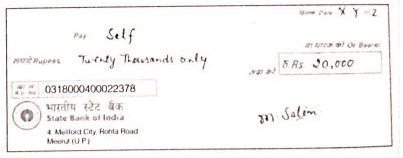
A shoe manufacturer, M. Salim has to make a payment to the leather supplier and writes a cheque for a specific amount. This means that the shoe manufacturer instructs his bank to pay this amount to the leather supplier. The leather supplier takes this cheque and deposits it in his own account in the bank. The money is trans- ferred from one bank account to another bank account in a couple of days. The transaction is complete without any payment of cash.
Now answer the following questions
Mr.Salim wants to withdraw Rs 20,000 in cash for making payments. How would he write a cheque to withdraw money?
1.
Benefit of depositors:
(i) Bank accepts the deposits and pays interest to the depositor.
(ii) Bank help people save their money and keep their money in safe custody of the bank.
(iii) People can withdraw the money as and when they require.
(iv) Banks also grant loans to people for a variety of purposes.
Benefit of deposits to the Nation:
(i) Banks us the major proportion of the deposit to extend loans.
(ii) There is a huge demand for loans for various economic activities. In times of need, business houses and industries can borrow money from the banks.
(iii) Banks mediate between those who have surplus and those who are in need of these funds. Thus, it helps ion the economic development of the Nation.
2.
Benefit of depositors:
(i) Bank accepts the deposits and pays interest to the depositor.
(ii) Bank help people save their money and keep their money in safe custody of the bank.
(iii) People can withdraw the money as and when they require.
(iv) Banks also grant loans to people for a variety of purposes.
Benefit of deposits to the Nation:
(i) Banks us the major proportion of the deposit to extend loans.
(ii) There is a huge demand for loans for various economic activities. In times of need, business houses and industries can borrow money from the banks.
(iii) Banks mediate between those who have surplus and those who are in need of these funds. Thus, it helps ion the economic development of the Nation.
3.
There is great need to expand formal sources of credit in rural India because:
(i) There is no organisation that supervises the credit activities of lenders in the informal sector. They lend at whatever interest rate they choose.
(ii) No one can stop rural money-lenders from using unfair means to get their money back.
4.
Currency (coins and notes) is legal tender money which cannot be refused in payment for transactions. Everybody is bound to accept it in exchange for goods and services and in discharge of debts. None can refuse to accept it because non-acceptance is an offence. It is issued by the government or duly authorised Central Bank.
5.
(a) Medium of Exchange (b) Measure of Value
(c) Standards of demand payments (d) Store of Value.
6.
The basic behind the SHGs is to provide a financial resource for the poor through organizing the rural poor especially women, into small Self Help Groups. They also provide timely loans at a responsible interest rate without collateral. Objectives of the SHGs:
(a) To organize rural poor especially women into small Self Help Groups.
(b) To collect savings of their members.
(c) To provide loans without collateral.
(d) To provide timely loans for a variety of purposes.
(e) To provide loans at responsible rate of interest and easy terms.
(f) Provide platform to discuss and act on a variety of social issues such education, health, nutrition, domestic violence etc.
7.
Cheap and affordable credit plays a crucial role for the country's development. There is a huge demand for loans for various economic activities. The credit helps people to meet the ongoing expenses of production and thereby develop their business. Many people could then borrow for a variety of different needs. They could grow crops, do business, set up industries etc. In this way credit plays a vital role in the development of a country.
8.
Development is sustained by a proper credit policy. By giving loans in agriculture, industry and trade, banks provide the necessary funds needed for carrying on the business.
This results in increased production and services, more employment and profits.
For cultivators, credit is needed for the betterment of agricultural practices. If farmers and poor people get credit at cheaper rates then they will be able to generate self employment for themselves and lead their life in a better way. When everyone leads a good life then development takes place.
9.
Credit at reasonable rates should be available for all so that the poor people can benefit from the cheaper loan rates.
10.
The various differences between formal and informal sources of credit are shown in the following table:
Formal Sources of Credit
1. They cover those sources of credit which are registered by the Government and have to follow its rules and regulations e.g. Banks, Cooperatives.
2. The RBI supervises the functioning of formal sources of credit.
3. Apart from profit-making, they have also an objective of social welfare.
4. The rate of interest charged by formal sources is always much lower than that of informal sources.
5. The terms of credit are also fair and reasonable.
Informal Sources of Credit
1. They include those small and scattered units which are outside the control of the Government e.g. individual moneylenders, traders, employers, etc.
2. There is no organizational supervision or adherence to rules and regulations in the credit extending activities in this sector.
3. Their only motive is to extract profit as much as possible.
4. They charge random and much higher interests in comparison to formal sectors.
5. They impose very tough and sometimes even, unreasonable terms of credit on the borrower.
11.
Large number of poor people in a country does not effect their capacity to borrow. Poor have low capacity to borrow since they have no collateral to offer. They cannot get any credit from formal sources of credit like banks and cooperatives. They mostly take loans from informal sources of credit like moneylenders, friends, relatives, etc.
12.
Lenders ask for collateral while lending because if payment of interest and repayment of the principal are not made on time, the lenders can sell the collateral assest and recover their money.
13.
Yes, in rural areas generally crops and food-grains are directly exchanged without the use of money. Similarly, agricultural labourers are normally paid not in cash but ion kind, e.g., 5kg wheat or rice per day.
14.

10th Standard CBSE Syllabus & Materials
10th Standard CBSE
CBSE 10th Social Science PS - Federalism - New Model Questions Papers Study Material - QB365 Set A
NEW10th Standard CBSE
CBSE 10th Social Science PS - Power Sharing - New Model Questions Papers Study Material - QB365 Set A
NEW10th Standard CBSE
CBSE 10th Social Science GEO - Manufacturing Industries - New Model Questions Papers Study Material - QB365 Set A
NEW10th Standard CBSE
CBSE 10th Social Science GEO - Minerals and Energy Resources - New Model Questions Papers Study Material - QB365 Set A



CBSE 10th Standard CBSE Subjects
CBSE Standards





