
 100% FREE ACCESS
10th Standard CBSE Syllabus & Materials
10th Standard CBSE
CBSE 10th Social Science ECO - Globalisation and the Indian Economy - New Model Questions Papers Study Material - QB365 Set A
NEW10th Standard CBSE
CBSE 10th Social Science ECO - Money and Credit - New Model Questions Papers Study Material - QB365 Set A
NEW10th Standard CBSE
CBSE 10th Social Science ECO - Sectors of the Indian Economy - New Model Questions Papers Study Material - QB365 Set A
NEW10th Standard CBSE
CBSE 10th Social Science ECO - Development - New Model Questions Papers Study Material - QB365 Set A
NEW10th Standard CBSE
CBSE 10th Social Science PS - Outcomes of Democracy - New Model Questions Papers Study Material - QB365 Set A
NEW10th Standard CBSE
CBSE 10th Social Science PS - Gender, Religion and Caste - New Model Questions Papers Study Material - QB365 Set A

Published on: 14/02/2020
10th Standard CBSE Social Science Public Question Model Question Paper I 2019-2020
Download CBSE Class 10th Standard CBSE Social Science question papers, sample papers, important questions, and previous year solved papers in PDF format. Get free study materials, NCERT solutions, and exam preparation resources for Class 10th Standard CBSE Social Science
Questions + Answers key
Take MCQ Social Science Test
1.
Which alliance was set up by the Nepalese people to restore democracy in Nepal?
2.
What are SHGs?
3.
Who is a producer?
4.
Which two sections of society get special emphasis in Indian Constitution regarding equal status and equal opportunities?
5.
Mention two benefits that local companies get when they set up production units in association with the MNCs.
6.
Which factors influence the location of an industry?
7.
Name the ports which drew during the colonial period.
8.
What factors do contribute to an increase in the production of maize?
9.
What is Bye-election?
10.
What is the role of border roads and national highways in transportation?
11.
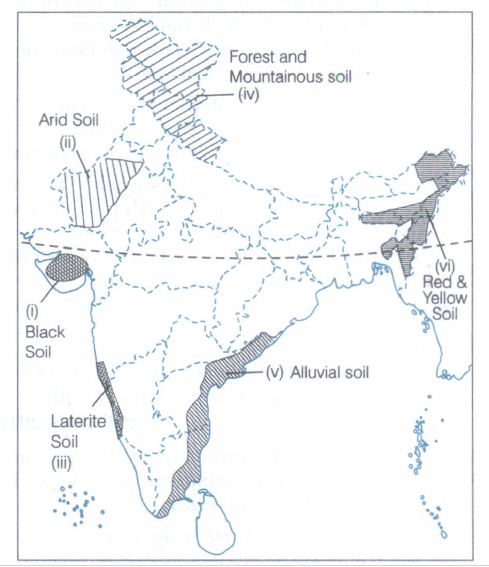
On the physical outline map of India given below, identify any four soil types of India.
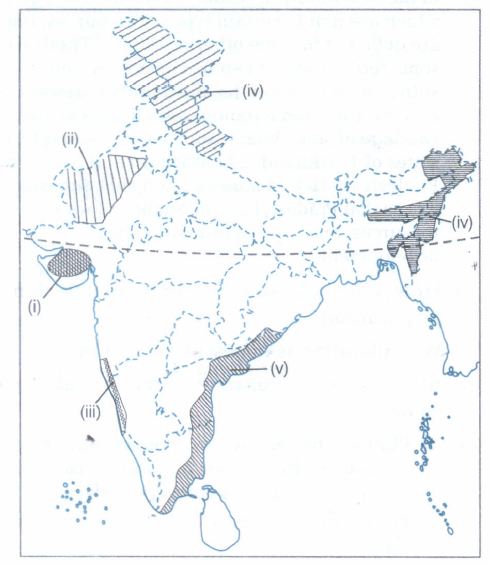
12.
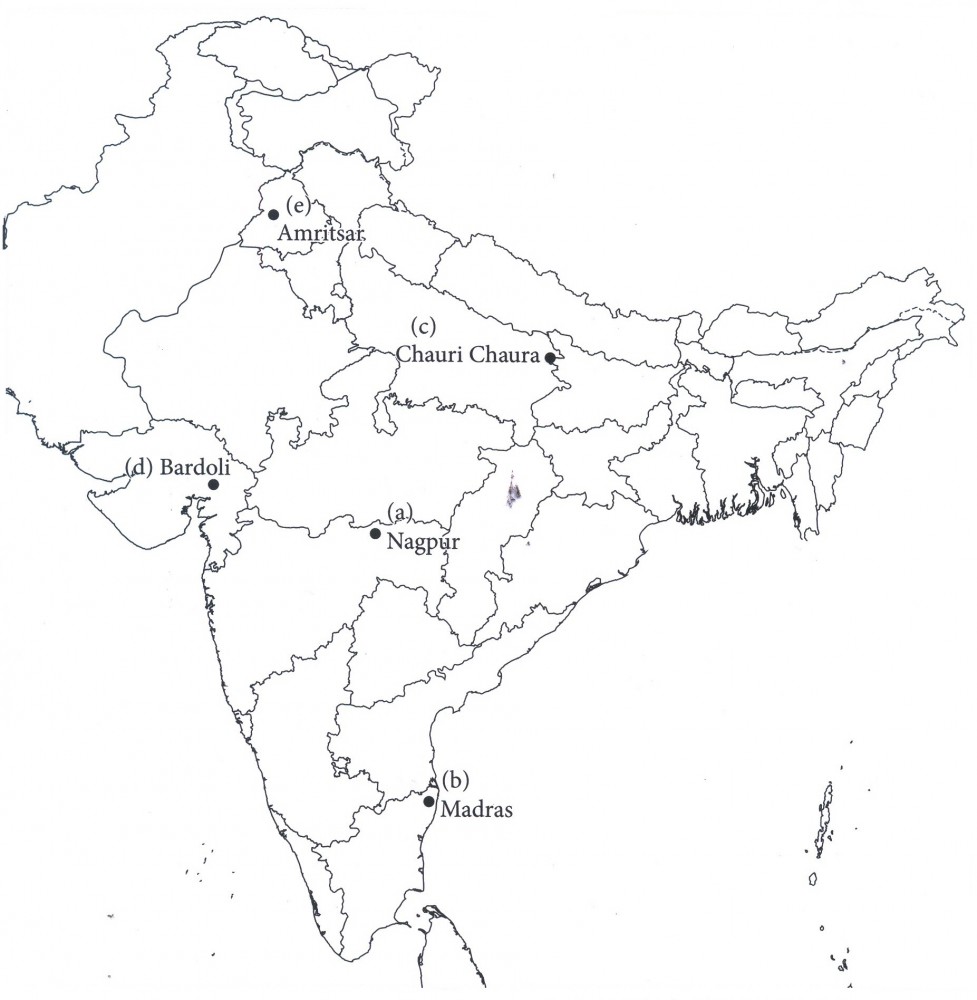
Five features with serial nos. (i) to (v) are marked in the given outline political map of India. Identify these features with the help of the following information and write their correct names on the lines marked in the map:
(a) A place where Indian National Congress Session was held in Dec. 1920.
(b) A place where Indian National Congress Session was held in 1927.
(c) A place where violence occurred due to which Mahatma Gandhi suddenly called off the Non-cooperation Movement.
(d) A place of peasants' Satyagraha in Gujarat.
(e) A place associated with Jallianwalla Bagh massacre.
13.
Explain the challenge of expansion of democracy by stating three points.
14.
Distinguish between endangered and extinct species.
15.
"India is highly dependent on coal for meeting its commercial energy requirement". Support the statement with three arguments.
16.
Why did the woodblock method become popular in Europe?
17.
"For a long time the publishing market excluded the poor." Give reasons for such an exclusion.
18.
Write True or False against each statement:
a) At the end of the nineteenth century, 80 per cent of the total workforce in Europe was employed in the technologically advanced industrial sector.
b) The international market for fine textiles was dominated by India till the eighteenth century.
c) The American Civil War resulted in the reduction of cotton exports from India.
d) The introduction of the fly shuttle enabled handloom workers to improve their productivity.
19.
'Pressure groups and movement exert influence on politics in different ways. Support the statement with examples.
20.
"Legal constitutional changes by themselves cannot overcome challenges to Democracy". Explain with examples.
21.
Discuss the reasons for the emergence of nationalist tensions in the Balkans.
22.
"Constant complaints by people can be seen as a testimony to the success of an democracy." Explain.
23.
Write a short note on effect of the Great Depression the US economy.
24.
Give for reasons for the rising importance of tertiary sector in India.
25.
Explain any three methods of traditional rainwater harvesting techniques in India.
26.
How did print culture develop in Europe? Explain.
27.
What was the most visible form of French control in Vietnam?
28.
Since the United States is a ___________________ type of federation, all the constituent States have equal powers and States are ______________vis-a-vis the federal government. But India is a _____________________ type of federation and some States have more power than others. In India, the ____________ government has more powers.
1.
()
Seven party alliance[SPA]
2.
They are Self-Help Groups formed by the poor rural women.
3.
A producer is a person or group of person who produce either goods or services or both by creating utility.
4.
Two sections of society getting special emphasis in Indian Constitution regarding equal status and equal opportunities are women, and disadvantaged and discriminated castes and tribes.
5.
The benefits that local companies can get are:
(a) MNCs can provide money for additional investment like buying latest and new machines for faster production
(b) MNCs might bring the latest technology of production with them.
6.
Cost, government policies and specialized labour influence the location of industry.
7.
Bombay and Calcutta.
8.
Use of modern inputs such as HYV seeds, fertilisers and irrigation have contributed to an increase in the production of maize.
9.
Elections held to fill a vacancy caused by the death or any other house.
10.
Border roads play in important role in connecting strategically important difficult areas and helps in the economic development of the area. National Highways are the primary road system which links extreme parts of the country.
11.
(I) Black soil (ii) Arid soil
(iii) Laterite soil (iv) Forest and Mountainous soil
(v) Alluvial soil (vi) Red and Yellow soil
12.
13.
The challenge of expansion is very common challenge faced by an established democracy.
(a) The challenge of expansion involves applying the basic principles of democracy across all the regions, different social groups and various institutions.
(b) It involves ensuring greater power to local governments, extension of federal principle to all the units of the federation and inclusion of women and minority groups.
(c) It also implies that less and less decisions should remain outside the arena of democratic control. Most countries including India and other democracies, like the United States, face this challenge.
14.
| Endangered species | Extinct species |
| These are species which are facing danger of extinction |
These are species which are not found after searches of known or likely areas where they may occur |
| The survival of such species is difficult if the negative factors that have led to a decline in their population continue to operate |
They are already missing and their survival is suspicious |
| Example of these species are black buck, wild ass, Indian rhino, crocodile, lion-tailed macaque and so on. |
Examples of these species are Asiatic cheetah, pink-headed duck and so on |
15.
coal found in India is not of good quality, but still it is essential is meeting the commercial energy requirements, in the following ways.
(a) Coal provides a substantial part of the nation's energy needs
(b) It is used for power generation
(c) It supplies energy to industries as well as for domestic needs
16.
(i) The production of handwritten manuscripts could not meet the ever-increasing demand for books.
(ii) Copying was an expensive, laborious and time-consuming business.
(iii) The manuscripts were fragile, awkward to handle and could not be carried around or read easily. By the early fifteenth century, woodblocks started being widely used in Europe to print textiles, playing cards and religious pictures with simple, brief texts.
17.
(i) Introduction of libraries : But soon, people had easier access to books with the introduction of circulating libraries in 1740.
(ii) Cheap novels: Technological improvements in printing brought down the price of books and innovations in marketing led to expanded sales.
(iii) Hiring out novels : In France, publishers found that they could make super profits by hiring out novels by the hour. The novel was one of the first mass-produced items to be sold.
18.
(a) False
(b) True
(c) False
(d) True
19.
Pressure groups and movements exert influence on politics in a variety of ways.
(i) They try to gain public support and sympathy for their cause by carrying out information campaigns, organising meetings, filing petitions, etc.
(ii) By organising strikes and disruptions, they seek to make the government take note of their demands
(iii) They also influence decision-making by lobbying.
(iv) The issues raised by them often influence the policies of political parties.
(v) Formation of new political parties.
20.
Legal reform is the best way of reforming politics by making new laws to ban undesirable things. But legal constitutional changes cannot always challenges to democracy. Legal changes have sometimes a counterproductive result. For example, some state has banned people having more than two children from contesting panchayat elections. But, other says that the law is the denial of democratic opportunity to many poor women from contesting elections. In another way it discourages political participation. Thus those laws are best which empower people to carry out democratic reforms.
21.
The Balkan region during 1871 comprised modern-day states like Romania, Bulgaria, Albania, Greece, Macedonia, Croatia, Bosnia-Herzegovina, Slovenia, Serbia and Montenegro. Its inhabitants were known as Slavs.
(a) This region had various ethnic and geographical diversities and was under the Ottoman Empire for a long period. As the ideas of romantic nationalism spread in this region, it resulted in breaking up of the Ottoman Empire which made the situation even more serious.
(b) The Ottoman Empire could not do much to integrate these regions. As a result, most of the European subject nationalities broke away from the Ottoman Empire's control and declared their independence.
(c) The Balkan people based their claim to be independent on the basis of nationality. They referred to the examples from history as a proof that they were once independent and were subjugated by foreign powers. Therefore, they thought of their struggles as attempts to win back their long-lost independence.
(d) Because of this development, various other Slavic nationalities also struggled to define their identity and independence which made the Balkan a region of severe conflicts. At the same time they were jealous, of each other and wanted to gain more territory at the expense of the others.
(e) European powers like Russia, Germany, England, Austro-Hungary too fought with each other to control more colonies and establish their naval and military might. They were also keen to grab more of the Balkan region for expanding their trade. This made the situation more serious which ended up with the waging of the First World War.
22.
Complaints are treated as testimony to the success of democracy in the following ways.
(a) Complaints highlight the awareness of the people and their expectations from the system that has been put in place.
(b) It reflects that citizens are not overawed by those in power and can objectively and critically examine the difference they have made.
(c) It is a measure of their participation in public debates which democracy seeks to encourage.
(d) A public expression of dissatisfaction with democracy shows the success of the democratic project.
(e) It shows that people have transformed themselves from being subjects to being citizens.
23.
(i) With the fall in prices and the prospect of a depression, the banks also called domestic lending and called back loans.
(ii) Farms were unable to sell their harvests.
(iii) Faced with falling income, many households in the US could not repay what they had borrowed and were forced to give up their homes. cars and other consumer durables.
(iv) Industrial production registered a fail of about 35 per cent.
(v) The number of the unemployed started rising, and in 1933 it touched 17 million. As unemployment soared, people trudged long distances looking for any work they could find. Ultimately, the US banking system itself collapsed.
24.
(a) In any country several services such as hospitals, educational institutions, post and telegraph services, police stations, courts, village administrative offices , municipal corporations , defence, transport, banks, insurance companies, etc. are required. These can be considered as basic services. In a developing country the government has to take responsibility for the provision of these services.
(b) The development of agriculture and industry leads to the development of services such as transport, trade, storage and the like, as we have already seen. Greater the development of the primary and secondary sectors, more would be the demand for such services.
(c) As income levels rise, certain sections of people start demanding many more services like eating out, tourism, shopping, private hospitals, private schools, professional training etc. These changes can be seen in cities, especially in big cities.
(d) Over the past decade or so, certain new services such as those based on information and communication technology have become important and essential. The production of these services has been rising rapidly.
25.
(a) Roof-Top Rainwater Harvesting
(i) Here, the rainwater is collected in underground tanks connected to the rooftop through pipes.
(ii) Rain falling on rooftops travels down the pipes to the tanks and is stored for future usage.
(iii) It is also used for recharging hand pumps and tube wells.
(iv) 'Rooftop rain water harvesting' was commonly practised to store drinking water, particularly in Rajasthan.
(b) Bamboo Drip Irrigation System
(i) It was practised in Meghalaya.
(ii) It is a 200-year old system.
(iii) Here, the water from the streams is tapped using bamboo pipes and used for irrigating the roots of plants.
(iv) The long bamboo pipes are connected with each other to form a chain from the stream to the crops.
(v) The water flows through the pipes and drops directly at the site of the plant.
(c) Diversion Channels
(i) In hill and mountainous regions, people built diversion channels like the guls' or luls' of the Western Himalayas for agriculture. Diversion Channels.
(ii) In the flood plains of Bengal, people developed inundation channels to irrigate their fields.
(d) Rain fed Storage
(i) In arid and semi-arid regions, agricultural fields were converted into rain fed storage structures that allowed the water to stand and moisten the soil like the 'khadins' in Jaisalmer and `Johads' in other parts of Rajasthan.
26.
(i) Paper from China : Paper reached Europe from China through the Silk route in the 11th century. With this, the production of manuscripts written by scribes became a regular feature.
(ii) Role of travellers and explorers : Marco Polo, a great explorer reached Italy after several years of exploration in China in the year 1295. Marco Polo brought back with him the technology of woodblock printing. Now Italians started publishing books with woodblocks. The technology became popular in other parts of Europe, as well.
(iii) Woodblock printing : By the early fifteenth century, woodblocks started being widely used in Europe to print textiles, playing cards and religious pictures with simple, brief texts.
(iv) Johann Gutenberg and the printing press : A major revolution in the print technology was brought by Johann Gutenberg. He developed the first known printing press in the 1430's. The first book he printed was the Bible.
(v) Spread of printing presses : In the next hundred years i.e. between 1450 and 1550, printing presses were set up in most countries of Europe.
27.
()
The most visible form of French control in Vietnam was in the form of military and economic domination.
28.
(i) coming together
(ii) stronger
(iii) holding together
(iv) Central

10th Standard CBSE Syllabus & Materials
10th Standard CBSE
CBSE 10th Social Science PS - Federalism - New Model Questions Papers Study Material - QB365 Set A
NEW10th Standard CBSE
CBSE 10th Social Science PS - Power Sharing - New Model Questions Papers Study Material - QB365 Set A
NEW10th Standard CBSE
CBSE 10th Social Science GEO - Manufacturing Industries - New Model Questions Papers Study Material - QB365 Set A
NEW10th Standard CBSE
CBSE 10th Social Science GEO - Minerals and Energy Resources - New Model Questions Papers Study Material - QB365 Set A



CBSE 10th Standard CBSE Subjects
CBSE Standards





