
 100% FREE ACCESS
10th Standard CBSE Syllabus & Materials
10th Standard CBSE
CBSE 10th Social Science ECO - Globalisation and the Indian Economy - New Model Questions Papers Study Material - QB365 Set A
NEW10th Standard CBSE
CBSE 10th Social Science ECO - Money and Credit - New Model Questions Papers Study Material - QB365 Set A
NEW10th Standard CBSE
CBSE 10th Social Science ECO - Sectors of the Indian Economy - New Model Questions Papers Study Material - QB365 Set A
NEW10th Standard CBSE
CBSE 10th Social Science ECO - Development - New Model Questions Papers Study Material - QB365 Set A
NEW10th Standard CBSE
CBSE 10th Social Science PS - Outcomes of Democracy - New Model Questions Papers Study Material - QB365 Set A
NEW10th Standard CBSE
CBSE 10th Social Science PS - Gender, Religion and Caste - New Model Questions Papers Study Material - QB365 Set A

Published on: 14/02/2020
10th Standard CBSE Social Science Public Question Model Question Paper II 2019-2020
Download CBSE Class 10th Standard CBSE Social Science question papers, sample papers, important questions, and previous year solved papers in PDF format. Get free study materials, NCERT solutions, and exam preparation resources for Class 10th Standard CBSE Social Science
Questions + Answers key
Take MCQ Social Science Test
1.
Why and when did the movement start in Nepal?
2.
What objects were used as money in India, before the introduction of coins?
3.
I had booked a train ticket in one of the super-fast trains. The train was delayed for long hours without any reason. What can I do in this situation?
4.
Name a Noble Prize winning writer who is a descendant of indentured labour from India.
5.
Which techniques of cotton textile production came into use after the 18th century?
6.
Who discovered spinning jenny?
7.
How is higher productivity achieved in commerical farming?
8.
What is meant by value of trade?
9.
What is the idea behind democracy?
10.
Who maintain the district roads?
11.
What are the major challenges to democracy in India? Explain.
12.
What was the Second Movement of Democracy in Nepal?
13.
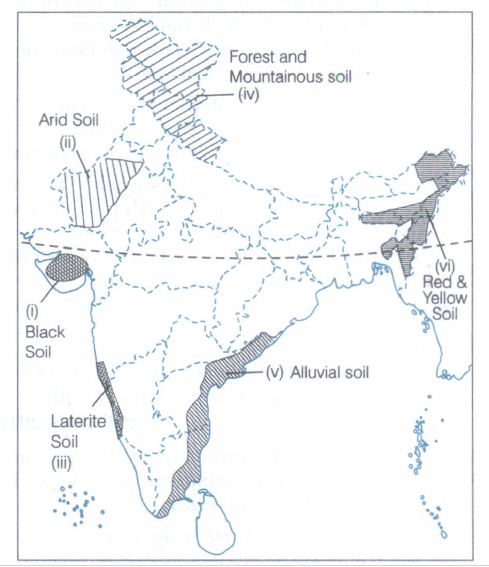
On the physical outline map of India given below, identify any four soil types of India.
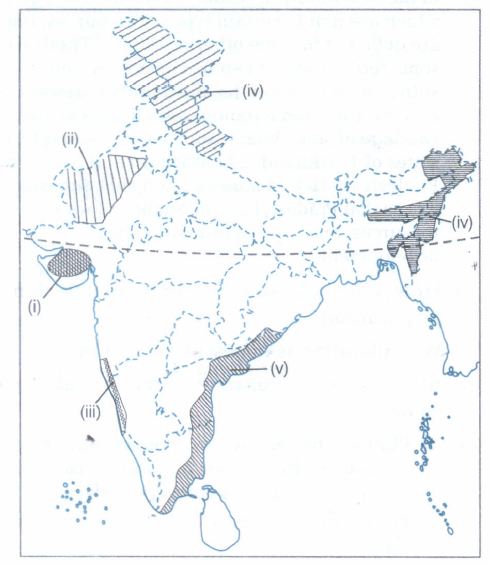
14.
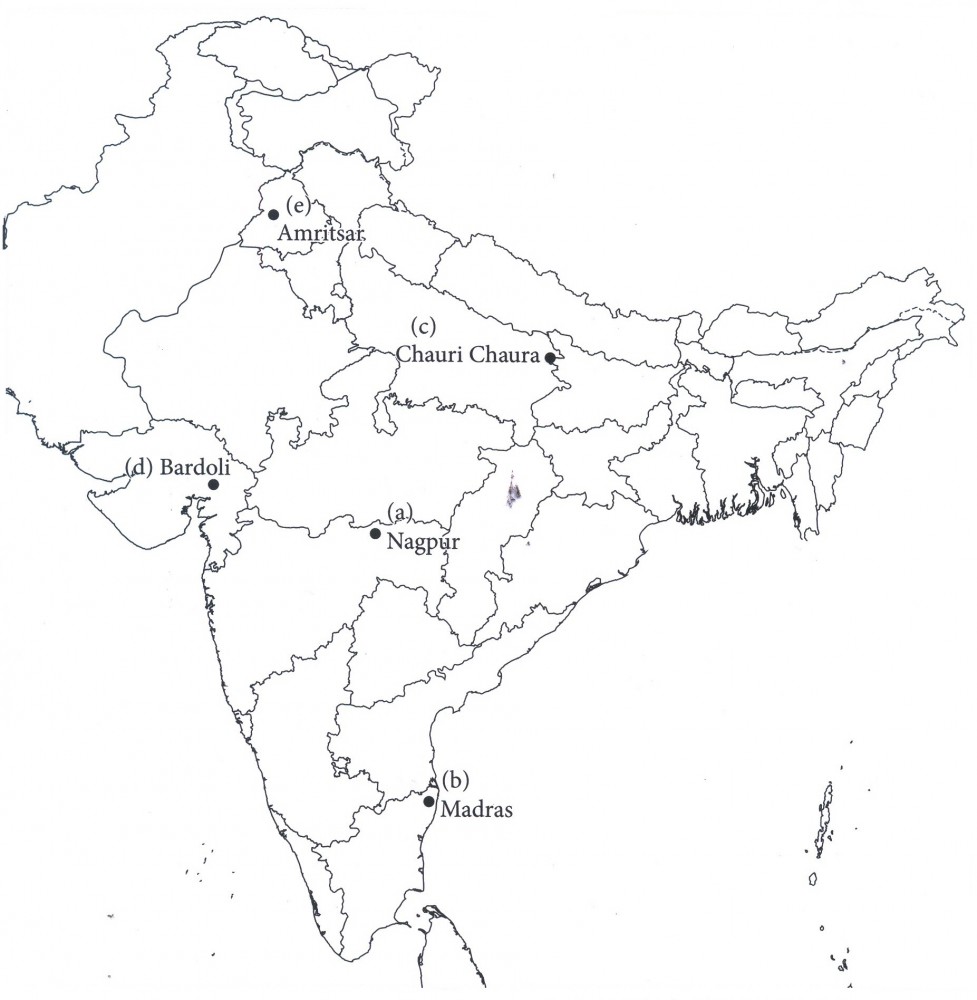
Five features with serial nos. (i) to (v) are marked in the given outline political map of India. Identify these features with the help of the following information and write their correct names on the lines marked in the map:
(a) A place where Indian National Congress Session was held in Dec. 1920.
(b) A place where Indian National Congress Session was held in 1927.
(c) A place where violence occurred due to which Mahatma Gandhi suddenly called off the Non-cooperation Movement.
(d) A place of peasants' Satyagraha in Gujarat.
(e) A place associated with Jallianwalla Bagh massacre.
15.
Explain with three suitable examples the meaning of 'right to be informed' as provided under Consumer Protection Act, 1986.
16.
What is biodiversity? Why is biodiversity important for human lives?
17.
Who produced a popular music book that had a picture on the cover announcing the 'Dawn of the century'?
18.
Explain the contribution of Devaki Nandan Khatri in Hindi novels.
19.
Write about your definition of good democracy in not more than fifty words. Also discuss some features of democracy.
20.
List out the merits and demerits of democracy.
21.
Explain the impact of the First World War on Britain's economy.
22.
How does tertiary sector help in the development of primary and secondary sectors? Explain with examples.
23.
Explain any three methods of traditional rainwater harvesting techniques in India.
24.
Explain the role of print in the religious reforms in India.
25.
Write short notes to show what you know about:
a) The Gutenberg Press
b) Erasmus’s idea of the printed book
c) The Vernacular Press Act
26.
What does Indo-China comprise of?
27.
Since the United States is a ___________________ type of federation, all the constituent States have equal powers and States are ______________vis-a-vis the federal government. But India is a _____________________ type of federation and some States have more power than others. In India, the ____________ government has more powers.
1.
()
King Gyanendra, in February 2005, dissolved the Parliament, dismissed the democratically elected government and seized power.This led to a movement in 2006, to take away the power from the king.
2.
Foodgrains and cattle were used as money before the introduction of coins in India.
3.
You can approach consumer court for deficiency in service and claim refund of super-fast charges as damage.
4.
VS Naipaul is a Nobel Prize winning writer who is a descendant of indentured labour from India.
5.
The power loom technique of cotton textile production came into use after the 18th century.
6.
James Hargreaves.
7.
In commercial farming, use of higher doses of modern inputs, like High Yielding Variety (HYV) seeds, chemical fertilisers, insecticide and pesticides practised to get higher productivity.
8.
It refers to the value of exports plus the value of imports during the year.
9.
Deliberation and negotiation
10.
These roads are maintained by the Zila Parishad.
11.
The following are the major challenges to democracy in India.
(a) Foundational Challenge: This challenge involves:
(i) making transition to democracy and then instituting democratic government.
(ii) bringing down the existing non-democratic regime.
(iii) keeping military away from controlling government.
(iv) establishing a sovereign and functional state.
(b) Challenge of expansion of democracy: This challenge signifies:
(i) extension of democratic power to local governments
(ii) expansion of federal principles to all the federal units
(iii) political empowerment to women and minorities.
(c) Challenge of deepening of democracy: This challenge ensures:
(i) strengthening of democratic institutions and democratic principles.
(ii) to check the influence of the wealthy and powerful people in democratic decisions.
(iii) empowering the general section of people through democratic institutions.
12.
(i) It was a movement started by all the major political parties in the parliament by r forming a Seven Party Alliance. It was aimed at regaining popular control over the government from the king and restoring democracy.
(ii) It started with a four-day strike in Kathmandu, the country's capital. This protest soon turned into an indefinite strike in which Maoist insurgents and various other organizations joined hands.
(iii) On 21 April, they served an ultimatum to the king. They stuck to their demand for restoration of parliament, power to an all-party government and a new constituent assembly.
(iv) On 24 April 2006, the last day of the ultimatum, the king was forced to concede all the three demands.
(v) The SPA chose Girija Prasad Koirala as the new Prime Minister of the interim government. The restored parliament met and passed laws taking away most of the powers of the king.
(vi) The SPA and the Maoists came to an understanding about pow the new Constituent
Assembly was going to be elected. This struggle came to be known as Nepal's second movement for democracy
13.
(I) Black soil (ii) Arid soil
(iii) Laterite soil (iv) Forest and Mountainous soil
(v) Alluvial soil (vi) Red and Yellow soil
14.
15.
The meaning of 'right to be informed' as provided under Consumer Protection Act, 1986 is as follows.
(a) It is the right of the consumer to get information about ingredients used, price, batch number, date of manufacture, expiry date, address of the manufacturer, etc. of a product.
(b) This information helps the consumers to choose the best product after comparing the information given for different products. It helps the consumers to use the product effectively.
(c) It complies with the right of the consumers to be informed and to seek remedy through courts.
(d) Consumers can complain and ask for compensation of replacement if the product is found to be defective. Similarly, consumers can protest and complain if someone sells goods at more than the maximum retail price.
16.
Biodiversity:
Biodiversity refers to rich flora and wildlife. In this diversity, species with diverse forms and functions live together.
Importance of Biodiversity for Human:
Biodiversity is important for human lives because the human being, along with the biodiversity, form a complete ecological system in which we are a part and are dependent on this system for our own existence.
17.
(i) The cover page of a music book published by E.T.Paul in 1900 shows the sign of progress as the picture of railway, camera, machines, printing press and factory. Above all, 'DAWN OF THE EARTH' is printed.
(ii) The glorification of machines and technology is even more marked on the cover page of a trade magazine.
(iii) The trade magazine shows two magicians. Aladdin is shown as representing the east and the past. Whereas the one is the motor mechanic with modern tools and builds bridges, ships, towers and high rise buildings. He represents the west and modernity
18.
Devaki Nandan Khatri was the first author of mystery novels in India. His writings created a novel-reading public in Hindi. His best-seller, Chandrakanta - a romance with dazzling elements of make - believe fantasy is believed to have contributed immensely in popularising the Hindi language. It also promoted the Nagari script among the educated classes of those times. Although, it was apparently written purely for the 'pleasure of reading', this .novel also given some interesting insights into the fears and desires of its reading public.
19.
Democracy is the governance by a group of people (government) who are elected by the people of the country in free and fair elections. The government governs the country according to the constitution. In a democracy, people have freedom of speech and expression and judiciary is independent of the control of executive and legislature.
Features:
(a) People choose their own government.
(b) Final decision making powers rests with the elected representatives of the people.
(c) Holding of free and fair elections.
(d) Every adult citizen has one vote and every vote has equal value.
(e) Guarantee of fundamental rights and freedom to the people.
(f) Rule of law prevails.
(g) Judiciary is independent of legislature and executive.
20.
Merits of democracy:
(a) Democracy assures equality in every sphere of life like political, social and economic.
(b) It upholds basic individual liberties like freedom of speech, expression and thought.
Demerits of democracy:
(a) Democracy gives more importance to quantity rather than quality.
(b) It is not a stable or fixed form of government, there is always uncertainty regarding its functions.
(c) Sometimes, democracy is viewed as government rule by ignorance. Political analysts have condemned democracy as a perverted form of government.
21.
The impact of First World War on Britain's economy were as follows
(i) Britain which was a leading economy of the world before the First World War faced a prolonged crisis. While Britain was pre-occupied with war, industries had developed in Japan and India. After the war, Britain found it difficult to recapture its earlier position.
(ii) Britain has borrowed liberally from the USA for its war time expenditure, thus at the end of the war, Britain was burdened with huge external debt.
(iii) After the war, production in Britain contracted which led to huge job losses. In 1921, one in every five British 2 workers was out of work. Anxiety and uncertainty about work became an enduring part of the post-war time.
22.
(a) In any country several services such as hospitals, educational institutions, post and telegraph services, police stations, courts, village administrative offices , municipal corporations , defence, transport, banks, insurance companies, etc. are required. These can be considered as basic services. In a developing country the government has to take responsibility for the provision of these services.
(b) The development of agriculture and industry leads to the development of services such as transport, trade, storage and the like, as we have already seen. Greater the development of the primary and secondary sectors, more would be the demand for such services.
(c) As income levels rise, certain sections of people start demanding many more services like eating out, tourism, shopping, private hospitals, private schools, professional training etc. These changes can be seen in cities, especially in big cities.
(d) Over the past decade or so, certain new services such as those based on information and communication technology have become important and essential. The production of these services has been rising rapidly.
23.
(a) Roof-Top Rainwater Harvesting
(i) Here, the rainwater is collected in underground tanks connected to the rooftop through pipes.
(ii) Rain falling on rooftops travels down the pipes to the tanks and is stored for future usage.
(iii) It is also used for recharging hand pumps and tube wells.
(iv) 'Rooftop rain water harvesting' was commonly practised to store drinking water, particularly in Rajasthan.
(b) Bamboo Drip Irrigation System
(i) It was practised in Meghalaya.
(ii) It is a 200-year old system.
(iii) Here, the water from the streams is tapped using bamboo pipes and used for irrigating the roots of plants.
(iv) The long bamboo pipes are connected with each other to form a chain from the stream to the crops.
(v) The water flows through the pipes and drops directly at the site of the plant.
(c) Diversion Channels
(i) In hill and mountainous regions, people built diversion channels like the guls' or luls' of the Western Himalayas for agriculture. Diversion Channels.
(ii) In the flood plains of Bengal, people developed inundation channels to irrigate their fields.
(d) Rain fed Storage
(i) In arid and semi-arid regions, agricultural fields were converted into rain fed storage structures that allowed the water to stand and moisten the soil like the 'khadins' in Jaisalmer and `Johads' in other parts of Rajasthan.
24.
(i) Debate over social issues: Print initiated an intense controversies between social and religious reformers and the Hindu orthodoxy over matters like widow immolation, monotheism, Brahmanical priesthood and idolatry. In Bengal, as the debate developed, tracts and newspapers proliferated, circulating a variety of arguments. To reach a wider audience, the ideas were printed in the everyday, spoken language of ordinary people.
(ii) Ideas of Reformers: Print carried the ideas of social reformers to the common people. For example Sambad Kaumudl carried the ideas and philosophy of Raja Ram Mohan Roy
(iii) Reforms in Muslims: In north India, the ulama were deeply anxious about the collapse of Muslim dynasties. They feared that colonial rulers would encourage conversion, change the Muslim personal laws. To counter this, they used cheap lithographic presses, published Persian and Urdu translations of holy scriptures, and printed religious newspapers and tracts. The Deoband Seminary, founded in 1867, published thousands upon thousands of fatwas telling Muslim readers how to conduct themselves in their everyday lives, and explaining the meanings of Islamic doctrines.
(iv) Reforms in Hindus: Among Hindus, too, print encouraged the reading of religious texts, especially in the vernacular languages. The first printed edition of the Ramcharitmanas of Tulsidas, a sixteenth- century text, came out from Calcutta in 1810.
25.
(a) The Gutenberg Press It was the first printing press of Europe. It was invented by Johann Gutenberg of Strasbourg. He grew up in a large agricultural estate and had knowledge and experience in operating olive and wine presses. The olive press provided him the model for the printing press and he used moulds for casting metal types for letters of the alphabet. He invented the printing press around the year 1448.
(b) Erasmus's Idea of the Printed Book Erasmus was a Latin scholar. He was not happy with printing of books because he was afraid that this would lead to circulation of books with rebellious ideas. He felt that although a few books may give useful information, the majority of books may be just useless or give stupid, scandalous or irreligious ideas which may lead to provoke rebellion. According o him such books devalue the valuable books.
(c) The Vernacular Press Act It was passed in 1878 by the British Government in India. This Act provided the government with extensive rights to censor reports and editorials in the vernacular press. If a vernacular paper published any seditious material, the paper was banned and its printing machinery was seized. This was a complete violation of the freedom of expression.
26.
()
Indo-China comprises modern-day Vietnam, Laos and Cambodia.
27.
(i) coming together
(ii) stronger
(iii) holding together
(iv) Central

10th Standard CBSE Syllabus & Materials
10th Standard CBSE
CBSE 10th Social Science PS - Federalism - New Model Questions Papers Study Material - QB365 Set A
NEW10th Standard CBSE
CBSE 10th Social Science PS - Power Sharing - New Model Questions Papers Study Material - QB365 Set A
NEW10th Standard CBSE
CBSE 10th Social Science GEO - Manufacturing Industries - New Model Questions Papers Study Material - QB365 Set A
NEW10th Standard CBSE
CBSE 10th Social Science GEO - Minerals and Energy Resources - New Model Questions Papers Study Material - QB365 Set A



CBSE 10th Standard CBSE Subjects
CBSE Standards





