
 100% FREE ACCESS
10th Standard CBSE Syllabus & Materials
10th Standard CBSE
CBSE 10th Social Science ECO - Globalisation and the Indian Economy - New Model Questions Papers Study Material - QB365 Set A
NEW10th Standard CBSE
CBSE 10th Social Science ECO - Money and Credit - New Model Questions Papers Study Material - QB365 Set A
NEW10th Standard CBSE
CBSE 10th Social Science ECO - Sectors of the Indian Economy - New Model Questions Papers Study Material - QB365 Set A
NEW10th Standard CBSE
CBSE 10th Social Science ECO - Development - New Model Questions Papers Study Material - QB365 Set A
NEW10th Standard CBSE
CBSE 10th Social Science PS - Outcomes of Democracy - New Model Questions Papers Study Material - QB365 Set A
NEW10th Standard CBSE
CBSE 10th Social Science PS - Gender, Religion and Caste - New Model Questions Papers Study Material - QB365 Set A

Published on: 14/02/2020
10th Standard CBSE Social Science Public Question Model Question Paper IV 2020
Download CBSE Class 10th Standard CBSE Social Science question papers, sample papers, important questions, and previous year solved papers in PDF format. Get free study materials, NCERT solutions, and exam preparation resources for Class 10th Standard CBSE Social Science
Questions + Answers key
Take MCQ Social Science Test
1.
Name most influential book, of Phan Boi Chau.
2.
In environment destruction women are affected more than men - Explain.
3.
Describe some of your duties as consumers, if you visit a shopping complex in your locality.
4.
What is the main difference between a federal form of government and a unitary one? Explain with an example.
5.
Mention any five restrictions imposed by the British government upon the Indian merchants in the 19th century.
6.
How did ideas about science, reason and nationality find their way into popular literature in the 18th century Europe?
7.
"Indian novelists used the novel as a powerful medium to criticize the defects of the society." Justify the statement with the suitable examples.
8.
Let us group these together into some broad categories. Given below are some spheres or sites of democratic politics. You may place against each of these the specific challenges that you noted for one or more countries or cartoons in the previous section. In addition to that write one item for India for each of these spheres. In case you find that some challenges do not fit into any of the categories given below, you can create new categories and put some items under that.
| Constitutional design |
| Democratic rights |
| Elections |
| Federalism, decentralization |
| Accommodation of diversity |
| Political Organisation |
| Any Other Category |
| Any Other Category |
| Foundational Challenge |
| Challenge of Expansion |
| Challenge of deepening |
9.
What are the major properties of mica? Mention any three.
10.
Besides banks, what are the other sources of credit from which the small farmers borrow?
11.
Why should manufacturers or producers display information on the label of products?
12.
Oil India Limited (OIL) belongs to which type of industry?
13.
What technological helped in improving production of India industry during the 20th century?
14.
Name the rain-fed crop mostly grown in areas which hardly needs irrigation. Give an example.
15.
Which organisation aim to liberalise international trade?
16.
What is transparency?
17.
Which are the primary road systems?
18.
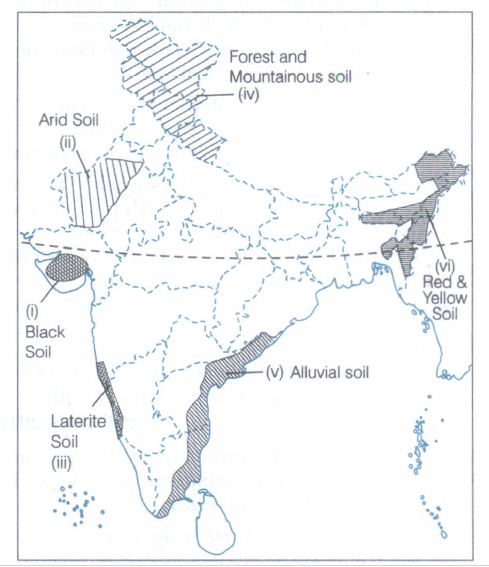
On the physical outline map of India given below, identify any four soil types of India.
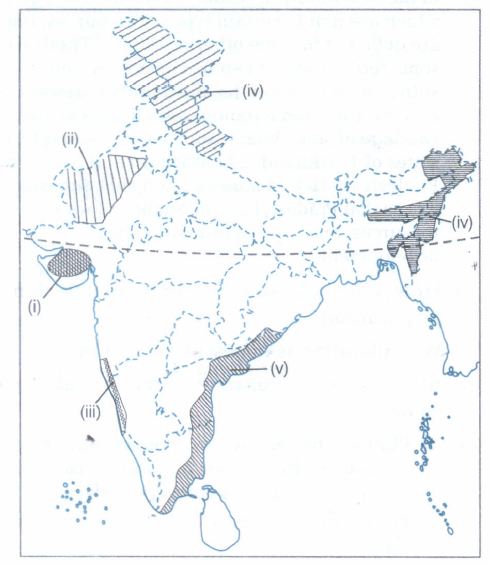
19.
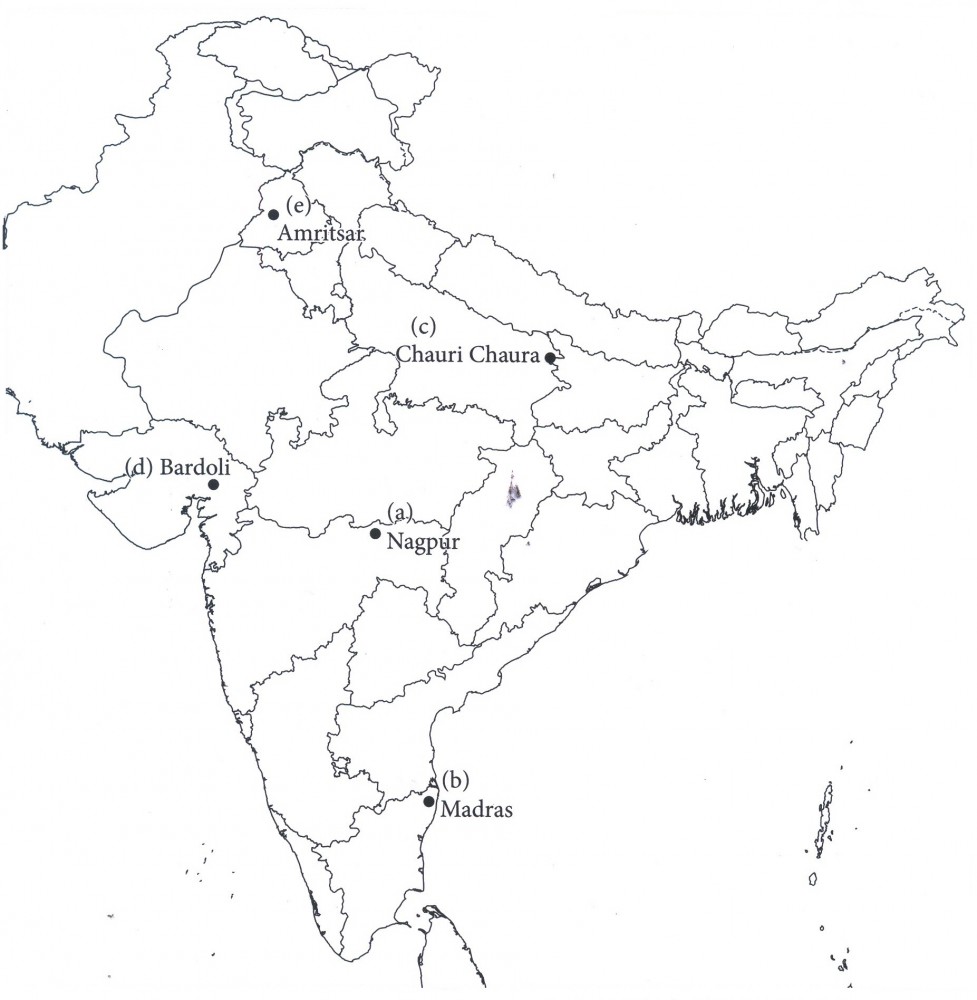
Five features with serial nos. (i) to (v) are marked in the given outline political map of India. Identify these features with the help of the following information and write their correct names on the lines marked in the map:
(a) A place where Indian National Congress Session was held in Dec. 1920.
(b) A place where Indian National Congress Session was held in 1927.
(c) A place where violence occurred due to which Mahatma Gandhi suddenly called off the Non-cooperation Movement.
(d) A place of peasants' Satyagraha in Gujarat.
(e) A place associated with Jallianwalla Bagh massacre.
20.
What led to the rise of the revolutionaries after the establishment of the conservative regimes in Europe after 1815?
21.
How can the workers of unorganised sector be protected?
22.
What was the result of the abolishing of Corn Laws?
23.
What is a multi-purpose river valley projects? Give any four objectives of the multi-purpose river valley project?
24.
"Most negative feature of democracy is that its examination never gets over." Support the statement with three arguments.
25.
What is the meaning of democracy reform? Give two examples of democratic reforms in India.
26.
Distinguish between pressure groups and political parties by stating any one point of distinction.
1.
()
'The History of the Loss of Vietnam'
2.
(i) The forest dependent Communities directly depend on various components of the forest and wildlife for food, drink, medicine, culture, spirituality etc.
(ii) Within the poor, women are affected more than men.
(iii) In many societies, women have the major responsibility of collection of fuel, fodder, water and other basic subsistence needs.
(iv) As these resources are depleted, the drudgery of women increases and sometimes they have to walk for more than 10 km to collect these resources.
(v) This causes serious health problems for women and negligence of home and children.
(vi) Due to increased hours of work, there are many serious social implications.
(vii) The indirect impact of degradation such as severe drought or deforestation induced floods, etc. also hits the poor hardest.
(viii) Poverty in these cases is a direct outcome of environmental destruction.
3.
Any person, who buys goods or services in the market and uses it is called a Consumer. Duties of a Consumer are
(i) Ensuring that the product is within the expiry date at the time of purchase.
(ii) Paying no more than the maximum retail price printed on the goods purchased.
(iii) Always asking for a cash memo/receipt for the goods purchased.
(iv) Ensuring that the goods purchased are not spurious or of inferior quality.
(v) In case, it is found later that the goods are defective, getting it exchanged or repaired. In case, the trader refuses or does not refund the amount paid, the consumer's duty is to lodge a complaint with the District Consumer Forum.
4.
The main difference between a federal form of government and a unitary are
(i) In the federal form of government like in India, the powers are divided between the Central Government and State Governments. Both levels have their areas of jurisdiction. On the other hand, in a unitary form of government, the National Government has all the powers. Any constitutional power given to the states or regions of the country is dependent on the National Government, which can be withdrawn at any time. Sri Lanka is one such example.
(ii) In a federal system, a State Government has powers of its own for which it is not answerable to the Central Government. On the other hand, in a unitary system, the State Government does not have power of its own.
5.
(i) The spare within which Indian merchants could function, became limited.
(ii) They were barred from Trading with Europe in manufactured goods.
(iii) They had to export mostly raw materials and food grains, raw cotton, opium, wheat and indigo required by the British.
(iv) They were gradually edged out of the shipping business.
(v) Till the First World War, European Managing Agencies controlled a large sector of Indian industries.
6.
(i) Collectively, the writings of thinkers provided a critical commentary on tradition, superstition and despotism.
(ii) Scholars and thinkers argued for the rule of reason rather than custom, and demanded that everything be judged through the application of reason and rationality.
(iii) They attacked the scared authority of the Church and the despotic power of the state, thus eroding the legitimacy of a social order based on tradition.
(iv) The Writings of Voltaire and Rousseau were read Widely and those who read these books saw the world through new eyes, eyes that were questioning, critical and rational.
7.
(i) Indians used the novel as a powerful medium to criticise what they considered defects in their society and to suggest remedies. Writers like Viresalingam used the novel mainly to propagate their ideas about society among a wider readership.
(ii) Novels also helped in establishing a relationship with the past. Many of them told thrilling stories of adventures and intrigues set in the past. Through glorified accounts of the past, these novels helped in creating a sense of national pride among their readers. At the same time, people from all walks of life could read novels so long as they shared a common language. This helped in creating a sense of collective belonging on the basis of one's language. (iii) Novels made their readers familiar with the ways in which people in other parts of their land spoke their language.
(iv) As elsewhere in the world, in India too, the novel became a popular medium of entertainment among the middle class. The circulation of printed books allowed people to amuse themselves in new ways.
(v) A reason for the popularity of novels among women was that it allowed for a new conception of womanhood. Stories of love which was a staple theme of many novels showed women who could choose or refuse their partners and relationships.
(vi) From the 1920s, in Bengal too a new kind of novel emerged that depicted the lives of peasants and 'low' castes. Advaita Malla Burman's (1914-51) Titash Ekti Nadir Naam (1956) is an epic about the Mallas, a community of fisherfolk who live off fishing in the river Titash.
(vii) Basheer's short novels and stories were written in the ordinary language of conversation. With wonderful humour, Basheer's novels spoke about details from the everyday life of Muslim households.
(viii) Premchand's novels, for instance, are filled with all kinds of powerful characters drawn from all levels of society. In his novels you meet aristocrats and landlords, middle level peasants and landless labourers, middle-class professionals and people from the margins of society.
8.
| Constitutional design | (i) It is related to framing of the Constitution and giving rights and freedom to people. (ii) It applies for countries like Saudi Arabia, China, Belgium, Nepal and Poland. |
| Democratic rights | (i) To provide people with basic rights and freedoms in countries like Saudi Arabia, Guantanamo Bay and Poland. (ii) In India, even now in villages, people of lower caste are discriminated. |
| Working of institutions | (i) Challenge to non-democratic countries like Mexico, Myanmar and China. (ii) In India, some parties and organisations work on caste and communal lines. |
| Elections | (i) To hold free and fair elections in' countries like Mexico, Chile and Poland. (ii) In India, rigging of elections is a big challenge to democracy. |
| Federalism, decentralization | (i) To establish democratic institutions at local levels also in Yugoslavia and Belgium. (ii) In India, the challenge is to establish linguistic equality |
| Accommodation of diversity | (i) To resolve social diversified issues in countries like Northern Ireland, Yugoslavia, Belgium and Sri Lanka. (ii) In India, caste and communal clashes pose a challenge to democracy |
| Political Organisation | (i) To democratize organisations in countries like Ghana, Northern Ireland, Sri Lanka and South Africa. (ii) In India, there is increased criminalisation of political parties |
| Religious and equality | (i) To establish religious equality in countries like Saudi Arabia and Northern Ireland. (ii) In India, religious, social and economic discrimination of people belonging to lower castes exists |
9.
a) Mica a mineral made up of a series of plates or leaves.
b) It splits easily into thin sheets. These sheets can be so thin that a thousand can be layered into a mica sheet of a few centimetres high.
c) Mica can be clear, black, green, red yellow or brown.
d) It has excellent di-electric strength, low power loss factor, insulating properties and resistance to high voltage.any three]
10.
Besides banks, the small farmers borrow from landlords, moneylenders, traders, relatives and friends etc.
11.
Manufacturers or producers should display the information because consumers have the right to be informed about the particulars of goods and services that they purchase.
12.
Oil India Limited belongs to the Joint sector industries.
13.
the introduction of fly shuttle
14.
Jowar is the rain fed crop grown in areas which hardly needs irrigation. Major Jowar producing states were Maharashtra, Karnataka, Andhra Pradesh and Madhya Pradesh in 2011-12.
15.
WTO
16.
In a democratic government, a citizen has the right and the means to examine the decisions taken by the govt. It is known as transparency.
17.
National highways
18.
(I) Black soil (ii) Arid soil
(iii) Laterite soil (iv) Forest and Mountainous soil
(v) Alluvial soil (vi) Red and Yellow soil
19.
20.
The following were the reasons that led to the rise of revolutionaries after the establishment of conservative regimes in Europe after 1815.
(a) During the years following 1815, the conservative regimes began curbing activities that questioned the legitimacy of the autocratic governments in Europe.
(b) Criticism and dissent was not tolerated.
(c) Censorship was imposed to control the spread of the ideas like liberty and freedom.
(d) Freedom of expression was curbed as thinkers were not allowed to raise their views.
(e) But for the liberal nationalists the memory of the French Revolutions continued to inspire and they began to carry their opposition secretly and formed secret societies to spread the ideas of nationalism and train the revolutionaries.
21.
The workers in the unorganised sector need protection on the following issues
(i) Wages They are low and not regular. There is no provision for overtime, paid leave, etc. Minimum wages rules should be implemented strictly.
(ii) Safety Construction workers can get injured while working and they need to work under safe conditions. There should be a check on the working conditions along with the provision of insurance.
(iii) Health Long working hours and unhygienic working environment affect the health of the workers adversely. Health insurance along with a fixed number of working hours should be made mandatory.
22.
(i) The silk scrapping of Corn Laws lead to free trade of food grains.
(ii) After the abolition of Corn Laws, food could be imported into Britain more cheaply than it could be produced within the country.
(iii) British farmers were unable to compete with imports. Vast areas of land were now left uncultivated and thousands of men and women were thrown out of work. They flocked to the cities or migrated overseas.
(iv) Increase in demand due to fall in prices and increase in income leads to mismatch between demand and supply of food grains.
(v) Many countries of the world like Russia. America and Australia and some eastern European countries started exporting food grains to Britain which gave further set back to the local producers.
23.
A multi-purpose river project is a large-scale hydro project for water retention canals and irrigation, water processing and pipelines.
Objectives of Multi-purpose River Valley Projects:
1. The main objectives are:
(a) To produce electricity from water
(b) To improve the quality of groundwater by reducing the ground water pollution.
(c) To conserve water
(d) To avoid flooding of rivers.
(e) To meet the increasing demand of water.
(f) To augment the ground water storage and raise the water table.
24.
(a) The working sphere of democracy:
(i) Promote equality among citizens
(ii) Enhance the dignity of the individual
(iii) Improve the quality of decision making
(iv) Provide a method to resolve conflict.
(b) Democracy is also having the fields of work are - social situations, economic achievement and the culture of the nation. It has great responsibilities, huge working area and the high population. So whatever work is done by democracy seems to be very small in terms of problems. That's why it is said that the most negative feature of democracy is that its examination never gets over.
25.
(i) Carefully devised changes in law can help to discourage wrong political practices and encourage good ones. At the same time, legal-constitutional changes by themselves cannot overcome challenges to democracy. They are to be carried out mainly by political activities, parties movements and politically conscious citizens.
(ii) Legal changes can sometimes be counter-productive. Generally, laws that seek to ban something are not very successful. Rather laws that give political actors incentives to do good things have more chances of working. For, example, the `Right to Information Act' empowers people to act as watchdogs of democracy.
(iii) The main focus of political reforms should be on ways to strengthen democratic practice. The most important concern should be to increase and improve the quality of political participation by ordinary citizens.
(iv) Any proposal for political reforms should think not only about what is a good solution but also about who will implement it and how measures that rely or democratic movements, citizens' organisations and the media are likely to succeed.
26.
()
Pressure groups resort to agitational politics like marches, demonstrations and strikes to achieve their aims.Politics parties use only constitutional means to achieve their aims.

10th Standard CBSE Syllabus & Materials
10th Standard CBSE
CBSE 10th Social Science PS - Federalism - New Model Questions Papers Study Material - QB365 Set A
NEW10th Standard CBSE
CBSE 10th Social Science PS - Power Sharing - New Model Questions Papers Study Material - QB365 Set A
NEW10th Standard CBSE
CBSE 10th Social Science GEO - Manufacturing Industries - New Model Questions Papers Study Material - QB365 Set A
NEW10th Standard CBSE
CBSE 10th Social Science GEO - Minerals and Energy Resources - New Model Questions Papers Study Material - QB365 Set A



CBSE 10th Standard CBSE Subjects
CBSE Standards





