
 100% FREE ACCESS
10th Standard CBSE Syllabus & Materials
10th Standard CBSE
CBSE 10th Social Science ECO - Globalisation and the Indian Economy - New Model Questions Papers Study Material - QB365 Set A
NEW10th Standard CBSE
CBSE 10th Social Science ECO - Money and Credit - New Model Questions Papers Study Material - QB365 Set A
NEW10th Standard CBSE
CBSE 10th Social Science ECO - Sectors of the Indian Economy - New Model Questions Papers Study Material - QB365 Set A
NEW10th Standard CBSE
CBSE 10th Social Science ECO - Development - New Model Questions Papers Study Material - QB365 Set A
NEW10th Standard CBSE
CBSE 10th Social Science PS - Outcomes of Democracy - New Model Questions Papers Study Material - QB365 Set A
NEW10th Standard CBSE
CBSE 10th Social Science PS - Gender, Religion and Caste - New Model Questions Papers Study Material - QB365 Set A

Published on: 14/02/2020
10th Standard CBSE Social Science Public Question Model Question Paper V 2019-2020
Download CBSE Class 10th Standard CBSE Social Science question papers, sample papers, important questions, and previous year solved papers in PDF format. Get free study materials, NCERT solutions, and exam preparation resources for Class 10th Standard CBSE Social Science
Questions + Answers key
Take MCQ Social Science Test
1.
Explain the challenge of expansion of democracy by stating three points.
2.
Describe the distribution of different types of forests in India.
3.
"The consumer movement arose out of dissatisfaction of the consumers." Justify the statement with arguments.
4.
How are Federations contrasted with unitary government?
5.
Describe any four Impacts of Manchester imports on the cotton weavers of India.
6.
Why did the readership of novel begin to include poorer people? Give any three reasons.
7.
How had the earliest Print Revolution developed in the world? Explain.
8.
How is the mining activity injurious to the health of the miners and environment? Explain
9.
What are the basic elements of democracy in practical sense?
10.
Name the extreme locations connected by the east-west corridor.
11.
I had booked a train ticket in one of the super-fast trains. The train was delayed for long hours without any reason. What can I do in this situation?
12.
Who was a jobber?
13.
What is the initial period of companies who set up production units in the special economic zones(SEZs) do not have to pay taxes?
14.
Give reasons for the following:
(i) The Kent Act led to housing crisis in Bombay.
(ii) Expansion of the city has always posed a problem in Bombay.
15.
What are kharif crops? Give two examples.
16.
What is meant by commercial bank?
17.
Name the states where aluminium plants are located.
18.
Which alliance was set up by the Nepalese people to restore democracy in Nepal?
19.
On the physical outline map of India given below, identify any four soil types of India.
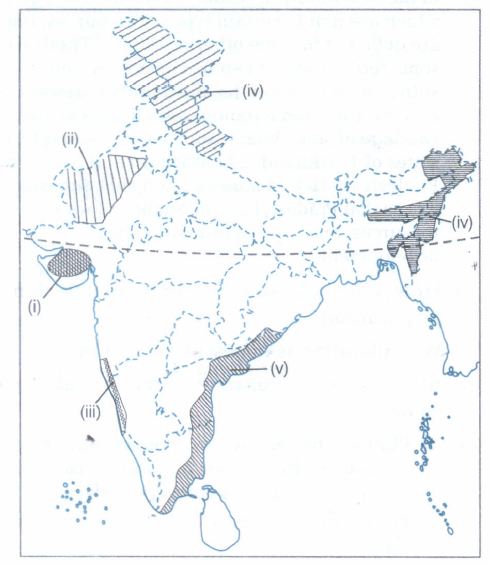
20.
Locate and label the following items with appropriate symbols on the same map:
(a) Chauri-Chaura-The place of calling off the Non-Cooperation Movement (N.C.M.)
(b) Amritsar-The place where Jallianwalla Bagh incident took place.
21.
"Different countries face different kinds of challenges". Support the statement with suitable examples.
22.
"Equality before law did not necessarily stand for universal suffrage in Europe." Discuss.
23.
List out the merits and demerits of democracy.
24.
Why is tertiary sector growing so rapidly in India? Explain it with four reasons.
25.
Explain the impacts of the First World War.
26.
Three-fourths of the earth's surface is covered with water, but still there is a scarcity of water across the globe. Explain giving three reasons.
27.
In which way did the early printed books closely resemble the manuscripts? Explain.
1.
The challenge of expansion is very common challenge faced by an established democracy.
(a) The challenge of expansion involves applying the basic principles of democracy across all the regions, different social groups and various institutions.
(b) It involves ensuring greater power to local governments, extension of federal principle to all the units of the federation and inclusion of women and minority groups.
(c) It also implies that less and less decisions should remain outside the arena of democratic control. Most countries including India and other democracies, like the United States, face this challenge.
2.
(a) Jammu and Kashmir, Andhra Pradesh, Uttaranchal, Kerala, Tail Nadu, West Bengal and Maharashtra have large percentage of reserved forests.
(b) Madhya Pradesh has the largest area under permanent forests - 75%
(c) Bihar, Haryana, Punjab, Himachal Pradesh, Orissa, and Rajasthan have the large areas of protected forests.
(d) All north-eastern states and parts of Gujarat have a very high % of unclassed forests.
3.
(i) In India, the consumer movement as a 'social force' originated with the necessity of protecting and promoting the interests of consumers against unethical and unfair trade practices.
(ii) Whenever a complaint regarding goods or service is made, the seller tries to shift all the responsibility on to the buyer.
(iii) Rampant (unchecked) food shortages, hoarding, black marketing, adulteration of food items gave birth to the consumer movement in an organized form in the 1960s.
(iv) Till the 1970s, consumer organizations were largely engaged in writing articles and holding exhibitions. They formed consumer groups to look into the malpractices in ration shops and overcrowding in the road passenger transport only. More recently, India witnessed an upsurge in the number of consumer groups.
4.
(i) Under the Unitary system, either there is only one level of government or the sub units are subordinate to the central government.
(ii) The Central government can pass on orders to the provincial or the local government.
(iii) But in a federal system, the central government cannot order the state government to do something
(iv) State government has powers of its own which it is not answerable to the central government.
(v) Both these governments are separately answerable to the people.
5.
The bad impacts of Manchester imports on the cotton weavers of India were
(i) Export market of cotton weavers collapsed and local market shrank.
(ii) Cotton clothes made up of machine were so cheap, that Indian weavers could not easily compete with them.
(iii) As American Civil War broke out and cotton supplies from the US were cut off, Indian weavers could not get sufficient supply of raw cotton.
(iv) Raw cotton exports from India increased, so Indian weavers could not get enough raw cotton and were forced to buy raw cotton at exorbitant price.
6.
(i) Introduction of libraries : But soon, people had easier access to books with the introduction of circulating libraries in 1740.
(ii) Cheap novels: Technological improvements in printing brought down the price of books and innovations in marketing led to expanded sales.
(iii) Hiring out novels : In France, publishers found that they could make super profits by hiring out novels by the hour. The novel was one of the first mass-produced items to be sold.
7.
(i) Print technology in the 6th and 7th century : From AD 594 onwards, books in Chine were printed by rubbing paper against the linked surface of woodblocks.
(iii) Gutenberg and the printing press : The major turning point in the growth of print technology came in 1448 when Johann Gutenberg invented the first printing press. The shift from hand printing to mechanical printing led to the print revolution.
8.
(i) The dust and noxious fumed inhaled by miners makes them vulnerable to pulmonary diseases. The risk of collapsing mine roofs, inundation and fires in coal mines are a constant threat to miners. The water sources in the region get contaminated due to mining.
(ii) Dumping of waste leads to deregulation of land, soil and increase in stream and river pollution. Stricter safety regulations and implementation of environmental laws are essential to prevent mining from becoming a 'killer industry'.
9.
The basic elements of democracy are formal constitutions, regular, fair and free elections, political parties and fundamental rights to citizens.
10.
Silcher and Porbandar are the extreme locations connected by the east-west corridor.
11.
You can approach consumer court for deficiency in service and claim refund of super-fast charges as damage.
12.
Jobber was an old and trusted worker employed by the Indian industrialists to recruit the new workers.
13.
5 years
14.
(i) Because landlords withdrew houses from the market.
(ii) Because of scarcity of land.
15.
Kharif season sowing is done with the onset of monsoon (June) and harvesting is done with the retreat of the monsoon (September). Two main crops of Kharif season are rice and cotton.
16.
It is a financial institution which performs the functions of accepting deposits from the general public and giving loans for investment with the aim of earning profit.
17.
Chhattisgarth, Tamil Nadu, Kerala, Uttar Pradesh, Maharashtra and West Bengal.
18.
()
Seven party alliance[SPA]
19.
(I) Black soil (ii) Arid soil
(iii) Laterite soil (iv) Forest and Mountainous soil
(v) Alluvial soil (vi) Red and Yellow soil
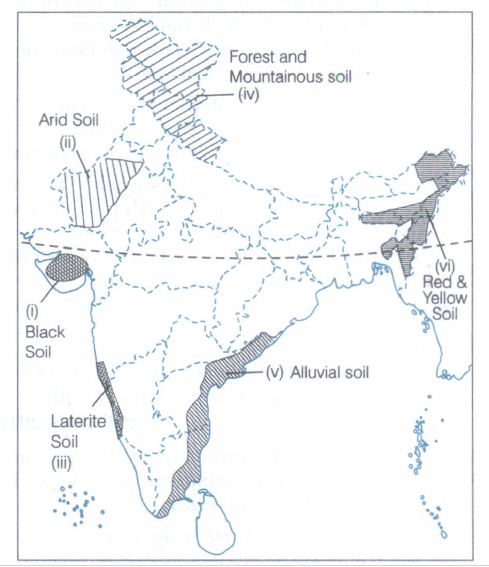
20.
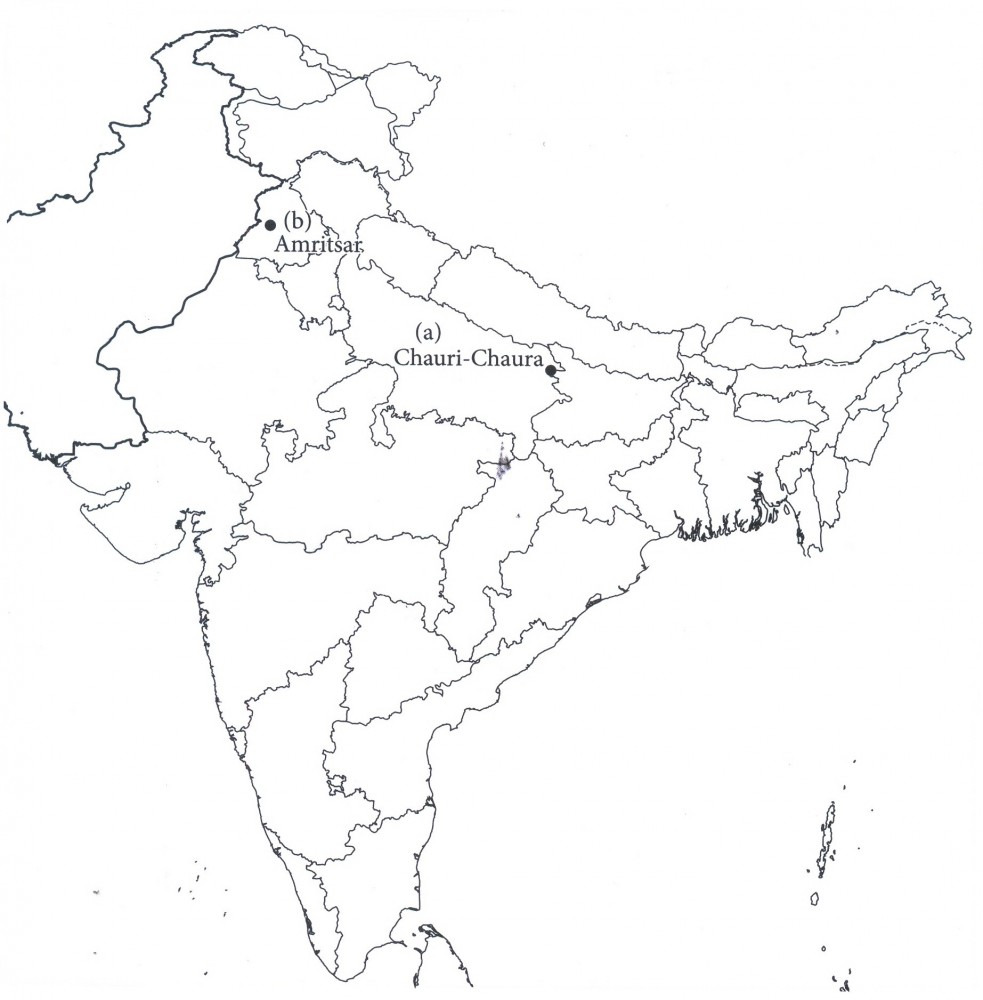
21.
It is true that different countries facp different kinds of challenges —
(i) Non-democratic countries false foundational challenges. This involves bringing down the existing non-democratic regime, keeping military away from controlling government and establishing a sovereign and functional state. Example: In Myanmar, military rule should be challenged. Suu Kyi should be freed and should be elected as the representative of the popular government.
(ii) Every democracy faces the challenge of deepening of democracy. This involves applying the basic principle of democratic government across all the regions, different social groups and various institutions. Example: In Saudi Arabia, women are not allowed to take part in public activities, and no freedom of religion is there for the minorities.
(iii) Every democracy faces the challenge of expansion. This involves strengthening of the institutions and practices of democracy. It requires an attempt to bring down that control and influence of the rich and powerful people in making governmental decision. Example: In USA, Black or African-American people have won equal rights, but are still poor, less educated and marginalised.
22.
The new middle class in Europe advocated the concept of liberalism emphasising the concept of freedom and equality for all.
But at the same time, this was not visible in the political experiment around Europe. The right to vote was exclusively with the propertied class, that too only men. Women even with property rights were excluded from right to vote.
The Jacobins who stood for revolution for equality were also biased on this issue. They too granted right to vote to all adult male population only.
Napoleon who stood to end privileges too reduced women to the margin of the society with no political rights. For ling did these women and non-propertied male struggled to win political rights for themselves.
23.
Merits of democracy:
(a) Democracy assures equality in every sphere of life like political, social and economic.
(b) It upholds basic individual liberties like freedom of speech, expression and thought.
Demerits of democracy:
(a) Democracy gives more importance to quantity rather than quality.
(b) It is not a stable or fixed form of government, there is always uncertainty regarding its functions.
(c) Sometimes, democracy is viewed as government rule by ignorance. Political analysts have condemned democracy as a perverted form of government.
24.
(a) In any country several services such as hospitals, educational institutions, post and telegraph services, police stations, courts, village administrative offices , municipal corporations , defence, transport, banks, insurance companies, etc. are required. These can be considered as basic services. In a developing country the government has to take responsibility for the provision of these services.
(b) The development of agriculture and industry leads to the development of services such as transport, trade, storage and the like, as we have already seen. Greater the development of the primary and secondary sectors, more would be the demand for such services.
(c) As income levels rise, certain sections of people start demanding many more services like eating out, tourism, shopping, private hospitals, private schools, professional training etc. These changes can be seen in cities, especially in big cities.
(d) Over the past decade or so, certain new services such as those based on information and communication technology have become important and essential. The production of these services has been rising rapidly.
25.
(i) It was the first modern industrial was which involved industrial nations.
(ii) Machine guns, tanks, aircraft, chemical weapons ect., are used on a massive scale.
(iii) Unthinkable death and destruction.
(iv) Most of the people killed and injured were man of working age.
(v) Declined the household income.
(vi) Men were forced to join in the war.
(vii) Women slapped into undertake jobs which they were not used to.
26.
(a) It is predicted that large parts of India will join countries or regions having absolute water scarcity by 2025.
(b) Through, it is the fact that water is abundant and renewable, it is difficult to imagine that we may suffer from water scarcity.
(c) It is associated with regions having low rainfall or those that are drought prone.
(d) The availability of water resources varies over space and time, mainly due to the variations in seasonal and annual precipitation, but water scarcity in most due to the variations in seasonal and annual precipitation, but water scarcity in most cases is caused but over-exploitation, excessive use and unequal access to water among different social groups.
27.
(i) Early printed books were technically printed but those were not very different from manuscripts.
(ii) There were many kinds of same features available in similar books which made printed books closely resembling with manuscripts.
(iii) Both printed books and manuscripts looked similar because metal letters imitated the ornamental handwritten style.
(iv) Like handwritten manuscripts, borders of printed books were also illuminated by hand with foliage and other patterns and illustrations were painted.
(v) In the books printed for rich people, space for decoration was kept blank on the printed pages.
(vi) Each buyer could choose the design and decide on the painting school that would do the illustrations.

10th Standard CBSE Syllabus & Materials
10th Standard CBSE
CBSE 10th Social Science PS - Federalism - New Model Questions Papers Study Material - QB365 Set A
NEW10th Standard CBSE
CBSE 10th Social Science PS - Power Sharing - New Model Questions Papers Study Material - QB365 Set A
NEW10th Standard CBSE
CBSE 10th Social Science GEO - Manufacturing Industries - New Model Questions Papers Study Material - QB365 Set A
NEW10th Standard CBSE
CBSE 10th Social Science GEO - Minerals and Energy Resources - New Model Questions Papers Study Material - QB365 Set A



CBSE 10th Standard CBSE Subjects
CBSE Standards





