
 100% FREE ACCESS
10th Standard CBSE Syllabus & Materials
10th Standard CBSE
CBSE 10th Social Science ECO - Globalisation and the Indian Economy - New Model Questions Papers Study Material - QB365 Set A
NEW10th Standard CBSE
CBSE 10th Social Science ECO - Money and Credit - New Model Questions Papers Study Material - QB365 Set A
NEW10th Standard CBSE
CBSE 10th Social Science ECO - Sectors of the Indian Economy - New Model Questions Papers Study Material - QB365 Set A
NEW10th Standard CBSE
CBSE 10th Social Science ECO - Development - New Model Questions Papers Study Material - QB365 Set A
NEW10th Standard CBSE
CBSE 10th Social Science PS - Outcomes of Democracy - New Model Questions Papers Study Material - QB365 Set A
NEW10th Standard CBSE
CBSE 10th Social Science PS - Gender, Religion and Caste - New Model Questions Papers Study Material - QB365 Set A

Published on: 05/09/2019
Challenges to Democracy
Download CBSE Class 10th Standard CBSE Social Science question papers, sample papers, important questions, and previous year solved papers in PDF format. Get free study materials, NCERT solutions, and exam preparation resources for Class 10th Standard CBSE Social Science
Questions + Answers key
Take MCQ Social Science Test
1.
Explain the challenge of deepening of democracy by stating three points.
2.
Explain any three aspects of challenge of expansion of democracy.
3.
"The challenge of expansion is very common which an established democracy faces". Comment.
4.
How are some countries in the world facing foundational challenge of democracy? Explain with examples.
5.
"A challenge is an opportunity for progress". Support the statement with your arguments.
6.
What are the qualifications of democracy?
The rulers elected by the people must take all the major decisions
Elections must offer a choice and fair opportunity to the people to change the current rulers.
The choice and opportunity should be available to all the people on an equal basis
All of the above
7.
Which act is considered the watch dog of democracy?
The information to Right Act
The Right to Live Act
The Right to Information Act
None of these
8.
Which among the given is the dominant form of government in the contemporary world?
Dictatorship
Democracy
Military rule
None of these
9.
According to the text, how much of the world is working under democratic government?
One fourth
Two fourth
Three fourth
None of these
10.
According to the text, how much of globe is still not under democratic government?
One fourth
Two fourth
Three fourth
None of these
11.
Are legal reforms sufficient to overcome the challenges of democracy?
12.
What does the challenge of deepening involve?
13.
What distinguishes democracy from other forms of government?
14.
Which is the most common form of democracy in today's world and why?
15.
How do we define a good democracy?
16.
Examine the features of democracy in its expanded form.
17.
What is a challenge? Explain the three major challenges before the countries of the world regarding democracy?
18.
'Most of the democracies of the world face the challenge of expansion and challenge of deepening of democracy'? Justify the statement.
19.
What must not take place in a democracy if it is a good democracy?
20.
What are the major challenges to democracy in India? Explain.
1.
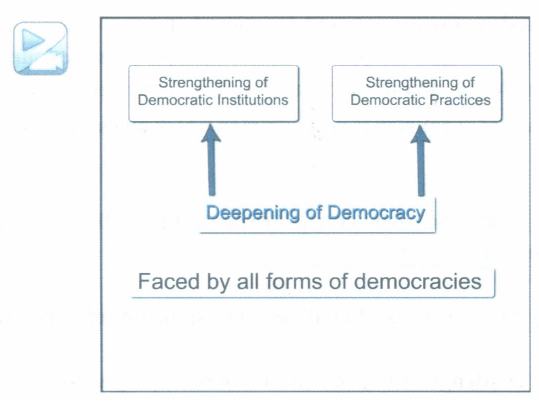
The challenge of deepening of democracy is faced by every democracy in one way or the other. This challenge ensures:
(a) strengthening of democratic institutions and principles.
(b) to check the influence of the wealthy and powerful people in the democratic decisions.
(c) empowering the general section of people through democratic institutions
2.
The challenge of expansion is very common challenge faced by an established democracy.
(a) The challenge of expansion involves applying the basic principles of democracy across all the regions, different social groups and various institutions.
(b) It involves ensuring greater power to local governments, extension of federal principle to all the units of the federation and inclusion of women and minority groups.
(c) It also implies that less and less decisions should remain outside the arena of democratic control. Most countries including India and other democracies, like the United States, face this challenge.
3.
The challenge of expansion is very common challenge faced by an established democracy.
(a) The challenge of expansion involves applying the basic principles of democracy across all the regions, different social groups and various institutions.
(b) It involves ensuring greater power to local governments, extension of federal principle to all the units of the federation and inclusion of women and minority groups.
(c) It also implies that less and less decisions should remain outside the arena of democratic control. Most countries including India and other democracies, like the United States, face this challenge.
4.
The foundational challenge of democracy consists of making the transition to democracy and then instituting a democratic government.
This challenge involves three main areas of change.
(a) It brings down the existing non-democratic regime.
(b) It keeps the military away from controlling governement.
(c) It establishes a sovereign and functional state.
The example of struggle for democracy in Nepal justifies the foundational challenge People demanded abolition of monarchy and establishment of democratic institutions.
5.
A challenge is not just any problem. Only those difficulties are a 'challenge' which are significant and can be overcome and therefore carry within them an opportunity for progress. Democracy is the dominant form of government in the contemporary world. It does not face a particular challenger, but the promise of democracy is far from realised anywhere in the world. Democracy as a whole faces certain challenges. Legal constitutional changes by themselves cannot help to overcome challenges to democracy-like economic inequality, unemployment, illiteracy, caste, gender discrimination. Democratic reforms can be carried out by political activities, parties, movements and politically conscious citizens, in order to realise the opportunity in a challenge, in order to overcome it an go up to a higher level.
6.
(d)
All of the above
7.
(c)
The Right to Information Act
8.
(b)
Democracy
9.
(c)
Three fourth
10.
(a)
One fourth
11.
()
No, legal reforms are not sufficient or effective to meet the challenges unless they are backed by political parties, politically-conscious citizens and movements.
12.
()
The challenge of deepening of democracy involves strengthening of the institutions and practices of democracy.
13.
()
Democracy unlike other forms of government requires all its citizens to take part in the political process.
14.
()
The most common form of democracy in today's world is representative democracy because most of the modern democracies involve large number of people in the decision-making process.
15.
()
A good democracy is the form of government in which people get equal status and opportunities in the decision-making process. Government is also limited by basic rules of the constitution and rights of the citizens.
16.
The features of democracy can be categorised in the form of questions followed by classification of features like:
(a) Who are the rulers in the democracy?
People are the rulers in the democracy who ruled with the help of its elected representatives of the people.
(b) What kind of election constitutes a democratic election?
Free and fair election constitutes a democratic election. But the elections must offer a real choice between political alternatives. And it should be possible for people to use this choice to remove the existing rulers if they wish so.
(c) Who are the people who can elect the rulers?
Citizens above 18 years of age elect the rulers on the basis of one person, one vote, one value, i.e. universal adult franchise. As democracy is based on the fundamental principles of political equality in a good democracy, each adult citizen must have one vote and each vote must have one value.
(d) What kind of government is democracy?
Good democracy is based on the rule of law ans respect for rights. A democratic government cannot do whatever it likes simply because it has won an election. It has to respect basic rules.
(e) As democracy is based on deliberation and negotiation, every major decision has to go through a series of consultations and every office-bearer has certain rights and responsibilities assigned by the constitution and the law.
Thus, a good democratic government rules within limits set by constitutional law and citizens' rights.
17.
A challenge refers to a difficulty which carries within it an opportunity for further progress and can be overcome
The following are the major challenges to democracy in India.
(a) Foundational challenge: This challenge involves:
(i) making transition to democracy and then instituting democratic government.
(ii) bringing down the existing non-democratic regime.
(iii) keeping military away from controlling government.
(iv) establishing a sovereign and functional state.
(b) Challenge of expansion of democracy: This challenge signifies:
(i) extension of democratic power to local governments.
(ii) expansion of federal principles to all the federal units.
(iii) political empowerment to women and minorities.
(c) Challenge of deepening of democracy: This challenge ensures:
(i) strengthening of democratic institutions and democratic principles.
(ii) to check the influence of the wealthy and powerful people in democratic decisions.
(iii) empowering the general section of people through democratic institutions.
18.
The challenge of expansion is a very common challenge faced by an established democracy.
(a) The challenge of expansion involves applying the basic principles of democracy across all the regions, different social groups and various institutions.
(b) It involves ensuring greater power to local governments, extension of federal principle to all the units of the federation and inclusion of women and minority groups.
(c) It also implies that less and less decisions should remain outside the arena of democratic control. Most countries including India and other. democracies, like the United States, face this challenge.
The challenge of deepening of democracy is faced by every democracy in one way or the other. This challenge ensures:
(a) strengthening of democratic institutions and principles.
(b) to check the influence of the wealthy and powerful people in the democratic decisions.
(c) empowering the general section of people through democratic institutions
19.
The following factors must not take place in a democracy, if it is a good democracy.
(a) Corruption in any form
(b) Decision-making based only on the interests of the majority group.
(c) Rigging election results.
(d) Concentration of power in few hands
(e) Overlooking of interest of people at large
(f) Electing candidates with corrupt and criminal backgrounds
(g) Improper governance
20.
The following are the major challenges to democracy in India.
(a) Foundational Challenge: This challenge involves:
(i) making transition to democracy and then instituting democratic government.
(ii) bringing down the existing non-democratic regime.
(iii) keeping military away from controlling government.
(iv) establishing a sovereign and functional state.
(b) Challenge of expansion of democracy: This challenge signifies:
(i) extension of democratic power to local governments
(ii) expansion of federal principles to all the federal units
(iii) political empowerment to women and minorities.
(c) Challenge of deepening of democracy: This challenge ensures:
(i) strengthening of democratic institutions and democratic principles.
(ii) to check the influence of the wealthy and powerful people in democratic decisions.
(iii) empowering the general section of people through democratic institutions.

10th Standard CBSE Syllabus & Materials
10th Standard CBSE
CBSE 10th Social Science PS - Federalism - New Model Questions Papers Study Material - QB365 Set A
NEW10th Standard CBSE
CBSE 10th Social Science PS - Power Sharing - New Model Questions Papers Study Material - QB365 Set A
NEW10th Standard CBSE
CBSE 10th Social Science GEO - Manufacturing Industries - New Model Questions Papers Study Material - QB365 Set A
NEW10th Standard CBSE
CBSE 10th Social Science GEO - Minerals and Energy Resources - New Model Questions Papers Study Material - QB365 Set A



CBSE 10th Standard CBSE Subjects
CBSE Standards





