
 100% FREE ACCESS
10th Standard CBSE Syllabus & Materials
10th Standard CBSE
CBSE 10th Social Science ECO - Globalisation and the Indian Economy - New Model Questions Papers Study Material - QB365 Set A
NEW10th Standard CBSE
CBSE 10th Social Science ECO - Money and Credit - New Model Questions Papers Study Material - QB365 Set A
NEW10th Standard CBSE
CBSE 10th Social Science ECO - Sectors of the Indian Economy - New Model Questions Papers Study Material - QB365 Set A
NEW10th Standard CBSE
CBSE 10th Social Science ECO - Development - New Model Questions Papers Study Material - QB365 Set A
NEW10th Standard CBSE
CBSE 10th Social Science PS - Outcomes of Democracy - New Model Questions Papers Study Material - QB365 Set A
NEW10th Standard CBSE
CBSE 10th Social Science PS - Gender, Religion and Caste - New Model Questions Papers Study Material - QB365 Set A

Published on: 03/09/2019
Nationalism in India
Download CBSE Class 10th Standard CBSE Social Science question papers, sample papers, important questions, and previous year solved papers in PDF format. Get free study materials, NCERT solutions, and exam preparation resources for Class 10th Standard CBSE Social Science
Questions + Answers key
Take MCQ Social Science Test
1.
Why did political leaders differ sharply over the question of separate electorates?
2.
Discuss the salt March to make clear why it was an effective symbol of resistance against colonialism.
3.
What is meant by the idea of Satyagraha?
4.
Which one of the following is not true regarding the Jallianwala Bagh incident?
It took place on 10th April 1919
Satyagrahis were forced to rub their noses on the ground and crawl on the streets.
Its aim was to create a 'internal effect' on the minds of the Satyagrahis.
Its aim was to create a feeling of terror and awe.
5.
The Peasants of Kheda district could not pay the revenue because they were affected by?
The crop
Extreme poverty
A plague epidemic
All of these
6.
Which of the following is not true regarding the impact of the First World War?
Defence expenditure resulted in increased taxes.
Forced recruitment of soldiers was introduced in the villages.
Income tax was introduced and custom duties increased.
The hardship ended with the war as the British introduced the Rowlatt Act.
7.
Five features with serial nos. (i) to (v) are marked in the given outline political map of India. Identify these features with the help of the following information and write their correct names on the lines marked in the map:
(a) A place where Indian National Congress Session was held in Dec. 1920.
(b) A place where Indian National Congress Session was held in 1927.
(c) A place where violence occurred due to which Mahatma Gandhi suddenly called off the Non-cooperation Movement.
(d) A place of peasants' Satyagraha in Gujarat.
(e) A place associated with Jallianwalla Bagh massacre.
8.
Who wrote Hind Swaraj?
9.
In which Indian National Congress session, the idea of Khilafat - Non - Cooperation Movement was accepted?
10.
Who led the Khilafat movement in Bombay?
11.
Write a short note on the Non-Cooperation Movement.
1.
Political leaders differed sharply over the question of Separate electorates because
(i) The Muslim leaders thought that their interest could only be protected in a Muslim state, and in a Hindu majority state they would be at the mercy of the Hindus. They wanted reserved seats in the Central Assembly and representation in proportion to population in the Muslim- dominated provinces, viz, Bengal and Punjab.
(ii) Dr BR Ambedkar, the leader of the depressed classes, was in favour of separate electorates for his community but Gandhiji believed that separate electorate for Dalits would slow down the process of their integration into society. Later Ambedkar accepted Gandhiji's position and signed 'Poona Pact'.
2.
Salt March was an effective symbol or tool of resistance against colonialism because
(i) All classes could identify with salt as it was an essential food item.
(ii) Tax on salt and the monopoly over its manufacturing was a sign of the oppression of British rule.
Gandhiji reached Dandi on 6th April, 1930 and violated Salt law by manufacturing salt from sea water. Breaking the Salt law was an apparent defiance of British authority and was a direct challenge to British rule in India.
People were not only asked to refuse cooperation with the British, but to break the unjustified colonial laws.
Thousands of people from different parts of the country broke the Salt law, manufactured it and demonstrated in front of government salt factories.
With the spread of the movement, foreign cloth was boycotted, liquor shops were picketed, peasants refused to pay revenue, chaukidari taxes, village officials resigned, forest people violated forest laws by collecting wood and grazing their cattle in the forest. In this way, Salt March inspired people from different segments of our society and became our effective tool of resistance against the colonial power.
3.
Satyagraha is a method of agitation and protest based on truth and non-violence. It was first introduced by Mahatma Gandhi in the National Movement. The method was passive resistance, consisting of defiance of laws, non-payment of taxes, boycott of government institutions, etc.
First, Gandhiji applied Satyagraha in 1916 in Champaran district of Bihar to help the peasant against the unjust plantation owners. Then he organised Satyagraha in Kheda district of Gujarat in support of peasants in 1917 and also in Ahmedabad in favour of cotton mill workers in 1918.
4.
(a)
It took place on 10th April 1919
5.
(d)
All of these
6.
(d)
The hardship ended with the war as the British introduced the Rowlatt Act.
7.
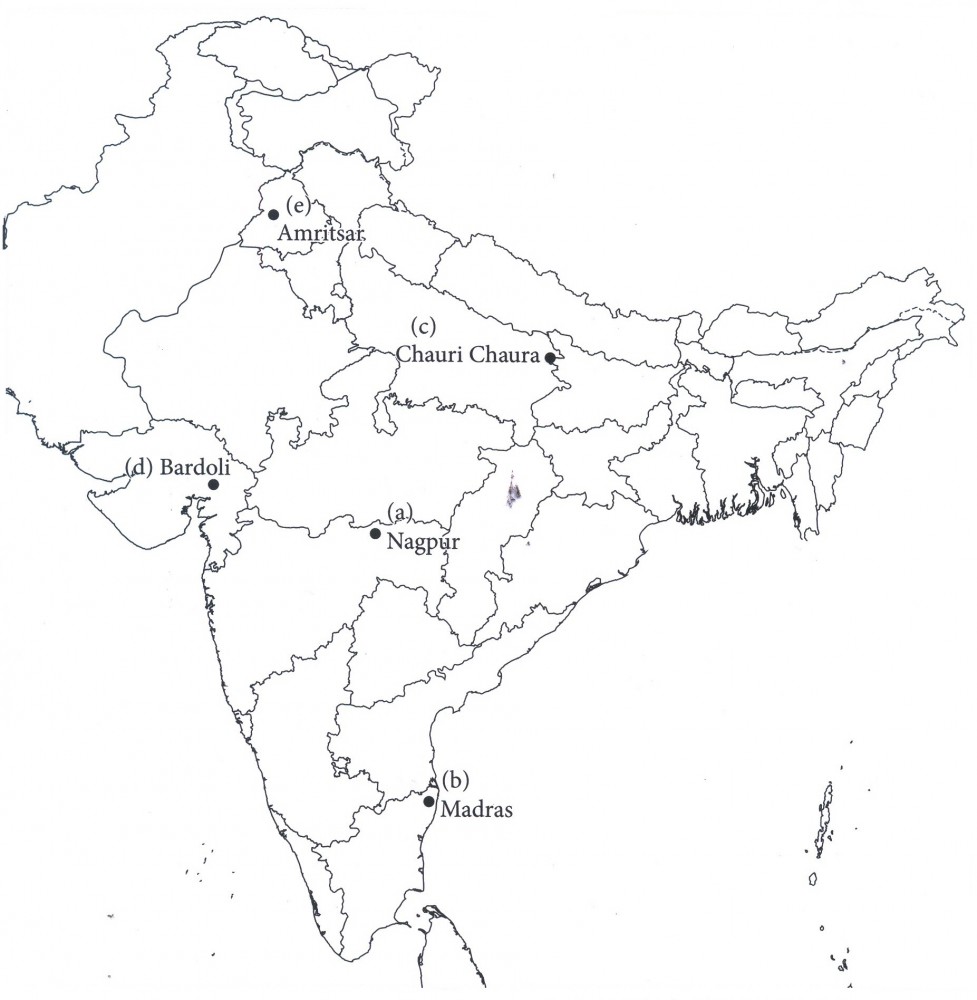
8.
Hind Swaraj was written by Mahatma Gandhi.
9.
The idea of Khilafat - Non - Cooperation was accepted at the Indian National Congress Session in Calcutta (Kolkata) in September 1920.
10.
Muhammad Ali and Shaukal Ali led the Khilafat movement in Bombay.
11.
Non-Cooperation Movement was launched by Gandhiji's in 1920.He had the following three basic objectives.
(a) He wanted remedial action from the British for the wrong done in Jallianwalla Bagh.
(b) He wanted a solution to the Khilafat issue.
(c) The most important objective was the attainment of swaraj.
The Non-Cooperation Movement had different versions for the people living in the urban areas, countryside, plantations and hilly areas. With the call of Gandhiji, educated middle class led the movement in towns and cities. The teachers and students left educational institutions, lawyers refused to practise in the government law courts and people began to boycott foreign goods. This had a great economic impact on the Britishers. In the countryside too, peasants organised movements against talukdars and landlords in villages under the leadership of Baba Ramchandra to reduce revenue demand and abolition of begar. Tribal people started an armed struggle in the Gudem Hills of Andhra Pradesh led by Alluri Sitaram Raju. Workers in the plantations of Assam began opposing the Inland Emigration Act of 1859 to retain their right to free movement. At some places the movement turned violent. The tragic incident at Chauri-Chaura forced Gandhiji to call off the movement. Here the crowd attacked the police station and set it on fire, killing many policemen. Gandhiji felt that Indians need to be trained for a non-violent mass movement.

10th Standard CBSE Syllabus & Materials
10th Standard CBSE
CBSE 10th Social Science PS - Federalism - New Model Questions Papers Study Material - QB365 Set A
NEW10th Standard CBSE
CBSE 10th Social Science PS - Power Sharing - New Model Questions Papers Study Material - QB365 Set A
NEW10th Standard CBSE
CBSE 10th Social Science GEO - Manufacturing Industries - New Model Questions Papers Study Material - QB365 Set A
NEW10th Standard CBSE
CBSE 10th Social Science GEO - Minerals and Energy Resources - New Model Questions Papers Study Material - QB365 Set A



CBSE 10th Standard CBSE Subjects
CBSE Standards





