
 100% FREE ACCESS
10th Standard Syllabus & Materials
10th Standard
TN 10th English Prose - 4 - The Attic Important Questions And Answers Study Material - QB365 Set A
NEW10th Standard
TN 10th English Supplementary - 3 - The Story of Mulan Important Questions And Answers Study Material - QB365 Set A
NEW10th Standard
TN 10th English Poem - 3 - I am Every Woman Important Questions And Answers Study Material - QB365 Set A
NEW10th Standard
TN 10th English Prose - 3 - Empowered Women Navigating The World Important Questions And Answers Study Material - QB365 Set A
NEW10th Standard
TN 10th English Supplementary - 2 - Zigzag Important Questions And Answers Study Material - QB365 Set A
NEW10th Standard
TN 10th English Poem - 2 - The Grumble Family Important Questions And Answers Study Material - QB365 Set A

Published on: 06/02/2020
10th Standard Mathematics Questions -I- 2019-2020
Download Tamil Nadu 10th Standard Maths question papers, model tests, one-mark questions, important questions, and public exam papers in PDF format. Free study materials and answer keys for TN State Board students.
Questions + Answers key
Take MCQ Maths Test1.
The angle of elevation of the top of tree from a point at a distance of 250 m from its base is 60o. The height of tree is ___________
250 m
\(250\sqrt { 3 } \)
\(\frac { 250 }{ 3 } m\)
\(200\sqrt { 3 } \)
2.
If the smallest value and co-efficient of range a data are 25 and 0.5 respectively. Then the largest value is ___________
25
75
100
12.5
3.
A purse contains 10 notes of Rs. 2000, 15 notes of Rs. 500, and 25 notes of Rs. 200.One note is drawn at random. What is the probability that the note is either a Rs. 500, note or Rs. 200 note?
\(\frac { 1 }{ 5 } \)
\(\frac { 3 }{ 10 } \)
\(\frac { 2 }{ 3 } \)
\(\frac { 4 }{ 5 } \)
4.
A floating boat having a length 3m and breadth 2m is floating on a lake. The boat sinks by 1 cm when a man gets into it. The mass of the man is (density of water is 10000 kg/m3)
50 kg
60 kg
70 kg
80 kg
5.
The curved surface area of a cylinder is 264 cm2 and its volume is 924 cm2. The ratio of diameter to its height is ___________
3:7
7:3
6:7
7:6
6.
The material of a cone is converted into the shape of a cylinder of equal radius. If the height of the cylinder is 5 cm, then height of the cone is ___________
10 cm
15 cm
18 cm
24 cm
7.
If the mid-point of the line segment joining \(A\left( \frac { x }{ 2 } ,\frac { y+1 }{ 2 } \right) \) and B(x + 1, y-3) is C(5, -2) then find the values of x, y ____________
(6, -1)
(-6, 1)
(-2, 1)
(3, 5)
8.
Find the ratio in which the line segment joining the points (-3, 10) and (6,-8) is internally divided by (-1, 6) ____________
7:2
3:4
2:7
5:3
9.
10.
I the given figure DE||AC which of the following is true.
\(x=\frac { ay }{ b+a } \)
\(x=\frac { a+b }{ ay } \)
\(x=\frac { ay }{ b-a } \)
\(\frac { x }{ y } =\frac { a }{ b } \)
11.
If triangle PQR is similar to triangle LMN such that 4PQ = LM and QR = 6 cm then MN is equal to ____________
12 cm
24 cm
10 cm
36 cm
12.
13.
\(\frac { { x }^{ 2 }+7x12 }{ { x }^{ 2 }+8x+15 } \times \frac { { x }^{ 2 }+5x }{ { x }^{ 2 }+6x+8 } =\_ \_ \_ \_ \_ \_ \_ \_ \_ \)
x+2
\(\frac { x }{ x+2 } \)
\(\frac { 35{ x }^{ 2 }+60x }{ { 48x }^{ 2 }+120 } \)
\(\frac { 1 }{ x+2 } \)
14.
15.
16.
The difference between the remainders when 6002 and 601 are divided by 6 is ____________
2
1
0
3
17.
If f is constant function of value \(\frac { 1 }{ 10 } \), the value of f(1) + f(2) + ... + f(100) is _________
\(\frac { 1 }{ 100 } \)
100
\(\frac { 1 }{ 10 } \)
10
18.
If function f : N⟶N, f(x) = 2x then the function is, then the function is ___________
Not one - one and not onto
one-one and onto
Not one -one but not onto
one - one but not onto
19.
Let f(x) = x2 - x, then f(x- 1) - (x + 1) is ___________
4x
2-2x
2-4x
4x-2
20.
If f : R⟶R is defined by (x) = x2 + 2, then the preimage 27 are _________
0.5
5, -5
5, 0
\(\sqrt { 5 } ,-\sqrt { 5 } \)
21.
which of the following is true?
0 ≤ p(∈) ≤ 1
p(∈) > 1
p(∈) < 0
\(-\frac { 1 }{ 2 } \ge P(\in )\le \frac { 1 }{ 2 } \)
22.
23.
24.
25.
If (sin α + cosec α)2 + (cos α + sec α)2 = k + tan2α + cot2α, then the value of k is equal to
9
7
5
3
26.
The probability of getting a job for a person is \(\frac{x}{3}\). If the probability of not getting the job is \(\frac{2}{3}\) then the value of x is
2
1
3
1.5
27.
The range of the data 8, 8, 8, 8, 8. . . 8 is
0
1
8
3
28.
The electric pole subtends an angle of 30° at a point on the same level as its foot. At a second point ‘b’ metres above the first, the depression of the foot of the pole is 60°. The height of the pole (in metres) is equal to
\(\sqrt { 3 } \) b
\(\frac { b }{ 3 } \)
\(\frac { b }{ 2 } \)
\(\frac { b }{ \sqrt { 3 } } \)
29.
If the sequence t1, t2, t3... are in A.P. then the sequence t6, t12, t18,.... is
a Geometric Progression
an Arithmetic Progression
neither an Arithmetic Progression nor a Geometric Progression
a constant sequence
30.
The least number that is divisible by all the numbers from 1 to 10 (both inclusive) is
2025
5220
5025
2520
31.
The point of intersection of 3x − y = 4 and x + y = 8 is
(5, 3)
(2, 4)
(3, 5)
(4, 4)
32.
If (5, 7), (3, p) and (6, 6) are collinear, then the value of p is
3
6
9
12
33.
34.
If \(\triangle\)ABC is an isosceles triangle with \(\angle\)C = 90o and AC = 5 cm, then AB is
2.5 cm
5 cm
10 cm
\(5\sqrt { 2 } \)cm
35.
36.
The height of a right circular cone whose radius is 5 cm and slant height is 13 cm will be
12 cm
10 cm
13 cm
5 cm
37.
If f(x) = 2x2 and g(x) = \(\frac{1}{3x}\), then f o g is
\(\\ \frac { 3 }{ 2x^{ 2 } } \)
\(\\ \frac { 2 }{ 3x^{ 2 } } \)
\(\\ \frac { 2 }{ 9x^{ 2 } } \)
\(\\ \frac { 1 }{ 6x^{ 2 } } \)
38.
Let A = {1, 2, 3, 4} and B = {4, 8, 9, 10}. A function f: A ⟶ B given by f = {(1, 4), (2, 8), (3, 9), (4,10)} is a
Many-one function
Identity function
One-to-one function
Into function
39.
If the roots of the equation q2x2 + p2x + r2 = 0 are the squares of the roots of the equation qx2 + px + r = 0, then q, p, r are in __________.
A.P
G.P
Both A.P and G.P
none of these
40.
41.
Let A = {0, 1, 2, 3} and B = {1, 3, 5, 7, 9} be two sets. Let f : A \(\rightarrow\)B be a function given by f(x) = 2x + 1. Represent this function as an arrow .
42.
Let A = {0, 1, 2, 3} and B = {1, 3, 5, 7, 9} be two sets. Let f: A \(\rightarrow\)B be a function given by f(x) = 2x + 1. Represent this function as a set of ordered pairs.
43.
Let A = {1,2, 3, 4} and B = {-1, 2, 3, 4, 5, 6, 7, 8, 9, 10, 11, 12} Let R = {(1, 3), (2, 6), (3, 10), (4, 9)} \(\subseteq \) A x B be a relation. Show that R is a function and find its domain, co-domain and the range of R.
44.
Find the sum and product of the roots for each of the following quadratic equations:
2x2 + 5x + 7 = 0
45.
Find the slope of a line joining the points (sin θ, -cos θ) and (-sin θ, cos θ)
46.
In fig. if PQ || BC and PR || CD prove that
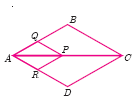
\(\frac { QB }{ AQ } =\frac { DR }{ AR } \)
47.
If A and B are two mutually exclusive events of a random experiment and P(not A) = 0.45, P(A U B) = 0.65, then find P(B).
48.
A die is rolled and a coin is tossed simultaneously. Find the probability that the die shows an odd number and the coin shows a head.
49.
Find the slope of the line which is Parallel to y = 0.7 x − 11
50.
Find the maximum volume of a cone that can be carved out of a solid hemisphere of radius r units.
51.
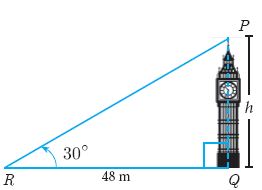
A tower stands vertically on the ground. from a point on the ground, which is 48m away from the foot of the tower, the angel of elevation of the top of the tower is 30°.find the height of the tower.
52.
The ratio of the volumes of two cones is 2 : 3. Find the ratio of their radii if the height of second cone is double the height of the first.
53.
Using the functions f and g given below, find f o g and g o f. Check whether f o g = g o f.
f(x) = x - 6, g(x) = x2
54.
Find the first term and common difference of the Arithmetic Progressions whose nth terms are given below tn = -3 + 2n
55.
Check whether the following sequences are in A.P. or not?
x + 2, 2x + 3, 3x + 4, ....
56.
Find the LCM of the following
8x4y2, 48x2y4
57.
Determine whether the sets of points are collinear? \((-\frac12 ,3)\), (- 5, 6) and (-8, 8)
58.
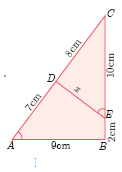
\(\angle A=\angle CED\) prove that \(\Delta\ CAB \sim \Delta CED\) Also find the value of x.
59.
60.
prove that \(\frac { sinA }{ 1+cosA } =\frac { 1-cosA }{ sinA } \)
61.
The shadow of a tower, when the angle of elevation of the sum is 45o is found to be 10 metres, longer than when it is 60o. find the height of the tower
62.
From a point on a bridge across a river, the angles of depression of the banks on opposite sides at the river are 30° and 45°, respectively. If the bridge is at a height at 3 m from the banks, find the width at the river.
63.
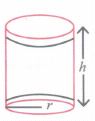
A wooden article was made by scooping out a hemisphere from each end of a cylinder as shown in figure. If the height of the cylinder is 10 cm and its base is of radius 3.5 cm find the total surface area of the article.
64.
S.D. of a data is 2102, mean is 36.6, then find its C.V.
65.
Find two consecutive natural numbers whose product is 20.
66.
Seven years ago, Varun's age was five times the square of Swati's age. Three years hence Swati's age will be two fifth of Varun's age. Find their present ages.
67.
How many terms of the AP: 24, 21, 18, ... must be taken so that their sum is 78?
68.
If the sum of the first 14 terms of an AP is 1050 and its first term is 10, find the 20th term.
69.
Find the area of the triangle formed by the points P(-1, 5, 3), Q(6, -2) and R(-3, 4).
70.
f(x) = (1+ x)
g(x) = (2x - 1)
Show that fo(g(x)) = gof(x)
71.
Let f = {(2, 7); (3, 4), (7, 9), (-1, 6), (0, 2), (5,3)} be a function from A = {-1,0, 2, 3, 5, 7} to B = {2, 3, 4, 6, 7, 9}. Is this
(i) an one-one function
(ii) an onto function,
(iii) both one and onto function?
72.
If A = \(\left[ \begin{matrix} 1 & 8 & 3 \\ 3 & 5 & 0 \\ 8 & 7 & 6 \end{matrix} \right] \), B = \(\left[ \begin{matrix} 8 & -6 & -4 \\ 2 & 11 & -3 \\ 0 & 1 & 5 \end{matrix} \right] \), C = \(\left[ \begin{matrix} 5 & 3 & 0 \\ -1 & -7 & 2 \\ 1 & 4 & 3 \end{matrix} \right] \) compute the following
\(\\ \frac { 1 }{ 2 } A-\frac { 3 }{ 2 } B\)
73.
if sin\(\theta \) (1 + sin2\(\theta \)) = cos2\(\theta \), then prove that cos6\(\theta \) - 4cos4\(\theta \) + 8cos2\(\theta \) = 4
74.
The King, Queen and Jack of the suit spade are removed from a deck of 52 cards. One card is selected from the remaining cards. Find the probability of getting
(i) a diamond
(ii) a queen
(iii) a spade
(iv) a heart card bearing the number 5.
75.
If two dice are rolled, then find the probability of getting the product of face value 6 or the difference of face values 5.
76.
Find X and Y if X + Y = \(\left[ \begin{matrix} 7 & 0 \\ 3 & 5 \end{matrix} \right] \) and X - Y = \(\left[ \begin{matrix} 3 & 0 \\ 0 & 4 \end{matrix} \right] \)
77.
The mean and variance of seven observations are 8 and 16 respectively. If five of these are 2, 4, 10, 12 and 14, then find the remaining two observations.
78.
A vertical pole fixed to the ground is divided in the ratio 1:9 by a mark on it with lower part shorter than the upper part. If the two parts subtend equal angles at a place on the ground, 25 m away from the base of the pole, what is the height of the pole?
79.
A(-3, 0) B(10, - 2) and C(12, 3) are the vertices of ΔABC. Find the equation of the altitude through A and B.
80.
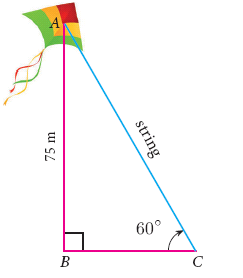
A kite is flying at a height of 75m above the ground, the string attached to the kite is temporarily tied to a point on the ground. The inclination of the string with the ground is \(60°\).find the length of the string ,assuming that there is no slack in the string.
81.
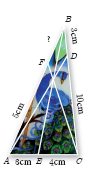
An artist has created a triangular stained glass window and has one strip of small length left before completing the window. She needs to figure out the length of left out portion based on the lengths of the other sides as shown in the figure.
82.
In \(\triangle\)ABC , with \(\angle\)B=90° , BC = 6 cm and AB = 8 cm, D is a point on AC such that AD = 2 cm and E is the midpoint of AB. Join D to E and extend it to meet at F. Find BF.
83.
Find the equation of a line whose intercepts on the x and y axes are given below. 4, -6
84.
As shown in figure a cubical block of side 7 cm is surmounted by a hemisphere. Find the surface area of the solid.
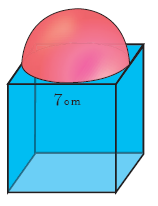
85.
A hemispherical section is cut out from one face of a cubical block such that the diameter l of the hemisphere is equal to side length of the cube. Determine the surface area of the remaining solid.
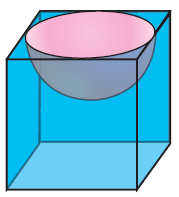
86.
Let A = {1, 2} and B = {1, 2, 3, 4}, C = {5, 6} and D = {5, 6, 7, 8}, Verify whether A x C is a subset of B x D?
87.
Iniya bought 50 kg of fruits consisting of apples and bananas. She paid twice as much per kg for the apple as she did for the banana. If Iniya bought Rs. 1800 worth of apples and Rs. 600 worth bananas, then how many kgs of each fruit did she buy?
88.
Find the volume of the iron used to make a hollow cylinder of height 9 cm and whose internal and external radii are 21 cm and 28 cm respectively
89.
Construct a triangle \(\triangle\)PQR such that QR = 5 cm, \(\angle\)P = 30o and the altitude from P to QR is of length 4.2 cm.
90.
Construct a \(\triangle\)PQR such that QR = 6.5 cm,\(\angle\)P = 60oand the altitude from P to QR is of length 4.5 cm.
1.
(b)
\(250\sqrt { 3 } \)
2.
(b)
75
3.
(d)
\(\frac { 4 }{ 5 } \)
4.
(b)
60 kg
5.
(b)
7:3
6.
(b)
15 cm
7.
(a)
(6, -1)
8.
(c)
2:7
9.
(d)
10.
(c)
\(x=\frac { ay }{ b-a } \)
11.
(b)
24 cm
12.
(d)
13.
(b)
\(\frac { x }{ x+2 } \)
14.
(c)
15.
(c)
16.
(b)
1
17.
(d)
10
18.
(d)
one - one but not onto
19.
(c)
2-4x
20.
(b)
5, -5
21.
(a)
0 ≤ p(∈) ≤ 1
22.
(b)
23.
(d)
24.
(b)
25.
(b)
7
26.
(b)
1
27.
(a)
0
28.
(b)
\(\frac { b }{ 3 } \)
29.
(b)
an Arithmetic Progression
30.
(d)
2520
31.
(c)
(3, 5)
32.
(c)
9
33.
(b)
34.
(d)
\(5\sqrt { 2 } \)cm
35.
(a)
36.
(a)
12 cm
37.
(c)
\(\\ \frac { 2 }{ 9x^{ 2 } } \)
38.
(c)
One-to-one function
39.
(b)
G.P
40.
(a)
41.
An arrow diagram
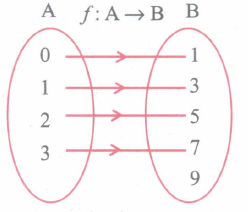
42.
A = {1,2,3},B = {1,3,5, 7,9}
f(x) = 2x + 1
f(0)) = 2(0) + 1 = 1
f(1) = 2(1) + 1=3
f(2) = 2(2) + 1 = 5
f(3) = 2(3) + 1 = 7
(i) A set of ordered pairs.
f = {(0, 1), (1, 3), (2, 5), (3, 7)}
(ii) A table
| x | 0 | 1 | 2 | 3 |
| f(x) | 1 | 3 | 5 | 7 |
(ii) An arrow diagram
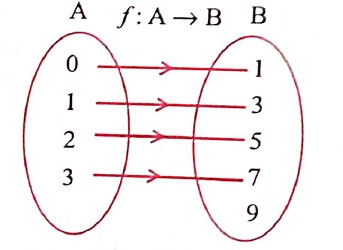
(iv) A Graph f = \(\{(x, f(x) / x \in A\}\)
= {(0, 1), (1, 3), (2, 5), (3, 7)}
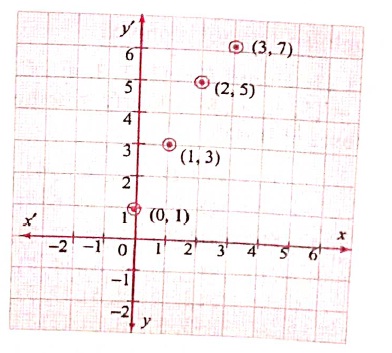
43.
Domain of R = {1,2,3,4}
Co-domain of R = B = {-1, 2, 3,4,5,6, 7, 9, 10, 11,12}
Range of R = {3, 6,10, 9}
44.
2x2 + 5x + 7 = 0
a = 2. b = 5, c = 7
α + β = \(-\frac {b}{a}\) = \(-\frac {5}{2}\) and αβ = \(\frac {c}{a}=\frac {7}{2}\)
α + β = \(-\frac {5}{2}\); αβ = \(\frac {7}{2}\)
45.
Given points (sin θ, -cos θ) and (-sin θ, cos θ)
Slope of a line = \(\frac{y_{1}-y_{2}}{x_{1}-x_{2}}\)
\(=\frac{-\cos \theta-\cos \theta}{\sin \theta+\sin \theta}=-\frac{2 \cos \theta}{2 \sin \theta}=-\cot \theta\)
46.
From (1) and (2) we have
\(\frac{A Q}{A B} =\frac{A R}{A D}
\)
\(\frac{A B}{A Q} =\frac{A D}{A R}
\)
\(\frac{A Q+Q B}{A Q} =\frac{A R+R D}{A R}
\)
\(1+\frac{Q B}{A Q} =1+\frac{R D}{A R}
\)
\(\Rightarrow \frac{Q B}{A Q} =\frac{D R}{A R}
\)
47.
Since A and B are mutually exclusive events
\(\mathrm{P}(A \cap B)=0\)
P(not A) = 0.45
P(A) = 1 - P(not A)
P(A) = 1 - 0.45 = 0.55
\(\mathrm{P}(A \cup B)=\mathrm{P}(\mathrm{A})+\mathrm{P}(\mathrm{B})-\mathrm{P}(A \cap B)\)
0.65 = 0.55 + P(B) - 0
P(B) = 0.65 - 0.55 = 0.1
48.
Sample space
S = {1H,1T,2H,2T,3H,3T,4H,4T,5H,5T,6H,6T};
n(S) = 12
Let A be the event of getting an odd number and a head.
A = {1H, 3H, 5H}; n(A) = 3
P(A) = \(\frac { n(A) }{ n(S) } =\frac { 3 }{ 12 } =\frac { 1 }{ 4 } \)
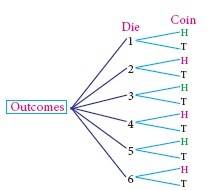
49.
Given line is y = 0.7x - 11 is in the form
y = mx + c
Slope m = 0.7
slope of the line parallel to y = 0.7 x - 11 is
m = 0.7.
(Slopes are equal when the lines are parallel)
50.
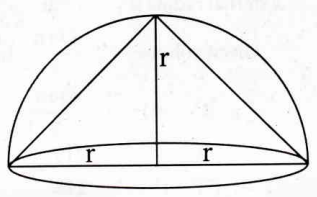
Radius of hemisphere = r units
Radius of cone = Radius of hemisphere
Height of cone = Radius of hemisphere
Maximum volume of cone = \(\frac{1}{3} \pi r^{2} h \text { cu. units }\)
\(=\frac{1}{3} \pi\left(r^{2}\right) r=\frac{1}{3} \pi r^{3} \text { cu. units }\)
51.
Let PQ the height of the tower.
Take PQ = h and QR is the distance between the tower and the point R.in right triangle PQR,\(\angle \)PRQ=30°
tan\(\theta =\frac { PQ }{ QR } \)
tan30° = \(\frac { h }{ 48 } \) gives,\(\frac { 1 }{ \sqrt { 3 } } =\frac { h }{ 48 } \) so, h =\(16\sqrt { 3 } \)
Therefore the height of the tower \(16\sqrt { 3 } \) m
52.
Let r1 and h1 be the radius and height of the cone - I and let r2 and h2 be the radius and height of the cone-II.
Given h2 = 2h1 = 2 and \(\frac { Volume\ of\ the\ cone\ I }{ Volume\ of\ the\ cone\ II } =\frac { 2 }{ 3 } \)
\(\frac { \frac { 1 }{ 3 } { \pi r }_{ 1 }^{ 2 }{ h }_{ 1 } }{ \frac { 1 }{ 3 } { \pi r }_{ 2 }^{ 2 }{ h }_{ 2 } } =\frac { 2 }{ 3 } \)
\(\frac { { r }_{ 1 }^{ 2 } }{ { r }_{ 2 }^{ 2 } } \times \frac { { h }_{ 1 } }{ 2{ h }_{ 2 } } =\frac { 2 }{ 3 } \)
\(\frac { { r }_{ 1 }^{ 2 } }{ { r }_{ 2 }^{ 2 } } =\frac { 4 }{ 3 } \text {gives} \frac { { r }_{ 1 } }{ { r }_{ 2 } } =\frac { 2 }{ \sqrt { 3 } } \)
Therefore, ratio of their radii = 2 : \(\sqrt3\)
53.
f(x) = x - 6, g(x) = x2
fog(x) = f(g(x)) = f(x2) = x2 - 6 ...(1)
gof(x) = g(f(x)) = g(f(x)) = g(x - 6) = (x - 6)2
= x2 - 12x + 36
fog(x) ≠ gof
54.
Given the nth term of the A.P. is tn = - 3 + 2n
Put n = 1
t1 = -3 + 2(1) = - 3 + 2
a = t1 = -1
Put n = 2
t2 = -3 + 2(2) = - 3 + 4
t2 = 1
Common difference d = t2 - t1 = 1 - (-1)
= 1 + 1 = 2
First term a = - 1; Common difference d = 2
55.
To check that the given sequence is in A.P., it is enough to check if the differences between the consecutive terms are equal or not.
t2 - t1 = (2x + 3) - (x - 2) = x + 1
t3 - t1 = (3x +4) - (2x +3) = x +1
t2 - t1 = t3 - t2
Thus, the differences between consecutive terms are equal.
Hence the sequence x + 2, 2x + 3, 3x + 4,..... is in A.P
56.
8x4y2, 48x2y4
First let us find the LCM of the numerical coefficients.
That is, LCM (8, 48) = 2 x 2 x 2 x 6 = 48
Then find the LCM of the terms involving variables.
That is, LCM (x4y2, x2y4) = x4y4
Finally find the LCM of the given expression.
We conclude that the LCM of the given expression is the product of the LCM of the numerical coefficient and the LCM of the terms with variables.
Therefore, LCM (8x4y2, 48x2y4) = 48 x4y4
57.
Given points are \((-\frac12 ,3)\), (- 5, 6) and (-8, 8)
Let us use area of triangle formula
Area of triangle = \(\frac{1}{2}\left[x_{1}\left(y_{2}-y_{3}\right)+\right.
\left.\quad x_{2}\left(y_{3}-y_{1}\right)+x_{3}\left(y_{1}-y_{2}\right)\right]
\)
\(=\frac{1}{2}\left[-\frac{1}{2}(6-8)-5(8-3)-8(3-6)\right]
\)
\(=\frac{1}{2}\left[-\frac{1}{2}(-2)-5(5)-8(-3)\right]
\)
\(=\frac{1}{2}[1-25+24]=\frac{1}{2}(0)=0
\)
Since, the area of triangle is zero, the given points are collinear.
58.
\(\Delta \ CAB\) and \(\Delta CED\),\(\angle C\) is common, \(\angle A=\angle CED\)
Therefore, \(\Delta CAB\sim \Delta CED\)
Hence, \(\frac { CA }{ CE } =\frac { AB }{ DE } =\frac { CB }{ CD } \)
\(\frac { AB }{ DE } =\frac { CB }{ CD } \quad \frac { 9 }{ x } =\frac { 10+2 }{ 8 } ,x=\frac { 8\times 9 }{ 12 } =6\) cm.
59.
60.
\(\frac { sinA }{ 1+cosA } = \)\(\frac { sinA }{ 1+cosA } \)\(\times \frac { 1-cosA }{ 1-cosA } \) [ multiply numerator and denominator by the conjugate of 1+cosA]
= \(\frac { sinA(1-cosA) }{ (1+cosA)\quad (1-cosA) } =\frac { sinA(1-cosA) }{ 1-co{ s }^{ 2 }A } \)
= \(\frac { sinA(1-cosA) }{ si{ n }^{ 2 }A } =\frac { 1-cosA }{ sinA } \)
61.
62.
A and B represent points on the bank on opposite sides at the river, so that AB is the width of the river. P is a point on the bridge at a height of 3m i.e., DP = 3 m. We are interested to determine the width at the river which is the length at the side AB of the ΔAPB.
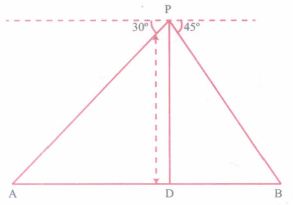
Now, AB = AD + DB
In right ΔAPD,
ㄥA = 30o
So, tan 30° = \(\frac { 1 }{ \sqrt { 3 } } =\frac { 3 }{ AD } \)
i.e., \(\frac { 1 }{ \sqrt { 3 } } =\frac { 3 }{ AD } \) (or) AD = 3\(\sqrt { 3 } \)
Also, in right ΔPBD,
B = 45o
So, BD = PD = 3m
Now, AB = BD + AD
= 3 + 3\(\sqrt { 3 } \) = 3(1+\(\sqrt { 3 } \))m
Therefore, the width at the river is 3(+\(\sqrt { 3 } \))m
63.
Radius of the cylinder be r
Height of the cylinder be h
Total surface area of the article
= CSA of cylinder + CSA of 2 hemispheres
= 2ㅠrh + 2πr2 = 2πr(h + 2r)
\(=2\times \frac { 22 }{ 7 } \times 3.5\times (10+2\times 3.5)\)
= 22 x 17 = 374 cm2
64.
σ = 21.2, \(\bar { x } \) = 36.6
CV = \(\frac { \sigma }{ \bar { x } } \) x 100 = \(\frac { 21.2 }{ 36.6 } \) x 100 = 57.92%
65.
Let a natural number be x.
The next number = x + 1
x (x + 1) = 20
X2+x-20 = 0
(x + 5)(x - 4) = 0
x=-5,4
∴ x=4
(∵ x≠-5, x is a natural number
The next number = 4 + 1= 5
Two consecutive numbers are 4,5.
66.
Seven years ago, let Swathi's age be x years .
Seven years ago, let Varun's age was 5x2 years.
Swathi's present age = x + 7 years
Varun's present age = (5x2 + 7) years
3 years hence, we have
Swathi's age = x + 7 + 3 years
=x + 10 years
Varun's age = 5x2 + 7 + 3 years
= 5x2 + 10 years
It is given that 3 years hence Swathi's age will
be \(\frac{2}{5}\) of Varun's age.
∴ x+10=\(\frac{2}{5}\)(5x2+10)
⇒ x+10=2x2+4
⇒ 2x2-x-6=0
⇒ 2x(x-2)+3(x-2)=0
⇒(2x+3)(x-2)=0
⇒ x-2=0
⇒ x=2(∵2x+3≠0 as x>0)
Hence Swathi's present age = (2 + 7) years
= 9 years
Varun's present age = (5 x 22 + 7) years
= 27 years
67.
Here a = 24, d = 21-24 = -3, Sn = 78. We need to find n.
We know that,
Sn= \(\frac{n}{2}\) (2a + (n - 1)d)
78 = \(\frac{n}{2}\) 48 + (n -1)(-3))
78 = \(\frac{n}{2}\) 2(51-3n)
or 3n2 - 51n + 156 = 0
n2 -17n + 52 = 0
(n - 4)(n - 13) = 0
n = 4 or 13
The number of terms are 4 or 13.
68.
Here S14 = 1050
n = 14
a = 10
Sn = \(\frac{n}{2}\) 2(2a + (n -1)d)
1050 = \(\frac{14}{2}\)(20 + 13d)
= 140 + 91d
910 = 91d
d = 10
a20 = 10 + (20 - 1) x 10
= 20
∴ 20th term = 200.
69.
The area of the triangle formed by the given points is equal to
= \(\frac { 1 }{ 2 } \) [-1.5 (-2 - 4) + 6 (4 - 3) + (-3) (3 + 2)]
= \(\frac { 1 }{ 2 } \) [9 + 6 - 15] = 0
We can have a triangle at area 0 square units? What does this mean?
If the area of a triangle is 0 square units, then its vertices will be collinear.
70.
f(x) = 1 + x
g(x) = (2x - 1)
fog(x) = f(g(x) = f(2x - 1)
= 1 + 2x - 1 = 2x ...(1)
gof(x) = g(f(x) = g(1 + x) = 2(1 + x) - 1
= 2 + 2x - 1
= 2x + 1 ...(2)
(1) \(\neq \)(2)
\(\therefore\) fog(x) \(\neq \) gof(x)
It is verified
71.
It is both one-one and onto function
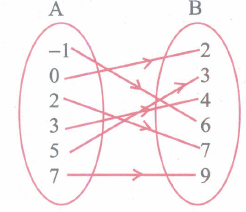
All the elements in A have their separate images in B. All the elements in B have their preimage in A. Therefore it is one-one and onto function.
72.
\(\\ \frac { 1 }{ 2 } A-\frac { 3 }{ 2 } B\) = \(\frac {1}{2}\)(A - 3B)
= \(\frac { 1 }{ 2 } \left( \left[ \begin{matrix} 1 & 8 & 3 \\ 3 & 5 & 0 \\ 8 & 7 & 6 \end{matrix} \right] -3\left[ \begin{matrix} 8 & -6 & -4 \\ 2 & 11 & -3 \\ 0 & 1 & 5 \end{matrix} \right] \right) \)
= \(\frac { 1 }{ 2 } \left[ \left[ \begin{matrix} 1 & 8 & 3 \\ 3 & 5 & 0 \\ 8 & 7 & 6 \end{matrix} \right] +\left[ \begin{matrix} -24 & 18 & 12 \\ -6 & -33 & 9 \\ 0 & -3 & -15 \end{matrix} \right] \right] =\frac { 1 }{ 2 } \left[ \begin{matrix} -23 & 26 & 15 \\ -3 & -28 & 9 \\ 8 & 4 & -9 \end{matrix} \right] \)
= \(\left[ \begin{matrix} -\frac { 23 }{ 2 } & 13 & \frac { 15 }{ 2 } \\ -\frac { 3 }{ 2 } & -14 & \frac { 9 }{ 2 } \\ 4 & 2 & -\frac { 9 }{ 2 } \end{matrix} \right] \)
73.
Given sin \(\theta \) (1+ sin2 \(\theta \)) = cos2 \(\theta \)
Squaring on both the sides.
sin2 \(\theta \)(1+ sin2 \(\theta \))2 = cos4 \(\theta \)
\(\Rightarrow\left(1-\cos ^{2} \theta\right)\left\{1+\left(1-\cos ^{2} \theta\right)\right\}^{2}=\cos ^{4} \theta\)
\(\Rightarrow\left(1-\cos ^{2} \theta\right)\left\{1+\left(1-\cos ^{2} \theta\right)^{2}+2(1)\left(1-\cos ^{2} \theta\right)\right\}
=\cos ^{4} \theta
\)
\(\Rightarrow\left(1-\cos ^{2} \theta\right)\left(1+1+\cos ^{4} \theta-2(1) \cos ^{2} \theta\right.
\left.+2-2 \cos ^{2} \theta\right)=\cos ^{4} \theta
\)
\(\Rightarrow\left(1-\cos ^{2} \theta\right)\left(4-4 \cos ^{2} \theta+\cos ^{4} \theta\right)=\cos ^{4} \theta
\)
\(\Rightarrow 4-4 \cos ^{2} \theta+\cos ^{4} \theta-4 \cos ^{2} \theta+4 \cos ^{4} \theta-\cos ^{6} \theta
\ =\cos ^{4} \theta
\)
\(\Rightarrow \ 4-8 \cos ^{2} \theta+5 \cos ^{4} \theta-\cos ^{6} \theta=\cos ^{4} \theta
\)
\(4-8 \cos ^{2} \theta+4 \cos ^{4} \theta-\cos ^{6} \theta=0
\)
\(4=8 \cos ^{2} \theta-4 \cos ^{4} \theta+\cos ^{6} \theta
\)
\(\Rightarrow \cos ^{6} \theta-4 \cos ^{4} \theta+8 \cos ^{2} \theta=4
\)
74.
King spade, Queen spade, Jack spade are removed
∴ total number of cards = 52 - 3 = 49.
(i) Probability (diamond)= \(\frac { 13 }{ 49 } \)
(ii) Probability (queen) \(\frac { 4-1 }{ 49 } =\frac { 3 }{ 49 } \)
(iii) Probability (spade) = \(\frac { 13-3 }{ 49 } =\frac { 10 }{ 49 } \)
(iv) Probability (heart bearing number 5) = \(\frac { 13-5 }{ 49 } =\frac { 8 }{ 49 } \)
75.
Product of face values 6: { (1, 6), (2, 3), (6, 1), (3,2)}
Difference of face value 5: {(1, 6), (6, 1)}
P(product 6) = \(\frac { 4 }{ 6\times 6 } =\frac { 4 }{ 36 } =\frac { 1 }{ 9 } \)
p( difference 5) = \(\frac { 2 }{ 2\times 6 } =\frac { 1 }{ 18 } \)
76.
X + Y = \(\left[ \begin{matrix} 7 & 0 \\ 3 & 5 \end{matrix} \right] \) ...(1)
X - Y= \(\left[ \begin{matrix} 3 & 0 \\ 0 & 4 \end{matrix} \right] \) ...(2)
______________
\((1)+(2)\Rightarrow 2x=\left[ \begin{matrix} 10 & 0 \\ 3 & 9 \end{matrix} \right] \)
\(=\left[ \begin{matrix} 5 & 0 \\ \frac { 3 }{ 2 } & \frac { 9 }{ 2 } \end{matrix} \right] \)
\((1)-(2)\Rightarrow X+Y=\left[ \begin{matrix} 7 & 0 \\ 3 & 5 \end{matrix} \right] \)
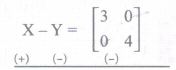
\(2Y=\left[ \begin{matrix} 4 & 0 \\ 3 & 1 \end{matrix} \right] \Rightarrow Y=\frac { 1 }{ 2 } \left[ \begin{matrix} 4 & 0 \\ 3 & 1 \end{matrix} \right] \)
\(\therefore Y=\left[ \begin{matrix} 2 & 0 \\ \frac { 3 }{ 2 } & \frac { 1 }{ 2 } \end{matrix} \right] \)
\(X=\left[ \begin{matrix} 5 & 0 \\ \frac { 3 }{ 2 } & \frac { 9 }{ 2 } \end{matrix} \right] , Y=\left[ \begin {matrix} 2 & 0 \\ \frac { 3 }{ 2 } & \frac { 1 }{ 2 } \end{matrix} \right] \)
77.
Mean = 8
Variance = 16.
Let a and b be the missing observations
\(\frac{\text { Sum of observations }}{\text { Number of observations }}=\text { Mean }\)
\(\frac{2+4+10+12+14+a+b}{7}=8\)
42 + a + b = 56
a + b = 56 - 42 = 14
b = 14 - a
Variance \(=\frac{\sum_{i=1}^{n}\left(x_{i}-\bar{x}\right)^{2}}{n}
\)
\(= \frac{\sum_{i=1}^{7}\left(x_{i}-\bar{x}\right)^{2}}{7}
\)
\(=\frac{(2-8)^{2}+(4-8)^{2}+(10-8)^{2}+(12-8)^{2}+(14-8)^{2}+(a-8)^{2}+(b-8)^{2}}{7}\)
\(16=\frac{36+16+4+16+36+(a-8)^{2}+(b-8)^{2}}{7}\)
108 + (a - 8)2 + (b - 8)2 = 112
(a - 8)2 + (b - 8)2 = 4 ..(2)
Put b = 14 - a in (2)
(a - 8)2 + (b - 8)2 = 4
(a - 8)2 + (14 - a ) - 8)2 = 4
(a - 8 )2 + (6 - a)2 = 4
a2 + 64 - 16a + 36 + a2 - 12a - 4 = 0
2a2 - 28a + 96 = 0
Divided by 2,
a2 - 14a + 48 = 0
(a - 6) (a - 8) = 0
a = 6 or a = 8
a = 6 , b = 14, a = 14 - 6 = 8
a = 6 and b = 8
Remaining numbers are 6 and 8.
78.
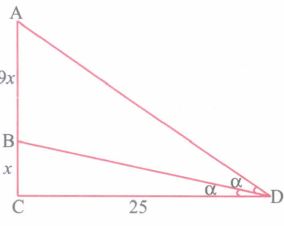
Let AC be the pole and let point 'B' divide it in the ratio
\(\not x: 9 \not x=1: 9\)
Let 'D' be the point 25 m.
\(tan\alpha =\frac { x }{ 25 } \) \(tan2\alpha =\frac { 10x }{ 25 } \)
\(tan2\alpha =\frac { 2tan\alpha }{ 1-{ tan }^{ 2 }\alpha } \)
\(\frac{\not 10 x^{5}}{\not 25}=\frac{2 \times \frac{x}{25}}{1-\frac{x^{2}}{625}}\)
.JPG)
Height of pole = 10x
= \(100\sqrt { 5 } \)
x = \(10\sqrt { 5 } \) m
79.
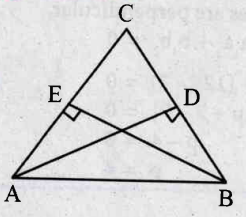
Given vertices are A(- 3, 0), B(10, - 2) and, C(12, 3).
Slope of BC = \(\frac{y_{1}-y_{2}}{x_{1}-x_{2}}=\frac{-2-3}{10-12}=\frac{-5}{-2}=\frac{5}{2}\)
Altitude AD is perpendicular to BC and passing through A(- 3, 0)
Slope of AD = \(-\frac{2}{5}\)
Equation of AD y - y1 = m(x - x1)
\(y-0=-\frac{2}{5}(x+3)\)
5y = -2x - 6
2x + 5y + 6 = 0
Slope of AC \(=\frac{y_{1}-y_{2}}{x_{1}-x_{2}}=\frac{0-3}{-3-12}=\frac{-3}{-15}=\frac{1}{5}\)
Altitude BE is perpendicular to AC and passing through B(10, - 2). Slope of BE = 5
Equation of BE y - y1 = m(x - x1)
y + 2 = - 5(x - 10)
y + 2 = -5x + 50
5x + y - 48 = 0
80.
Let AB be the height of the kite above the ground. Then, AB = 75.
Let AC be the length of the string.
In right triangle ABC,\(\angle \)ACB = \(60°\)
\(sin\theta =\frac { AB }{ AC } \)
\(sin60°=\frac { 75 }{ AC } \)
gives \(\frac { \sqrt { 3 } }{ 2 } =\frac { 75 }{ AC } \) so, AC = \(\frac { 150 }{ \sqrt { 3 } } =50\sqrt { 3 } \)
Hence, the length of the string is 50\(\sqrt { 3 } m\)
81.
Clearly In \(\triangle\)ABC, D, E, F are points on lines BC, CA, AB respectively using Ceva's theorem, we have
\(\frac{A E}{E C} \times \frac{C D}{D B} \times \frac{B F}{F A}=1\) ...(1)
From the diagram it is clear that
AE = 3, EC = 4, CD = 10, DB = 3, FA = 5
Substituting these values in (1)
\(
\frac{3}{4} \times \frac{10}{3} \times \frac{B F}{5} =1
\)
\(B F =\frac{1 \times 4 \times 3 \times 5}{3 \times 10}=2 \mathrm{~cm}\)
82.
Consider DABC, Then D, E, F are respective points on the sides CA, AB and Be. By construction D, E, F are collinear
By Menelaus' Theorem, \(\frac { AE }{ EB } \times \frac { BF }{ FC } \times \frac { CD }{ DA } =1\)
FC = FB + BC = BF + 6
By Pythagoras Theorem AC2 = AB2 + BC2
=64+36=100
\(\therefore \) AC = 10, CD = 8
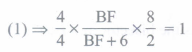
\(4BF=BF+6\Rightarrow BF=2cm\)
83.
Given intercepts are 4, - 6
a = 4, b = - 6
Equation of the line in the intercepts form is
\(\frac{x}{a}+\frac{y}{b}=1
\)
\(\frac{x}{4}+\frac{y}{-6}=1
\)
3x - 2y - 12 = 0
84.
Edge of cube = 7 cm
surface area of a cube = 6a2 sq. units
= 6(7)2
= 294 cm2
radius of hemisphere = \(\frac{7}{2} \mathrm{~cm}\)
[Only C.S.A is considered as the hemisphere surmounted]
C.S.A of hemisphere \(=2 \pi r^{2} \text { sq. units } \)
\(=2 \times \frac{22}{7} \times \frac{7}{2} \times \frac{7}{2} \)
= 77 Cm2
Surface area of = T.S.A of cube + C.S.A the solid of hemisphere area of circular region (bottom of hemisphere)
\(=294+77-\left(\frac{22}{7} \times \frac{7}{2} \times \frac{7}{2}\right)\)
= 371 - 38.5
= 332.5 cm2
85.
Let r be the radius of the hemisphere.
Given that, diameter of the hemisphere = side of the cube = l
Radius of the hemisphere = \(\frac{l}{2}\)
TSA of the remaining solid = Surface area of the cubical part + C.S.A. of the hemispherical part − Area of the base of the hemispherical part
= 6 x (Edge)2 + 2\(\pi\)r2−\(\pi\)r2
= 6 x (Edge)2 + \(\pi\)r2
\(=6{ \times (l) }^{ 2 }+\pi { \left( \frac { l }{ 2 } \right) }^{ 2 }=\frac { 1 }{ 4 } (24+\pi ){ l }^{ 2 }\)
Total surface area of the remaining solid \(=\frac { 1 }{ 4 } (24+\pi ){ l }^{ 2 }\)sq. units
86.
A = {1, 2),B = {1, 2, 3, 4}, C = {5, 6},D = {5, 6, 7, 8}
A x C = {1, 2} x {5, 6}
\(\mathrm{A} \times \mathrm{C}=\{(1,5),(1,6),(2,5),(2,6)\}\)
B x D = { 1, 2, 3, 4} x { 5, 6, 7, 8}
\(\begin{array}{r} \mathrm{B} \times \mathrm{D}=\{({1,5}),(1,6),(1,7),(1,8) ({2,5}),(2,6),(2,7),(2,8) (3,5),(3,6),(3,7),(3,8) (4,5),(4,6),(4,7),(4,8)\} \end{array}\)
(A x C) is a subset of (B x D)
87.
Let the weight of applies be a kg.
Let the weight of bananas be b kg.
a+b = 50
ax = Rs. 1800...(1)
by = Rs. 600 ..(2)
x = 2y ....(3)
Use (3) in (1) ⇒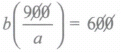
∵ 3b = 2a ....(5)
∵ a + b = 50
\(a+\frac { 2a }{ 3 } =50\Rightarrow \frac { 5a }{ 3 } =50\)
\(\Rightarrow a=50\times \frac { 3 }{ 5 } \)
= 30
∴ b = 20
∴ Iniya bought 30kg of applies and 20 kg of bananas.
88.
Let r, R and h be the internal radius, external radius and height of the hollow cylinder respectively.
Given that, r = 21cm, R = 28 cm, h = 9 cm
Now, volume of hollow cylinder = \(\pi\)(R2 − r2)h cu. units
\(=\frac { 22 }{ 7 } \left( { 28 }^{ 2 }-21^{ 2 } \right) \times 9\)
\(=\frac { 22 }{ 7 } (784-441)\times 9=9702\)
Therefore, volume of iron used = 9702 cm3
89.
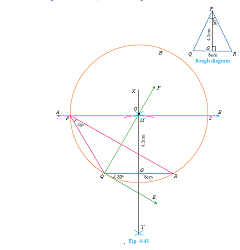
Construction
Step 1 : Draw a line segment QR = 5 cm.
Step 2 : At Q draw QE such that \(\angle\)RQE = 30o.
Step 3 : At Q draw QF such that \(\angle EQF\) = 90o
Step 4 : Draw the perpendicular bisector XY to QR which intersects QF at O and QR at G.
Step 5 : With O as centre and OQ as radius draw a circle.
Step 6: From G mark an arc in the line XY at M, such that GM = 42. cm.
Step 7 : Draw AB through M which is parallel to QR.
Step 8 : AB meets the circle at P and S.
Step 9 : Join QP and RP. Then\(\triangle\)PQR is the required triangle
90.
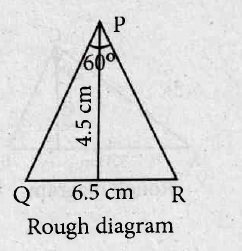
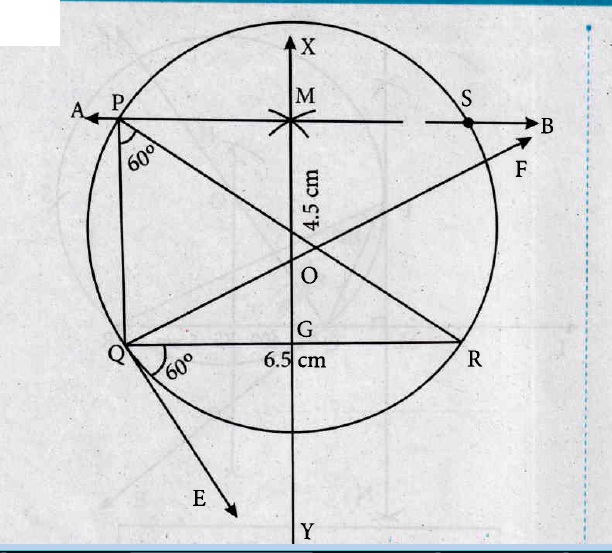
Construction:
Steps (1) Draw QR = 6.5 cm.
Steps (2) Draw \(\angle RQE={ 60 }^{ 0 }\)
Steps (3) Draw \(\angle FQE={ 90 }^{ 0 }\)
Steps (4) Drawn the perpendicular bisector XY to ER which intersects QF at O and ER at G.
Steps (5) With O as center and OQ as radius drawn a circle
Steps (6) XY intersects QR at G. On XY, from G marked an arc at M, such that GM = 4.5 cm
Steps (7) Drawn AB through M which is parallel to QR
Steps (8) AB meets the circle at P and S
Steps (9) Joined QP and RP Then \(\triangle\)PQR is the required triangle.
Steps (10) Here \(\triangle\)SQR is also another required triangle.

10th Standard Syllabus & Materials
10th Standard
TN 10th English Prose - 2 - The Night the Ghost Got in Important Questions And Answers Study Material - QB365 Set A
NEW10th Standard
TN 10th English Supplementary - 1 - The Tempest Important Questions And Answers Study Material - QB365 Set A
NEW10th Standard
TN 10th English Poem - 1 - Life Important Questions And Answers Study Material - QB365 Set A
NEW10th Standard
TN 10th English Prose - 1 - His First Flight Important Questions And Answers Study Material - QB365 Set A



Tamilnadu Stateboard 10th Standard Subjects
Tamilnadu Stateboard Standards





