
 100% FREE ACCESS
10th Standard Syllabus & Materials
10th Standard
TN 10th English Prose - 4 - The Attic Important Questions And Answers Study Material - QB365 Set A
NEW10th Standard
TN 10th English Supplementary - 3 - The Story of Mulan Important Questions And Answers Study Material - QB365 Set A
NEW10th Standard
TN 10th English Poem - 3 - I am Every Woman Important Questions And Answers Study Material - QB365 Set A
NEW10th Standard
TN 10th English Prose - 3 - Empowered Women Navigating The World Important Questions And Answers Study Material - QB365 Set A
NEW10th Standard
TN 10th English Supplementary - 2 - Zigzag Important Questions And Answers Study Material - QB365 Set A
NEW10th Standard
TN 10th English Poem - 2 - The Grumble Family Important Questions And Answers Study Material - QB365 Set A

Published on: 06/02/2020
10th Standard Mathematics Questions -I- 2019-2020
Download Tamil Nadu 10th Standard Maths question papers, model tests, one-mark questions, important questions, and public exam papers in PDF format. Free study materials and answer keys for TN State Board students.
Questions + Answers key
Take MCQ Maths Test1.
The top of two poles of height 18.5m and 7m are connected by a wire. If the wire makes an angle of measures 360o with horizontal, then the length of the wire is ____________
23m
18m
28m
25.5m
2.
If m cos θ + n sin θ = a and m sin θ - n cos θ = b then a2 + b2 is equal to ___________
m2-n2
m2+n2
m2n2
n2-m2
3.
If x = r sin θ cos φ y = r sin θ. Then x2 + y2 + z2___________
r
r2
\(\cfrac { { r }^{ 2 } }{ 2 } \)
2r2
4.
A number x is chosen at random from -4, -3, -2, -1, 0, 1, 2, 3, 4. The probability that \(\left| x \right| \le 3\) is ___________
\(\frac { 3 }{ 9 } \)
\(\frac { 4 }{ 9 } \)
\(\frac { 1 }{ 9 } \)
\(\frac { 7 }{ 9 } \)
5.
If the observations 1, 2, 3, ... 50 have the variance V1 and the observations 51, 52, 53, ... 100 have the variance V2 then \(\frac { { V }_{ 1 } }{ { V }_{ 2 } } \) is ___________
2
1
3
0
6.
If the smallest value and co-efficient of range a data are 25 and 0.5 respectively. Then the largest value is ___________
25
75
100
12.5
7.
A floating boat having a length 3m and breadth 2m is floating on a lake. The boat sinks by 1 cm when a man gets into it. The mass of the man is (density of water is 10000 kg/m3)
50 kg
60 kg
70 kg
80 kg
8.
The height of a cone is 60 cm. A small cone is cut off at the top by plane parallel to the base and its volume is \(\left[ \frac { 1 }{ 64 } \right] ^{ th }\) the volume of the original cone. Then the height of the smaller cone is ___________
45 cm
30 cm
15 cm
20 cm
9.
A line passing through the point (2, 2) and the axes enclose an area ∝. The intercept on the axes made by the line are given by the roots of ____________
x2-2-∝x+∝ = 0
x2+2∝x+∝ = 0
x2-∝x+2∝ = 0
none of these
10.
The area of triangle formed by the points (a, b+c), (b, c+a) and (c, a+b) is ____________
a+b+c
abc
(a+b+c)2
0
11.
12.
13.
I the given figure DE||AC which of the following is true.
\(x=\frac { ay }{ b+a } \)
\(x=\frac { a+b }{ ay } \)
\(x=\frac { ay }{ b-a } \)
\(\frac { x }{ y } =\frac { a }{ b } \)
14.
15.
The real roots of the quadratic equation x2-x-1 are ___________
1, 1
-1, 1
\(\frac { 1+\sqrt { 5 } }{ 2 } ,\frac { 1-\sqrt { 5 } }{ 2 } \)
None
16.
Consider the following statements:
(i) The HCF of x+y and x8-y8 is x+y
(ii) The HCF of x+y and x8+y8 is x+y
(iii) The HCF of x-y nd x8+y8 is x-y
(iv) The HCF of x-y and x8-y8 is x-y
(i) and (ii)
(ii) and (iii)
(i) and (iv)
(ii) and (iv)
17.
18.
19.
If \(f(x)=\frac { x+1 }{ x-2 } ,g(x)=\frac { 1+2x }{ x-1 } \) then fog(x) is ___________
Constant function
Quadratic function
Cubic function
Identify function
20.
If f(x) + f(1 - x) = 2 then \(f\left( \frac { 1 }{ 2 } \right) \) is ___________
5
-1
-9
1
21.
22.
The function t which maps temperature in degree Celsius into temperature in degree Fahrenheit is defined Fahrenheit degree is 95, then the value of C \(t(C)=\frac { 9c }{ 5 } +32\) is ___________
37
39
35
36
23.
How many balls, each of radius 1 cm, can be made from a solid sphere of lead of radius cm?
64
216
512
16
24.
A cylinder 10 cone and have there are of a equal base and have the same height. what is the ratio of there volumes?
3:1:2
3:2:1
1:2:3
1:3:2
25.
26.
Which of the following is not a measure of dispersion?
Range
Standard deviation
Arithmetic mean
Variance
27.
The electric pole subtends an angle of 30° at a point on the same level as its foot. At a second point ‘b’ metres above the first, the depression of the foot of the pole is 60°. The height of the pole (in metres) is equal to
\(\sqrt { 3 } \) b
\(\frac { b }{ 3 } \)
\(\frac { b }{ 2 } \)
\(\frac { b }{ \sqrt { 3 } } \)
28.
a cot \(\theta \) + b cosec\(\theta \) = p and b cot \(\theta \) + a cosec\(\theta \) = q then p2- q2 is equal to
a2 - b2
b2 - a2
a2 + b2
b - a
29.
In an A.P., the first term is 1 and the common difference is 4. How many terms of the A.P. must be taken for their sum to be equal to 120?
6
7
8
9
30.
An A.P. consists of 31 terms. If its 16th term is m, then the sum of all the terms of this A.P. is
16 m
62 m
31 m
\(\frac { 31 }{ 2 } \) m
31.
If A is a point on the Y axis whose ordinate is 8 and B is a point on the X axis whose abscissae is 5 then the equation of the line AB is
8x + 5y = 40
8x - 5y = 40
x = 8
y = 5
32.
A man walks near a wall, such that the distance between him and the wall is 10 units. Consider the wall to be the Y axis. The path travelled by the man is
x = 10
y = 10
x = 0
y = 0
33.
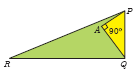
In the given figure, PR = 26 cm, QR = 24 cm, \(\angle PAQ\) = 90o, PA = 6 cm and QA = 8 cm. Find \(\angle\)PQR
80o
85o
75o
90o
34.
The perimeters of two similar triangles ∆ABC and ∆PQR are 36 cm and 24 cm respectively. If PQ = 10 cm, then the length of AB is
\(6\frac { 2 }{ 3 } cm\)
\(\frac { 10\sqrt { 6 } }{ 3 } cm\)
\(66\frac { 2 }{ 3 } cm\)
15 cm
35.
A shuttle cock used for playing badminton has the shape of the combination of
a cylinder and a sphere
a hemisphere and a cone
a sphere and a cone
frustum of a cone and a hemisphere
36.
37.
If g = {(1,1), (2,3), (3,5), (4,7)} is a function given by g(x) = αx + β then the values of α and β are
(-1,2)
(2,-1)
(-1,-2)
(1,2)
38.
If n(A x B) = 6 and A = {1,3} then n(B) is
1
2
3
6
39.
The values of a and b if 4x4 - 24x3 + 76x2 + ax + b is a perfect square are
100, 120
10, 12
-120, 100
12, 10
40.
A system of three linear equations in three variables is inconsistent if their planes
intersect only at a point
intersect in a line
coincides with each other
do not intersect
41.
Let A = {1,2,3,7} and B = {3,0,–1,7}, which of the following are relation from A to B ?
R4 = {(7,–1), (0, 3), (3, 3), (0, 7)
42.
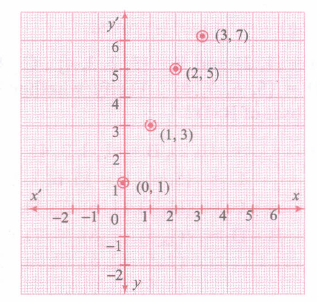
Let A = {0, 1, 2, 3} and B = {1, 3, 5, 7, 9} be two sets. Let f: A \(\rightarrow\)B be a function given by f(x) = 2x + 1. Represent this function as a graph.
43.
Let A = {0, 1, 2, 3} and B = {1, 3, 5, 7, 9} be two sets. Let f: A \(\rightarrow\)B be a function given by f(x) = 2x + 1. Represent this function as a table.
44.
Let A = {1,2, 3, 4} and B = {-1, 2, 3, 4, 5, 6, 7, 8, 9, 10, 11, 12} Let R = {(1, 3), (2, 6), (3, 10), (4, 9)} \(\subseteq \) A x B be a relation. Show that R is a function and find its domain, co-domain and the range of R.
45.
Write down the quadratic equation in general form for which sum and product of the roots are given below.
\(-\frac { 7 }{ 2 } ,\frac { 5 }{ 2 } \)
46.
Find the sum of the following
6 + 13 + 20 + ...+ 97
47.
Find the slope of the following straight lines \(7x-\frac { 3 }{ 17 } \) = 0
48.
Find the equation of a line through the given pair of points (2, 3) and (-7, -1)
49.
Find the area of the triangle formed by the points :(–10, –4), (–8, –1) and (–3, –5)
50.
A and B are two events such that, P(A) = 0.42, P(B) = 0.48, P(A ∩ B) = 0.16. Find (i) P(not A) (ii) P(not B) (iii) P(A or B)
51.
What is the probability that a leap year selected at random will contain 53 saturdays. (Hint: 366 = 52 x 7 + 2)
52.
The barrel of a fountain-pen cylindrical in shape, is 7 cm long and 5 mm in diameter. A full barrel of ink in the pen will be used for writing 330 words on an average. How many words can be written using a bottle of ink containing one fifth of a litre?
53.
Solve 2m2+ 19m + 30 = 0
54.
PQ is a tangent drawn from a point P to a circle with centre O and QOR is a diameter of the circle such that \(\angle\)PQR = 120o. Find \(\angle\)OPQ.
55.
A conical flask is full of water. The flask has base radius r units and height h units, the water poured into a cylindrical flask of base radius xr units. Find the height of water in the cylindrical flask.
56.
prove the following identities.\(\frac { 1-ta{ n }^{ 2 }\theta }{ co{ t }^{ 2 }\theta -1 } =ta{ n }^{ 2 }\theta \)
57.
Find the sum of first 28 terms of an A.P. whose nth term is 4n - 3.
58.
Let f = {(-1, 3), (0, -1), (2, -9)}. be a linear function from Z into Z. Find f(x).
59.
If \(\triangle\)ABC is similar to \(\triangle\)DEF such that BC = 3 cm, EF = 4 cm and area of \(\triangle\)ABC = 54 cm2. Find the area of \(\triangle\)DEF.
60.
prove that 1+\(\frac { co{ t }^{ 2 }\theta }{ 1+cosec\theta } \) = cosec\(\theta \)
61.
62.
Construct a triangle similar to a given triangle PQR with its sides equal to \(\frac{3}{5}\) of the corresponding sides of the triangle PQR (scale factor \(\frac { 3 }{ 5 } <1\))
63.
If 15tan2 θ+4 sec2 θ=23 then find the value of (secθ+cosecθ)2 -sin2 θ
64.
From a point on a bridge across a river, the angles of depression of the banks on opposite sides at the river are 30° and 45°, respectively. If the bridge is at a height at 3 m from the banks, find the width at the river.
65.
A spherical ball of iron has been melted and made into small balls. If the radius of each smaller ball is one-fourth of the radius of the original one, how many such balls can be made?
66.
| Team A | 50 | 20 | 10 | 30 | 30 |
| Team B | 40 | 60 | 20 | 20 | 10 |
Which team is more consistent?
67.
Find two consecutive natural numbers whose product is 20.
68.
The sum of two numbers is 15. If the sum of their reciprocals is \(\frac{3}{10}\), find the numbers.
69.
How many terms of the AP: 24, 21, 18, ... must be taken so that their sum is 78?
70.
Which of the following list of numbers form an AP ? If they form an AP, write the next two terms:
1, 1, 1, 2, 2, 2, 3, 3, 3
71.
Find the value of k if the points A(2, 3), B(4, k) and (6, -3) are collinear.
72.
A function f: [-7,6) \(\rightarrow\) R is defined as follows.
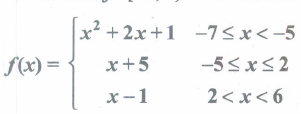
\(\cfrac { 4f(-3)+2f(4) }{ f(-6)-3f(1) } \)
73.
A function f: [-7,6) \(\rightarrow\) R is defined as follows.
find 2f(-4) + 3f(2)
74.
Find
\(\frac { 16{ x }^{ 2 }-2x-3 }{ 3{ x }^{ 2 }-2x-1 } \div \frac { 8{ x }^{ 2 }+11x+3 }{ 3{ x }^{ 2 }-11x-4 } \)
75.
The King, Queen and Jack of the suit spade are removed from a deck of 52 cards. One card is selected from the remaining cards. Find the probability of getting
(i) a diamond
(ii) a queen
(iii) a spade
(iv) a heart card bearing the number 5.
76.
77.
At a fete, cards bearing numbers 1 to 1000, one number on one card are put in a box. Each player selects one card at random and that card is not replaced. If the selected card has a perfect square number greater than 500, the player wins a prize. What is the probability that (i) the first player wins a prize (ii) the second player wins a prize, if the first has won?
78.
The angles of elevation and depression of the top and bottom of a lamp post from the top of a 66 m high apartment are 60° and 30° respectively. Find
The height of the lamp post.
79.
A man is standing on the deck of a ship, which is 40 m above water level. He observes the angle of elevation of the top of a hill as 60° and the angle of depression of the base of the hill as 30° . Calculate the distance of the hill from the ship and the height of the hill. (\(\sqrt { 3 } \) = 1.732)
80.
From the top of a lighthouse, the angle of depression of two ships on the opposite sides of it are observed to be 30° and 60°. If the height of the lighthouse is h meters and the line joining the ships passes through the foot of the lighthouse, show that the distance between the ships is \(\frac { 4h }{ \sqrt { 3 } } \)m.
81.
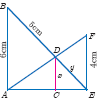
In the given figure AB || CD || EF. If AB = 6cm, CD = x cm, EF = 4 cm, BD = 5 cm and DE = y can. Final x and y
82.
The volume of a cone is 1005\(\frac{5}{7}\)cu. cm. The area of its base is 201\(\frac{1}{7}\)sq. cm. Find the slant height of the cone.
83.
Find the equation of a straight line Passing through (1, -4) and has intercepts which are in the ratio 2:5
84.
Find the values of a and b if the following polynomials are perfect squares
4x4 - 12x3 + 37x2 + bx + a
85.
If f(x) = \(\frac { x-1 }{ x+1 } \), x ≠ 1 show that f(f(x)) = -\(\frac{1}{x}\), provided x ≠ 0.
86.
A solid sphere and a solid hemisphere have equal total surface area. Prove that the ratio of their volume is 3\(\sqrt{3}\) : 4.
87.
5 m long ladder is placed leaning towards a vertical wall such that it reaches the wall at a point 4m high. If the foot of the ladder is moved 1.6 m towards the wall, then find the distance by which the top of the ladder would slide upwards on the wall
88.
The volume of a cylindrical water tank is 1.078 x 10⁶ litres. If the diameter of the tank is 7m, find its height.
89.
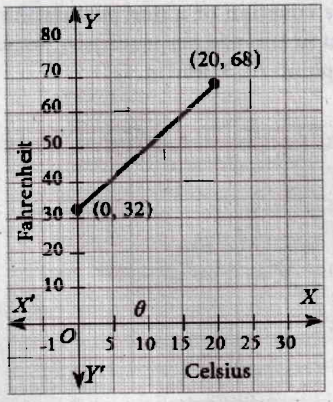
The graph relates temperatures y (in Fahrenheit degree) to temperatures x (in Celsius degree) Find the slope and y intercept
90.
Simplify
\(\frac { 2{ a }^{ 2 }+5a+3 }{ 2{ a }^{ 2 }+7a+6 } \div \frac { { a }^{ 2 }+6a+5 }{ -5{ a }^{ 2 }-35a-50 } \)
1.
(a)
23m
2.
(b)
m2+n2
3.
(b)
r2
4.
(d)
\(\frac { 7 }{ 9 } \)
5.
(b)
1
6.
(b)
75
7.
(b)
60 kg
8.
(c)
15 cm
9.
(c)
x2-∝x+2∝ = 0
10.
(d)
0
11.
(d)
12.
(c)
13.
(c)
\(x=\frac { ay }{ b-a } \)
14.
(c)
15.
(c)
\(\frac { 1+\sqrt { 5 } }{ 2 } ,\frac { 1-\sqrt { 5 } }{ 2 } \)
16.
(a) Capital employed - Goodwill + current liabilities
17.
(c)
18.
(b)
19.
(d)
Identify function
20.
(d)
1
21.
(a)
22.
(c)
35
23.
(a)
64
24.
(a)
3:1:2
25.
(d)
26.
(c)
Arithmetic mean
27.
(b)
\(\frac { b }{ 3 } \)
28.
(b)
b2 - a2
29.
(c)
8
30.
(i) To check if h is one – one, we assume that h(b1) = h(b2)
Then we get 2.47 b1 + 54.10 = 2.47 b2 + 54.10
2.47b1 = 2.47b2 ⇒ b1 = b2
Thus, h(b1) = h(b2) ⇒ b1 = b2, So, the function h is one – one.
(ii) If the length of the thigh bone b = 50, then the height is
h(50) = (2.47 x 50) + 54.10 = 177.6 cms
(iii) If the height of a person is 147.96 cms, then h(b) = 147.96 and so the length of the thigh bone is given by 2.47b + 54.10 = 147.96.
b = \(\frac { 93.86 }{ 2.47 } \)
Therefore, the length of the thigh bone is 38 cms.
31.
(a)
8x + 5y = 40
32.
(a)
x = 10
33.
(d)
90o
34.
(d)
15 cm
35.
(d)
frustum of a cone and a hemisphere
36.
(d)
37.
(b)
(2,-1)
38.
(c)
3
39.
(c)
-120, 100
40.
(d)
do not intersect
41.
A = { 1, 2, 3, 7}, B = { 3, 0, -1, 7}
A x B = {(1, 3), (1, 0), (1, - 1), (1, 7),(2,3), (2, 0), (2, -1), (2, 7), (3,3), (3, 0), (3, - 1), (3, 7), (7, 3)., (7, 0), (7, -1), (7 ,7)}
R4 = {(7, - 1), (0, 3), (3, 3), (0, 7)}
In this (0, 3) and (0, 7) ∈ R4
But (0, 3) and (0, 7) are not the elements of A x B.
Hence R4 is not a relation from A to B.
42.
A Graph f = {(x, f(x) / x \(\epsilon \) A}
{(0, 1), (1, 3), (2, 5), (3, 7)}
43.
A table
| x | 0 | 1 | 2 | 3 |
|---|---|---|---|---|
| f(x) | 1 | 3 | 5 | 7 |
44.
Domain of R = {1,2,3,4}
Co-domain of R = B = {-1, 2, 3,4,5,6, 7, 9, 10, 11,12}
Range of R = {3, 6,10, 9}
45.
\({ x }^{ 2 }-\left( -\frac { 7 }{ 2 } \right) x+\frac { 5 }{ 2 } =0\) gives 2x2 + 7x + 5 = 0
46.
Here t2 - t1 = t3 - t2
13 - 6 = 20 - 13 = 7
It is an Arithmetic series
Sum \(\mathrm{S}_{\mathrm{n}}=\frac{n}{2}(a+l)\)
a = 6 : l = 97
a + (n - 1) d = 97
6 + (n - 1) (7) = 97
(n - 1) (7) = 97 - 6
(n - 1) (7) = 91
\(n-1=\frac{91}{7}=13\)
n = 13 + 1 = 14
Now \(S_{n}=\frac{14}{2}(6+97)=7 \times 103\)
6 + 13 + 20 +...+ 97 = 721
47.
\(7x-\frac { 3 }{ 17 } \) = 0
Comparing with ax + by + c = 0
\(\text { Slope } =-\frac{a}{b}
\)
\(=-\frac{7}{0}=\text { undefined }
\)
48.
Given points (2, 3) and (- 7, - 1)
Equation of the line passing through (x1 , y1) and (x2, y2) is
\( \frac{y-y_{1}}{y_{2}-y_{1}}=\frac{x-x_{1}}{x_{2}-x_{1}} \)
\(\frac{y-3}{-1-3}=\frac{x-2}{-7-2} \)
9 (y - 3) - 4 (x - 2)
9y - 27 = 4 x - 8
4 x - 9y +19 = 0
49.
(–10, –4), (–8, –1) and (–3, –5)
.JPG)
Area of triangle \(=\frac{1}{2}\left[x_{1}\left(y_{2}-y_{3}\right)+x_{2}\left(y_{3}-y_{1}\right)+\right.
\left.x_{3}\left(y_{1}-y_{2}\right)\right] \text { sq. units }
\)
\(=\frac{1}{2}[-10(-1+5)-8(-5+4)-3(-4+1)]
\)
\(=\frac{1}{2}[-10(4)-8(-1)-3(-3)]
\)
\(=\frac{1}{2}[-40+8+9]
\)
\(=\frac{1}{2}[-40+17]=-\frac{23}{2}=-11.5
\)
[ Area cannot be negative ]
Area of triangle = 11.5 sq. units.
50.
(i) Given P(A) = 0.42
P(not A) = 1 - P(A)
\(\mathrm{P}(\bar{A})=1-0.42=0.58\)
(ii) Given P(B) = 0.48
P(not B) = 1 - P(B)
\(\mathrm{P}(\bar{B})=1-0.48=0.52\)
(iii) P(A or B) = \(P(A \cup B)\)
\(=\mathrm{P}(\mathrm{A})+\mathrm{P}(\mathrm{B})-\mathrm{P}(A \cap B)\)
= 0.42 + 0.48 - 015
= 0.90 - 0.16
P(A or B) = 0.74
51.
leap year has 366 days. So it has 52 full weeks and 2 days. 52 Saturdays must be in 52 full weeks.
The possible chances for the remaining two days will be the sample space.
S = {(Sun-Mon, Mon-Tue, Tue-Wed, Wed-Thu, Thu-Fri, Fri-Sat, Sat-Sun)}
n(S) = 7
Let A be the event of getting 53rd Saturday.
Then A = {Fri-Sat, Sat-Sun}; n(A) = 2
Probability of getting 53 Saturdays in a leap year is P(A0 = \(\frac { n(A) }{ n(S) } =\frac { 2 }{ 7 } \).
52.
Height of the barrel = h = 7 cm
Diameter = 5 mm
radius r = \(\frac{5}{2}=2.5 \mathrm{~mm}=0.25 \mathrm{~cm}\)
Volume of cylindrical barrel = \(\pi r^{2} h\)
\(=\frac{22}{7} \times 0.25 \times 0.25 \times 7\)
= 1.375 cm2
Given 1.375 cm3 of ink is used for writing 330 words
Number of words that can be written with one - fifth of a litre
\({\left[\because 1000 \mathrm{~cm}^{3}=1 \mathrm{ltr} ; \frac{1}{5} \times 1000 \mathrm{~cm}^{3} ; 200 \mathrm{~cm}^{3}\right]}
\)
\(=\frac{330}{1.375} \times 200=48000 \text { words }
\)
53.
2m2 + 19m + 30 = 2m2 + 4m + 15m + 30 = 2m(m + 2) + 15(m + 2)
= (m + 2)(2m + 15)
Now, equating the factors to zero we get,
(m + 2)(2m + 15) = 0
m + 2 gives, m = -2 or 2m + 15 = 0 we get, m = \(\frac {-15}{2}\)
Therefore the roots are -2, \(\frac {-15}{2}\)
Some equations which are not quadratic can be solved by reducing them to quadratic equations by suitable substitutions. Such examples are illustrated below.
54.
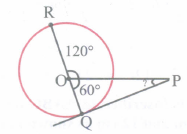
Given PQ is the tangent from the point P outside the circle and OQ is the radius.
We know that tangent meet the radius perpendicularly
\( \therefore \angle P Q O =90^{\circ} \)
\(\angle P O Q =180-120=60^{\circ} \)
\( [\because\ \angle\ P O Q \ and\ \angle P O R\ are \ linear\ pair \ of\ angles]\)
\( In \ \triangle P O O \angle P O O+\angle P O O+\angle O P Q=180^{\circ}\)
[sum of angles of a triangle]
60o + 90o + \(\angle\)OPQ = 180o
\(\angle\)OPQ = 180o - 150o
\(\angle\)OPQ = 30o
55.
Radius of conical flask = 'r' units
Height of conical flask = 'h' units
Volume of conical flask = Volume of water
\(=\frac{1}{3} \pi r^{2} h \text { cu. units }\)
Since, water is poured into the cylindrical flask
Volume of cylinder = Volume of water
\(\pi(\mathrm{xr})^{2} H=\frac{1}{3} \pi r^{2} h\)
[xr - radius of cylinder, H - height]
\(\mathrm{X}^{2} \mathrm{r}^{2} \mathrm{H}=\frac{r^{2}}{3} h\)
Height of the water in cylinder flask
\(\mathrm{H}=\frac{h}{3 x^{2}}\)
56.
\(
\frac{1-\tan ^{2} \theta}{\cot ^{2} \theta-1} =\tan ^{2} \theta
\)
\(\text { LHS } =\frac{1-\tan ^{2} \theta}{\cot ^{2} \theta-1}
\)
\(=\frac{1-\frac{\sin ^{2} \theta}{\cos ^{2} \theta}}{\frac{\cos ^{2} \theta}{\sin ^{2} \theta}-1}
\)
\(=\frac{\frac{\left(\cos ^{2} \theta-\sin ^{2} \theta\right)}{\cos ^{2} \theta}}{\frac{\left(\cos ^{2} \theta-\sin ^{2} \theta\right)}{\sin ^{2} \theta}}\)
\(=\frac{\left(\cos ^{2} \theta-\sin ^{2} \theta\right)}{\cos ^{2} \theta} \times \frac{\sin ^{2} \theta}{\left(\cos ^{2} \theta-\sin ^{2} \theta\right)}
\)
\(=\frac{\sin ^{2} \theta}{\cos ^{2} \theta}=\tan ^{2} \theta=\text { RHS }\)
57.
Given n = 28
tn = 4n - 3
t1 = 4(1) - 3 = 4 - 3 = 1 = a
t2 = 4(2) - 3 = 8 - 3 = 5
d = t2 - t1 = 5 - 1 = 4
\(\mathrm{S}_{\mathrm{n}} =\frac{n}{2}[2 a+(n-1) d]
\)
\(=\frac{28}{2}[2(1)+(28-1)(4)]
\)
= 14 [2 + 27 (4)] = 14 [2 + 108]
= 14 x 110 = 1540
Sum of first 28 terms of the given A.P. = 1540
58.
f = {(-1, 3), (0, -1), 2, -9)
Since 'f' is a linear function
f(x) = (ax) + b
in (0 , -1) , when x = 0 , f(0) = -1
a(0) + b = -1 , b = -1
in (-1 , 3) , when x = -1 , f(-1) = 3
a( -1) + b = 3 ,a - 1 = 3
-a = 4, a = -4
f(x) = - 4x - 1
59.
Since the ratio of area of two similar triangles is equal to the ratio of the squares of any two corresponding sides, we have
\(\frac { Area(\Delta ABC) }{ Area(\Delta DEF) } =\frac { { BC }^{ 2 } }{ { EF }^{ 2 } } \) gives \(\frac { 54 }{ Area(\Delta DEF) } =\frac { { 3 }^{ 2 } }{ { 4 }^{ 2 } } \)
\(Area(\Delta DEF)=\frac { 16\times 54 }{ 9 } =96{ cm }^{ 2 }\)
60.
1 + \(\frac { co{ t }^{ 2 }\theta }{ 1+cosec\theta +1 } \) = 1+ \(\frac { cose{ c }^{ 2 }\theta -1 }{ cosec\theta +1 } \) [since cosec2-1 = cot2\(\theta \)
= 1+\(\frac { (cosec\theta +1)(cosec\theta -1) }{ cosec\theta +1 } \)
1 +( cosec\(\theta \)-1) = cosec\(\theta \)
61.
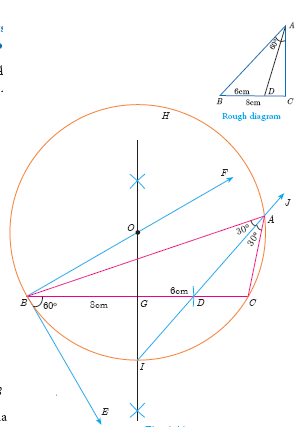
62.
Given a triangle PQR we are required to construct another triangle whose sides are \(\frac{3}{5}\) of the corresponding sides of the triangle PQR.

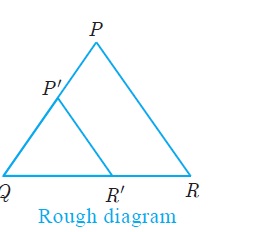
Steps of construction
1. Construct a \(\triangle\) PQR with any measurement
2. Draw a ray QX making an acute angle with QR on the side opposite to vertex P.
3. Locate 5 (the greater of 3 and 5 in \(\frac { 3 }{ 5 } \)) points.
Q1Q2, Q3, Q4 and Q5 on QX so that QQ1 = Q1Q2 = Q2Q3 = Q4Q5
4. Join Q5R and draw a line through Q3 (the third point, 3 being smaller of 3 and 5 in \(\frac { 3 }{ 5 } \)) parallel to Q5R to intersect QR at R'.
5. Draw line through R' parallel to the line RP to intersect QP at P'.
Then, \(\triangle\)P'QR' is the required triangle each of whose sides is three-fifths of the corresponding sides of \(\triangle\) PQR.
63.
64.
A and B represent points on the bank on opposite sides at the river, so that AB is the width of the river. P is a point on the bridge at a height of 3m i.e., DP = 3 m. We are interested to determine the width at the river which is the length at the side AB of the ΔAPB.
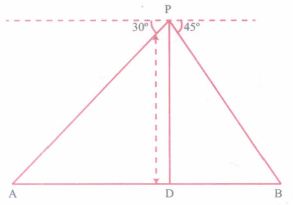
Now, AB = AD + DB
In right ΔAPD,
ㄥA = 30o
So, tan 30° = \(\frac { 1 }{ \sqrt { 3 } } =\frac { 3 }{ AD } \)
i.e., \(\frac { 1 }{ \sqrt { 3 } } =\frac { 3 }{ AD } \) (or) AD = 3\(\sqrt { 3 } \)
Also, in right ΔPBD,
B = 45o
So, BD = PD = 3m
Now, AB = BD + AD
= 3 + 3\(\sqrt { 3 } \) = 3(1+\(\sqrt { 3 } \))m
Therefore, the width at the river is 3(+\(\sqrt { 3 } \))m
65.
No. of balls required \(=\frac { \frac { 4 }{ 3 } \pi { r }^{ 3 } }{ \frac { 4 }{ 3 } \pi \times { \left( \frac { r }{ 4 } \right) }^{ 3 } } \)
\(={ r }^{ 3 }\times \frac { 4 }{ r } \times \frac { 4 }{ r } \times \frac { 4 }{ r } =64\)
66.
| Team A | ||
| x1 | d1 = x - 28 | d12 |
| 50 | 22 | 484 |
| 20 | -8 | 64 |
| 10 | -18 | 324 |
| 30 | 2 | 4 |
| 30 | 2 | 4 |
| 140 | Σd = 0 | 880 |
\(\bar { { x }_{ 1 } } \) =\(\frac { 140 }{ 5 } \) =28
σ1 =\(\sqrt { \frac { \Sigma d^{ 2 } }{ n } } =\sqrt { \frac { 880 }{ 5 } } \)
= \(\sqrt { 176 } \)
= 13.27
CV1 = \(\frac { \sigma }{ \bar { x_{ 1 } } } \) x 100
CV1 = \(\frac { 13.27 }{ 28 } \) x 100
= 47.39%
CV1 < CV2
| Team B | ||
| x2 | d2 = x - 28 | d2 |
| 40 | 10 | 100 |
| 60 | 30 | 900 |
| 20 | -10 | 100 |
| 20 | -10 | 100 |
| 10 | -20 | 400 |
| 150 | Σd = 0 | 1600 |
\(\bar { { x }_{ 2 } } =\frac { 150 }{ 5 } \) =30
σ2 =\(\sqrt { \frac { \Sigma d^{ 2 } }{ n } } =\sqrt { \frac { 1600 }{ 5 } } \)
= \(\sqrt { 320 } \)
=17.89
CV1 = \(\frac { { \sigma }_{ 2 } }{ \bar { { x }_{ 2 } } } \) x 100
CV2 = \(\frac { 17.89 }{ 30 } \) x 100
= 59.63%
∴ Team A is more consistent.
67.
Let a natural number be x.
The next number = x + 1
x (x + 1) = 20
X2+x-20 = 0
(x + 5)(x - 4) = 0
x=-5,4
∴ x=4
(∵ x≠-5, x is a natural number
The next number = 4 + 1= 5
Two consecutive numbers are 4,5.
68.
Let the numbers be ∝, β
Sum of the roots = ∝ + β = 15 ...(1)
\(\frac { 1 }{ \alpha } +\frac { 1 }{ \beta } =\frac { 3 }{ 10 } \quad \quad \quad ...(2)\)
\(\\ \frac { +\alpha }{ \alpha \beta } =\frac { 3 }{ 10 } \)
10(∝+ β)= 3∝β ....(3)
30∝β=10x15=150
Products of the roots =∝β=50 ....(4)
∴ From (1) & (4), we have
x2-15x+50=0
(x-10)(x-5)=0⇒x=10,5
69.
Here a = 24, d = 21-24 = -3, Sn = 78. We need to find n.
We know that,
Sn= \(\frac{n}{2}\) (2a + (n - 1)d)
78 = \(\frac{n}{2}\) 48 + (n -1)(-3))
78 = \(\frac{n}{2}\) 2(51-3n)
or 3n2 - 51n + 156 = 0
n2 -17n + 52 = 0
(n - 4)(n - 13) = 0
n = 4 or 13
The number of terms are 4 or 13.
70.
1,1,1,2,2,2,3,3,3
t2 - t1 = 1-1 = 0
t3 - t2 = 1-1 = 0
t4 - t3 = 2-1 = 1
Here t2 - t1 ≠ t3 - t2
ஃ It is not an A.P.
71.
Since the given points are collinear, the area a the triangle formed by them must be 0, i.e.,
= \(\frac { 1 }{ 2 } \) [2(k + 3) + 4(-3 - 3) + 6(3 - k)] = 0
= \(\frac { 1 }{ 2 } \) [-4k] = 0
k = 0
Area of ΔABC
= \(\frac { 1 }{ 2 } \)[2(0 + 3) + 4(-3 - 3) + 6(3 - 0)] = 0
72.
\(\cfrac { 4f(-3)+2f(4) }{ f(-6)-3f(1) } \)
For f(1) & f(3)
Since 1 & 3 lies between -5 ≤ x ≤2, We take, f(x) = x +5
f(1) = 1 + 5 = 6
f(-3) = -3 +5 = 2
For f(4): Since 4 lies between 2 < x < 6 We take, f(x) = x -1
f(4) = 4 -1 = 3
For f(-6): Since -6 lies between -7≤ x < -5 ,We take, f(x) = x² + 2x +1
f(-6) = (-6)² + 2(-6) + 1 = 36 -12 + 1 = 24 +1 = 25
Now ,\(\cfrac { 4f(-3)+2f(4) }{ f(-6)-3f(1) } \) =\(\frac{ 4(2) +2(3) }{ 25 - 3(6)}\)
= \(\frac{ 8 + 6 }{ 25 -18}\)
= \(\frac{14 }{ 7}\) = 2
Hence, the value of \(\cfrac { 4f(-3)+2f(4) }{ f(-6)-3f(1) } \) = 2
73.
2f(-4) + 3f(2)
f(-4) = x + 5 = -4 + 5 = 1
2f(-4) = 2 x 1 = 2
f(2) = x + 5 = 2 + 5 = 7
3f(2) = 3(7) = 21
∴ 2f(-4) + 3f(2) = 2 + 21 = 23
74.
\(\frac { 16{ x }^{ 2 }-2x-3 }{ 3{ x }^{ 2 }-2x-1 } \div \frac { 8{ x }^{ 2 }+11x+3 }{ 3{ x }^{ 2 }-11x-4 } =\frac { 16{ x }^{ 2 }-2x-3 }{ 3{ x }^{ 2 }-2x-1 } \times \frac { 3{ x }^{ 2 }-11x-4 }{ 8{ x }^{ 2 }+11x+3 } \)
= \(\frac { \left( 8x+3 \right) \left( 2x-1 \right) }{ \left( 3x+1 \right) \left( x-1 \right) } \times \frac { \left( 3x+1 \right) \left( x-4 \right) }{ \left( 8x+3 \right) \left( x+1 \right) } =\frac { \left( 2x-1 \right) \left( x-4 \right) }{ \left( x-1 \right) \left( x+1 \right) } =\frac { 2{ x }^{ 2 }-9x+4 }{ { x }^{ 2 }-1 } \)
75.
King spade, Queen spade, Jack spade are removed
∴ total number of cards = 52 - 3 = 49.
(i) Probability (diamond)= \(\frac { 13 }{ 49 } \)
(ii) Probability (queen) \(\frac { 4-1 }{ 49 } =\frac { 3 }{ 49 } \)
(iii) Probability (spade) = \(\frac { 13-3 }{ 49 } =\frac { 10 }{ 49 } \)
(iv) Probability (heart bearing number 5) = \(\frac { 13-5 }{ 49 } =\frac { 8 }{ 49 } \)
76.
77.
Sample space S = {1, 2, 3, 4,.... 1000}
n(S) = 1000
Let A be the event of selecting a card that is perfect square greater than 500
A = {232, 242, 252, 262, 272, 282, 292, 302, 312}
n(A) = 9
(i) Probability of the first player wins a prize By picking one of the cards from A he may win a prize
\(P(A)=\frac{n(A)}{n(S)}=\frac{9}{1000}\)
(ii) Probability of the second player winning a prize, if the first has won
Let 'B' be the event of second player wins a prize.
Since the card picked in (i) is not replaced
n(B) = 3
n(S) = 1000 -1 = 999
\(P(B)=\frac{n(B)}{n(S)}=\frac{8}{999}\)
78.
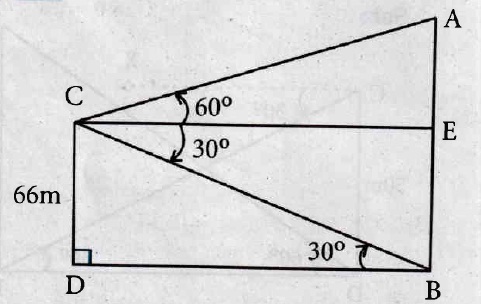
Let AB be the lamp post and CD be the apartment given CD = 66 m = EB.
\(
\angle A C E=60^{\circ}
\)
\(\angle E C B=\angle C B D=30^{\circ}
\)
In the right triangle \(\triangle\)BDC
\(\tan 30^{\circ}=\frac{C D}{B D}\)
\(
\frac{1}{\sqrt{3}}=\frac{66}{B D}
\)
\(B D=66 \sqrt{3}\)
= 66 x 1.732 = 114.312 m
The distance between the lamp post and the apartment = 114.31 m
Now BD = EC = 114.31 m
In the right triangle \(\triangle\)ACE
\(
\tan 60^{\circ} =\frac{A E}{C E}
\)
\(\sqrt{3} =\frac{A E}{66 \sqrt{3}}
\)
\(A E =66 \sqrt{3} \times \sqrt{3}[\text { From (1)] }\)
= 66 x 3 =198m
Height of the lamp post = AB
= AE + EB = 198 + 66 = 264m
79.
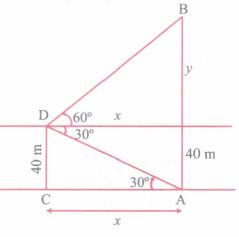
Let a man is standing on the deck of a ship at a point E
Such that AE = 40 m.
AE = BD = 40m
Also AB = ED
Let BC be the height of the hill.
(i) In right triangle \(\triangle\)ABE
\( \tan 30^{\circ} =\frac{A E}{A B} \)
\(\frac{1}{\sqrt{3}} =\frac{40}{A B} \)
\(A B =40 \sqrt{3} m \)
AB = 40 x 1.732 - 69.28 m
Distance of the hill from the ship = 69.28 m
(ii) In the right triangle \(\triangle\)CDE
\( \tan 60^{\circ} =\frac{C D}{E D} \)
\(\sqrt{3} =\frac{C D}{40 \sqrt{3}} \quad[\because A B=E D=40 \sqrt{3} \mathrm{~m}]\)
\(C D=40 \sqrt{3} \times \sqrt{3}=40 \times 3=120 \mathrm{~m}\)
Now height of the hill = BC = BD + DC
= 40 + 120 = 160m
Height of the hill = 160 m
Distance of the hill from ship = 69.28 m.
80.
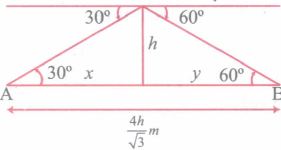
Let D and C be the positions of two ships AB be the light house of height 'h'm.
In right triangle BAC
\(\tan 60^{\circ} =\frac{A B}{A C} \)
\(\sqrt{3} =\frac{h}{A C} \)
\(\mathrm{AC} =\frac{h}{\sqrt{3}} \)
In right triangle BAD
\(\tan 30^{\circ} =\frac{A B}{A D} \)
\(\frac{1}{\sqrt{3}} =\frac{h}{A D} \)
\(\mathrm{AD} =h \sqrt{3} \)
\((1)+(2) \Rightarrow \mathrm{AC}+\mathrm{AD}=\frac{h}{\sqrt{3}}+h \sqrt{3} \)
\(\mathrm{DC}=\frac{h+h \sqrt{3} \sqrt{3}}{\sqrt{3}} \)
\(\mathrm{DC}=\frac{h+3 h}{\sqrt{3}}=\frac{4 h}{\sqrt{3}} m \)
Distance between the ships is \(\frac{4 h}{\sqrt{3}} m\)
81.
Given AB || CD || EF
AB = 6 cm, BD = 5 cm, EF = 4 cm, CD = x cm, DE = y cm
\(\text { In } \triangle E C D \text { and } \triangle E A B\)
\( \angle C E D=\angle A E B \) [common]
\(\angle E C D=\angle E A B \) [corresponding angles]
\(\triangle E C D \sim \triangle E A B\)
[By AA similarity criteria] ...(1)
\(\therefore \ \frac{E C}{E A}=\frac{C D}{A B}\)
[ Corresponding parts of similar triangles are proportional]
\(\frac{E C}{E A}=\frac{x}{6}\) ....(2)
In \(\triangle A C D\ and\ \triangle A E F \)
\(\angle C A D=\angle E A F\) [Common]
\( \angle A C D =\angle A E F \) [Corresponding angles]
\(\triangle A C D \sim \triangle A E F \) [By AA similarity]
\(\frac{A C}{A E} =\frac{C D}{E F}\)
[Corresponding parts of similar triangle are proportional]
\(\therefore \quad \frac{A C}{A E}=\frac{x}{4}\) ....(3)
Adding (2) and (3)
\( \frac{E C}{E A}+\frac{A C}{A E} =\frac{x}{6}+\frac{x}{4} \)
\(\frac{E C+A C}{A E} =\frac{4 x+6 x}{24} \)
\(\frac{A E}{A E} =\frac{10 x}{24} \)
\(1 =\frac{10 x}{24} \)
\(\mathrm{x} =\frac{24}{10}=\frac{12}{5} \mathrm{~cm}\)
From (1) \(\triangle E C D \sim \triangle E A B\)
\( \frac{D C}{A B} =\frac{E D}{E B} \)
\(\frac{x}{6} =\frac{y}{5+y} \)
\(\because \mathrm{x}=\frac{12}{5} \Rightarrow \frac{12 / 5}{6} =\frac{y}{5+y} \)
\(\frac{12}{5 \times 6} =\frac{y}{5+y} \)
12(5 + y) = 30 y
60 + 12y = 30 y
60 = 30y - 12y
18y = 60
\( y=\frac{60}{18} \)
\(y=\frac{10}{3} \mathrm{~cm}\)
82.
Volume of a cone = 1005 \(\frac{5}{7}\) cu.cm
\(\text { i.e., } \frac{1}{3} \pi r^{2} h=1005 \frac{5}{7}\)
area of base = area of circle
\(
=201 \frac{1}{7} \text { sq. units }
\)
\(i.e
\ \pi r^{2}=201 \frac{1}{7} \Rightarrow r^{2}=64
\)
Substituting in (1), r = 8 cm
\(\frac{1}{3}\left(201 \frac{1}{7}\right) \mathrm{h}=1005 \frac{5}{7}
\)
\(\frac{1}{3}\left(\frac{1408}{7}\right) \mathrm{h}=\frac{7040}{7}
\)
\(h=\frac{7040}{7} \times \frac{7}{1408} \times 3=15 \mathrm{~cm}\)
Slant height of cone \(l =\sqrt{h^{2}+r^{2}}
\)
\(=\sqrt{15^{2}+8^{2}}=\sqrt{225+64}
\)
\(=\sqrt{289}=17 \mathrm{~cm}
\)
83.
Given that intercepts are in the ratio 2 : 5
\(\frac{a}{b} =\frac{2}{5} \)
\(a =\frac{2 b}{5} \)
Equation of the line in Intercepts form is \(\frac{x}{a}+\frac{y}{b}=1\)
\(\frac{x}{\left(\frac{2 b}{5}\right)}+\frac{y}{b}=1 \)
\(\frac{5 x}{2 b}+\frac{y}{b}=1 \)
5x + 2y = 2b
This passes through ( 1, - 4)
5(1) + 2(-4) = 2b
\(5-8=2 b \Rightarrow b=-\frac{3}{2} \)
\(a =\frac{2 b}{5}=\frac{2\left(-\frac{3}{2}\right)}{5}=-\frac{3}{5} \)
Equation of a straight line is
\(\frac{x}{a}+\frac{y}{b}=1 \Rightarrow \frac{x}{\left(-\frac{3}{5}\right)}+\frac{y}{\left(-\frac{3}{2}\right)}=1\)
\(\frac{5 x}{-3}+\frac{2 y}{-3}=1\)
5x + 2y + 3 = 0.
84.
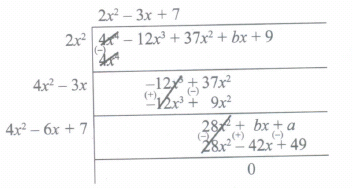
b=-42
a=49
85.
\(f(x)=\frac { x-1 }{ x+1 } ,x\neq 0\)
\(f(f(x))=f\left( \frac { x-1 }{ x+1 } \right) =\frac { \left( \frac { x-1 }{ x+1 } \right) -1 }{ \left( \frac { x-1 }{ x+1 } \right) +1 } \)
\(=\frac{\frac{\not x-1-x-1}{(\not x+1)}}{\frac{\not x-1+x+1}{(\not x+1)}}=\frac{-2}{2 x}=\frac{-1}{x}\)
Hence it is proved.
86.
Let r1 and r2 be the radii of sphere and hemisphere respectively.
Given TS.A of sphere = T.S.A of hemisphere
\(4 \pi r_{1}^{2} =3 \pi r_{2}^{2}
\)
\(\frac{r_{1}^{2}}{r_{2}^{2}} =\frac{3}{4} \Rightarrow \frac{r_{1}}{r_{2}}=\frac{\sqrt{3}}{2}
\)
Ratio of their volumes : \(\frac{V_{1}}{V_{2}}=\frac{\frac{4}{3} \pi r_{1}^{3}}{\frac{2}{3} \pi r_{2}^{3}}=2\left(\frac{r_{1}}{r_{2}}\right)^{3}\)
\(=2\left(\frac{\sqrt{3}}{2}\right)^{3}
\)
\(=\frac{3 \sqrt{3}}{4}=3 \sqrt{3}: 4
\)
Ratio of their volumes = \(3 \sqrt{3}: 4\)
87.
Clearly the ladder AC make a right triangle with the wall AB force at a distance BC. \(\angle\)B - 90o
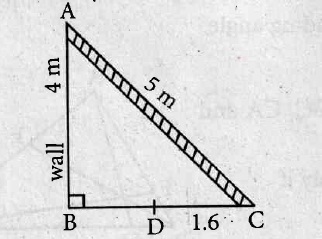
By Pythagoras theorem
AC2 = AB2 + BC2
52 = 42 + BC2
BC2 = 25 - 16
BC2 = 9
BC = 3m
If C moves 1.6 m towards the wall BC becomes
3m - 1.6m = 1.4m
Now in \(\triangle\)ABC
AC2 = AB2 + BC2
52 = AB2 +(1.4)2
25 - 1.96 = AB2
AB2 = 23.04
AB = 4.8m
The new height of the wall = 4.8 m
Difference =4.8 - 4 = -0.8m
The ladder would be placed 0.8 m upward the wall.
88.
Let r and h be the radius and height of the cylinder respectively.
Given that, volume of the tank = 1.078 x 106 = 1078000 litre
1078 m3 (since 1l = \(\frac{1}{1000}m^3\))
diameter = 7m gives radius = \(\frac{7}{2}\)m
volume of the tank = \(\pi\)r h 2 cu. units
1078 = \(\frac { 22 }{ 7 } \times \frac { 7 }{ 2 } \times \frac { 7 }{ 2 } \times h\)
Therefore, height of the tank is 28 m
89.
From the figure,
slope = \(\frac { change\quad in\quad y\quad coordinate }{ change\quad is\quad x\quad coordinate } \)
=\(\frac { 68-32 }{ 20-0 } =\frac { 36 }{ 20 } =\frac { 9 }{ 5 } \)= 1.8
The line crosses the Y axis at (0, 32)
So the slope is \(\frac { 9 }{ 5 } \) and y intercept is 32.
90.
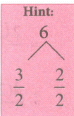
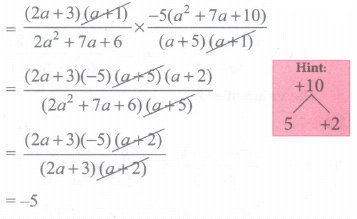
\(\frac { 2{ a }^{ 2 }+5a+3 }{ 3{ a }^{ 2 }+7a+6 } \div \frac { { a }^{ 2 }+6a+5 }{ -5{ a }^{ 2 }-35a-50 } \)
\(=\frac { { 2a }^{ 2 }+5a+3 }{ { 2a }^{ 2 }+7a+6 } \times \frac { -5{ a }^{ 2 }-35a-50 }{ { a }^{ 2 }+6a+5 } \)

10th Standard Syllabus & Materials
10th Standard
TN 10th English Prose - 2 - The Night the Ghost Got in Important Questions And Answers Study Material - QB365 Set A
NEW10th Standard
TN 10th English Supplementary - 1 - The Tempest Important Questions And Answers Study Material - QB365 Set A
NEW10th Standard
TN 10th English Poem - 1 - Life Important Questions And Answers Study Material - QB365 Set A
NEW10th Standard
TN 10th English Prose - 1 - His First Flight Important Questions And Answers Study Material - QB365 Set A



Tamilnadu Stateboard 10th Standard Subjects
Tamilnadu Stateboard Standards





