
 100% FREE ACCESS
10th Standard CBSE Syllabus & Materials
10th Standard CBSE
CBSE 10th Social Science ECO - Globalisation and the Indian Economy - New Model Questions Papers Study Material - QB365 Set A
NEW10th Standard CBSE
CBSE 10th Social Science ECO - Money and Credit - New Model Questions Papers Study Material - QB365 Set A
NEW10th Standard CBSE
CBSE 10th Social Science ECO - Sectors of the Indian Economy - New Model Questions Papers Study Material - QB365 Set A
NEW10th Standard CBSE
CBSE 10th Social Science ECO - Development - New Model Questions Papers Study Material - QB365 Set A
NEW10th Standard CBSE
CBSE 10th Social Science PS - Outcomes of Democracy - New Model Questions Papers Study Material - QB365 Set A
NEW10th Standard CBSE
CBSE 10th Social Science PS - Gender, Religion and Caste - New Model Questions Papers Study Material - QB365 Set A

Published on: 29/11/2018
Some of the important questions are covered from the entire syllabus. Students can get plenty of question paper with answer key for their exam practice.
Download CBSE Class 10th Standard CBSE Maths question papers, sample papers, important questions, and previous year solved papers in PDF format. Get free study materials, NCERT solutions, and exam preparation resources for Class 10th Standard CBSE Maths
Questions + Answers key
Take MCQ Maths Test
1.
Find the mean of the following frequency distribution:
| Class | 0-6 | 6-12 | 12-18 | 18-24 | 24-30 |
|---|---|---|---|---|---|
| Frequency | 7 | 5 | 10 | 12 | 6 |
2.
Find cosec 30° and cos 60° geometrically.
3.
Find a quadratic polynomial with zeroes \(3+\sqrt { 2 } \) and \(3-\sqrt { 2 } \) .
4.
A rational number in its decimal expansion is 327.7081. What can you say about the prime factors of q. when this number is expressed in the form \(\frac{p}{q}\)? Give reason.
5.
If the equation \(px^{ 2 }+4x-3=0\) has real roots, then find the value of p
6.
Find the radius of the circle whose endpoints of diameter are (24, 1) and (2, 23).
7.
If P(E)=0.15, then find P(not E).
8.
Find the ratio of the volumes of two cones with equal heights and ratio of their radii as 1 : 3.
9.
A bucket is in the form of a frustum of a cone whose radii of bottom and top are 7 cm and 28 cm respectively. If the capacity of the bucket is 21560 cm3, find the whole surface area of the bucket.
10.
Find the probability of getting a perfect square number from the numbers 1 to 10.
11.
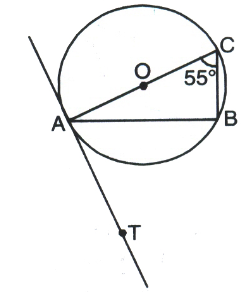
In the given figure, AB is a chord of circle and AOC is diameter such that angle ACB = \({ 55 }^{ \circ }\). If AT is a tangent to the circle at point A, then find angle BAT.
12.
From a point Q, the length of tangent to a circle is 24 cm and the distance of Q from the centre is 25 cm, then find the radius of circle.
13.
If the numbers n-2, 4n-1 and 5n+2 are in A.P., find the value of n..
14.
The area of circle is numerically equal to twice its circumference. Find the diameter of the circle.
15.
Find the distance between the points (0, 5) and (-5, 0).
16.
If the first term of an A.P. is -5 and the common difference is 2, then find the sum of the first 6 terms.
17.
The height of a tower is 30 m. Calculate the length of its shadow made on the level ground when the sun's altitude is 60o .
18.
Check whether the following are quadratic equations: x2-3x+5=(x+5)2
19.
Find the roots of the equation \(2x^{ 2 }+x-4=0\) by the method of completing the squares.
20.
The sum of first n terms of an A.P.is given by Sn = 3n2 - 4n. Determine the A.P.and the 12th term.
21.
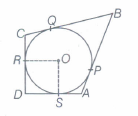
A circle is inscribed in a ΔBC having sides AB=8 cm, BC = 10 cm and CA = 12 cm as shown in figure. Find AD, BE and CF
22.
If PA and PB are two tangents drawn from a point P to a circle with centre O touching it at A and B, prove that OP is perpendicular bisector of AB.
23.
Draw a triangle with sides 5 cm, 6 cm and 7 cm. Then draw another triangle whose sides are \(\frac { 4 }{ 5 } \) of the corresponding sides of first triangle.
24.
How many three-digit numbers are divisible by 11?
25.
A speed of a boat in still water is 11km/hour. It can go 12km upstream and return downstream to the original point in 2 hours 45 minutes. Find the speed of the stream.
26.
The median of the following data is 525. Find the values of x and y if the total frequency is 100.
| Class Interval | 0-100 | 100-200 | 200-300 | 300-400 | 400-500 | 500-600 | 600-700 | 700-800 | 800-900 | 900-1000 |
| Frequency | 2 | 5 | x | 12 | 17 | 20 | y | 9 | 7 | 4 |
27.
In \(\triangle\) ABC, AD is a median and 0 is any point on AD. BO and CO on producing meet AC and AB at E and F respectively. Now AD is produced to X such that OD = DX as shown in figure.
Prove that:
(i) EF II BC
(ii) AO : AX = AF : AB
28.
Prove the following identities, where the angles involved are acute angles for which the expressions are defined.
\({ (\sin { A } +cosecA) }^{ 2 }+{ (\cos { A } +\sec { A } ) }^{ 2 }=7+\tan ^{ 2 }{ A } +\cot ^{ 2 }{ A } \)
29.
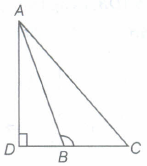
In the given figure, ABC is a triangle in which \(\angle ABC>{ 90 }^{ ° }\) and \(AD\bot CB\) produced. Prove that AC2 = AB2 + BC2 + 2 BC . BD
30.
150 workers were engaged to finish a piece of work in a certain number of days. Four workers dropped the second day, four more workers dropped the third day and so on. It takes 8 more days to finish the work now. Find the number of days in which the work was completed.
1.
| x | 3 | 9 | 15 | 21 | 27 | |
|---|---|---|---|---|---|---|
| f | 7 | 5 | 10 | 12 | 6 | \(\Sigma f=40\) |
| fx | 21 | 45 | 150 | 252 | 162 | \(\Sigma fx=630\) |
\(\Sigma fx=630\) , \(\Sigma f=40\)
Mean = \(\frac { 630 }{ 40 } =15.75\)
2.
Consider a triangle ABC with each side equal to 2a.
\(\angle A=\angle B =\angle C\) = 60°
Draw AD is perpendicular to BC
\(\triangle BDA\cong \triangle CDA\) by RHS
BD = CD
\(\angle BAD=\angle CAD\) = 30° by CPCT
By Pythagoras theorem,
\(AD=\sqrt{3}a\)
In \(\triangle BDA\), cosec 30° = \(\frac{AB}{BD}=\frac{2a}{a}=2\)
and cos 60° = \(\frac{BD}{AB}=\frac{a}{2a}=\frac{1}{2}\)
3.
x2-6x+7
4.
Here, 327.7081 is terminating. So, it represents a rational number.
Thus, \(327.7081=\frac { 3277081 }{ 10000 } =\frac { p }{ q } \)
Here, q = 104 = 2 x 2 x 2 x 2 x 5 x 5 x 5 x 5
= 24 x 54 = (2 x 5)4
So, the prime factors of q are 2 and 5.
5.
\(P\ge -\frac { 4 }{ 3 } \)
6.
Given endpoints of diameter of a circle are (x1,y1)=(24, 1) and (x2, y2)=(2, 23).
Now, diameter of a circle, d = \(\sqrt { { \left( 2-24 \right) }^{ 2 }+{ (23-1) }^{ 2 } } \) \([ \therefore distance=\sqrt { { \left( { x }_{ 2 }-{ x }_{ 1 } \right) }^{ 2 }-{ \left( { y }_{ 2 }-{ y }_{ 1 } \right) }^{ 2 } }] \)
= \(\sqrt { { \left( -22 \right) }^{ 2 }+{ (22) }^{ 2 } } =\sqrt { { (22) }^{ 2 }+(1+1) } \)
=\(22\sqrt { 1+1 } =22\sqrt { 2 } \) units
\(\therefore \) Radius of a circle, r = \(\frac { d }{ 2 } \) = \(\frac { 22\sqrt { 2 } }{ 2 } \) = \(11\sqrt { 2 } \) units.
7.
0.95
8.
1 : 9
9.
3344 cm2
10.
Perfect square numbers from 1 to 10 are 1, 4 and 9
Therefore, Required probability = \(\frac { 3 }{ 10 } \)
11.
55∘
12.
7 cm
13.
As , n-2, 4n-1 and 5n+2 are in AP.
\(\therefore \) 4n-1-(n-2)=5n+2-(4n-1)
\(\Rightarrow \) 4n-1 -n+2=5n+2-4n+1
\(\Rightarrow \) 3n+1=n+3
\(\Rightarrow \) 2n=2
\(\Rightarrow \) n=1
14.
\({ \pi r }^{ 2 }=2\pi r\times 2\)
\(\Rightarrow \quad r=4\Rightarrow \quad d=2r=8\)
15.
\(5\sqrt { 2 }\ \ units\)
16.
0
17.
Let PQ is tower and QR is its shadow.
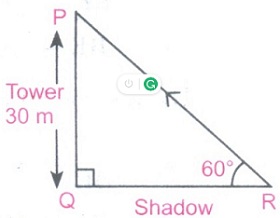
In right \(\Delta\) PQR,
\(\frac { PQ }{ QR } =\tan { { 60 }^{ o } } \)
\(\Rightarrow\) \(\frac { 30 }{ QR } =\sqrt { 3 } \)
\(\Rightarrow\) \(QR=\frac { 30 }{ \sqrt { 3 } } \)
\(=10\sqrt { 3 } \) m
18.
Given equation is, x2-3x+5=(x+5)2
x2-3x+5=x2+10x+25
13x+20=0
Which is not of the form ax2+bx+c=0
Hence it is not a quadratic equation
19.
On dividing by 2 ,we get
\(x^{ 2 }+\frac { x }{ 2 } -2=0\)
Adding and subtracting \(\left( \frac { 1 }{ 4 } \right) ^{ 2 }\) we get
\(x^{ 2 }+2x\left( \frac { 1 }{ 4 } \right) +\left( \frac { 1 }{ 4 } \right) ^{ 2 }-\left( \frac { 1 }{ 4 } \right) ^{ 2 }-2=0\)
\(\Rightarrow \left( x+\frac { 1 }{ 4 } \right) ^{ 2 }-\frac { 33 }{ 16 } =0\)
\(\Rightarrow \left( x+\frac { 1 }{ 4 } \right) ^{ 2 }=\frac { 33 }{ 16 } =0\)
Taking the square root we get
\(\left( x+\frac { 1 }{ 4 } \right) =\pm \frac { \sqrt { 33 } }{ 4 } \)
\(x=\frac { -1+\sqrt { 33 } }{ 4 } ,\frac { -1-\sqrt { 33 } }{ 4 } \)
20.
Sn = 3n2 - 4n
S1 = 3(1)2 - 4(1) = - 1
S2 = 3(2)2- 4(2) = 4
a1 = S1 =- 1
a2 = S2- S1 = 4 - (- 1) = 5
d = a2 - a1 = 5 - (-1) = 6
A.P. is - 1, 5, 11,............
a12 = a + 11d
=-1 +11 \(\times\) 6
= 65.
21.
We know that, tangents drawn from an exterior point to a circle are equal in length.
AD = AF = x cm
BD = BE = y cm
CE = CF = z cm
Given, AB = 8 cm
⇒ AD + BD = 8cm
⇒ x + y = 8
BC = 10 cm ⇒ BE + CE = 10 cm
⇒ y + z = 10
and CA = 12 cm ⇒ CF + AF = 12 cm
⇒ z + x = 12
On adding Eqs. (i), (ii) and (iii), we get
2(x + y + z) =30
⇒ x + y + z = 15
On subtracting Eq. (ii) from Eq. (iv), we get
x =15 - 10 = 5
On subtracting Eq. (iii) from Eq. (iv), we get
y = 15-12 = 3
On subtracting Eq. (i) from Eq. (iv), we get
z=15-8=7
AD = xcm = 5 cm
BE= ycm = 3 cm
and CF = z cm = 7 cm
Hence, the length of AD, BE and CE are 5 cm, 3 cm and 7 cm, respectively.
22.
Let OP intersect AB at a point C. Here, PA and PB are the two tangents from a point P lying outside the circle, to the circle with centre O.
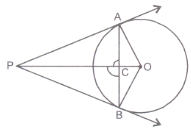
\(\angle \)APO = \(\angle \)BPO [∵ O lies on the bisector of ZAPB]
Now, in \(\triangle\)ACP and \(\triangle\)BCP, we have
AP = BP [tangents from an external pointl
PC = PC [commonl]
\(\angle \)APO = \(\angle \)BPO [proved above]
⇒ \(\triangle\)ACP ≅ \(\triangle\)BCP [by SAS congruence axiom]
⇒ AC = BC [c.p.c.t.]
and \(\angle \)ACP = \(\angle \)BCP
= \(1\over2\) x 180° = 90° [c.p.c.t.]
Hence, OP is the perpendicular bisector of AB.
23.
Given : A ΔABC, in which AB = 5 cm, BC = 6 cm and CA = 7 cm.
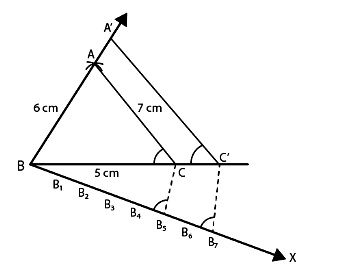
Required: ΔA'BC' ∼ ΔABC with \(\frac { 4 }{ 5 } \) (reduced) scale-factor.
Steps of Construction :
1. Construct ΔABC, such that AB=5cm, BC = 6 cm and CA = 7 cm.
2. Through B, construct an acute ㄥCBX, 90o).
3. Mark five points on BX such that BB1 = B1B2 = B2B3 - B3B4 = B4B5.
4. Join B5C.
5. Through B4, draw B4C'||B5C, intersecting BC in C'.
6. Through C', draw C'A'||CA, intersecting BA in A'.
Hence, ΔA'BC' is the required triangle.
24.
The three-digit numbers which are divisible by 11 are 110, 121, 132, ..., 990
Let there are n, 3-digit numbers divisible by 11
Clearly, it forms an A.P. with a = 110, d = 11
So, an = 990
\(\Rightarrow\) a + ( n - 1 )d = 990
110 + ( n - 1 )d = 990
110 + 11n - 11 = 990
11n + 99 = 990 \(\Rightarrow\) 11n = 891
\(\Rightarrow\) n = 81
Thus, there are 81 numbers of three-digit which are divisible by 11.
25.
Let speed of the stream be x km/h
Speed of the boat in still water = I I km/h
\(\therefore \) Upstream speed be (11-x) km/h and downstream speed be (11+x) km/h
Distance = 12 km
Time taken for downstream direction = \(\frac { 12 }{ 11+x } \) hours
Time taken for upstream direction = \(\frac { 12 }{ 11-x } \) hours
ATQ \(\frac { 12 }{ 11+x } +\frac { 12 }{ 11-x } =2\frac { 3 }{ 4 } \Rightarrow \frac { 12(11-x)+12(11+x) }{ (11+x)(11-x) } =\frac { 11 }{ 4 } \)
\(\Rightarrow \frac { 132+132 }{ 121-x^{ 2 } } =\frac { 11 }{ 4 } \Rightarrow 4\times 264=11(121-x^{ 2 })\)
\(\Rightarrow \frac { 4\times 264 }{ 11 } =121-x^{ 2 }\Rightarrow 4\times 24=121-x^{ 2 }\)
\(\Rightarrow x^{ 2 }=25\Rightarrow x=\pm 5\)
Hence speed of the stream is x=5 km/h
26.
| Class interval | Frequency | Cumalative frequency |
| 0-100 | 2 | 2 |
| 100-200 | 5 | 7 |
| 200-300 | x | 7+x |
| 300-400 | 12 | 19+x |
| 400-500 | 17 | 36+x |
| 500-600 | 20 | 56+x |
| 600-700 | y | 56+x+y |
| 600-700 | y | 56+x+y |
| 700-800 | 9 | 65+x+y |
| 800-900 | 7 | 72+x+y |
| 900-1000 | 4 | 76+x+y |
| N=100 |
It is given that n = 100
So, 76 + x + y = 100, i.e., x + y = 24
The median is 525, which lies in the class 500 – 600
So, l = 500, f = 20, cf = 36 + x, h = 100
Using the formula : Median \(=l+\left(\frac{\frac{n}{2}-\mathrm{cf}}{f}\right) h, \text { we get }\)
\(525=500+\left(\frac{50-36-x}{20}\right) \times 100\)
i.e. 525 - 500 = (14 - x) \(\times\) 5
i.e. 25 = 70 - 5 x
i.e. 5 x = 70 - 25 = 45
So, x = 9
Therefore, from (1), we get 9 + y = 24
i.e. y = 15
27.
BC and OX bisect each other
So BXCO is a parallelogram, BE II XC and BX II CF
In \(\triangle\)ABX, by B.P.T.,
\(\frac { AF }{ FB } =\frac { AO }{ OX } ...(i)\)
In \(\triangle\)AXC,
\(\frac { AE }{ EC } =\frac { AO }{ OX } ...(ii)\)
(i) and (ii) give,
\(\frac { AE }{ FB } =\frac { AE }{ EC } \quad \)
So by converse of B.P.T.,
EF II BC
(i) give \(\frac { OX }{ OA } =\frac { AB }{ AF } \)
Adding 1 on both sides
\(\frac { AX }{ OA } =\frac { AB }{ AF } \)
or OA : AX = AF : AB
28.
LHS = \({ (\sin { A } +cosecA) }^{ 2 }+{ (\cos { A } +\sec { A } ) }^{ 2 }\)
\(=\sin ^{ 2 }{ A } +{ cosec }^{ 2 }A+2\sin { A } cosecA+\cos ^{ 2 }{ A } +\sec ^{ 2 }{ A } +2\cos { A } \sec { A } \)
\(\left[ \because { (a+b) }^{ 2 }={ a }^{ 2 }+{ b }^{ 2 }+2ab \right] \)
\(=(\sin ^{ 2 }{ A } +\cos ^{ 2 }{ A } )+(1+\cot ^{ 2 }{ A } )+2\sin { A } \frac { 1 }{ \sin { A } } +(1+\tan ^{ 2 }{ A } )+2\cos { A } \frac { 1 }{ \cos { A } } \)\(\left[ \because { cosec }^{ 2 }A=1+\cot ^{ 2 }{ A } ,\sec ^{ 2 }{ A } =1+\tan ^{ 2 }{ A } ,cosecA=\frac { 1 }{ \sin { A } } and\sec { A } =\frac { 1 }{ \cos { A } } \right] \)\(=1+1+\cot ^{ 2 }{ A } +2+1+\tan ^{ 2 }{ A } +2\quad \left[ \because \sin ^{ 2 }{ A } +\cos ^{ 2 }{ A } =1 \right] \)
\(=7+\tan ^{ 2 }{ A } +\cot ^{ 2 }{ A } \)
= RHS
Hence proved.
29.
Given In figure, ABC is a triangle in which \(\angle ABC>{ 90 }^{ ° }\) and \(AD\bot CB\) produced.
To prove AC2 = AB2 + BC2 + 2 BC . BD
Proof In right angled \(\triangle ADC\), \(\angle D={ 90 }^{ ° }\)
\(\therefore\) AC2 = AD2 + DC2 [by Pythagoras theorem]
= AD2 + (BD + BC)2 [\(\because\) DC = DB + BC]
= (AD2 + BD2) + BC2 + 2 BD . BC
[\(\because\) (a + b)2 = a2 + b2 + 2ab]
\(\Rightarrow\) AC2 = AB2 + BC2 + 2 BC . BD
[\(\because\) in right angled \(\triangle ADB\), AB2 = AD2 + DB2]
30.
Let the number of days in which work was finished be n.
Number of workers on Ist day = 150
Number of workers on IInd day = 146
Number of workers on IIIrd day = 142 and so on
One day equivalent of all the worker
= 150 + 146 + 142 + ... upto to n workers
\(={n\over2}[2\times150+(n-1)\times(-4)]\)
\(={n\over2}(304-4n)=152n-{2n}^{2}\) ....(i)
If 150 workers would have worked every day then number of days required to finish the work = ( n - 8 )
\(\therefore\) One day equivalent of workers = 150 ( n - 8) = 150n - 1200 ...(ii)
From (i) and (ii), we have
152n - 2n2 = 150n - 1200
\(\Rightarrow\) 2n2 - 2n - 1200 = 0
\(\Rightarrow\) n2 - n - 600 = .0
\(\Rightarrow\) ( n - 25 ) ( n + 24 ) = 0
\(\Rightarrow\) n = - 24, n = 25
\(\therefore\) Work has completed in 25 days.

10th Standard CBSE Syllabus & Materials
10th Standard CBSE
CBSE 10th Social Science PS - Federalism - New Model Questions Papers Study Material - QB365 Set A
NEW10th Standard CBSE
CBSE 10th Social Science PS - Power Sharing - New Model Questions Papers Study Material - QB365 Set A
NEW10th Standard CBSE
CBSE 10th Social Science GEO - Manufacturing Industries - New Model Questions Papers Study Material - QB365 Set A
NEW10th Standard CBSE
CBSE 10th Social Science GEO - Minerals and Energy Resources - New Model Questions Papers Study Material - QB365 Set A



CBSE 10th Standard CBSE Subjects
CBSE Standards





