
 100% FREE ACCESS
10th Standard Syllabus & Materials
10th Standard
TN 10th English Prose - 4 - The Attic Important Questions And Answers Study Material - QB365 Set A
NEW10th Standard
TN 10th English Supplementary - 3 - The Story of Mulan Important Questions And Answers Study Material - QB365 Set A
NEW10th Standard
TN 10th English Poem - 3 - I am Every Woman Important Questions And Answers Study Material - QB365 Set A
NEW10th Standard
TN 10th English Prose - 3 - Empowered Women Navigating The World Important Questions And Answers Study Material - QB365 Set A
NEW10th Standard
TN 10th English Supplementary - 2 - Zigzag Important Questions And Answers Study Material - QB365 Set A
NEW10th Standard
TN 10th English Poem - 2 - The Grumble Family Important Questions And Answers Study Material - QB365 Set A

Published on: 13/05/2020
10th Standard Maths English Medium Model Question Paper Part - III
Download Tamil Nadu 10th Standard Maths question papers, model tests, one-mark questions, important questions, and public exam papers in PDF format. Free study materials and answer keys for TN State Board students.
Questions + Answers key
Take MCQ Maths Test1.
If x = r sin θ cos φ y = r sin θ. Then x2 + y2 + z2___________
r
r2
\(\cfrac { { r }^{ 2 } }{ 2 } \)
2r2
2.
If pth, qth and rth terms of an A.P. are a, b, c respectively, then (a(q - r) + b(r - p) + c(p - q) is____________
0
a + b + c
p + q + r
pqr
3.
4.
The range of the data 8, 8, 8, 8, 8. . . 8 is
0
1
8
3
5.
tan \(\theta \) cosec2\(\theta \) - tan\(\theta \) is equal to
sec\(\theta \)
\(cot^{ 2 }\theta \)
sin\( \theta \)
\(cot\theta \)
6.
The value of \(si{ n }^{ 2 }\theta +\frac { 1 }{ 1+ta{ n }^{ 2 }\theta } \) is equal to
\(ta{ n }^{ 2 }\theta \)
1
\(cot^{ 2 }\theta \)
0
7.
The least number that is divisible by all the numbers from 1 to 10 (both inclusive) is
2025
5220
5025
2520
8.
If slope of the line PQ is \(\frac { 1 }{ \sqrt { 3 } } \) then slope of the perpendicular bisector of PQ is
\(\sqrt { 3 } \)
\(-\sqrt { 3 } \)
\(\frac { 1 }{ \sqrt { 3 } } \)
0
9.
How many tangents can be drawn to the circle from an exterior point?
one
two
infinite
zero
10.
If \(\triangle\)ABC is an isosceles triangle with \(\angle\)C = 90o and AC = 5 cm, then AB is
2.5 cm
5 cm
10 cm
\(5\sqrt { 2 } \)cm
11.
A solid sphere of radius x cm is melted and cast into a shape of a solid cone of same radius. The height of the cone is
3x cm
x cm
4x cm
2x cm
12.
If f(x) = 2x2 and g(x) = \(\frac{1}{3x}\), then f o g is
\(\\ \frac { 3 }{ 2x^{ 2 } } \)
\(\\ \frac { 2 }{ 3x^{ 2 } } \)
\(\\ \frac { 2 }{ 9x^{ 2 } } \)
\(\\ \frac { 1 }{ 6x^{ 2 } } \)
13.
If the ordered pairs (a + 2, 4) and (5, 2a + b) are equal then (a, b) is
(2,-2)
(5,1)
(2,3)
(3,-2)
14.
15.
If 15tan2 θ+4 sec2 θ=23 then find the value of (secθ+cosecθ)2 -sin2 θ
16.
In \(AD\bot BC\) prove that AB2 + CD2 = BD2 + AC2.
17.
Final the probability of choosing a spade or a heart card from a deck of cards.
18.
Find the number of coins, 1.5 cm is diameter and 0.2 cm thick, to be melted to form a right circular cylinder of height 10 cm and diameter 4.5 cm.
19.
Which of the following list of numbers form an AP ? If they form an AP, write the next two terms:
1, 1, 1, 2, 2, 2, 3, 3, 3
20.
If R = {(a, -2), (-5, b), (8, c), (d, -1)} represents the identity function, find the values of a, b, c and
21.
Find the area of the quadrilateral whose vertices, taken in order, are (-4, -2), (-3, -5), (3, -2) and (2, 3).
22.
A triangular shaped glass with vertices at A(-5, -4), B(1, 6) and C(7, -4) has to be painted. If one bucket of paint covers 6 square feet, how many buckets of paint will be required to paint the whole glass, if only one coat of paint is applied.
23.
If A = \(\left[ \begin{matrix} 1 & 1 \\ -1 & 3 \end{matrix} \right] \), B = \(\left[ \begin{matrix} 1 & 2 \\ -4 & 2 \end{matrix} \right] \), C = \(\left[ \begin{matrix} -7 & 6 \\ 3 & 2 \end{matrix} \right] \) verify that A(B + C) = AB + AC
24.
A bag contains 6 green balls, some black and red balls. Number of black balls is as twice as the number of red balls. Probability of getting a green ball is thrice the probability of getting a red ball. Find (i) number of black balls (ii) total number of balls.
25.
A vertical pole fixed to the ground is divided in the ratio 1:9 by a mark on it with lower part shorter than the upper part. If the two parts subtend equal angles at a place on the ground, 25 m away from the base of the pole, what is the height of the pole?
26.
Given that
\(f(x)=\left\{\begin{array}{cc} \sqrt{x-1} & x \geq 1 \\ 4 & x<1 \end{array}\right.\)
Find
i) f(0)
ii) f(3)
iii) f(a + 1) in terms of a (Given that a ≥ 0)
27.
The volume of a solid hemisphere is 29106 cm3. Another hemisphere whose volume is two-third of the above is carved out. Find the radius of the new hemisphere.
28.
If lth, mth and nth terms of an A.P are x, y, z respectively, then show that x(m - n) + y(n - l) + z(l - m) = 0
29.
If the radii of the circular ends of a conical bucket which is 45 cm high are 28 cm and 7 cm, find the capacity of the bucket. (Use π = \(\frac{22}{7}\))
30.
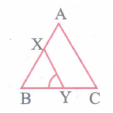
In figure the line segment XY is parallel to side AC of \(\Delta ABC\) and it divides the triangle into two parts of equal areas. Find the ratio \(\cfrac { AX }{ AB } \)
31.
Find the standard deviation of 30, 80, 60, 70, 20, 40, 50 using the direct method.
32.
Prove that the equation x2(a2+b2)+2x(ac+bd)+(c2+ d2) = 0 has no real root if ad≠bc.
33.
Find the LCM and HCF of 6 and 20 by the prime factorisation method.
34.
Show that the points (1, 7), (4, 2), (-1,-1) and (-4,4) are the vertices of a square.
35.
Find the intercepts made by the following lines on the coordinate axes. 4x + 3y + 12 = 0
36.
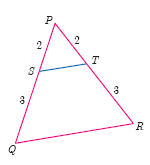
Show that \(\triangle\)PST~\(\triangle\)PQR
37.
Reduce the rational expressions to its lowest form
\(\frac { { x }^{ 2 }-16 }{ { x }^{ 2 }+8x+16 } \)
38.
Using the functions f and g given below, find f o g and g o f. Check whether f o g = g o f
f(x) = 4x2 - 1, g(x) = 1 + x
39.
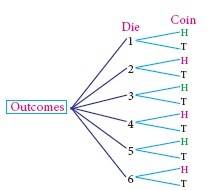
A die is rolled and a coin is tossed simultaneously. Find the probability that the die shows an odd number and the coin shows a head.
40.
prove the following identity.
\(\sqrt { \frac { 1+sin\theta }{ 1-sin\theta } } =sec\theta +tan\theta\)
41.
In an A.P. the sum of first n terms is \(\frac { { 5n }^{ 2 } }{ 2 } +\frac { 3n }{ 2 } \). Find the 17th term
42.
The radius of a spherical balloon increases from 12 cm to 16 cm as air being pumped into it. Find the ratio of the surface area of the balloons in the two cases.
43.
Discuss the nature of solutions of the following quadratic equations.
x2 - 8x + 16 = 0
44.
Draw the graph of y = 2x2 - 3x - 5 and hence solve 2x2 - 4x - 6 = 0
45.
Construct a \(\triangle\)ABC such that AB = 5.5 cm, \(\angle\)C = 25o and the altitude from C to AB is 4 cm.
46.
Construct a \(\triangle\)PQR such that QR = 6.5 cm,\(\angle\)P = 60oand the altitude from P to QR is of length 4.5 cm.
1.
(b)
r2
2.
(a)
0
3.
(b)
4.
(a)
0
5.
(d)
\(cot\theta \)
6.
(b)
1
7.
(d)
2520
8.
(b)
\(-\sqrt { 3 } \)
9.
(b)
two
10.
(d)
\(5\sqrt { 2 } \)cm
11.
(c)
4x cm
12.
(c)
\(\\ \frac { 2 }{ 9x^{ 2 } } \)
13.
(d)
(3,-2)
14.
(b)
15.
16.
From \(\Delta ADC\) we have
AC2 = AD2 + CD2 ....(1)
(Pythagoras theorem)
From \(\Delta ADB\) we have
AB2 = AD2 + BD2 ...(2)
(Pythagoras theorem)
Subtracting (1) from (2) we have,
AB2 - AC2 = BD2 - CD2
AB2 + CD2 = BD2 + AC2
17.
Total number of cards = 52
Event of selecting a spade card = A
Event of selecting a heart card = B
n(A) = 13, n(B) = 13
P(A) =\(\frac { 13 }{ 52 } =\frac { 1 }{ 4 } \), P(B) =\(\frac { 13 }{ 52 } =\frac { 1 }{ 4 } \).
A ⋂ B refers to a card is both spade and heart. It is not possible

A, B are exclusive events.
P(A,B) = P(A) + P(B) =\(\frac { 1 }{ 4 } +\frac { 1 }{ 4 } =\frac { 1 }{ 2 } \).
18.
No. of coins required \(=\frac{Volume\ of\ the\ cylinder}{Volume\ of\ 1\ coin}\)
\(=\frac { \pi { r }_{ 1 }^{ 2 }{ h }_{ 1 } }{ \pi { r }_{ 2 }^{ 2 }{ h }_{ 2 } } =\frac { \pi \times \frac { 42 }{ 20 } \times \frac { 45 }{ 20 } \times 10 }{ \pi \times \frac { 15 }{ 20 } \times \frac { 15 }{ 20 } \times \frac { 2 }{ 10 } } \)
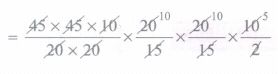
= 450
19.
1,1,1,2,2,2,3,3,3
t2 - t1 = 1-1 = 0
t3 - t2 = 1-1 = 0
t4 - t3 = 2-1 = 1
Here t2 - t1 ≠ t3 - t2
ஃ It is not an A.P.
20.
R = {(a, -2), (-5, b), (8, c), (d, -1)} represents the identity function.
a = -2, b = -5, c = 8, d = -1.
21.
We have Area of the quadrilateral
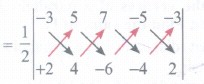
=\(\frac { 1 }{ 2 } \) [(-12 - 30 - 28 -10) - (+ 10 + 28 + 30 + 12)]
\(\frac { 1 }{ 2 } \) [-80 - (80)]
\(\frac { 1 }{ 2 } \)[-160] = -80 = 80 square units.
(∵ Area is always +ve).
22.
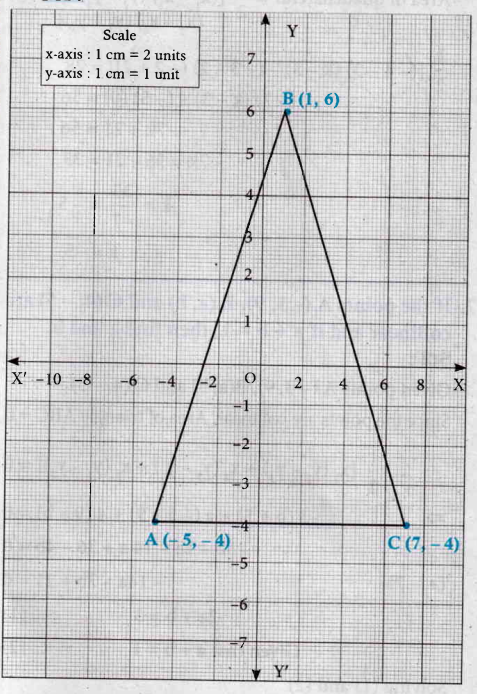
Given vertices are A (- 5, - 4), B (1, 6) and C (7, - 4)
Area of triangle \(=\frac{1}{2}\left[\mathrm{x}_{1}\left(\mathrm{y}_{2}-\mathrm{y}_{3}\right)+\mathrm{x}_{2}\left(\mathrm{y}_{3}-\mathrm{y}_{1}\right)+\right. \left.\mathrm{x}_{3}\left(\mathrm{y}_{1}-\mathrm{y}_{2}\right)\right] \text { sq. units } \)
Area of triangle ABC \(=\frac{1}{2}[-5(6+4)+ 1(-4+4)+7(-4-6)] \)
\(=\frac{1}{2}[-50+0-70]=\frac{-120}{2}=-60\)
[Area cannot be negative].
Area = 60 sq. units.
Given that one bucket of paint can be applied for 6 sq. feet
No. of buckets \(=\frac{60}{6}=10\)
23.
LHS = A(B + C)
B + C = \(\left[ \begin{matrix} 1 & 2 \\ -4 & 2 \end{matrix} \right] +\left[ \begin{matrix} -7 & 6 \\ 3 & 2 \end{matrix} \right] =\left[ \begin{matrix} -6 & 8 \\ -1 & 4 \end{matrix} \right] \)
A(B + C) = \(\left[ \begin{matrix} 1 & 1 \\ -1 & 3 \end{matrix} \right] \times \left[ \begin{matrix} -6 & 8 \\ -1 & 4 \end{matrix} \right] =\left[ \begin{matrix} -6-1 & 8+4 \\ 6-3 & -8+12 \end{matrix} \right] =\left[ \begin{matrix} -7 & 12 \\ 3 & 4 \end{matrix} \right] \) ......(1)
RHS = AB + AC
AB = \(\left[ \begin{matrix} 1 & 1 \\ -1 & 3 \end{matrix} \right] \times \left[ \begin{matrix} 1 & 2 \\ -4 & 2 \end{matrix} \right] =\left[ \begin{matrix} 1-4 & 2+2 \\ -1-12 & -2+6 \end{matrix} \right] =\left[ \begin{matrix} -3 & 4 \\ -13 & 4 \end{matrix} \right] \)
AC = \(\left[ \begin{matrix} 1 & 1 \\ -1 & 3 \end{matrix} \right] \times \left[ \begin{matrix} -7 & 6 \\ 3 & 2 \end{matrix} \right] =\left[ \begin{matrix} -7+3 & 6+2 \\ 7+9 & -6+6 \end{matrix} \right] =\left[ \begin{matrix} -4 & 8 \\ 16 & 0 \end{matrix} \right] \)
Therefore, AB + AC = \(\left[ \begin{matrix} -3 & 4 \\ -13 & 4 \end{matrix} \right] +\left[ \begin{matrix} -4 & 8 \\ 16 & 0 \end{matrix} \right] =\left[ \begin{matrix} -7 & 12 \\ 3 & 4 \end{matrix} \right] \) ....(2)
From (1) and (2), A(B + C) = AB + AC. Hence proved.
24.
Number of green balls is n(G) = 6
Let number of red balls is n(R) = x
Therefore, number of black balls is n(B) = 2x
Total number of balls n(S) = 6 + x + 2x = 6 + 3x
It is given that, P(G) = 3 x P(R)
\(\frac { 6 }{ 6+3x } =3\times \frac { x }{ 6+3x } \)
3x = 6 gives, x = 2
(i) Number of black balls = 2 x 2 = 4
(ii) Total number of balls = 6 + (3 x 2) = 12
25.
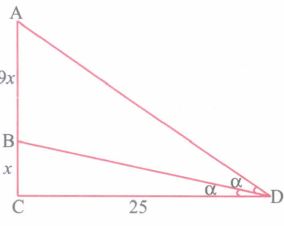
Let AC be the pole and let point 'B' divide it in the ratio
\(\not x: 9 \not x=1: 9\)
Let 'D' be the point 25 m.
\(tan\alpha =\frac { x }{ 25 } \) \(tan2\alpha =\frac { 10x }{ 25 } \)
\(tan2\alpha =\frac { 2tan\alpha }{ 1-{ tan }^{ 2 }\alpha } \)
\(\frac{\not 10 x^{5}}{\not 25}=\frac{2 \times \frac{x}{25}}{1-\frac{x^{2}}{625}}\)
.JPG)
Height of pole = 10x
= \(100\sqrt { 5 } \)
x = \(10\sqrt { 5 } \) m
26.
i) f(0) = 4
ii) \(f(3)=\sqrt { 3-1 } =\sqrt { 2 } \)
iii) \(f(a+1)=\sqrt { a+1-1 } =\sqrt { a } \)
27.
Let r be the radius of the hemisphere.
Given that, volume of the hemisphere = 29106 cm3
Now, volume of new hemisphere = \(\frac{2}{3}\)(Volume of original sphere)
= \(\frac{2}{3}\) x 29106
Volume of new hemisphere = 19404 cm3
\(\frac { 2 }{ 3 } \pi { r }^{ 3 }=19404\)
\({ r }^{ 3 }=\frac { 19404\times 3\times 7 }{ 2\times 22 } =9261\)
\(r=\sqrt [ 3 ]{ 9261 } =21cm\)
Therefore, r = 21 cm
28.
Let a be the first term and d be the common difference. It is given that
t1 = x, tm = y, tn = z
Using the general term formula
a + (l - 1)d = x .............(1)
a + (m - 1)d = y ............(2)
a + (n -1)d = z ................(3)
We have, x (m- n) +y (n -l) + z(l -m)
= a[(m-n) + (n - l) + (l - m)] + d [(m - n)(l - 1) + (n - l) (m -1) + (l - m) (n - 1)]
= a[0] + d[lm - ln - m + n + mn - lm - n + l + ln - mn - l + m]
= a(0) + d(0) = 0
29.
Clearly bucket forms frustum of a cone such that the radii of its circular ends are r1 = 28 cm, r2 = 7 cm, h = 45 cm
Capacity of the bucket = volume of the frustum
\(\Rightarrow \frac { 1 }{ 3 } \times \pi h[{ r }_{ 1 }^{ 2 }+{ r }_{ 2 }^{ 2 }+{ r }_{ 1 }{ r }_{ 2 }]\)
\(\Rightarrow \frac { 1 }{ 3 } \times \frac { 22 }{ 7 } \times 45[{ 28 }^{ 2 }+{ 7 }^{ 2 }+28\times 7)]\)
= 22 x 15 x (28 x 4 + 7 + 28)
\(\Rightarrow 330\times 147{ cm }^{ 2 }\Rightarrow 48510{ cm }^{ 2 }\)
30.
Given XY IIA C
So,
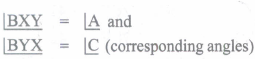
\(\therefore \Delta ABC\sim \Delta XbY\) (AAA similarity criterion)
So, \(\cfrac { ar(ABC) }{ ar(XBY) } =\left( \cfrac { AB }{ XB } \right) ^{ 2 }\) ...(1)
ar(ABC) = 2ar(XBY)
\(\cfrac { ar(ABC) }{ ar(ABC) } =\cfrac { 2 }{ 1 } \) ...(2)
From (1) and (2),
\(\left( \cfrac { AB }{ XB } \right) ^{ 2 }=\cfrac { 2 }{ 1 } i.e.,\cfrac { AB }{ XB } =\cfrac { \sqrt { 2 } }{ 1 } \)
\(\cfrac { XB }{ AB } =\cfrac { 1 }{ \sqrt { 2 } } \)
\(1-\frac{X B}{A B}=1-\frac{1}{\sqrt{2}}\)
\(\cfrac { AB-XB }{ AB } =\cfrac { \sqrt { 2 } -1 }{ \sqrt { 2 } } \)
\(\cfrac { AX }{ AB } =\cfrac { \sqrt { 2 } -1 }{ \sqrt { 2 } } =\cfrac { 2-\sqrt { 2 } }{ 2 } \)
31.
| x | x2 |
| 30 | 900 |
| 80 | 6400 |
| 60 | 3600 |
| 70 | 4900 |
| 20 | 400 |
| 40 | 1600 |
| 50 | 2500 |
| Σx = 350 | Σx2 = 20300 |
σ =\(\sqrt { \frac { \Sigma x^{ 2 } }{ n } -\left( \frac { \Sigma x }{ n } \right) ^{ 2 } } \)
=\(\\ \sqrt { \frac { 20300 }{ 7 } -\left( \frac { 350 }{ 7 } \right) ^{ 2 } } \)
=\(\sqrt { 400 } \) = 20
32.
D= b2-4ac
⇒ 4(ac + bd)2 - 4(a2 + b2)(c2 + d2)
⇒ 4[(ac + bd)2 - (a2 + b2)(c2 + d2)]
⇒ 4(a2c2 + b2d2 + 2acbd - a2c2b2c2 - a2d2 - b2d2]
⇒ 4[2acbd - a2d2 - b2c2]
⇒ 4[a2d2 + b2c2 - 2adbc]
⇒-4[ ad - bc]2
We have ad≠ bc
∴ ad- be of 0
⇒ (ad - bc)2 > 0
⇒ 4(ad - bc)2 < 0 ⇒ D < 0
Hence the given equation has no real roots.
33.
We have 6 = 21 x 31 and
20 = 2 x 2 x 5 = 22 x 51
You can find HCF (6, 20) = 2 and LCM (6, 20) = 2 x 2 x 3 x 5 = 60.
As done in your earlier classes. Note that HCF (6, 20) = 21 = product of the smallest power of each common prime factor in the numbers.
LCM (6, 20) = 22 x 31 x 51 = 60.
= Product of the greatest power of each prime factor, involved in the numbers.
34.
Let A(1, 7), B(4, 2), C(-1, -1) and D(-4, 4) be the given paints. One way at showing that ABCD is a square is to use the property that all its sides should be equal and both its diagonals should be equal.
Now,
AB = \(\sqrt { (1-4)^{ 2 }+(7-4)^{ 2 } } =\sqrt { 9+25 } =\sqrt { 34 } \)
BC = \(\\ \sqrt { (4+1)^{ 2 }+(2+1)^{ 2 } } =\sqrt { 25+9 } =\sqrt { 34 } \)
CD = \(\sqrt { (-1+4)^{ 2 }+(-1-4)^{ 2 } } =\sqrt { 9+25 } =\sqrt { 34 } \)
DA =\(\sqrt { (1+4)^{ 2 }+(7-4)^{ 2 } } =\sqrt { 25+9 } =\sqrt { 34 } \)
AC = \(\sqrt { (1+1)^{ 2 }+(7+1)^{ 2 } } =\sqrt { 4+64 } =\sqrt { 68 } \)
BD = \(\\ \sqrt { (4+4)^{ 2 }+(2-4)^{ 2 } } =\sqrt { 64+4 } =\sqrt { 68 } \)
Since, AB = BC = CD = DA and AC = BD, all the four sides at the quadrilateral ABCD are equal and its diagonals AC and BD are also equal. Therefore, ABCD is a square.
35.
4x + 3y + 12 = 0
4x + 3y = -12
Dividing by - 12
\(\Rightarrow \ \frac{4 x}{-12}+\frac{3 y}{-12} =1 \)
\(\Rightarrow \ \frac{x}{(-3)}+\frac{y}{(-4)} =1 \)
\(\frac{x}{a}+\frac{y}{b} =1 \)
x intercept = a = -3
y intercept = b = -4.
36.
In \(\triangle\)PST and \(\triangle\)PQR
\(\frac { PS }{ PQ } =\frac { 2 }{ 2+3 } =\frac { 2 }{ 5 } ,\frac { PT }{ PR } =\frac { 2 }{ 2+3 } =\frac { 2 }{ 5 } \)
Thus, \(\frac { PS }{ PQ } =\frac { PT }{ PR } \) and \(\angle\)P is is common
Therefore, by SAS similarity,
\(\triangle\)PST~\(\triangle\)PQR
37.
\(\frac { { x }^{ 2 }-16 }{ { x }^{ 2 }+8x+16 } =\frac { \left( x+4 \right) \left( x-4 \right) }{ { \left( x+4 \right) }^{ 2 } } =\frac { x-4 }{ x+4 } \)
38.
f(x) = 4x2 - 1, g(x) = 1 + x
f o g = f(g(x)) = f(1 + x) = 4(1 + x)2 - 1
= 4(1 + 2x + x2) - 1
= 4 + 8x + 4x2 - 1
= 4x2 + 8x + 3
g o f = g(f(x)) = 1 + 4x2 - 1
= 4x2
f o g ≠ g o f
39.
Sample space
S = {1H,1T,2H,2T,3H,3T,4H,4T,5H,5T,6H,6T};
n(S) = 12
Let A be the event of getting an odd number and a head.
A = {1H, 3H, 5H}; n(A) = 3
P(A) = \(\frac { n(A) }{ n(S) } =\frac { 3 }{ 12 } =\frac { 1 }{ 4 } \)
40.
\( \sqrt{\frac{1+\sin \theta}{1-\sin \theta}} =\sec \theta+\tan \theta \)
\(\mathbf{L H S} =\sqrt{\frac{1+\sin \theta}{1-\sin \theta}} \)
\(=\sqrt{\frac{1+\sin \theta}{1-\sin \theta} \times \frac{1-\sin \theta}{1-\sin \theta}}\)
[Multiplying the Numerator and denominator by \(\sqrt{1-\sin \theta}\)]
\( =\sqrt{\frac{1^{2}-\sin ^{2} \theta}{(1-\sin \theta)^{2}}} \quad\left[\because(a+b)(a-b)=a^{2}-b^{2}\right] \)
\(=\sqrt{\frac{\cos ^{2} \theta}{(1-\sin \theta)^{2}}} \quad\left[\because 1-\sin ^{2} \theta=\cos ^{2} \theta\right] \)
\(=\frac{\cos \theta}{1-\sin \theta} \)
\(=\frac{\cos \theta}{1-\sin \theta} \times \frac{1+\sin \theta}{1+\sin \theta} \)
[Multiplying Numerator and denominator by \(1+\sin \theta\)]
\( =\frac{\cos \theta(1+\sin \theta)}{1^{2}-\sin ^{2} \theta}=\frac{\cos \theta(1+\sin \theta)}{\cos ^{2} \theta} \)
\({\left[\because(a+b)(a-b)=a^{2}-b^{2}\right]\left[1-\sin ^{2} \theta=\cos ^{2} \theta\right]} \)
\(=\frac{1+\sin \theta}{\cos \theta}=\frac{1}{\cos \theta}+\frac{\sin \theta}{\cos \theta} \)
\(=\sec \theta+\tan \theta=\text { RHS }\)
41.
The 17th term can be obtained by subtracting the sum of first 16 terms from the sum of first 17 terms
\({ S }_{ 17 }=\frac { 5\times \left( 17 \right) ^{ 2 } }{ 2 } +\frac { 3\times 17 }{ 2 } =\frac { 1445 }{ 2 } +\frac { 51 }{ 2 } =748\)
\({ s }_{ 16 }=\frac { 5\times \left( 16 \right) ^{ 2 } }{ 2 } +\frac { 3\times 16 }{ 2 } =\frac { 1280 }{ 2 } +\frac { 48 }{ 2 } =664\)
Now, t17 = S17 - S16 = 748 - 664 = 84
42.
Let r1 and r2 be the radii of the balloons.
Given that, \(\frac { { r }_{ 1 } }{ { r }_{ 2 } } =\frac { 12 }{ 16 } =\frac { 3 }{ 4 } \)
Now, ratio of C.S.A. of balloons \(=\frac { 4\pi { r }_{ 1 }^{ 2 } }{ 4\pi { r }_{ 2 }^{ 2 } } =\frac { { r }_{ 1 }^{ 2 } }{ { r }_{ 2 }^{ 2 } } ={ \left( \frac { { r }_{ 1 } }{ { r }_{ 2 } } \right) }^{ 2 }={ \left( \frac { 3 }{ 4 } \right) }^{ 2 }=\frac { 9 }{ 16 } \)
Therefore, ratio of C.S.A. of balloons is 9:16.
43.
x2 - 8x + 16 = 0
Step 1 Prepare the table of values for the equation y = x2 - 8x + 16
| x | -1 | 0 | 1 | 2 | 3 | 4 | 5 | 6 | 7 | 8 |
| y | 25 | 16 | 9 | 4 | 1 | 0 | 1 | 4 | 9 | 16 |
Step 2: Plot the points for the above ordered pairs (x, y) on the graph using suitable scale.
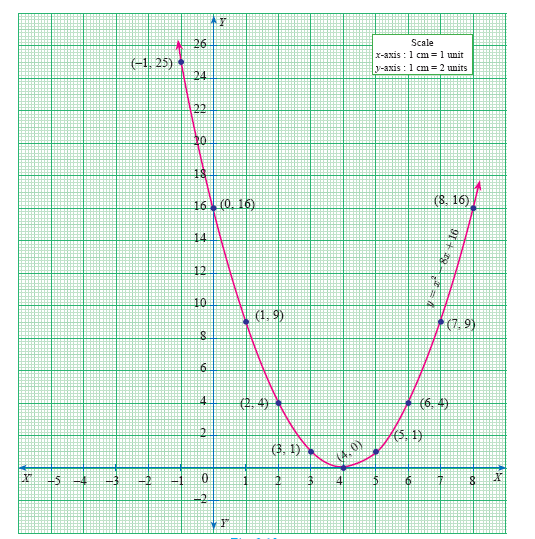
Step 3: Draw the parabola and mark the coordinates of the parabola which intersect with the X axis.
Step 4: The roots of the equation are the x coordinates of the intersecting points of the parabola with the X axis (4,0) which is 4.
Since there is only one point of intersection with X axis, the quadratic equation x2 - 8x + 16 = 0 has real and equal roots.
44.
| x | -4 | -3 | -2 | -1 | 0 | 1 | 2 | 3 | 4 |
| x2 | 16 | 9 | 4 | 1 | 0 | 1 | 4 | 9 | 16 |
| -2x2 | 32 | 18 | 8 | 2 | 0 | 2 | 8 | 18 | 32 |
| -3x | 12 | 9 | 6 | 3 | 0 | -3 | -6 | -9 | -12 |
| -5 | -5 | -5 | -5 | -5 | -5 | -5 | -5 | -5 | -5 |
| y=x2-3x-5 | 39 | 22 | 9 | 0 | -5 | -6 | -3 | 4 | 15 |
Draw the parabola using the points (-4, 39), (-3, 22), (-2, 9), (-1, 10), (0, -5), (1, -6), (2, -3), (3, 4), (4, 15).
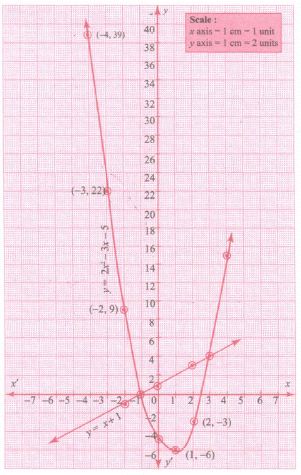
To solve 2x2- 4x - 6 = 0, subtract it from y = 2x2- 3x - 5
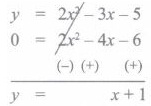 is a straight line
| x | -2 | 0 | 2 |
| 1 | 1 | 1 | 1 |
| y=x+1 | -1 | 1 | 3 |
Draw a straight line using the points (-2, -1), (0, 1), (2, 3). The points of intersection of the parabola and the straight line forms the roots of the equation.
The x-coordinates of the points of intersection forms the solution set.
∴ Solution {-1, 3}
45.
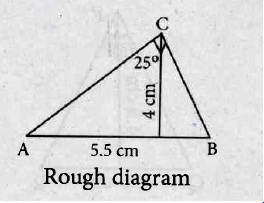
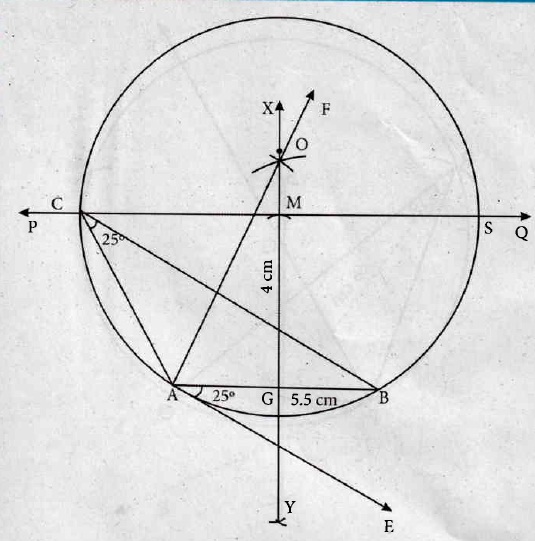
Construction:
Step (1) Draw \(\bar { AB } =5.5cm\)
Step (2) Draw \(\angle BAE={ 25 }^{ 0 }\)
Step (3) Draw \(\angle FAE={ 90 }^{ 0 }\)
Step (4) Drawn the perpendicular bisector XY to AB which intersects AF at O and AB at G.
Step (5) With O as center and OA as radius drawn a circle
Step (6) XY intersects AB at G. On XY from G marked an arc at M such that GM = 4 cm
Step (7) Drawn PQ through M which is parallel to AB.
Step (8) PQ meets the circle at C and S.
Step (9) Joined AC and BC. Now \(\triangle\)ABC is the required triangle
46.
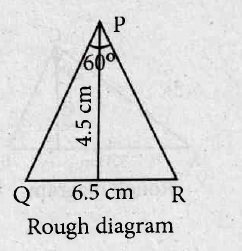
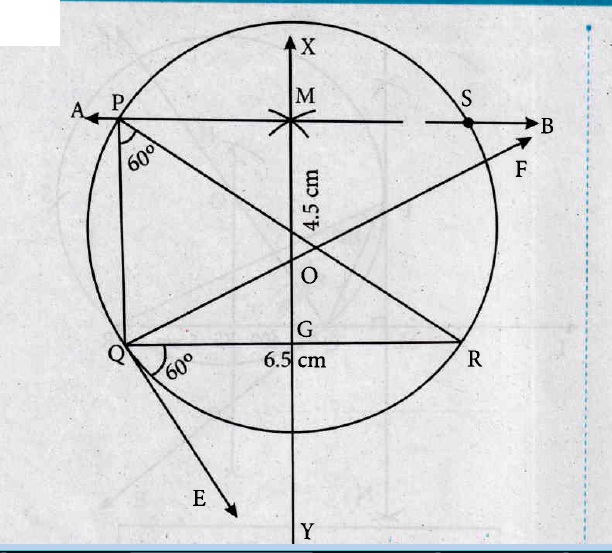
Construction:
Steps (1) Draw QR = 6.5 cm.
Steps (2) Draw \(\angle RQE={ 60 }^{ 0 }\)
Steps (3) Draw \(\angle FQE={ 90 }^{ 0 }\)
Steps (4) Drawn the perpendicular bisector XY to ER which intersects QF at O and ER at G.
Steps (5) With O as center and OQ as radius drawn a circle
Steps (6) XY intersects QR at G. On XY, from G marked an arc at M, such that GM = 4.5 cm
Steps (7) Drawn AB through M which is parallel to QR
Steps (8) AB meets the circle at P and S
Steps (9) Joined QP and RP Then \(\triangle\)PQR is the required triangle.
Steps (10) Here \(\triangle\)SQR is also another required triangle.

10th Standard Syllabus & Materials
10th Standard
TN 10th English Prose - 2 - The Night the Ghost Got in Important Questions And Answers Study Material - QB365 Set A
NEW10th Standard
TN 10th English Supplementary - 1 - The Tempest Important Questions And Answers Study Material - QB365 Set A
NEW10th Standard
TN 10th English Poem - 1 - Life Important Questions And Answers Study Material - QB365 Set A
NEW10th Standard
TN 10th English Prose - 1 - His First Flight Important Questions And Answers Study Material - QB365 Set A



Tamilnadu Stateboard 10th Standard Subjects
Tamilnadu Stateboard Standards





