
 100% FREE ACCESS
10th Standard Syllabus & Materials
10th Standard
TN 10th English Prose - 4 - The Attic Important Questions And Answers Study Material - QB365 Set A
NEW10th Standard
TN 10th English Supplementary - 3 - The Story of Mulan Important Questions And Answers Study Material - QB365 Set A
NEW10th Standard
TN 10th English Poem - 3 - I am Every Woman Important Questions And Answers Study Material - QB365 Set A
NEW10th Standard
TN 10th English Prose - 3 - Empowered Women Navigating The World Important Questions And Answers Study Material - QB365 Set A
NEW10th Standard
TN 10th English Supplementary - 2 - Zigzag Important Questions And Answers Study Material - QB365 Set A
NEW10th Standard
TN 10th English Poem - 2 - The Grumble Family Important Questions And Answers Study Material - QB365 Set A

Published on: 30/09/2019
Geometry
Download Tamil Nadu 10th Standard Maths question papers, model tests, one-mark questions, important questions, and public exam papers in PDF format. Free study materials and answer keys for TN State Board students.
Questions + Answers key
Take MCQ Maths Test1.
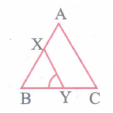
In figure the line segment XY is parallel to side AC of \(\Delta ABC\) and it divides the triangle into two parts of equal areas. Find the ratio \(\cfrac { AX }{ AB } \)
2.
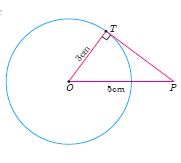
Find the length of the tangent drawn from a point whose distance from the centre of a circle is 5 cm and radius of the circle is 3 cm.
3.
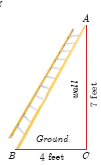
What length of ladder is needed to reach a height of 7 ft along the wall when the base of the ladder is 4 ft from the wall? Round off your answer to the next tenth place.
4.
An insect 8 m away initially from the foot of a lamp post which is 6 m tall, crawls towards it moving through a distance. If its distance from the top of the lamp post is equal to the distance it has moved, how far is the insect away from the foot of the lamp post?
5.
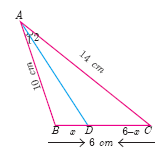
In the Figure, AD is the bisector of \(\angle\)BAC, if A = 10 cm, AC = 14 cm and BC = 6 cm. Find BD and DC.
6.
If \(\triangle\)ABC is similar to \(\triangle\)DEF such that BC = 3 cm, EF = 4 cm and area of \(\triangle\)ABC = 54 cm2. Find the area of \(\triangle\)DEF.
7.
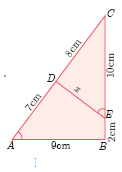
\(\angle A=\angle CED\) prove that \(\Delta\ CAB \sim \Delta CED\) Also find the value of x.
8.
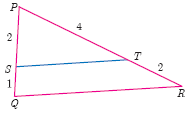
Show that \(\triangle\) PST~\(\triangle\) PQR
9.
Construct a triangle similar to a given triangle PQR with its sides equal to \(\frac { 7 }{ 4 } \) of the corresponding sides of the triangle PQR (scale factor \(\frac { 7 }{ 4 } \)>1)
10.
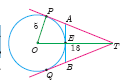
In figure, O is the centre of the circle with radius 5 cm. T is a point such that OT = 13 cm and OT intersects the circle E, if AB is the tangent to the circle at E, find the length of AB
11.
In trapezium ABCD, AB || DC, E and F are points on non-parallel sides AD and BC respectively, such that EF || AB. Show that \(\frac { AE }{ ED } =\frac { BF }{ FC } \)
12.
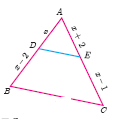
In \(\triangle\) ABC, if DE||BC, AD = x, DB = x − 2, AE = x +2 and EC = x − 1 then find the lengths of the sides AB and AC.
13.
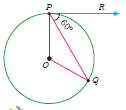
14.
How many tangents can be drawn to the circle from an exterior point?
one
two
infinite
zero
15.
Two poles of heights 6 m and 11 m stand vertically on a plane ground. If the distance between their feet is 12 m, what is the distance between their tops?
13 m
14 m
15 m
12.8 m
16.
If in \(\triangle\)ABC, DE || BC, AB = 3.6 cm, AC = 2.4 cm and AD = 2.1 cm then the length of AE is
1.4 cm
1.8 cm
1.2 cm
1.05 cm
17.
If in triangles ABC and EDF,\(\cfrac { AB }{ DE } =\cfrac { BC }{ FD } \) then they will be similar, when
\(\angle B=\angle E\)
\(\angle A=\angle D\)
\(\angle B=\angle D\)
\(\angle A=\angle F\)
1.
Given XY IIA C
So,
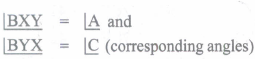
\(\therefore \Delta ABC\sim \Delta XbY\) (AAA similarity criterion)
So, \(\cfrac { ar(ABC) }{ ar(XBY) } =\left( \cfrac { AB }{ XB } \right) ^{ 2 }\) ...(1)
ar(ABC) = 2ar(XBY)
\(\cfrac { ar(ABC) }{ ar(ABC) } =\cfrac { 2 }{ 1 } \) ...(2)
From (1) and (2),
\(\left( \cfrac { AB }{ XB } \right) ^{ 2 }=\cfrac { 2 }{ 1 } i.e.,\cfrac { AB }{ XB } =\cfrac { \sqrt { 2 } }{ 1 } \)
\(\cfrac { XB }{ AB } =\cfrac { 1 }{ \sqrt { 2 } } \)
\(1-\frac{X B}{A B}=1-\frac{1}{\sqrt{2}}\)
\(\cfrac { AB-XB }{ AB } =\cfrac { \sqrt { 2 } -1 }{ \sqrt { 2 } } \)
\(\cfrac { AX }{ AB } =\cfrac { \sqrt { 2 } -1 }{ \sqrt { 2 } } =\cfrac { 2-\sqrt { 2 } }{ 2 } \)
2.
Given OP = 5 cm, radius r = 3 cm
To find the length of tangent PT.
In right angled \(\triangle\)OTP
OP2 = OT2 + PT2 gives PT2 = 25 - 9 = 16
Length of the tangent PT = 4cm
3.
Let x be the length of the ladder. BC = 4 ft, AC = 7 fit.
By Pythagoras theorem we have, AB2 = AC2 + BC2
x2 = 72 + 42 gives x2 = 49 + 16
x2 = 65, Hence \(x=\sqrt { 65 } \)
The number \(\sqrt { 65 } \) is between 8 and 8.1.
82 = 64 < 65.61 = 8.12
Therefore, the length of the ladder is approximately 8.1ft
4.
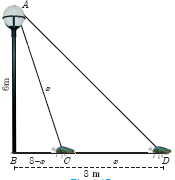
Distance between the insect and the foot of the lamp post BD = 8 m
The height of the lamp post, AB = 6 m
After moving a distance of x m, let the insect be at C
Let, AC = CD = x . Then BC = BD − CD = 8 − x
In \(\triangle\)ABC, \(\angle\)B = 90o
AC2 = AB2 + BC2 gives x2 = 62 + (8 - x)2
x2 = 36 + 64 − 16x + x2
16x = 100 then x = 6.25
Then, BC = 8 − x = 8 − 6.25 = 1.75m
Therefore the insect is 1.75 m away from the foot of the lamp post.
5.
Let BD = x cm, then DC = (6 – x)cm
AD is bisector of\(\angle\) A
Therefore by Angle Bisector Theorem
\(\frac { AB }{ AC } =\frac { BD }{ DC } \)
\(\frac { 10 }{ 14 } =\frac { x }{ 6-x } \quad \frac { 5 }{ 7 } =\frac { x }{ 6-x } \)
So, 12x = 30 we get, \(x=\frac { 30 }{ 12 } =2.5\)
Therefore, BD = 2.5 cm, DC = 6−x = 6−2.5 = 3.5 cm
6.
Since the ratio of area of two similar triangles is equal to the ratio of the squares of any two corresponding sides, we have
\(\frac { Area(\Delta ABC) }{ Area(\Delta DEF) } =\frac { { BC }^{ 2 } }{ { EF }^{ 2 } } \) gives \(\frac { 54 }{ Area(\Delta DEF) } =\frac { { 3 }^{ 2 } }{ { 4 }^{ 2 } } \)
\(Area(\Delta DEF)=\frac { 16\times 54 }{ 9 } =96{ cm }^{ 2 }\)
7.
\(\Delta \ CAB\) and \(\Delta CED\),\(\angle C\) is common, \(\angle A=\angle CED\)
Therefore, \(\Delta CAB\sim \Delta CED\)
Hence, \(\frac { CA }{ CE } =\frac { AB }{ DE } =\frac { CB }{ CD } \)
\(\frac { AB }{ DE } =\frac { CB }{ CD } \quad \frac { 9 }{ x } =\frac { 10+2 }{ 8 } ,x=\frac { 8\times 9 }{ 12 } =6\) cm.
8.
In \(\triangle\)PST and \(\triangle\)PQR,
\(\frac { PS }{ PQ } =\frac { 2 }{ 2+1 } =\frac { 2 }{ 3 } ,\frac { PT }{ PR } =\frac { 4 }{ 4+2 } =\frac { 2 }{ 3 } \)
Thus, \(\frac { PS }{ PQ } =\frac { PT }{ PR } \) and \(\angle\)P is common
Therefore, by SAS similarity,
\(\triangle\) PST~\(\triangle\)PQR
9.
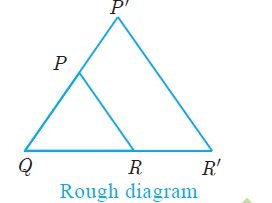
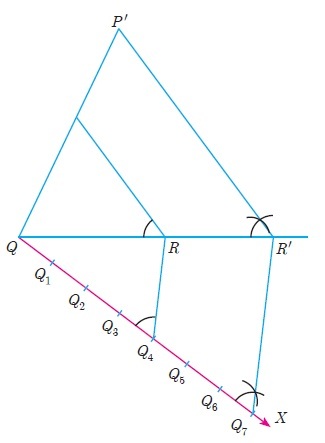
Given a triangle PQR, we are required to construct another triangle whose sides are \(\frac { 7 }{ 4 } \) of the corresponding sides of the triangle PQR.
Steps of construction
1. Construct a DPQR with any measurement.
2. Draw a ray QX making an acute angle with QR on the side opposite to vertex P.
3. Locate 7 points (the greater of 7 and 4 in \(\frac { 7 }{ 4 } \))
Q1,Q2,Q3,Q4,Q5,Q6 and Q7 on QX so that
QQ1 = Q1Q2 = Q2Q3 = Q4Q5 = Q5Q6 = Q6Q7
4. Join Q4 (the 4th point, 4 being smaller of 4 and 7 in \(\frac { 7 }{ 4 } \)) to R and draw a line through Q7 parallel to Q4R, intersecting the extended line segment QR at R'.
5. Draw a line through R' parallel to RP intersecting the extended line segment QP at P'.
Then \(\triangle\)P'QR' is the required triangle each of whose sides is seven-fourths of the corresponding sides of \(\triangle\)PQR.
10.
Since OP is the radius and PT tangent
\(\angle O P T=90^{\circ}\)
Applying Pythagoras theorem in \(\triangle\)OPT, we have
OT2 = OP2 + PT2
132 = 52 + PT2
PT2 = 169 - 25
PT2 = 144
PT = 12cm
Since the lengths of tangents drawn from an exterior point to a circle are equal.
AP = AE = x(say)
AT = PT - AP = (12-x)cm
Since AB is the tangent to the circle at E
\( \therefore \mathrm{OE} \perp \mathrm{AB} \)
\(\ \Rightarrow \angle O E A =90^{\circ} \)
\(\\ \Rightarrow \angle A E T =90^{\circ}\)
\( \\ \mathrm{AT}^{2} =\mathrm{AE}^{2}+\mathrm{ET}^{2}\)
[Applying Pythagoras theorem in \(\triangle\)AET ]
(12 - x)2 = x2 +(13 -5)2
144 - 24 + x2 = x2 +64
24x = 144 - 64
24x = 80
3x = 10
\( x=\frac{10}{3} \mathrm{~cm} \)
\(Similarly\ B E=\frac{10}{3} \mathrm{~cm}\)
AB = AE + BE
\( =\left(\frac{10}{3}+\frac{10}{3}\right) \mathrm{cm} \)
\(A B =\frac{20}{3} \mathrm{~cm}\)
11.
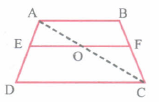
Given: ABCD is a trapezium in which DC || AB and EF || AB
To prove that \(\frac { AE }{ ED } =\frac { BF }{ FC } \)
Construction : join AC meeting EF at G
Proof:
In ADC, we have
EG || DC
\(\Rightarrow \frac{A E}{E D}=\frac{A G}{G C}\) [By Thales theorem] ...(1)
In ABC , we have
\(\frac{A G}{G C}=\frac{B F}{F C}\) [By Thales theorem] ....(2)
From (1) and (2), we get
\(\frac{A E}{E D}=\frac{B F}{F C}\)
12.
In \(\triangle\) ABC we have DE || BC.
By Thales theorem, we have \(\frac { AD }{ DB } =\frac { AE }{ EC } \)
\(\frac { x }{ x-2 } =\frac { x+2 }{ x-1 } \) gives x(x - 1) = (x - 2)(x + 2)
When x = 4, AD = 4, DB = x - 2, AE + x + 2 = 6, EC = x - 1 = 3
Hence, AB = AD + DB = 4 + 2 = 6, AC = AE + EC = 6 + 3 = 9
Therefore, AB = 6, AC = 9
13.
(d)
14.
(b)
two
15.
(a)
13 m
16.
(a)
1.4 cm
17.
(c)
\(\angle B=\angle D\)

10th Standard Syllabus & Materials
10th Standard
TN 10th English Prose - 2 - The Night the Ghost Got in Important Questions And Answers Study Material - QB365 Set A
NEW10th Standard
TN 10th English Supplementary - 1 - The Tempest Important Questions And Answers Study Material - QB365 Set A
NEW10th Standard
TN 10th English Poem - 1 - Life Important Questions And Answers Study Material - QB365 Set A
NEW10th Standard
TN 10th English Prose - 1 - His First Flight Important Questions And Answers Study Material - QB365 Set A



Tamilnadu Stateboard 10th Standard Subjects
Tamilnadu Stateboard Standards





