
 100% FREE ACCESS
10th Standard Syllabus & Materials
10th Standard
TN 10th English Prose - 4 - The Attic Important Questions And Answers Study Material - QB365 Set A
NEW10th Standard
TN 10th English Supplementary - 3 - The Story of Mulan Important Questions And Answers Study Material - QB365 Set A
NEW10th Standard
TN 10th English Poem - 3 - I am Every Woman Important Questions And Answers Study Material - QB365 Set A
NEW10th Standard
TN 10th English Prose - 3 - Empowered Women Navigating The World Important Questions And Answers Study Material - QB365 Set A
NEW10th Standard
TN 10th English Supplementary - 2 - Zigzag Important Questions And Answers Study Material - QB365 Set A
NEW10th Standard
TN 10th English Poem - 2 - The Grumble Family Important Questions And Answers Study Material - QB365 Set A

Published on: 12/05/2020
10th Standard Science English Medium Creative Important 7 Marks Questions
Download Tamil Nadu 10th Standard Science question papers, model tests, one-mark questions, important questions, and public exam papers in PDF format. Free study materials and answer keys for TN State Board students.
Questions + Answers key
Take MCQ Science Test1.
Complete the following fission reactions:
(a) 92U235+ 0n1 ⇾38Sr90+Xe+30n1
(b) 92U235+ 0n1 ⇾43Tc107+n+50n1
2.
Convert 1Bq into curie.
3.
Which unit is a measure of an individual's exposure to gamma radiation?
4.
Solve this equation for β - decay.
27Co60⇾ Ni+
5.
Solve this equation for ∝ - decay.
88Ra226 ➝Rn+________
6.
Find the type of decay.
90Th231⟶ 91pa231+_______.
7.
If Gadolinium - 150 undergoes through a - decay what is the new atomic mass of the resulting element?
8.
In the equation 6C14⟶ 7N14+-1e0 which decay of radioactive carbon-14 results in the new nitrogen - 14 atom.
9.
10Th234⟶91Pa234+ -1e0
Which type of nuclear radiation is being emitted here?
10.
How much energy will have been produced if the loss in mass during a fission reaction was 0.025 g?
11.
If the loss in mass during a fission reaction is 0.20 g, how much energy will have been produced?
12.
Three hundred and fifty atoms of Ur-235 split. If 2.9 x 10⁻⁸ J of energy is released from each atom when fission occurs. What nuclear mass was converted into energy?
13.
If the following quantity of energy was released during fission, determine the loss in mass that would result.
(a) 8.5 x 10¹⁴ J
(b) 2.9 x 10¹⁷ J
14.
Determine the energy produced in the fission reaction whose mass difference is 3.251 x 10⁻²⁸ kg.
15.
Plutonium - 239 specimen emits radiation of 4.3 x 10³ GBq per second convert this disintegrations in terms of curie.
(1 Bq = 2.703 x 10⁻¹¹curie)
16.
At 303 k the volume of an aluminium sphere is 0.3 m3. The coefficient linear expansion αL=24 K-1. If the final volume is 0.35 m3. What is the final temperature of aluminium sphere?
17.
A metal rod 6.522 m long at 285 k expands by 0.576 m at 363 k. Find the coefficient of linear expansion of the metal.
18.
A metal scale is graduated at 0°C so what would be original length of the object when measured at 25°C, reads 50 Cm? For a metal, the coefficient of linear expansion is 18 x 10-6/ °C.
19.
An aluminium sheet of length 30 m is made into cone for temperature range ΔT = 300 k. Find the change in length of AI sheet?
20.
If boiling point of water is 95°F, What will be the reading in kelvin scale?
21.
A piece of steel has a length 2 m at 200 k. At 250 k its length increases by 0.1 m. Find the coefficient of cubical expansion of steel.
22.
An object placed at 50 cm from a lens produces a virtual image at a distance of 10 cm in front of the lens. What is the focal length of the lens? Is it converging or diverging?
23.
When an object is placed at 25 cm from a concave lens, a virtual image is produced at a distance of 10 cm. Calculate the magnification produced by the lens.
24.
Draw a diagram to show how hypermetropia is corrected. The real position of hypermetropia eye is 1 m. What is the power of the lens required to correct this defect? G. T real position of the normal is 25 cm.
25.
The far position of a myopic person is 90 cm in front of the eye. What is the nature and power of the lens required to correct the problem?
26.
A person needs of power -4 D for correcting his distant vision. For correcting his real vision he needs a lens of power +1.5 D. What is focal length of the lens required for correcting.
(i) Distant vision and
(ii) Real vision?
27.
A concave lens has focal length of 20 cm. At what distance from the lens a 5 cm tall object be placed so that it forms an image at 15 cm from the lens? Calculate the size of the image formed.
28.
An object of height 6 cm is placed at a distance of 20 cm from a concave lens. It's focal length is 10 cm. Find the position and size of the image.
29.
An object is placed in front of a convex lens of a focal length 10 cm. What is the nature of the image formed if the object distance is 15 cm?
30.
A 5 cm tall object is placed fraction to the principle axis of a convex lens of focal length 20 cm. The distance of the object from the lens is 30 cm. Find the (i) Position, (ii) Nature, (iii) Size of the image formed.
31.
Light in air enters a diamond at 45°. What is the angle of refraction? G.T μdia = 2.42.
32.
Alight travels from air into water, the angle of refraction is 25° to the normal. Find the angle of incidence. Refractive index of water is 1.33. μa=1.
33.
Speed of light in glass is 2 x 10⁸ ms-1. Find the refractive index of glass.
34.
The refractive index of kerosene is 1.44 & that of diamond is 2.42. Calculate the refractive index of diamond with respect to kerosene.
35.
The refractive index of kerosene is 1.44. Find the velocity of light through kerosene.
36.
The diameter of the objective lens is 5 m and wavelength of light is 6000 Å. Find the resolving power of resolution of the telescope.
37.
At 10° C, how for away is a reflecting surface if you hear an echo in 0.274s?
38.
Find the speed of sound in air at 9.23° C.
39.
A boy hears two different sounds when a race car is moving toward and moving away. If the speed of sound in air is 340 ms-1. The frequency emitted by the car is 800 Hz and the car velocity is 120 ms-1. Find the frequency heard by the boy? (when the car moving forward).
40.
What is the frequency heard by a stationary observer when a train approaches with a speed of 30 ms-1. The frequency of the train is 600 Hz and the speed of sound is 340 m/s?
41.
An observer approaches a stationary sound source 1000 Hz at twice the speed of sound. What frequency does the observer hear?
42.
Calculate the force of gravitation between two bodies of weight 50 kg and 10 kg respectively place at 10 m apart. If their distance increased to 100 % then find the change in percentage of force. (New force is 75% less than the original force)
43.
A person of weight 50 kg is moving down in an elevator Calculate downward acceleration offered by the elevator whose reaction force is 400 N on the surface.
44.
Force of 50 N acts perpendicular on a body, which is fixed at a point O. The distance of point of action of force from O is 5 cm. Find the moment of force.
45.
When a constant force acts of 10 s on a body of mass 10 kg, which is initially at rest, moves a distance of 500 cm in 10 s. Calculate the frictional force required to bring the body to rest.
46.
If the acceleration due to gravity of a planet is half the acceleration due to gravity of the earth's surface and radius of planet is half the radius of the earth find the mass of planet in terms of mass of earth.
47.
The masses of two planets are in the ratio 1 : 2 their radii are in the ratio 1 : 2. Find the ratio of the acceleration due to gravity on the planets.
48.
A 2000 kg car traveling at 20 ms-1 hits concrete wall and stops in 0.05 s. What magnitude of impulse did the wall exert on the car?
49.
A body of mass 2 kg moving with uniform velocity of 40 ms-1 collides with another body at rest. If two bodies move together with a velocity of 20 m-1, Find the mass of the other body.
50.
Calculate the energy consumed by 120 w toaster in 20 min.
51.
Wire is 1 m long, 0.4 mm in diameter & has resistance of 20 Ω. Calculate its resistivity.
52.
Determine the following quantities of the given equivalent.
(i) The equivalent resistance
(ii) Total current through the circuit
(iii) The current through each resistor
(iv) Voltage drop across resistor
(v) Power dissipated in each resistor
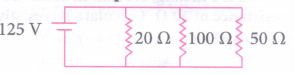
R1 = 20Ω; R2 = 100Ω; R350Ω; V = 125V
53.
Find the
(i) equivalent resistance,
(ii) current through each reactor,
(iii) Total current for the given circuit,
(iv) Voltage drop across each resistor.
54.
A 110 V light bulb takes 0.9 A current and operates 12h / day. Determine the energy consumed by the bulb for 30 days.
55.
What is the resistance of heating element of the heater when 20 A current passing through it at a potential of 220 V?
56.
An electric heater works for 30 min at 120 V and takes energy of 1 - 2 kwh. What is the current drawn by the heater?
57.
The potential difference between two conductor is 110 V. How much work in moving 5 C charge from one conductor to the other?
58.
The amount of work done to move 20C charge from one point to another is 2201. What is the potential difference between these two points?
59.
A current of 6 A flows through metal wire. How many coulombs of charge pass through the wire in 2 miniatures?
60.
100 W bulb draws 680 mA current. How much time will be required to pass 30 C of charge through the bulb?
61.
A sphere of mass 20 kg moving with a velocity 40 ms-1 collides with another sphere of mass 15 kg which is at rest. After collision they move with the same velocity. Find that velocity.
62.
A body of mass 20 x 10-3 kg when acted upon by a force for 4 second, attains a velocity of 100 m/s. If the same force is applied for 2 minutes, on a body of mass 10 kg at rest, what will be its velocity?
63.
Two bodies have masses in the ratio 2 : 3 when a force is applied on first body, it moves with an acceleration of 6 ms-2, How much acceleration will be the same force produce in the other body?
64.
A cricket ball of mass 100 g moving with a speed of 20 ms-1 is brought to rest by a player. Find the change in momentum of ball.
65.
A body of mass 20 kg is hung by a spring balance in a lift. What would be the weight when (i) The lift is ascending with an acceleration of 2 m/s2
(ii) The lift is descending with a same acceleration of 2 m/s2
(iii) The lift is descending with a constant velocity 2 ms-1
Given g = 10 m/s2
66.
A bullet of mass 50 g moving with a speed of 300 ms-1 is brought to rest in 1 s. Find the impulse and the force.
67.
A passenger of mass 72 kg is riding in a lift what is the apparent weight of a person in
(i) descending with constant velocity
(ii) ascending with constant acceleration 3 m/s2?
68.
Calculate the number of molecules in 11g of CO2
69.
Find the mass of 2.5 mole of oxygen atom.
70.
Calculate the number of moles in 2g of NaOH.
71.
Calculate the number of moles in 81g of aluminum.
72.
Calculate the gram molecular mass of carbon dioxide (CO2)
1.
(a) 92U235+ 0n1 → 38Sr90+ 54Xe143+ 30n1
(b) 92U235+ 0n1 → 43TC107+ 49In124+ 50n1
2.
1 Bq = one disintegration per second
1 curie = 3.7 x 10¹⁰ disintegration per second
(Bq)
\(\therefore 1Bq=\frac { 1 }{ 3.7\times { 10 }^{ 10 } } \)Curie
= 2.703 x 10⁻¹¹ci
3.
Roentgen
4.
27Co60⇾ 28Ni60 +-1e0
5.
88Ra226 ➝86Rn222+2He4
6.
90Th231→91a231 + -1e0(β - decay)
7.
Ga150⇾X146+ 2He4
New atomic number - 146
8.
Beta decay.
9.
Beta radiation (i.e. electrons).
10.
Given
Loss in mass, m = 0.026 g = 2.6 x 10⁻⁵ kg
To find: E= mc2
Solution
E = 2.6 x 10-5 x (3 X 108)2
Energy, E = 2.3 x 10¹²J
11.
Given
Loss in mass, m = 0.20 g = 2 x 10⁻⁴ kg
To find: E = mc2
Solution
E = 2 x 10-4 x (3 x 108)2
E = 1.8 x 10¹³J
12.
Given
The energy released from one atom = 2.9 x 10⁻⁸ J
For 350 atoms, E = 2.9 x 10-8 x 350
To find: mass, m = ?
E = mc2,
\(m=\frac { E }{ { c }^{ 2 } } =\frac { 2.9\times { 10 }^{ 8 }350 }{ { ({ 3\times 10 }^{ 8 }) }^{ 2 } } \)
mass, m=1.13 x 10⁻²²kg
13.
(a) Given
The energy released E = 8.5 x 10¹⁴ J
To find: Loss in mass, m = ?
Solution
\(m=\frac { E }{ { c }^{ 2 } } =\frac { 8.5\times { 10 }^{ 14 } }{ { ({ 3\times 10 }^{ 8 }) }^{ 2 } } \)
m = 9.4 x 10⁻³ kg
(b) Given
Energy released E = 2.9 x 10¹⁷ J
To find: Loss in mass, m =?
Solution
\(m=\frac { E }{ { c }^{ 2 } } =\frac { 2.9\times { 10 }^{ 17 } }{ { ({ 3\times 10 }^{ 8 }) }^{ 2 } } \)
= 3.2 kg
14.
Given
Mass defect = Difference in actual mass and mass of the product
∆m = 3.251 x 10⁻²⁸ kg
Velocity of light, c = 3 x 10⁸ ms-1
To find: Energy, E = ∆mc2 = ?
Solution
E = 3.251 x 10-28 x (3 x 108)2
E = 2.93 x 10⁻¹¹J
15.
1 Bq = 2.703 x 10⁻¹¹ curie
∴ 4.3 x 10³ GBq = 4.3 x 103 x 109 x 2.703 x10-11
= 11.62 x 101
= 116.2 curie
16.
The coefficient of linear expansion,
αL =24 K-1
The coefficient of cubical expansion,
αv =3αL= 3 x 24
= 72 K-1
The initial temperature, T1 = 303 K
The initial volume, V0 = 0.3 m3
The final volume, V1 = 0.35 m3
Change in volume ΔV = 0.35 - 0.30
= 0.05 m3
To find: The final temperature T2= ?
ΔV = αv. V0 (ΔT)
0.05 = 72 x 0.3 x (T2 - 303)
0.05 = 21.6 (T2 - 303)
= 21.6 T2 - 6544.8
21.6 T2 = 6544.8 - 0.05
T2 =\(\frac { 6544.8 }{ 21.6 } \)
Final temperature, T2 = 303K
17.
Initial temperature, t1 = 285 k
Final temperature, t2 = 363 k
Initial length, I1 = 6.522 m
Change in length, Δl = 0.576 m
To find: Coefficient of linear expansion αL=?
αL =\(\frac { \triangle l }{ l\triangle T } =\frac { ({ l }_{ 2 }-{ l }_{ 1 }) }{ { l }_{ 1 }(t_{ 2 }-{ t }_{ 1 }) } \)
=\(\frac { 6.576-6.522 }{ 6.5222(63-285) } \)
=\(\frac { 0.054 }{ 6.522(78) } =\frac { 0.054 }{ 508.7 } \)
αL =1.06 x 10⁻⁴ K-1.
18.
Initial temperature, t1 = 0°C
Final temperature, t2 = 25°C
Coefficient of linear expansion of metal,
α1 =18 x 10-6 C-1
Measured length, l1 = 50 cm
To find: True (or) Actual length l2 = ?
\(\frac { \triangle l }{ l\triangle T } =\frac { ({ l }_{ 2 }-{ l }_{ 1 }) }{ { l }_{ 1 }(t_{ 2 }-{ t }_{ 1 }) } \)
l2 = I1 (1 + α (t2 - t1)
∴ l2 = 50 x (1 + 18 x 10 -6 x (25 - 0)
= 50 x (1 + 450 x 10-6)
= 50 x (1 + 0.00045)
∴ l2 = 50.225 cm
The true length of the object at 00C =50.225 cm.
19.
Length of AI sheet, L = 30 m
Coefficient of linear expansion, Δl = 23 x 10-6 K-1
Change in temperature ΔT = 300 k
To find: Change in length ΔL =?
ΔL = L αL ΔL
= 30 x 23 x 10-6 x 300
= 2.07 x 10⁻¹
ΔL = 0.207 m
20.
F to (kelvin) K =(F--32) x \(\frac{5}{9}\) + 273
=(95 - 32) x \(\frac{5}{9}\) + 273
=\(\frac { 315 }{ 9 } \) + 273
=35+273 =308 K
21.
Coefficient of linear expansion αL=\(\frac { \triangle L }{ { L } } \times \frac { 1 }{ \triangle T } \)
Length of a steel piece L =2m
Initial temperature (Ti) = 200 k
Final temperature (Tf) = 250 k
ΔT=Tf - Ti
Increase in temperature, ΔT = 250 -200
=50 k
Increase in length, ΔL = 0.1 m
To find: Coefficient of increase expansion αL?
αL =\(\frac { 0.1 }{ 2 } \times \frac { 1 }{ 50 }\)
αL =0.001 k-1
Coefficient cubical expansion
= 3 x coefficient linear expansion
22.
Object distance, u = - 50 cm
Since the image distance is lesser than object distance and a virtual image is formed. It is a concave lens,
Image distance, v = - 10 cm
To find:
Focal length of the lens, f=?
\(\frac { 1 }{ f } =\frac { 1 }{ v } -\frac { 1 }{ u } \)
\(\frac { 1 }{ f } =\frac { -1 }{ 10 } -\left( \frac { 1 }{ -50 } \right) \)
\(\frac { 1 }{ f } =\frac { -1 }{ 10 } +\frac { 1 }{ 50 } \)
\(\frac { 1 }{ f } =\frac { -50+10 }{ 500 } \)
\(\frac { 1 }{ f } =\frac { -40 }{ 500 } \)
f=\(\frac { -500 }{ 40 } \)
∴ f =-12.5 cm
It is a diverging. ∵ it is concave lens.
23.
Object distance, u =25 cm
virtual image distance, v =-10 cm
To find: Magnification, m = ?
m = \(\frac{\text { Distance of the image }}{\text { Distance of the object }}=\frac{v}{u}\)
= \(\frac { -10 }{ 25 } \) = -0.4
Magnification,
m = -0.4
24.
It is corrected by using convex lens of suitable focal length.
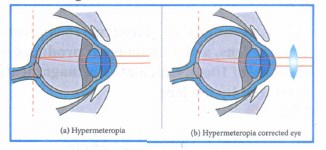
(a) Vision with hypermetropia
(b) Corrected vision using a convex lens
Near point of hypermetropia
eye, v = -1 m = -100 cm
Object distance, u= -25 cm
To find: Power of the lens, P = ?
\(\frac { 1 }{ u } -\frac { 1 }{ v } =\frac { 1 }{ f } \)
Near point of hypermetropia eye
\(\frac { 1 }{ f } =\frac { 1 }{ -100 } -\frac { 1 }{ (-25) } \)
=\(-\frac { 1 }{ 100 } +\frac { 1 }{ 25 } \)
\(\frac { 1 }{ f } =\frac { (-1+4) }{ 100 } \)
=\(\\ \frac { 3 }{ 100 } \) cm
∴ f=\(\frac { 100 }{ 3 } \) cm
Power of the lens, P=\(\frac { 1 }{ f } \) =3D
25.
Concave lens should be used to correct myopic eye.
Object distance u = Infinity
Far position of the defective eye v = -90 cm
To find: Power of the lens, P = ?
Nature of the lens =?
\(\frac { 1 }{ f } =\frac { 1 }{ v } -\frac { 1 }{ u } \)
\(\frac { 1 }{ f } =\frac { 1 }{ -90 } +\frac { 1 }{ \infty } \)
\(\frac { 1 }{ f } =\frac { 1 }{ -90 } \)
∴ f=-90 cm (or) 0.9 m
Power of the lens, P \(\frac { 1 }{ f } =\frac { 1 }{ 0.9 } \) =1.11 D
Concave lens of 1.11D is used to see distance object.
26.
Power, P = -4D
To find: Focal length of the lens, f = ?
For correct real vision, f = ?
P=\(\frac { 1 }{ f } \) =\(\frac { 1 }{ P } \Rightarrow \frac { 1 }{ -4 } \)
(i) f =-0.25 m
P=+1.5 D
P=\(\frac { 1 }{ f } \)
∴ f=\(\frac { 1 }{ P } \Rightarrow f=\frac { 1 }{ 1.5 } \)
(ii) Focal length of correcting, f = + 0.667 m
27.
Focal length, f = - 20 cm (concave lens)
h0 = 5 cm
Height of the object, h0 = 5 cm
Image distance v = -15 cm
\(\frac { 1 }{ f } =\frac { 1 }{ v } -\frac { 1 }{ u } \quad \frac { 1 }{ v } -\frac { 1 }{ f } \)
=\(\frac { 1 }{ u } \)
\(\frac { 1 }{ u } =\frac { 1 }{ -15 } +\frac { 1 }{ (20) } \)
=\(\frac { -20+15 }{ 300 } =\frac { -5 }{ 300 } \)
u = -60 cm
Magnification, m = \(\frac { { h }_{ i } }{ { h }_{ 0 } } =\frac { v }{ u } \)
hi = \(\frac { v }{ u } \).h0
Size of the image, hi =\(\frac { -15 }{ -60 } \) x 5
= \(\frac { 5 }{ 4 } \) = 12.5 cm
Image is diminished & Virtual
28.
Object distance, u = -20 cm
Focal length, f = -10 cm (Concave lens)
To find: Position & size of the image
i.e., v = ? ; hi =?
\(\frac { 1 }{ f } =\frac { 1 }{ u } -\frac { 1 }{ v } \)
\(\frac { 1 }{ v } =\frac { 1 }{ f } +\frac { 1 }{ u } =-\frac { 1 }{ 10 } -\frac { 1 }{ 20 } \)
\(\frac { 1 }{ v } =\frac { -3 }{ 20 } \)
∴ v = -6.7 cm
m = \(\frac { v }{ u } =\frac { -20/3 }{ -20 } =\frac { 1 }{ 3 } \)
Height of the image
hi = h0 x m = 6 x \(\frac { 1 }{ 3 } \) = 2 cm
Image is virtual, at a distance 6.7 cm from lens on the same side as the object and has a height of 2 cm.
29.
Object distance, u =-15 cm
Focal length, f =10 cm
To find: Nature of the image = ?
\(\frac { 1 }{ f } =\frac { 1 }{ u } -\frac { 1 }{ v } \)
\(\frac { 1 }{ v } =\frac { 1 }{ f } +\frac { 1 }{ u } =\frac { 1 }{ 10 } +\frac { 1 }{ -15 } \)
\(\frac { 1 }{ v } =\frac { 3-2 }{ 30 } =\frac { 1 }{ 30 } \)
\(\frac { 1 }{ v } =\frac { 1 }{ 30 } \)
∴ v=30 cm [image distance]
Magnification, m=\(\frac { v }{ u } =\frac { 30 }{ -15 } \) =-2
∴ Image is real, inverted, 30 cm from lens on the opposite side of the object & magnified 2 times.
30.
Object size, ho = 5 cm
Object size, h1 =5 cm
Object distance, u=-30 cm
Focal length of convex lens, f=20 cm
To find : Size of image hi = ?
Nature of image = ?
Position of image = ?
\(\frac { 1 }{ f } =\frac { 1 }{ v } -\frac { 1 }{ u } \)
\(\frac { 1 }{ v } =\frac { 1 }{ u } +\frac { 1 }{ f } \)
=\(\frac { -1 }{ 30 } +\frac { 1 }{ 20 } =\frac { -2+3 }{ 60 } \)
(or) \(\frac { 1 }{ v } =\frac { 1 }{ 60 } \) ⇒ = 60 cm
Magnification =\(=\frac{\text { height of the image size }}{\text { height of the object }}\)
=\(\frac { { h }_{ 2 } }{ { h }_{ 1 } } \)
m=\(\frac { { h }_{ 1 } }{ { h }_{ 0 } } \Rightarrow \frac { v }{ u } =\frac { 60 }{ -30 } \)=-2
∴ h2=h1 x (-2) =5 x (-2) =-10 cm
(i) The image is real, inverted and magnified.
(ii) Size of the image, h2 = -10 cm
31.
μa sin i = μdia sin r ............(1)
(Reactive index of air, μa = 1)
(Angle of incidence, i = 45°)
in (1)
(1) ⇒ (sin 450) =2.42 (sin r)
sin r=\(\left( \frac { sin{ 45 }^{ 0 } }{ 2.42 } \right) \)
r=sin-1\(\frac { \frac { 1 }{ \sqrt { 2 } } }{ 2.42 } \)
r=sin-1\(\left[ \frac { 1 }{ \sqrt { 2 } \times 2.42 } \right] \)
Angle of refraction,
r=16.977 =170.
32.
μ1 sin i = μ2 sin r
μa sin i = μw sin r
μa = 1
μw = 1.33
r = 25'
To find : Angle of incidence, i = ?
sin i =\(\frac { { \mu }_{ w } }{ { \mu }_{ a } } \)
sin r =\(\frac { 1.33\times sin25^{ 0 } }{ 1 } \)
i=sin-1\(\left( \frac { 1.33\times sin25^{ 0 } }{ 1 } \right) \)
Angle of incidence,
i=34.20.
33.
Velocity of light in air, c = 3 x 10⁸ ms-1
Velocity of light in glass, v = 2 x 10⁸ ms-1
To find: Refractive index of glass,
μ =\(\frac { c }{ v } \)=?
μ =\(\frac { 3\times { 10 }^{ 8 } }{ 2\times { 10 }^{ 8 } } \)=1.5
μ =1.5 (No unit)
34.
Refractive index of diamond with respect to kerosene
=\(=\frac{\text { Refractive index of diamond }}{\text { Refractive index of kerosene }}\)
=\(\frac { 3.42 }{ 1.44 } \)=1.68
35.
Velocity of light through air, ca = 3 x 10⁸ ms-1
To find : Speed of light through kerosene,
ck =?
Refractive index of kerosene, μk= 1.44
μk=\(\frac { { c }_{ a } }{ { c }_{ k } } \) ⇒ 1.44
μk= \(\frac { 3\times 10^{ 8 } }{ { c }_{ k } } \)
=2.083 x 10⁸ ms-1
Speed of light through kerosene,
ck = 2 083 x 108 ms-1
36.
Diameter of the objective lens, D = 5 m
Wavelength of light, λ = 6000Å or
6000 x 10-10 m
To find: Resolving power of telescope =?
Resolving power of telescope =\(\frac { D }{ 1.22\lambda } \)
=\(\frac { 5 }{ 1.22\times 6000\times 10^{ -10 } } \)
=\(\frac { 5 }{ 7.32\times { 10 }^{ -7 } } \)
Resolving power of telescope = 0.683 x 10⁷.
37.
Given
Temperature, T 10°C
Time, t = 0.274 s
Distance, D = ?
Velocity, v = (vo + 0.61T) ms-1
v = [331.4 + 0.61 x 10]
= 331.4 + 6.1
v = 337.5 ms-1
Distance, D = v x t
D = 337.5 x 0.274
D = 92.48 m
Distance due to reflecting surface = \(\frac{distance}{2}\)
= 46.2 m
38.
Given
Air temperature = 23°C
Velocity of sound in air, Vs = (331.4 + 0.61T) ms-1
= 331.4 + 0.61 x 23
= 331.4 +13.8
Vs = 345.2 ms-1
39.
Given
Frequency g car's distance, n = 800 Hz
Velocity of source, Vs = 120ms-1
Velocity of sound, v = 340 ms-1
To find: Frequency emitted by the car, n' = ?
Solution
Apparent frequency, n' =\(\left( \frac { v }{ v-{ v }_{ s } } \right) \times n\)
\(=\frac { 340 }{ 340-120 } \times 800\)
\(=\frac { 340 }{ 220 } \times 80\)
Apparent frequency, n' = 1236 Hz
40.
Given
Speed of the train, Vs =30 rns-1
Frequency of the train, n =600Hz
Speed of sound, v =340 ms-1
To find: Apparent frequency n =?
Solution
\(n'=\left( \frac { v }{ v-{ v }_{ s } } \right) \times 600\)
\(=\frac { 340 }{ 310 } \times 600\)
Apparent frequency n' = 658 Hz
41.
Given
Frequency of the source, n = 1000 Hz
Speed of observer, vL = 2 v
To find: Observer approaches the source
apparent frequency n' =?
Solution
\(n'=\left( \frac { v+{ v }_{ L } }{ v } \right) n\)
\(=\left( \frac { v+2v }{ v } \right) \times 1000\)
\(=\frac { 3b }{ v } \times 1000\)
Apparent frequency n' = 3000 Hz
42.
Mass of body 1, m1 = 50 kg
Mass of body 2, m2 = 10kg
Distance, R = 10m
Universal gravitation
constant, G = 6.67 x 10⁻¹¹ Nm2 kg-2
To find :Force of gravitation, F =\(\frac { G{ m }_{ 1 }{ m }_{ 2 } }{ { R }^{ 2 } } \)
F=\(\frac { 6.67\times 10^{ -11 }\times 50\times 10 }{ 10^{ 2 } } \)
Force, F = 33.35 x 10⁻¹¹ N
43.
Given:
Weight = 50 kg
To find: Acceleration, a = ? (downward)
Reaction, R = 400 N
R = m (g - a)
400 = 50 (10 - a)
400 = 500 - 50 a
500 = 500 - 400
50 a = 100
a=\(\frac{100}{50}\)
Downward acceleration, a = 20 ms-1
44.
Force, F = 50 N
Distance, d = 5 cm
To find: Momentum of force= F x d
Momentum of force, 50 x 5 x 10-2
= 250 x 10-2
= 2.5 Nm
45.
Time, t = 10 s
Mass of body, m = 10 kg
Initial velocity of the body, u1 = 0
Distance, d = 500 cm
= 500 x 10-2 m
To find : Force, F = ?
F=m1\(\frac { ({ u }_{ 1 }-{ v }_{ 1 }) }{ t } \)
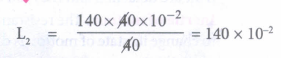
v1=\(\frac { distance }{ time\quad taken } \)
F=v1=\(\frac { 500\times 10^{ -2 } }{ 10 } \)
Force, F=0.5 N
46.
Acceleration due to gravity of a planet,
gp =\(\frac { 1 }{ 2 } \) ge
Radius of the planet Rp =\(\frac { 1 }{ 2 } \) Re
To find : Mass of the planet Mp = ?
gp =\(\frac { 1 }{ 2 } \)
ge =\(\frac { { GM }_{ p } }{ \left( \frac { 1 }{ 2 } .{ R }_{ e } \right) ^{ 2 } } =\frac { 1 }{ 2 } \)
ge =\(\frac { { GM }_{ p } }{ \left( \frac { 1 }{ 2 } .{ R }_{ e } \right) ^{ 2 } } \) ......(1)
ge =\(\frac { { GM }_{ e } }{ { R }_{ e }^{ 2 } } \) ........(2)
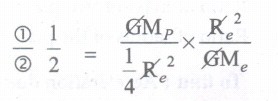
\(\frac { 1 }{ 2 } =\frac { 4{ M }_{ p } }{ { M }_{ e } } \)
⇒ Mp =\(\frac { 1 }{ 8 } \).Me
Mass of the planet, Mp =\(\frac { { M }_{ e } }{ 8 } \).
47.
Ratio of mass of two planets = M1 : M2 = 1:2
Ratio of radius of the planets = R1 : R2 = 1:2
To find : Acceleration due two planets
= g1 : g2 =?
g = \(\frac { GM }{ { R }^{ 2 } } \) gravitational
Constituent G = 6.674 x 10⁻¹¹ Nm2 kg-2
g1 = \(\frac { { GM }_{ 1 } }{ { R }_{ 1 }^{ 2 } } ;{ g }_{ 2 }=\frac { { GM }_{ 2 } }{ { R }_{ 2 }^{ 2 } } \)
\(\frac { { g }_{ 1 } }{ { g }_{ 2 } } =\frac { { M }_{ 1 }{ R }_{ 2 }^{ 2 } }{ { M }_{ 2 }{ R }_{ 1 }^{ 2 } } =\frac { 1 }{ 2 } \times \frac { 1 }{ 2 } \)
=\(\frac { 1 }{ 4 } \) = 1:4 (or) 1:2
g1 : g2 = 1:2
48.
Mass of the car m = 2000 kg
Speed of the car v = 20 ms-1
Time t = 0.05 s
To find : Impulse = ?
Impulse = F x t
Force =m x a
a =\(\frac { v }{ t } =\frac { 20 }{ 0.05 } \) =400 ms-2
F = ma ⇒ 2000 x 400
= 8 x 10⁵ N
Impulse = F x t ⇒ 8 x 105 x 0.5
4 x 10⁴ N s
The magnitude of impulse exerted by the wall on the car = 4 x 10⁴ Ns
49.
Mass of first body, m1 = 2 kg
Initial velocity of first body, u1 = 40 ms-1
Initial velocity of second body, u2 = 0
Final velocity of first body,
v1 z = Final velocity of the second body, v2
i.e., v1 = v2= 20 ms-1
To find : Mass of second body, m2 = ?
According to law of conservation of momentum,
m1u1 + m2u2 = m1v1+ m2v2
m1u1 + m2u2 = v1m2 + m2v2
2 x 40 + m2 x 0 =20 x 2 + 20 m2
80 =40 + 20m2
20 m2 =40 ⇒ m2
=\(\frac{40}{20}\) =2 kg
Mass of second body, m2 = 2 kg
50.
Given
Power of toaster P = 120w
Time, t = 20 min = 20 x 60
\(=\frac { 20 }{ 60 } h\)
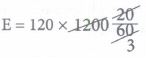
E = 40 w h (or) 144 000 ws
51.
Length of the wire I = 1 m
Area A = πr2
Diameter of the wire, d = 0.4mm
radius of the wire, r\(\frac { d }{ 2 } =0.2\times { 10 }^{ -3 }m\)
\(=3.14\times (0.2\times { 10 }^{ -3 })\)
Resistance of the wire R = 20Ω
Resisting Power =?
\(\rho =\frac { RA }{ l } \)
\(A={ \pi r }^{ 2 }\)
= 3.14 x 0.2 x 10-3 x 0.2 x 10-3
= 0.1256 x 10⁻⁶m2
ρ = 20 x 0.1256 x 10-6
ρ = 2.512 x 10⁻⁶Ωm
52.
Given
For resistance in parallel, the effective resistance R = ?
\(\frac { I }{ { R }_{ p } } =\frac { 1 }{ { R }_{ 1 } } +\frac { 1 }{ { R }_{ 2 } } +\frac { 1 }{ { R }_{ 3 } } \)
\(=\frac { 1 }{ 20 } +\frac { 1 }{ 100 } +\frac { 1 }{ 50 } \)
\(\frac { 1 }{ { R }_{ p } } =\frac { 5+1+2 }{ 100 } =\frac { 8 }{ 100 } \)
\({ R }_{ p }=\frac { 100 }{ 8 } =12.5\Omega \)
\({ R }_{ p }=12.5\Omega \)
i) Total current flowing
through the circuit \({ I }_{ p }=\frac { { V }_{ p } }{ { R }_{ p } } \)
\({ I }_{ p }=\frac { 125 }{ 12.5 } \)
\({ I }_{ p }=10A\)
(ii) In a parallel circuit, the potential drop across each resistor is same.
∵ V1 = V2 = V3 = 125 V
(iii) The current through each resistor according to ohm's law V = IR
\({ I }_{ 1 }=\frac { { V }_{ 1 } }{ { R }_{ 1 } } =\frac { 125 }{ 20 } =6.25A\)
\({ I }_{ 2 }=\frac { { V }_{ 2 } }{ { R }_{ 2 } } =\frac { 125 }{ 100 } =1.25A\)
\({ I }_{ 3 }=\frac { { V }_{ 3 } }{ { R }_{ 3 } } =\frac { 125 }{ 50 } =2.50A\)
(iv) Total current flowing the circuit
Ip= I1+ I2+I3
I=6.25 + 1.25 + 2.50 = 10A
(v) The electric power of each resistor
P1=V1I1= 125 x 6.25 = 781.25 W
P2 = V2I2 = 125 x 1.25 = 156.25 W
P3 = V3I3 = 125 x 50 = 312.50 W
53.
Given
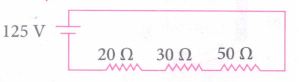
V= 125 V, R1 = 20\(\Omega \); R2=30\(\Omega \);R350\(\Omega \)
To find:
(i) Rs =?
(ii) Is =?
(iii) Is = ?
(iv) V1= ?, V2 = ?, V3= ?
(i) Resistance in series, Rs = R1+R2+R3
Rs = 20 + 30 + 50
= 1000
Rs = 100 \(\Omega \)
(ii) Total current, Is =\(\frac { V }{ { R }_{ s } } \)
\(\\ I=\frac { 125 }{ 100 } =1.25A\)
I=1.25A
(iii) Since resistors are in series, the current through each resistor is same.
Is = I1= I2=I3 =1.25A
Voltage drop across R1 is V1 = I1 R1
1.25 x 20
= 25V
V1 = 25V
Voltage drop across R2 is V2 = I2R2
Voltage drop across V2 1.25 x 30
V2 = 37.5 V
Voltage drop across R3is V3 = I3R3
V3 = 1.25 x 50
V3 = 62.5 V
Total Voltage, V1 + V2 + V3
25 + 37.5 + 62.5
= 125V
54.
Given :
Potential V = 110 V
Current passing through bulb, I = 0.9 A
Time, t = 12h / day
For 30 days, time t = 12 x 30
= 360h
To find: Energy consumed, E = ?
Solution
E = VIt
= 0.9 x 110 x 12 x 30
= 35.64 kwh
Energy, E = 35.64 kwh
55.
Given:
Current passing through heater I= 20 A
To find: Resistance of heating element R = ?
Solution
\(V=IR\Rightarrow \frac { V }{ I } =\frac { 220 }{ 20 } =11\Omega \)
Resistance, R = 11Ω
56.
Electrical energy,
E = 1.2 kwh = 1.2 x 10³ wh
Time, t =30 min\(\frac{1}{2}\) hour
To find: Current drawn by the heater, I = ?
Solution
Energy, E = Vlt \(\therefore I=\frac { E }{ Vt } \)
\(I=\frac { 1.2\times { 10 }^{ 3 }\times 2 }{ 120 } =20A\)
Current, I = 20A
57.
Given :
Potential difference, V = 110 V
Charge, q = 5 C
To find: Work done, W = ?
Solution
\(V=\frac { W }{ q } \therefore q\times V=W\)
W= 5 x 110 = 550 J
Work, W = 550J
58.
Given:
Amount work done W = 220 J
Quantity of charge q = 20 C
To find : Potential difference between
two points, V = ?
Solution :
\(V=\frac { W }{ q } =\frac { 220 }{ 20 } \)
=11V
Voltage, V = 11 volt
59.
Current flowing through the wire, I = 6 A
Time taken, t = 2 miniatures = 2 x 60 = 120 S
To find : Amount of charge passing
through wire, q = ?
Solution
\(I=\frac { q }{ t } \Rightarrow =6\times 120=720C\)
Charge, q = 720 C
60.
Given :
Charge passing through bulb, q = 30C
Current drawn by 100 W bulb, I = 680 x 10-3 A
To find: Time taken to pass
through the bulb t =? t=\(\frac{q}{I}\)
Solution :
\(I=\frac { q }{ t } =\frac { 30 }{ 680\times { 10 }^{ -3 } } \)
=441.173
Time required, t =7.35 min
61.
Given:
Mass of the first body, m1 = 20 kg
Mass of the second body, m2 = 15 kg
Initial velocity of first body, u1 = 40 ms-1
Initial velocity of second body, u2 = 0
(Second body is at rest initially)
Final velocity of the first body,
v1 = Final velocity of the second body, v2
i.e., v1 = v2 = v
According to law of conservation of momentum,
m1u1 + m2u2 = m1v1 + m2v2
m1u1 + m2u2 =(m1+m2)v
20 x 10 + 15 x 0 = (20+15)v
800 = 35 v
Velocity, v=\(\frac{800}{35}\)
=22.85 ms-1
62.
During impulse on first body:
Mass of the first body,
m1 = 20 x 10-3 kg
Time, t1 = 4 s
Initial velocity, u1= 0
Final velocity, v1 =100 m/s
During impulse on second body:
Mass of the second body,
m2 =10kg
Time, t2 = 2 minutes
= 2 x 60 s = 120 s
To find: Final velocity, v2 =?
Initial velocity, u2 = 0
(i) Impulse on the first body,
F.t1 =m1(v1-u1) [∵ u1=0]
F.t1 =m1v1
F.t1 =20 x 10-3 x 100
F.t1 =2 x 10-3 x 103 =2 Js .............(1)
(ii) Impulse on the second body
F.t2 =m2(v2-u2) [∵ u2=0]
F.t2 =m2v2
Ft2 =10 x v2 ...............(2)
Dividing al and CD, we get
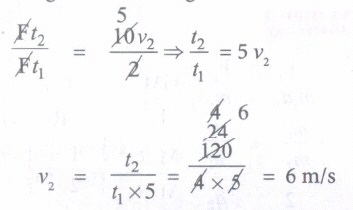
Velocity of the second body, v2 =6 m/s.
63.
Given:
Ratio of two masses, 2 : 3
i.e = m1 : m2 = 2: 3
Mass of first body, m1 = 2 kg
Mass of second body, m2 = 3 kg
Acceleration of the first body, a1 = 6 ms-2
To find: Acceleration of the second body, a2 =?
F1 = F2
\(\frac { { m }_{ 1 } }{ { m }_{ 2 } } =\frac { { a }_{ 2 } }{ { a }_{ 1 } } \)
\(\frac { 2 }{ 3 } =\frac { { a }_{ 2 } }{ 6 } \)
a2 =\(\frac { 6\times 2 }{ 3 } \) = 4 ms-2
Acceleration of the second body,
a2 = 4 ms-1
64.
Mass = 100g = 0.1 kg;
Initial speed u = 20 ms-1
Final velocity v = 0
Change in momentum = ?
mv - mu = 0.1 (0 - 20)
Change in momentum = -2 kg ms-1.
65.
Given:
Mass of a body, m = 20 kg
To find: Apparent weight, R= ?
(i) Whether lift is descending with the same acceleration of 2m/s2
(ii) When the lift is descending with the same acceleration of 2m/s2
(iii) When the lift is descending with a constant velocity 2ms-1.
(i) While ascending,
R = m (g+ a)
R = 20 [10 + 2] = 240N
= 24 kg weight
(ii) While descending,
R = m (g- a)
= 20 [10 - 2]
= 20 x 8 = 160N = 160 N
(iii) At constant velocity,
a = 0,
R = mg = 20 x 10 = 200N
= 20 kg weight.
66.
Given:
Mass of the bullet, m = 50 x 10-3 kg
Initial speed of the bullet, u = 300 m/s-1
Final speed, v = 0
time, t = 1s
To find: (i) Impulse (of a force), J =?
(ii) Force, F = ?
(i) Impulse, J = Change in momentum
= m (v - u)
= 50 X 10-3 [0 - 300]
= -15 Ns
(ii) Impulse = F x t
-15 = F x 1s
F = \(\frac { -15 }{ 1 } \) = -15 N
67.
Given:
Mass, m =72 kg
Acceleration due to gravity, g =10 ms-2
Constant acceleration, a =3 ms2
To find: Apparent weight, R = ?
(i) While descending with constant velocity.
(ii) While ascending with constant acceleration
(i) While descending with constant velocity,
a = 0, R = mg
R = 72 x 10 = 720 N
(ii) While ascending with constant acceleration
a = 3 ms-2
R = m (g + a)
= 72 (10 + 3)
Apparent weight,
R = 72 x 13 = 936 N
68.
Gram molecular of CO2 = 44g
Number of molecules present in 44g of CO2
= 6.023 X 10²³
∴ Number of molecules present in 11g of CO2
= \(\frac{6.023\times{10}^{23}}{44}\)x 11
= 1.53 x 10²³ molecules.
69.
Number of moles = \(\frac{Mass}{Atomic \ mass}\)
∴ Mass = Number of moles x Atomic mass
= 0.5 x 16
= 8g.
70.
Number of moles = \(\frac{Mass}{Molecular \ mass}\)
= \(\frac{2}{40}\) = 0.05
71.
Number of moles = \(\frac{Mass}{Atomic \ mass}\)
= \(\frac{81}{27}\) = 3 moles
72.
Atomic masses of C= 12, O= 16
Gram molecular mass of CO2 = 1(C) + 2(O) = 1(12) + 2(16) = 12 + 32 = 44
Gram molecular mass of CO2 = 44g.

10th Standard Syllabus & Materials
10th Standard
TN 10th English Prose - 2 - The Night the Ghost Got in Important Questions And Answers Study Material - QB365 Set A
NEW10th Standard
TN 10th English Supplementary - 1 - The Tempest Important Questions And Answers Study Material - QB365 Set A
NEW10th Standard
TN 10th English Poem - 1 - Life Important Questions And Answers Study Material - QB365 Set A
NEW10th Standard
TN 10th English Prose - 1 - His First Flight Important Questions And Answers Study Material - QB365 Set A



Tamilnadu Stateboard 10th Standard Subjects
Tamilnadu Stateboard Standards





