
 100% FREE ACCESS
10th Standard CBSE Syllabus & Materials
10th Standard CBSE
CBSE 10th Social Science ECO - Globalisation and the Indian Economy - New Model Questions Papers Study Material - QB365 Set A
NEW10th Standard CBSE
CBSE 10th Social Science ECO - Money and Credit - New Model Questions Papers Study Material - QB365 Set A
NEW10th Standard CBSE
CBSE 10th Social Science ECO - Sectors of the Indian Economy - New Model Questions Papers Study Material - QB365 Set A
NEW10th Standard CBSE
CBSE 10th Social Science ECO - Development - New Model Questions Papers Study Material - QB365 Set A
NEW10th Standard CBSE
CBSE 10th Social Science PS - Outcomes of Democracy - New Model Questions Papers Study Material - QB365 Set A
NEW10th Standard CBSE
CBSE 10th Social Science PS - Gender, Religion and Caste - New Model Questions Papers Study Material - QB365 Set A

Published on: 31/07/2018
Based on the current academic syllabus, some of the important questions are prepared from the chapter Outcomes of Democracy.
The questions are covers from the Higher Order Thinking Questions and Value Based Questions.
Download CBSE Class 10th Standard CBSE Social Science question papers, sample papers, important questions, and previous year solved papers in PDF format. Get free study materials, NCERT solutions, and exam preparation resources for Class 10th Standard CBSE Social Science
Questions + Answers key
Take MCQ Social Science Test
1.
Discuss the factors that denote the successful working of democracy in India.
2.
Explain with three examples how democracy promotes dignity and freedom of an individual.
3.
How is democracy a better form of government in comparison with other forms of governments? Explain.
4.
Explain the role of democratic governments in reducing economic disparities.
5.
Examine any three features on the basis of which maximum number of countries claims to practise democratic politics?
6.
What are the differences between democratic and non-democratic governments in the decision making process?
7.
What is a must for a successful democratic government?
8.
Give arguments to support or oppose the following assertions:
(i) Industrialized countries can afford democracy but the poor need dictatorship to become rich.
(ii) Democracy can't reduce inequality of incomes between different citizens.
(iii) Government in poor countries should spend less on poverty reduction, health, education and spend more on industries and infrastructure.
(iv) In democracy all citizens have one vote, which means that there is absence of any domination and conflict.
9.
Explain any four features that are common in all democratic set-ups of the government.
10.
Discuss some merits and demerits in the light of your study of the chapter.
11.
Which of the following is true with reference to democracy?
A. Democracy allows us to correct mistakes.
B. It can address all the socioeconomic and political problems.
A is true but B is false
A is false but B is true
Both A and B are true
Both A is true and B is false.
12.
Democratic governments do not very often share
aggression to each other
information
land and other resources
all of these
13.
What are the features common to all countries following politics?
it promotes equality to citizens
it promote dignity of an individual
both a and b
None of these
14.
Which South Asian country has always had a democratic government since independence?
Pakistan
Bangladesh
Bhutan
India
15.
Which of the following statement id true about democracy?
It is a good form of government due to lesser corruption.
It is a good form of government since it ensures higher rate of economic growth.
It is a good form of government as it is a rule by majority.
It is a good form of government as it respects the freedom and dignity of individuals.
16.
What is the most basic outcome of democracy?
significant decision making
powerful repressive governance
accountability of the citizens
None of these.
17.
Democracy is based on the ideas of
freedom
negotiation
deliberation
Both b and c
18.
A democratic government is a ............ government.
powerful
fruitful
repressive
legitimate
19.
What is regarded as a 'define plus point' of democratic regimes?
rule of majority
ability to handle social differences, divisions, and conflicts
participative decision making
None of these
20.
In the context of assessing democracy, which among the following is odd one out. Democracies need to ensure
free and fair elections
dignity of individual
majority rule
equal treatment before law
21.
List the countries which have the most stable democracies in the world.
22.
Which country is suffering from adverse form of economic inequality?
23.
In what ways are democracies different from each other?
24.
Democracy is not free from corruption. Is is true?
25.
Why are decisions delayed in democracy?
1.
The following factors denote the successful working of democracy in India.
(a) Indian Constitution is the greatest source of law the protector of fundamental rights of the citizens. No government can disobey the Constitution.
(b) Indian democracy holds elections on free and fair basis. People have the right to vote and elect their representatives.
(c) There is freedom to the people to express their views and opinions and even criticize the government and its policies from time to time.
2.
Democracy stands much superior to any other form of government in promoting dignity and freedom of the individual. This statement can be explained by giving the following examples.
(a) Recognition of the principle of equality has made it easier for women to wage a struggle against what is now legally or morally unacceptable.
(b) Democracy in India has strengthened the claims of the disadvantaged and discriminated castes for equal status and equal opportunity.
(c) A public expression of dissatisfaction with democracy shows the success of democratic project. It transforms people from the status of subject into that of citizens.
3.
Democracy is considered a better form of government than other forms because:
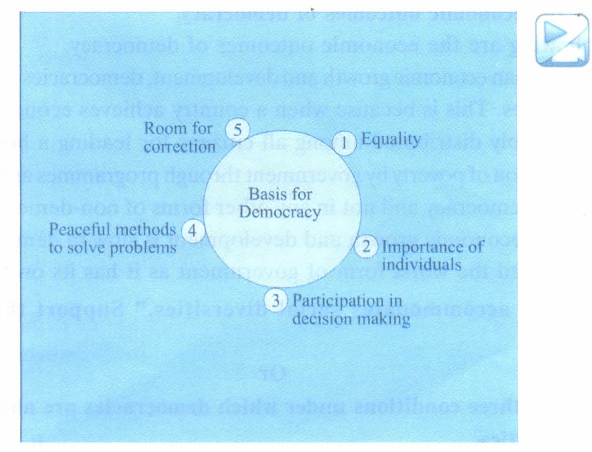
(a) it enhances dignity of the individual by giving every person equal treatment.
(b) it involves every citizen in the decision-making, thereby improving the quality of decision-making process. Every citizen has the right to vote and choose his representatives in the government.
(c) it is an effective form of government as it provides room to correct its own mistakes and resolves conflicts amicably. And above all democratic government is people's own government
4.
It is seen that on an average dictatorial regimes have had a slightly better record of economic growth. i.e., 4.34%. But when we compare their record only in poor countries (4.28%), there is no difference. There is enough evidence to show that within democracies there can be very high degree of inequalities. In countries like South Africa and Brazil, the top 20 percent people take away more than 60 percent of the national income, leaving less than 3 percent for the bottom 20 percent population.
Perhaps more than development, it is reasonable to expect democracies to reduce economic disparities. Democracies are based on political equality, but despite equality in the political area there are growing economic inequalities. the poor constitute a large proportion of our voters and no party would like to lose its votes. Yet democratically elected governments do not appear to be keen to tackle the problem of poverty. Democracies are expected to produce good government, but there is no guarantee that they would also produce development. As evidence shows, tire economic development depends on several factors. Such as country's size, global situation, co-operation from other countries, economic priorities adopted by the country etc.
5.
When any country follows this pattern, then they are able to claim to practise democratic politics.
(i) Elections are held at regular intervals and are fair and free.
(ii) Freedom of speech, expression and thought is another feature of democracy.
(iii) The dignity of the individuals is recognised.
6.
The decision making process of the non-democratic rulers is very quick. They are also efficient in decision making and even in the implementation of the decisions. This all happens because non-democratic rulers do not have to bother about deliberation in assemblies or about the public opinion. On the other hand, democratic form of government is based on deliberation and negotiation. This cause the process slow. They followed procedures and their decisions may be more acceptable to the people and are more effective.
7.
In a democracy, there must be a government which is accountable to the citizens, responsive to the needs and expectations of the citizens only then it can be effective and efficient.
8.
(a) This statement is incorrect. If we compare democracy and dictatorship regimes between 1950 to 2000, we find countries under dictatorship to be more economically advanced. But, if we compare between less developed countries, the difference is negligible. For example, India being a third world nation, now becomes one of the fast growing economies of the world. On the other hand, Zimbabwe which was a fairly prosperous nation, has run into huge international debt with the progression of Robert Mugabe's rule. Thus, it is not always proper to say that the poor need dictatorship to become rich.
(b) This statement is incorrect. Democracy reduces the inequality of incomes between citizens. For example, the Minimum Wages Act, enacted by the Indian Government have helped in increasing the per capita income of the country. There by, making its citizens more prosperous and reducing inequality in incomes of citizens.
(c) This statement is not correct as the government in poor countries should maintain a balance between investment on poverty, food, clothing, health, education and in industries and infrastructure. A country needs to spend on all the sectors maintaining a balance, so that every sector helps the other sector to grow.
(d) This statement is not correct. In democracy, every citizen has one vote, political parties cannot avoid any social group. The political parties have to formulate policies which will benefit all the groups. But all these do not mean that conflicts are totally absent in a democracy. They can happen if the demands of one social group are against the demands of the other social group.
Democracy only avoids the possibility of such conflicts by giving everyone equal rights and freedom in the society.
9.
(i) In a democracy, elections are held at regular intervals and are fair and free.
(ii) a democracy has a multi-party system and elections are held on the basis of universal adult franchise.
(iii) Freedom of speech, expression and thought is another feature of democracy. The media also helps in building a sound public opinion.
(iv) Democracy gives to its citizens a sound political system based on social equality.
(v) Another feature of a democracy is a strong opposition which keeps in check, the ruling party or the government.
(vi) Besides these, we also know how in a democracy, the dignity of the individuals is recognised and one can correct one's mistake in a democracy and avoid conflicts.
10.
Merits:
(i) Promotes equality among citizens
(ii) Enhances the dignity of the individual
(iii) Improves the quality of decision making
(iv) Provides a method to resolve conflicts
(v) Allows room to correct mistakes
Demerits:
(i) Takes more time to follow procedures before arriving at a decision as compared to a nondemocratic government.
(ii) Most democracies fall short of elections that provide a fair chance to everyone and in putting every decision to public debate.
(iii) Democratic governments do not have a very good record when it comes to sharing information with citizens.
(iv) Democracies often frustrate the needs of the people and often ignore the demands of a majority of its population.
11.
(b)
A is false but B is true
12.
(b)
information
13.
(c)
both a and b
14.
(d)
India
15.
(d)
It is a good form of government as it respects the freedom and dignity of individuals.
16.
(c)
accountability of the citizens
17.
(d)
Both b and c
18.
(d)
legitimate
19.
(b)
ability to handle social differences, divisions, and conflicts
20.
(c)
majority rule
21.
The United States, Canada and Switzerland have the most stable democracies because there is 100 per cent literacy and they have very successful welfare schemes for all citizens.
22.
Bangladesh is suffering from the adverse effect of economic inequality, i.e. poverty, as more than half of its population lives i poverty.
23.
In spite of common basic elements, democracies are different from each other in terms of social situation, economic achievement and cultures.
24.
There is no denying the fact the democracy is not free from corruption but, it is only in a democracy that people can openly expose this evil and ask for its elimination.
25.
Decisions are delayed in democracy because democratic governments are based on the idea of deliberation and negotiations.

10th Standard CBSE Syllabus & Materials
10th Standard CBSE
CBSE 10th Social Science PS - Federalism - New Model Questions Papers Study Material - QB365 Set A
NEW10th Standard CBSE
CBSE 10th Social Science PS - Power Sharing - New Model Questions Papers Study Material - QB365 Set A
NEW10th Standard CBSE
CBSE 10th Social Science GEO - Manufacturing Industries - New Model Questions Papers Study Material - QB365 Set A
NEW10th Standard CBSE
CBSE 10th Social Science GEO - Minerals and Energy Resources - New Model Questions Papers Study Material - QB365 Set A



CBSE 10th Standard CBSE Subjects
CBSE Standards





