
 100% FREE ACCESS
11th Standard CBSE Syllabus & Materials
11th Standard CBSE
CBSE 11th Economics PART-A - Presentation of Data - New Sample Question Papers Study Material - QB365 Set A
NEW11th Standard CBSE
CBSE 11th Economics PART-A - Organisation of Data - New Sample Question Papers Study Material - QB365 Set A
NEW11th Standard CBSE
CBSE 11th Economics PART-A - Collection of Data - New Sample Question Papers Study Material - QB365 Set A
NEW11th Standard CBSE
CBSE 11th Economics PART-A - Introduction to Economics and Statistics - New Sample Question Papers Study Material - QB365 Set A
NEW11th Standard CBSE
CBSE 11th Business Studies International Trade Sample Question Papers Study Material - QB365 Set A
NEW11th Standard CBSE
CBSE 11th Business Studies Evolution and Fundamentals of Business Sample Question Papers Study Material - QB365 Set A

Published on: 21/10/2025
Download CBSE Class 11th Standard CBSE Biology question papers, sample papers, important questions, and previous year solved papers in PDF format. Get free study materials, NCERT solutions, and exam preparation resources for Class 11th Standard CBSE Biology
Questions + Answers key
Take MCQ Biology Test
1.
How does the absorption and loss of potassium ions in the guard cells bring about the opening and closing of stomata?
2.
What is meant by double circulation? What is its significance?
3.
Describe the various types of placentations found in flowering plants.
4.
Cork cambium forms tissues that form the cork. Do you agree with this statement? Explain.
5.
During a college tour; while travelling at a higher altitude of maintains, Vijay complains of dizziness and vomiting sensation. The guide took him to the doctor. The doctor after diagnosing him gave some medicines and explained that it happened due to the change In air pressure, as we go towards the higher altitude,
(i) What is the cause of Vijay's sickness?
(ii) Which of the sensory organ get disturbed during the journey?
(iii) Name the part of the ear that maintains the air pressure.
(iv) What values did the guide possess?
6.
The biology teacher asked the students to verify the Pavlov's experiment in dogs to establish the conditioned response (reflex). The class was divided into two groups. The teacher asked them to submit the reports. roup 2 did not repeat the experiment. The teacher praised group 1 and also gave another chance to group 2 students.
(i) Which experiment was performed by students?
(ii) Explain the experiment in brief.
(iii) What is conditioned reflex?
(iv) What values did group 1 exhibit?
7.
Ria went to see the zoo in her town with her parents and saw many wild animals, their food habits, behavior, etc. She saw that there was a wide variety of animal life in the zoo. But she was amazed to see that the board placed in front of lion cage and monkey place which tells that both were mammals. However, she thought that they were totally different in appearance.
(i) Why lions and monkeys are considered to be mammals?
(ii) Explain the scientific reason to maintain a zoological park.
(iii) Is there any similar place to see a variety of plants? If any, then name some.
(iv) What values are shown by Ria?
8.
Describe different types of joints in the human skeleton.
9.
Write the difference between:
(a) Actin and Myosin
(b) Red and White muscles
(c) Pectoral and Pelvic girdle
10.
What is the need of a classification system in biology? How did different classification systems develop over a period of time?
1.
Role of potassium ions in transpiration: Levitt explained the mechanism of stomata action. In light starch produced during photosynthesis is converted into organic acids which cause a low concentration of potassium ions. When the concentration of organic acid is increased in guard cells, this increases the concentration of cell sap followed by subsequent absorption of water. In dark photosynthesis stops, accompanied by an increased concentration of CO2, the organic acids are converted into starch. The water comes out of guard cells it reduces the truer pressure and stomata get s closed.
2.
The double circulatory system of blood flow refers to the separate systems of pulmonary circulation and the systemic circulation in amphibians, birds and mammals (including humans). In contrast, fish have a single circulation system because they do not have lungs. All animals with lungs have a double circulatory system.
For instance, the adult human heart consists of two separated pumps, the right side with the right atrium and ventricle (which pumps deoxygenated blood into the pulmonary circulation), and the left side with the left atrium and ventricle (which pumps oxygenated blood into the systemic circulation). Blood in one circuit has to go through the heart to enter the other circuit.
Double circulation system is more efficient as it prevents mixing of oxygenated and deoxygenated blood. There is optimum utilization of oxygen because of this type of system.
3.
Placentation. The arrangement of ovules within the ovary is known as placentation. The placentation are of different types namely, marginal, axile, parietal, basal, central and free central.
Marginal. In marginal placentation the placenta forms a ridge along the ventral suture of the ovary and the ovules are borne on this ridge forming two rows, as in pea.
Axile. When the placenta is axial and the ovules are attached to it in a multilocular ovary, the placentaion is said to be axile, as in china rose, tomato and lemon. Parietal. In parietal placentation, the ovules develop on the inner wall of the ovary or on peripheral part. Ovary is one-chambered but it becomes two-chambered due to the formation of the false septum, e.g., mustard and Argemone. When the ovules are borne on central axis and septa are absent, as in Dianthus and Primrose the
placentation is called free central.
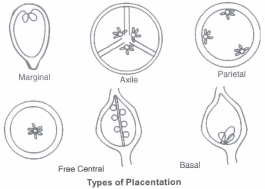
Basal. In basal placentation, the placenta develops at the base of ovary and a single ovule is attached to it, as in sunflower, marigold.
4.
Cork Cambium. As the stem continues to increase in girth due to the activity of vascular cambium, the outer cortical and epidermis layers get broken and need to be replaced to provide new protective cell layers. Hence, sooner or later, another meristematic tissue called cork cambium or phellogen develops, usually in the cortex region. Phellogen is a couple of layers thick. It is made of narrow, thin-walled and nearly rectangular cells. Phellogen cuts off cells on both sides. The outer cells differentiate into cork or phellem while the inner cells differentiate into secondary cortex or phelloderm. This is clear how cork cambium forms tissues that form the cork.
5.
(i) The cause of Vijay's sickness is the change of altitude in which there is change in the physiology of the body.
(ii) Internal ear gets affected which control balancing of body
(iii) Eustachian tube maintains the air pressure in the ear.
(iv) The guide is a very sensible person and is caring too.
6.
(i) Pavlov's experiment.
(ii) Pavlov's Experiment- The concept for which Pavlov experiment is done is to check the conditioned reflexes. Students conduct this experiment to know this concept of conditioned reflex, to examine the rate of salivations among dogs. Everytime when bell isrung they fed the dog of an expected response (drool) to an unlikely stimulus (the bell).
(iii) Conditioned reflex is acquired after birth, i.e., they are adopted during the course of lifetime.
(iv) Scientific attitude, awareness and sense of responsibility.
7.
(i) Lion and monkeys possess the mammalian characters.
(ii) Maintaining zoological parks conserver the endangered and critically endasgered species.
(iii) The natural biosphere reserves have variety of plants.
(iv) Ria is a good observer, enthusiastic and nature loving.
8.
Joints have been classified into three major structural forms, namely, fibrous, cartilaginous and synovial:
(a) Fibrous Joints :
Fibrous joints do not allow any movement. This type of joint is shown by the flat skull bones which fuse end-to-end with the help of dense fibrous connective tissues in the form of sutures, to form the cranium.
(b) Cartilaginous Joints :
In cartilaginous joints, the bones involved are joined together with the help of cartilages. The joint between the adjacent vertebrae in the vertebral column is of this pattern and it permits limited movements.
(c) Synovial Joints. Synovial joints are characterised by the presence of a fluid filled synovial cavity between the articulating surfaces of the two bones. Such an arrangement allows considerable movement. These joints help in locomotion and many other movements.
i) Ball and socket joint (between humerus and pectoral girdle),
ii) Hinge joint (knee joint),
iii) Pivot joint (between atlas and axis),
iv) Gliding joint (between the carpals) and
v) Saddle joint (between carpal and metacarpal of thumb).
9.
a) Actin and Myosin :
Actin filaments are thinner as compared to the myosin filaments, hence are commonly called thin and thick filaments respectively. Each actin (thin) filament is made of two 'F' (filamentous) actins helically wound to each other while each myosin (thick) filament is also a polymerised protein. Many monomeric proteins called Meromyosins constitute one thick filament.
(b) Red and White Muscles :
Muscle contains a red coloured oxygen storing pigment called myoglobin. Myoglobin content is high in some of the muscles which gives a reddish appearance. Such muscles are called the Red fibres. These muscles also contain plenty of mitochondria which can utilise the large amount of oxygen stored in them for ATP production. These muscles, therefore, can also be called aerobic muscles. On the other hand, some of the muscles possess very less quantity of myoglobin and therefore, appear pale or whitish. These are the White fibres. Number of mitochondria are also few in them, but the amount of sarcoplasmic reticulum is high. They depend on anaerobic process for energy.
(c) Pectoral and Pelvic Girdle :
Pectoral girdle is situated in the pectoral region of the body. Each half of pectoral girdle consists of a clavicleand a scapula. Scapula is a large triangular flat bone situated in the dorsal part of the thorax between the second and the seventh ribs. The dorsal, flat, triangular body of scapula has a slightly elevated ridge called the spine which projects as a flat, expanded process called the acromion. The clavicle articulates with this. Below the acromion is a depression called the glenoid cavity which articulates with the head of the humerus to form the shoulder joint. Each clavicle is a long slender bone with two curvatures. This bone is commonly called the collar bone. Pelvic girdle is situated in the pelvic region of the body. Pelvic girdle consists of two coxal bones. Each coxal bone is formed by the fusion of three bones - ilium, ischium and pubis. At the point of fusion of the above bones is a cavity called acetabulum to which the thigh bone articulates. The two halves of the pelvic girdle meet ventrally to form the pubic symphysis containing fibrous cartilage.
10.
There are millions of species on this planet.The largest phylum Arthropoda alone comprises of millions of species. To study all of them properly we need some system for categorizing them, based on some common characteristics.
Apart from that think of the differences in language and you will find different names for the same species in different languages.In the absence of a system of nomenclature it would have been difficult to share scientific knowledge among the scientists of different nations.
To make things easier and systematic the need for classification was felt.Earlier attempts by people like Aristotle segregated living beings into plants and animals.This was good point to start with, but there are certain living beings which do not fit in either of plants or animals.So a three kingdom classification was devised.The three kingdom classification was used for some time.But as none of the scientific theory is permanent so further discoveries led to creation of a five kingdom classification.The five kingdom classification is the most accepted system of classification.

11th Standard CBSE Syllabus & Materials
11th Standard CBSE
CBSE 11th Business Studies Forms of Business Organisation Sample Question Papers Study Material - QB365 Set A
NEW11th Standard CBSE
CBSE 11th Business Studies Business, Trade and Commerce Sample Question Papers Study Material - QB365 Set A
NEW11th Standard CBSE
CBSE 11th Physics Waves Sample Question Papers Study Material - QB365 Set A
NEW11th Standard CBSE
CBSE 11th Physics Kinetic Theory Sample Question Papers Study Material - QB365 Set A



NCERT Books

Syllabus

Exam Pattern

Sample Question Papers

Previous year Question Papers

Important Notes

MCQ Practice test

NCERT Exemplers

Case study Questions

Image Based Questions

Passage based Questions

HOT Questions

Value Based Questions

Model Questions Papers
NCERT ( Book Back ) Questions

Assertion and Reason
Important Questions And Answers

CBSE 11th Standard CBSE Subjects
CBSE Standards







