
 100% FREE ACCESS
11th Standard CBSE Syllabus & Materials
11th Standard CBSE
CBSE 11th Economics PART-A - Presentation of Data - New Sample Question Papers Study Material - QB365 Set A
NEW11th Standard CBSE
CBSE 11th Economics PART-A - Organisation of Data - New Sample Question Papers Study Material - QB365 Set A
NEW11th Standard CBSE
CBSE 11th Economics PART-A - Collection of Data - New Sample Question Papers Study Material - QB365 Set A
NEW11th Standard CBSE
CBSE 11th Economics PART-A - Introduction to Economics and Statistics - New Sample Question Papers Study Material - QB365 Set A
NEW11th Standard CBSE
CBSE 11th Business Studies International Trade Sample Question Papers Study Material - QB365 Set A
NEW11th Standard CBSE
CBSE 11th Business Studies Evolution and Fundamentals of Business Sample Question Papers Study Material - QB365 Set A

Published on: 21/10/2025
Download CBSE Class 11th Standard CBSE Biology question papers, sample papers, important questions, and previous year solved papers in PDF format. Get free study materials, NCERT solutions, and exam preparation resources for Class 11th Standard CBSE Biology
Questions + Answers key
Take MCQ Biology Test
1.
2.
3.
4.
5.
Depending on whether, the apex gets converted into a flower or continues to grow, how many major types of inflorescences are defined?
Two
Three
Four
Five
6.
Identify the incorrect statement.
Ciliates exchange genetic material during conjugation.
Slime moulds have an amoeboid stage.
Among the protists, only green algae have sexual cycle.
Among protozoa, both flagellates and sporozoa are symbiotic.
7.
Neuroglial cells are found in _______.
liver and kidney
brain and spinal cord
liver and brain
spinal cord only
8.
In some animal groups, the body is found divided into compartments with serial repetition of at least some organs. This characteristic feature is called ______.
Segmentation
Metamerism
Metagenesis
Metamorphosis
9.
Which of the following tissues is responsible for secondary growth?
Vascular Cambium
Cork Cambium
Secondary Cambium
both (a) and (b)
10.
What is the name of muscle fibres?
Muscular fibre
Fibrous tissue
Myofibril
Fibrosa
11.
Apical meristem is found at which of the following organs in plant?
Roots Tips
Shoot Tips
Both (a) and (b)
Leaf Tips
12.
Identify the tissue system from the following.
Parenchyma
Xylem
Epidermis
Phloem
13.
Genus represents ______.
an individual plant or animal
a collection of plants or animals
a group of closely related species of plants or animals.
None of the above
14.
Name (a) a parasitic plant and
(b) an insectivorous plant.
15.
Write the name of one animal which show these kind of respiration.
(i) Through body surface
(ii) Branchialrespiration
(iii) Tracheal respiration
(iv) Cutaneous respiration
16.
A separate layer of cuticle covers the epidermis . What is its use?
17.
Describe the inflorescence type of Solanaceae family.
18.
What is pseudo segmentation?
19.
Explain the alimentary canal of a pheretima with suitable diagram. Explain how the peculiar feeding habit of earthworm is helpful for humans.
20.
With suitable diagram explain the structure of dicot stem. Write main differences between dicot and monocot stems.
21.
How does biodiversity of a geographical location influence the classification of plant and animal species present in that location?
22.
List any six features of cartilaginous fishes.Give four examples of these.
23.
Cyanobacteria and heterotrophic bacteria have been clubbed together in Eubacteria of Kingdom Monera as per the five kingdom classification even though the two are different vastly from each other. Is this grouping of the two types of taxa in the same kingdorn justified? If so, why?
24.
Describe the nervous system of cockroach.
25.
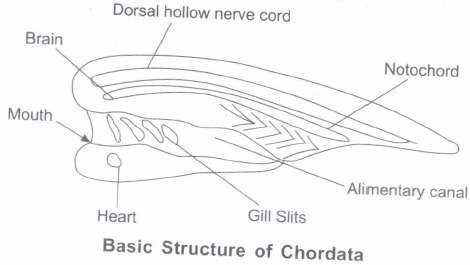
Give a schematic diagram showing basic architecture of a chordate.
26.
On the basis of which characters you can say that Aschelminthes are more advanced compared to Platyhelminthes?
27.
What is periderm? How does periderm formation take place in the dicot stems?
28.
What is the general structure of Bryophytes?
29.
While eating peach or pear, it is usually seen that some stone-like structures get entangled in the teeth. What are these stone-like structures called?
30.
31.
Given below is a graphical representation of abundance of lichens in a given area for a period of 10 years.
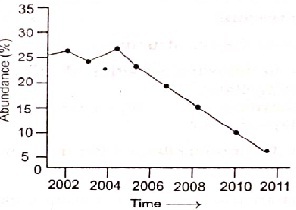
Study the graph carefully and answer the following questions
(i) What conclusion can be drawn from the graph?
(ii) Give reason for your answer in (i).
(iii) Comment upon the components that make up lichens.
Or (iii) Write two economic importance of lichens that makes it valuable for industry purpose.
32.
33.
34.
1.
(b)
2.
(d)
3.
(d)
4.
(c)
5.
(a)
Two
6.
(c)
Among the protists, only green algae have sexual cycle.
7.
(b)
brain and spinal cord
8.
(b)
Metamerism
9.
(d)
both (a) and (b)
10.
(c)
Myofibril
11.
(c)
Both (a) and (b)
12.
Epidermis from epidermal tissu system
13.
Genus represents a group of closely related species of plants or animals.
14.
(a) Cuscuta
(b) Venus fly-trap.
15.
(i) Euspongia
(ii) Fishes
(iii) Insects
16.
Cuticle and cutinised outer walls of epidermal cells reduce the rate of water loss through transpiration
17.
Solitary, axillary or terminal, umbellate or occasionally helicoid and scorpioid cyme.
18.
In tapeworms, body is divided into number of segments called proglottids that are budded off from the neck Each segment is able to perform all the vital function of body. This type of segmentation is called pseudo metamerism or pseudo segmentation.
19.
Alimentary Canal:
(i) The alimentary canal is a straight tube and runs between first to last segment of the body.
(ii) A terminal mouth opens into the buccal cavity (1-3 segments) which leads into muscular pharynx.
(iii) A small narrow tube, oesophagus (5-7 segments), continues into a muscular gizzard (8-9 segments).
(iv) It helps in grinding the soil particles and decaying leaves, etc.
(v) The stomach extends from 9-14 segments.
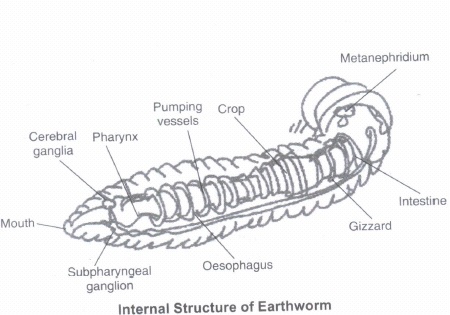
(i) The food of the earthworm is decaying leaves and organic matter mixed with soil. Calciferous glands, present in the stomach, neutralise the humic acid present in humus.
(ii) Intestine starts from the 15th segment onwards and continues till the last segment.
(iii) A pair of short and conical intestinal caecae project from the intestine on the 26th segment. The characteristic feature of the intestine between 26-35 segments is the presence of internal median fold of dorsal wall called typhlosole. This increases the effective area of absorption in the intestine.
(iv) The alimentary canal opens to the exterior by a small rounded aperture called anus. The ingested organic rich soil passes through the digestive tract where digestive enzymes breakdown complex food into smaller absorbable units. These simpler molecules are absorbed through intestinal membranes and are utilised.
Feeding habit and importance for human. The earthworm eats soil and decaying organic materials. Because of muscular pharynx the earthworms grinds everything very finely. Calciferous glands of the digestive system help in composting of organic materials of earthworm's food. Finally the waste product come out which is very good compost fertilizer. Because of this the method hastening composting process with the help of earthworm is known as vermin-composting. Otherwise also the earthworm facilitates turning over of the soil layer thereby helping in better aeration of the topsoil.
20.
Epidermis. The transverse section of a typical young dicotyledonous stem shows that the epidermis is the outermost protective layer of the stem. Covered with a thin layer of cuticle, it may bear trichomes and a few stomata.
Cortex. The cells arranged in multiple layers between epidermis and pericycle constitute the cortex. It consists of three sub-zones. The outer hypodermis, consists of a few layers of collenchymatous cells just below the epidermis, which provide mechanical strength to the young stem. Cortical layers below hypodermis consist of rounded thin-walled parenchymatous cells with conspicuous intercellular spaces. The innermost layer of the cortex is called the endodermis. The cells of the endodermis are rich in starch grains and the layer is also referred to as the starch sheath. Pericycle is present on the inner side of the endodermis and above the phloem in the form of semi-lunar patches of sclerenchyma. In between the vascular bundles, there are a few layers of radially placed parenchymatous cells, which constitute medullary rays
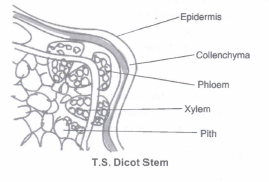
Vascular Bundles. A large number of vascular bundles are arranged in a ring; the 'ring' arrangement of vascular bundles is a characteristic of dicot stem. Each vascular bundle is conjoint, open, and with endarch protoxylem. A large number of rounded, parenchymatous cells with large intercellular spaces which occupy the central portion of the stem constitute the pith.
Differences between dicot and monocot stems
| Dicot Stem | Monocot Stem |
|---|---|
| 1. Vascular bundles are arranged in a ring. | 1. Vascular bundles are scattered. |
| 2. Secondary growth takes place. | 2. Secondary growth does not happen. |
| 3. Wood is formed. | 3. Wood is not formed. |
21.
The biodiversity of a geographical location may influence the classification in following ways:
i) If there is rich biodiversity then it means number of characters will be in plenty to study.
ii) More characters will give scientists more clues about possible variations.
iii) Similarity in characters would indicate towards phylogenetic relation between two or more species.
iv) On the other hand, if a given geographical area is poor in biodiversity then it becomes difficult to study more characters and one has to rely on limited set of characters.
v) Rich biodiversity means more resources and more reproduction leading to increased competition for survival. This can lead to emergence of certain new variations. These variations can lead to emergence of an altogether new species.
vi) One example can be recent discovery of a frog species from the Himalayan region. As Himalayan region is rich in biodiversity so it gives fertile ground for a new species to emerge.
22.
(i) They are mostly marine called poikilothermic animals(i.e., they have the capacity to regulate their body temperature)
(ii) The body is laterally compressed and spindle-shaped.
(iii) Notochord is persistent throughout the life.
(iv) Mouth is ventral in position, skin is tough containing minute placoid scales and teeth are modified placoid scales. They have strong jaw and predaceous by nature.
(v) Gill slits are generally five pairs and gill cover (operculum) are absent.
(vi) Heart is two-chambered with one auricle and one ventricle.
23.
Although the two are vastly different from each other. They still bear some common characters, on the basis of which they are introduced in Eubacteria of kingdom-Monera.
These characters are as follows :
(i) Both the groups do not possess well-defined nucleus.
(ii) Nucleus lacks nucleolus and nuclear membrane.
(ii) DNA (genetic material) lies freely in the cytoplasm.
(iv) They possess 70S type of ribosomes.
24.
Nervous System of Cockroach
(a) Nervous system consists of a brain in the head and segmentally arranged ganglia joined by paired longitudinal connectives along the ventral side and the nerves arising from each of the ganglia.
(b) The nervous system is spread throughout body.
(c) Brain is represented by the supraoesophageal ganglion in the head; it supplies nerves to the antennae and compound eyes.
(d) There are three ganglia in the thorax - one in prothorax, one in meso thorax and one in metathorax and six in the abdomen.
25.
26.
(a) Platyhelminthes are acoelomate, while Aschelminthes are pseudocoelomates. This indicates development of mesoderm.
(b) In Platyhelminthes both sexes are on the same animal, while in Aschelminthes there is segregation of sexes. This shows another point of evolution.
27.
As the stem continues to increase in girth due to the activity of vascular cambium, the outer cortical and epidermis layers get broken and need to be replaced to provide new protective cell layers. Hence, sooner or later, another meristematic tissue called cork cambium or phellogen develops, usually in the cortex region. Phellogen is a couple of layers thick. It is made of narrow, thin-walled and nearly rectangular cells. Phellogen cuts off cells on both sides. The outer cells differentiate into cork or phellem while the inner cells differentiate into secondary cortex or phelloderm. The cork is impervious to water due to suberin deposition in the cell wall. The cells of secondary cortex are parenchymatous. Phellogen, phellem, and phelloderm are collectively known as periderm. Due to activity of the cork cambium, pressure builds up on the remaining layers peripheral to phellogen and ultimately these layers die and slough off.
28.
Structure of Bryophytes. It is thallus-like and prostrate or erect, and attached to the substratum by unicellular or multicellular rhizoids. They lack true roots, stem or leaves. They may possess root-like, leaf-like or stem-like structures
29.
Sclereids, a type of sclerenchyma.
30.
31.
(i) The graph shows decline in abundance of lichens from the year 2004 onwards.
(ii) Lichens show decline abundance due to increasing pollution in the area as they do not grow in polluted areas.
(iii) Each lichen comprises of two components a fungus (mycobiont) and an alga (phycobiont). The fungal component of lichens either belongs to Ascomycetes or Basidiomycetes.The algal component is either a green alga or a cyanobacteria.
or
(iii) (a) Food and Fodder : Some lichens are used as food by catter pillars. mites and snials, etc.
(b) Medicinal Use : Some lichens have great significance in matricides and treatment of various diseases.
32.
33.
34.

11th Standard CBSE Syllabus & Materials
11th Standard CBSE
CBSE 11th Business Studies Forms of Business Organisation Sample Question Papers Study Material - QB365 Set A
NEW11th Standard CBSE
CBSE 11th Business Studies Business, Trade and Commerce Sample Question Papers Study Material - QB365 Set A
NEW11th Standard CBSE
CBSE 11th Physics Waves Sample Question Papers Study Material - QB365 Set A
NEW11th Standard CBSE
CBSE 11th Physics Kinetic Theory Sample Question Papers Study Material - QB365 Set A



NCERT Books

Syllabus

Exam Pattern

Sample Question Papers

Previous year Question Papers

Important Notes

MCQ Practice test

NCERT Exemplers

Case study Questions

Image Based Questions

Passage based Questions

HOT Questions

Value Based Questions

Model Questions Papers
NCERT ( Book Back ) Questions

Assertion and Reason
Important Questions And Answers

CBSE 11th Standard CBSE Subjects
CBSE Standards







