
 100% FREE ACCESS
11th Standard CBSE Syllabus & Materials
11th Standard CBSE
CBSE 11th Economics PART-A - Presentation of Data - New Sample Question Papers Study Material - QB365 Set A
NEW11th Standard CBSE
CBSE 11th Economics PART-A - Organisation of Data - New Sample Question Papers Study Material - QB365 Set A
NEW11th Standard CBSE
CBSE 11th Economics PART-A - Collection of Data - New Sample Question Papers Study Material - QB365 Set A
NEW11th Standard CBSE
CBSE 11th Economics PART-A - Introduction to Economics and Statistics - New Sample Question Papers Study Material - QB365 Set A
NEW11th Standard CBSE
CBSE 11th Business Studies International Trade Sample Question Papers Study Material - QB365 Set A
NEW11th Standard CBSE
CBSE 11th Business Studies Evolution and Fundamentals of Business Sample Question Papers Study Material - QB365 Set A

Published on: 21/10/2025
Download CBSE Class 11th Standard CBSE Biology question papers, sample papers, important questions, and previous year solved papers in PDF format. Get free study materials, NCERT solutions, and exam preparation resources for Class 11th Standard CBSE Biology
Questions + Answers key
Take MCQ Biology Test
1.
List out the differences between Monera and Protista
2.
Explain the terms
(i) Basidiocarp
(ii) Basidia
(iii) Basidiospores
3.
What do the terms phycobiont and mycobiont signify?
4.
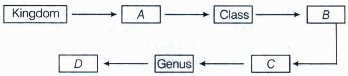
Write the relation between taxonomic category and taxonomic hierarchy.Fill in the missing category in following hierarchical arrangement in ascending order.
5.
Can you identify the correct sequence of taxonomical categories?
(a) Species \(\longrightarrow \) Order \(\longrightarrow \) Phylum \(\longrightarrow \) Kingdom
(b) Genus \(\longrightarrow \) Species \(\longrightarrow \) Order \(\longrightarrow \) Kingdom
(c) Species \(\longrightarrow \) Genus \(\longrightarrow \) Order \(\longrightarrow \) Phylum
6.
Holdfast, stipe and frond constitute the plant body in case of ______.
Rhodophyyceae
Chlorophyceae
Phaeophyceae
All of these
7.
Genus represents ______.
an individual plant or animal
a collection of plants or animals
a group of closely related species of plants or animals.
None of the above
8.
Define and understand the term Class.
9.
“All vertebrates are chordates but all chordates are not vertebrates”. Justify the statement.
10.
Why digestive tract of flatworms and coelenterates is called incomplete?
11.
How important is the presence of air bladder in Pisces?
12.
Why are bryophytes called as 'amphibians of plant kingdom'?
13.
Which is the dominate phase in pteridophyte?
14.
In which plant coralloid roots are present?
15.
Which green algae is used by space travellers as protein rich food?
16.
What are the main criteria used for five kingdom system of classification?
17.
Are chemosynthetic bacteria autotrophic or heterotrophic?
18.
Name the kingdom under which cyanobacteria have been classified.
19.
Describe phylum Coelenterata. Give suitable examples.
20.
Give differences between cartilaginous and bony fishes
21.
Could the number of eggs or young ones produced by an oviparous and viviparous mother be equal? Why?
1.
Differences between Monera and Protista
| Monera | Protista |
| Cell wall is made up of peptidogylcan. | Cell wall is made up of cellulose. |
| Respiratory apparatus is present in respiratory membrane. | It is present in mitochondria. |
| Ribosomes are 70S type. | Ribosomes are 80S type. |
| These are prokaryotic and have naked circular DNA. | Eukaryotic linear DNA is presents in nucleus. |
| Extrachromosomal DNA is presents in the from of plasmods. |
Extrachromosomal DNA is presents in organelles like mitochondria and chloroplast. |
2.
(i) Basidiocarp : It may be minute or very large structure which bears basidia, e.g., bracket fungi, puffballs.
(ii) Basidia : These are special reproductive bodies of Basidiomycetes where karyogamy, meiosis and basidiospore formation occurs.
(iii) Basidiospores : These are meiospores of Basidiomycetes. Basidiospores are borne at the tips of sterigmata or outgrowths of basidia.
3.
Lichen:
1. It signifies a symbiotic relationship between the algae and fungi.
2. In this association, the fungi provide shelter and protection to algae and in return get nutrition from algae.
Phycobiont and mycobiont:
1. They both are the components of a lichen.
2. Phycobiont signifies the algal component of a lichen.
3. On the other hand, mycobiont signifies the fungal constituent of a lichen.
4.
The category is a part of overall taxonomic arrangement called taxonomic category. All the categories together constitute the taxonomic hierarchy.
A - Phylum, B - Order, C - Family and D - Species
5.
Taxonomic hierarchy:
1. The different levels of hierarchy are based on the different categories.
2. The correct hierarchical arrangement of taxonomic categories in ascending order is from the lowest to the highest level of hierarchy.
3. Species → Genus → Family → Order → Class → Phylum → Kingdom
4. Here (a) represents the correct sequence.
5. In the case of (b) the species is followed by genus which is the opposite of how it must be.
6. In the case (c) represents the correct sequence.
Final Answer: Therefore, both (a) and (c) represents the correct sequence in the ascending form.
6.
The lamina of Phaeophyceae members large sized body with differentiation of holdfast, stipe and lamina.
7.
Genus represents a group of closely related species of plants or animals.
8.
Class:
A class includes related orders. Class defines more detailed characters other than broad architecture. For example, all mammals have mammary glands to secrete milk, have hairy body. All birds or aves have pneumatic bones to assist in flying. The common character among them is the presence of notochord thereby making them members of the same phylum.
9.
All chordates have a notochord, but only in vertebrate the vertical column develops from notochord, so all chordates are not vertebrates.All vertebrates are chordates as they have notochord in embryonic stage
10.
Because they have single opening both for ingestion and egestion.
11.
Gas bladder or air bladder is a gas-filled sac present in fishes. It helps in maintaining buoyancy. Thus, it helps fishes to ascend or descend and stay in the water current.
12.
Bryophytes are terrestrial plants. But, they need water for completion of their life cycle. External water is required for dehiscences of antheridia, liberation of antherozoids, transfer of antherozoids from antheridia to archegonia, etc. Rest other stages of life cycle are terrestrial, so they are called amphibians of plant kingdom.
13.
Sporophyte is the dominant phase in life cycle of pteridophytes.
14.
Cycas have coralloid root in which nitrogen-fixing cyanobacteria is present
15.
Chlorella is a unicellular green alga, rich in proteins and is used as food supplement even by space travellers.
16.
The main criteria used for five kingdom system of classification are
(i) Complexity of cell structure.
(ii) Complexity of organism's body.
(iii) Mode of obtaining nutrition.
(iv) Life cycle and phylogenetic relationship.
(v) Presence or absence of sexual reproduction.
17.
Chemosynthetic bacteria are autotrophs because they are able to synthesise their food from inorganic raw material with the help of energy obtained from chemical reaction.
18.
Cyanobacteria are prokaryotic organisms belonging to kingdom-Monera.
19.
Phylum - Coelenterata (Cnidaria)
Habit and Habitat. They are aquatic, mostly marine, sessile or free-swimming, radially symmetrical animals. The name cnidaria is derived from the cnidoblasts or cnidocytes (which contain the stinging capsules or nematocytes) present on the tentacles and the body. Cnidoblasts are used for anchorage, defense and for the capture of prey.
Key Structural Features. Cnidarians exhibit tissue level of organisation and are diploblastic. They have a central gastro-vascular cavity with a single opening, hypostome. Digestion is extracellular and intracellular. Some of the cnidarians, e.g., corals have a skeleton composed of calcium carbonate.
Basic Body Forms. Cnidarians exhibit two basic body forms called polyp and medusa. Polyp is a sessile and cylindrical form like Hydra, Adamsia, etc. whereas,
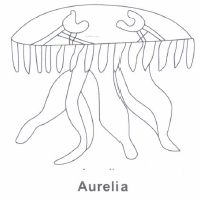
medussa is umbrella-shaped and free-swimming like Aurelia or jelly fish. Those cnidarians which exist in both forms exhibit alternation of generation
(Metagenesis), i.e., polyps produce medusae asexually and medusae form the polyps sexually (e.g., Obelia).
Examples: Physalia (Portuguese man-of-war), Adamsia (Sea anemone), Pennatula (Sea-pen), Gorgonia (Sea-fan) and Meandrina (Brain coral).
20.
Differences between cartilaginous and bony fishes
| Cartilaginous Fishes (Chondrichthyes) |
Bony Fishes (Osteichthyes) |
| They are always marine | They may be marine or freshwater |
| Skin is covered by small placoid scales | Skin is covered with large cycloid scales |
| Endoskeleton is cartilaginous | Endoskeleton is partly or completely bony |
| Gills slits are not covered by gill covers | Gill slits are covered by gill covers |
| Swim bladder is absent | Swim bladder is present |
| Tail fin is asmmetrical | Tail fin is symmetrical |
| Excretory matter is urea | Excretory matter is ammonia |
| They exhibit sexual dimorphism | Sexual dimorphism is usually present |
| Mostly viviparous | Usually oviparous |
| e.g, sharks, skates | e.g, Labeo, Catla, Hilsa |
21.
Viviparous animals: Viviparous animals are those animals in which both the fertilization (i.e. the fusion of male and female gametes) of egg that results in zygote and development of embryo take place inside the body of the female in the mother's womb.
These animals give birth to young ones directly.
Examples – mammals such as cows, goats, dogs, humans, etc.
Oviparous animals: Oviparous animals are those animals in which both the process of development of embryos take place outside the body of the female.
a) In oviparous animals fertilization can occur inside the mother’s body or outside the mother’s body.
b) Oviparous animals lay eggs outside their body. Example – birds, hen, frogs, etc.
Number of eggs or young ones produced by the oviparous and viviparous can be equal or not:
a) No, the number of eggs or young ones produced by an oviparous and viviparous mother cannot be equal.
b) The number of eggs laid by the oviparous animals are always more in number than the young ones produced by viviparous animals.
c) This is because the events of fertilization or development of embryos takes place outside the mother’s body so there are more chances that the eggs will get damaged prior to fertilization or development. So, to ensure the complete development of at least one embryo, oviparous animals lay more numbers of eggs than viviparous animals.
d) On the other hand in viviparous animals fertilization and development of embryos both occur inside the body of the female so there are 100% of its development.

11th Standard CBSE Syllabus & Materials
11th Standard CBSE
CBSE 11th Business Studies Forms of Business Organisation Sample Question Papers Study Material - QB365 Set A
NEW11th Standard CBSE
CBSE 11th Business Studies Business, Trade and Commerce Sample Question Papers Study Material - QB365 Set A
NEW11th Standard CBSE
CBSE 11th Physics Waves Sample Question Papers Study Material - QB365 Set A
NEW11th Standard CBSE
CBSE 11th Physics Kinetic Theory Sample Question Papers Study Material - QB365 Set A



NCERT Books

Syllabus

Exam Pattern

Sample Question Papers

Previous year Question Papers

Important Notes

MCQ Practice test

NCERT Exemplers

Case study Questions

Image Based Questions

Passage based Questions

HOT Questions

Value Based Questions

Model Questions Papers
NCERT ( Book Back ) Questions

Assertion and Reason
Important Questions And Answers

CBSE 11th Standard CBSE Subjects
CBSE Standards







