
 100% FREE ACCESS
11th Standard CBSE Syllabus & Materials
11th Standard CBSE
CBSE 11th Economics PART-A - Presentation of Data - New Sample Question Papers Study Material - QB365 Set A
NEW11th Standard CBSE
CBSE 11th Economics PART-A - Organisation of Data - New Sample Question Papers Study Material - QB365 Set A
NEW11th Standard CBSE
CBSE 11th Economics PART-A - Collection of Data - New Sample Question Papers Study Material - QB365 Set A
NEW11th Standard CBSE
CBSE 11th Economics PART-A - Introduction to Economics and Statistics - New Sample Question Papers Study Material - QB365 Set A
NEW11th Standard CBSE
CBSE 11th Business Studies International Trade Sample Question Papers Study Material - QB365 Set A
NEW11th Standard CBSE
CBSE 11th Business Studies Evolution and Fundamentals of Business Sample Question Papers Study Material - QB365 Set A

Published on: 21/10/2025
Download CBSE Class 11th Standard CBSE Biology question papers, sample papers, important questions, and previous year solved papers in PDF format. Get free study materials, NCERT solutions, and exam preparation resources for Class 11th Standard CBSE Biology
Questions + Answers key
Take MCQ Biology Test
1.
Name the following:
(a) The domain in three-domain system of classification, which includes Kingdoms, Fungi, Plantae and Animalia.
(b) The photosynthetic pigment common to cyanobacteria and green plants.
(c) A moneran that lacks cell wall.
(d) The characterisitic type of nutrition in animals.
(e) The chemical nature of fungal cell wall.
2.
Write the function of the following in case of frog
(i) Tongue
(ii) Pigment cells
(iii) Vocal sacs
(iv) Mucous glands
(v) Tympanic membrane
3.
Amphibians are supposed to be the linking point between aquatic and terrestrial life. Explain
4.
Describe economic importance of the largest phylum.
5.
Write short notes on following:
(a) Diploblastic and Triploblastic Organization
(b) Different types of coelom
(c) Segmentation
(d) Notochord
6.
What are the symmetries based on which animals can be classified? Describe with appropriate diagram.
7.
Define the following terms:
(a) Aestivation
(b) Placentation
(c) Actinomorphic
(d) Zygomorphic
(e) Superior ovary
(f) Perigynous flower
(g) Epipetalous stamen
8.
What is a tissue? Describe different types of simple tissues in plants.
9.
Sporozoans are parasitic protozoan protists which lack locomotory organelles atleast in trophozoite stage.
(i) Where are they found ?
(ii) What kind of nutrition they have?
(iii) Do they have nucleus ?
(iv) What is the made of reproduction ?
(v) List any four examples of sporozoans.
10.
11.
12.
Taxonomists refrain from using vernacular names of living organisms. They widely use binomial nomenclature as it has universal acceptance and explicitness. The scientific name of each organism is assigned by esteemed organisations, viz, ICBN and ICZN.
Consider the above given information and answer the following questions.
(i) What do the two components of binomial nomenclature represent?
(ii) (a) Who proposed binomial nomenclature and what is the origin of biological names? (or)
(b) There are universal rules for naming an organism.Comment.
(iii) How is the author's name mentioned in binomial nomenclature?
13.
Two types of compound leaves are shown below.
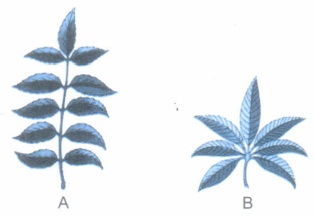
(a) Identify the types of compound leaves, A and B.
(b) Give an example of each.
(c) How do they differ from each other?
14.
The figure given below represents the different regions of a root tip.
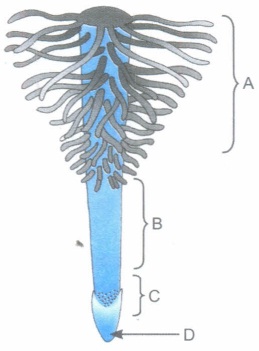
(a) Identify the regions A, B, C and D in the root tip.
(b) Write any two characteristics of the cells present in the region C
1.
(a) Eukarya
(b) Chlorophyll a
(c) Mycoplasma
(d) Holozoic
(e) Chitin.
2.
(i) Tongue is used to capture the prey.
(ii) Pigment cells impart colour to the skin.
(iii) Vocal sacs raise pitch of the sound during croaking.
(iv) Mucous glands discharge their slimy mucus onto the surface of ducts passing through the epidermis.
(v) Tympanic membrane serves to receive the sound waves.
3.
Amphibians are adapted to survive in both aquatic as well as terrestrial life. As research has proved that the life started in water and finally moved to land and air. Aquatic life has its own limitations. The area is limited and there is less variety in primary producers which limits the type of food available to the animals living in water. Specially in deep sea limited reach of sunlight doesn't permit variations of certain kind. Following paragraphs highlights certain features which amphibians developed to adapt in a terrestrial environment.
Emergence of lungs enabled frogs to breathe in air. When they are in water they breathe through skin. Some aquatic mammals, like whale need to come on surface, frequently, to breathe in oxygen which limits the time they can chase a prey underwater. So frogs are having a better mechanism to do so.
Emergence of four limbs meant frogs can travel larger distances. Their webbed fingers enable them to swim, while the stronger hind legs are used for better jump. Ease of mobility is helpful from two perspectives. One is in getting food and another is in saving from predators.
Frogs are ammonotelic which is more suitable for aquatic life. But later animals have switched over to ureotelic and urecotelic mode of excretion.
The feeding habit of frogs enables them to survive both on land as well as on water. While on land they eat small insects.
Presence of nictitating membrane over eyes allows them to swim under water. In higher animals, like mammals nictitating membrane becomes a vestigial organ showing their relationship with the aquatic life.
4.
The largest phylum is Arthropoda and its economic importance is as follows:
They are major agents for cross pollination. Insects, like butterflies and honey bee facilitate cross pollination.
Honey is an important food for human.
Many crustaceans, like lobsters and prawns are part of cuisine around the world.
The red dye cochineal, produced from a Central American species of insect, was economically important to the Aztecs and Mayans.
The blood of horseshoe crabs contains a clotting agent Limulus Amebocyte Lysate which is now used to test that antibiotics and kidney machines are free of dangerous bacteria, and to detect spinal meningitis and some cancers.
Maggots of housefly are used to treat those wounds which take time to heal because of absence of blood supply.
The relative simplicity of the arthropods' body plan, allowing them to move on a variety of surfaces both on land and in water, have made them useful as models for robotics.
They are carriers of many human parasite causing diseases like malaria, filaria and sleeping sickness.
Cockroaches are one of the major nuisance as they contaminate food in kitchens.
Termites are major causes of playing havoc with wooden furnitures.
Scorpions are known for their deadly sting, which can kill human and livestock.
5.
(a) Diploblastic and Triploblastic Organization
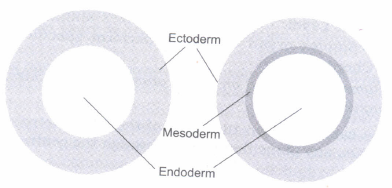
Diploblastic Organization. Animals in which the cells are arranged in two embryonic layers, an external ectoderm and an internal endoderm, are called diploblastic animals, e.g., coelenterates. An undifferentiated layer, mesoglea,
is present in between the ectoderm and the endoderm.
Triploblastic Organization. Those animals in which the developing embryo has a third germinal layer, mesoderm, in between the ectoderm and endoderm, are called triploblastic animals. Example: platyhelminthes to chordates.
(b) Coelom
Presence or absence of a cavity between the body wall and the gut wall is very important in classification. The body cavity, which is lined by mesoderm is called coelom.
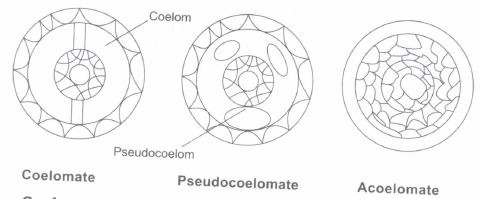
Coelomates. Animals possessing coelom are called coelomates, e.g., annelids, molluscs, arthropods, echinoderms, hemichordates and chordates.
Pseudocoelomates. In some animals, the body cavity is not lined by mesoderm, instead, the mesoderm is present as scattered pouches in between the ectoderm and endoderm. Such a body cavity is called pseudocoelom and the animals possessing them are called pseudocoelomates, e.g., aschelminthes.
Acoelomates. The animals in which the body cavity is absent are called acoelomates, e.g., platyhelminthes.
(c) Segmentation
In some animals, the body is externally and internally divided into segments with a serial repetition of at least some organs. For example, in earthworm, the body shows this pattern called metameric segmentation and the phenomenon is known as metamerism.
(d) Notochord
Notochord is a mesodermally derived rod-like structure formed on the dorsal side during embryonic development in some animals. Animals with notochord are called chordates and those animals which do not form this structure are called non-chordates, e.g., porifera to echinoderms.
6.
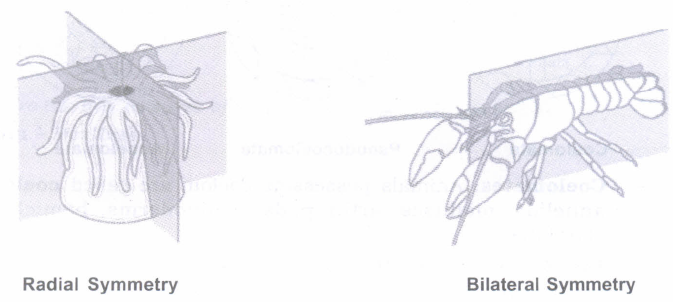
Animals can be categorized on the basis of their symmetry. Sponges are mostly asymmetrical, i.e., any plane that passes through the centre does not divide them into equal halves.
Radial Symmetry. When any plane passing through the central axis of the body divides the organism into two identical halves, it is called radial symmetry. Coelenterates, ctenophores and echinoderms have this kind of body plan.
Bilateral Symmetry. In certain animals the body can be divided into identical left and right halves in only one plane and this type of symmetry is called bilateral symmetry. Examples: Annelids, Arthropods, Mammals
7.
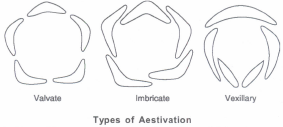
(a) Aestivation. The mode of arrangement of sepals or petals in floral bud with respect to the other members of the same whorl is known as aestivation. The main types of aestivation are valvate, twisted, imbricate and vexillary. Valvate. When sepals or petals in a whorl just touch one another at the margin, without overlapping, as in Calotropis, it is said to be valvate.
Twisted. If one margin of the appendage overlaps that of the next one and so on, as in china rose, lady's finger and cotton, it is called twisted. Imbricate. If the margins of sepals or petals overlap one another but not in any particular direction as in Cassia and gulmohur, the aestivation is called imbricate
Vexillary. In pea and bean flowers, there are five petals, the largest (standard) overlaps the two lateral petals (wings) which in turn overlap the two smallest anterior petals (keel); this type of aestivation is known as vexillary or papilionaceous, e.g. pea
(b) Placentation. The arrangement of ovules within the ovary is known as placentation. The placentation are of different types namely, marginal, axile, parietal, basal, central and free central.
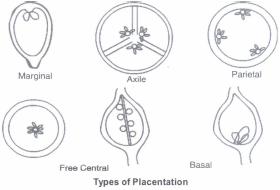
Marginal. In marginal placentation the placenta forms a ridge along the ventral suture of the ovary and the ovules are borne on this ridge forming two rows, as in pea.
Axile. When the placenta is axial and the ovules are attached to it in a multilocular ovary, the placentaion is said to be axile, as in china rose, tomato and lemon.
Parietal. In parietal placentation, the ovules develop on the inner wall of the ovary or on peripheral part. Ovary is one-chambered but it becomes two - chambered due to the formation of the false septum, e.g., mustard and Argemone. When the ovules are borne on central axis and septa are absent, as in Dianthus and Primrose the placentation is called free central.
Basal. In basal placentation, the placenta develops at the base of ovary and a single ovule is attached to it, as in sunflower, marigold.
(c) Actinomorphic. When a flower can be divided into two equal radial halves in any radial plane passing through the centre, it is said to be actinomorphic, e.g., mustard, datura, chilli.
(d) Zygomorphic. When a flower can be divided into two similar halves only in one particular vertical plane, it is zygomorphic, e.g., pea, gulmohur, bean, Cassia.
(e) Superior Ovary or Hypogynous Flower. Based on the position of calyx, corolla and androecium in respect of the ovary on thalamus, the flowers are described as hypogynous perigynous and epigynous. In the hypogynous flower the gynoecium occupies the highest position while the other parts are situated below it. The ovary in such flowers is said to be superior, e.g., mustard, china rose and brinjal.
(f) Perigynous Flower. If gynoecium is situated in the centre and other parts of the flower are located on the rim of the thalamus almost at the same level, it is called perigynous. The ovary here is said to be half inferior, e.g., plum, rose, peach
(g) Epipetalous Stamens. When stamens are attached to the petals, they are epipetalous as in brinjal
8.
A tissue is a group of cells having a common origin and usually performing a common function.
Simple Tissues. A simple tissue is made of only one type of cells. Simple tissues are of following types:
(a) Parenchyma
(b) Collenchyma
(c) Sclerenchyma
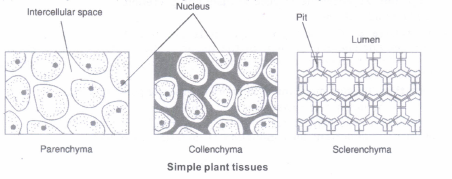
Parenchyma. Parenchyma forms the major component within organs. The cells of the parenchyma are generally isodiametric. They may be spherical, oval, round, polygonal or elongated in shape. Their walls are thin and made up of cellulose. They may either be closely packed or have small intercellular spaces.
Function. The parenchyma performs various functions like photosynthesis, storage, secretion.
Collenchyma. The collenchyma occurs in layers below the epidermis in dicotyledonous plants. It is found either as a homogeneous layer or in patches. It consists of cells which are much thickened at the corners due to a deposition of cellulose, hemicellulose and pectin. Collenchymatous cells may be oval, spherical or polygonal and often contain chloroplasts. These cells assimilate food when they contain chloroplasts. Intercellular spaces are absent.
Function. They provide mechanical support to the growing parts of the plant such as young stem and petiole of a leaf.
Sclerenchyma. Sclerenchyma consists of long, narrow cells with thick and lignified cell walls having a few or numerous pits. They are usually dead and without protoplasts. On the basis of variation in form, structure, origin and development, sclerenchyma may be either fibres or sclereids. The fibres are thick-walled, elongated and pointed cells, generally occurring in groups, in various parts of the plant. The sclereids are spherical, oval or cylindrical, highly thickened dead cells with very narrow cavities (lumen). These are commonly found in the fruit walls of nuts; pulp of fruits like guava, pear and sapota; seed coats of legumes and leaves of tea.
Function. Sclerenchyma provides mechanical support to organs.
9.
(i) Sporozoans are intracellular endoparasities of invertebrates and vertebrates.
(ii) They have nutrition which is mostly absorptive type and rarely digestive.
(iii) Sporozoans are commonly uninucleate.
(iv) Asexual reproduction occurs by multiple fission and sexual reproduction involves fusion of gametes.
(v) Examples Plasmodium, Toxoplasma, Monocystis and Eimeria.
10.
11.
12.
(i) The two components of binomial nomenclature : generic name and specific epithet.
(ii) (a) Carl Linnaeus proposed binomial nomenclature.
Scientific names are based in Latin or Greek.
(or)
(b) The rules framed by Linnaeus and by these codes are as follows :
(a) The names are generally in Latin and written in Italics. They are Latinised or derived from Latin irrespective of their origin.
(b) The first word in a biological name represents the genus while, the second word denotes the specific epithet.
(c) Both the words in a biological name, when handwritten, are separately underlined or printed in Italics to indicate their Latin origin.
(d) The first word denoting the genus starts with a capital letter while, the specific epithet starts with a small letter, e.g. Mangifera indica.
(e) Name of the author appears after the specific epithet, i.e. at the end of the biological name and is written in an abbreviated form, e.g. Mangifera indica Linn, Linn is for Linnacus.
(f) Generic and common names may be same, e.g. Gorilla gorilla.
(iii) Name of the author appears after the specific epithet, i.e. at the end of the biological name. It is generally written in abbreviated form, eg. Mangifera indica Linn. It indicates that this species was first described by Linnaeus.
13.
(a) A - Pinnately compound leaf
B - Palmately compound leaf
(b) A- e.g. Neem
B - e.g. Silk cotton
(c) In pinnately compound leaves (A), a number of leaflets are arranged along the length of the rachis.
In palmately compound leaves (B), the leaflets are attached at a common point in the tip of the rachis.
14.
(a) A - Region of maturation
B - Region of elongation
C - Region of meristematic activity
D - Root cap
(b) The cells in C (meristem)
(i) are thin-walled
(ii) have dense protoplasm
(iii) divide repeatedly

11th Standard CBSE Syllabus & Materials
11th Standard CBSE
CBSE 11th Business Studies Forms of Business Organisation Sample Question Papers Study Material - QB365 Set A
NEW11th Standard CBSE
CBSE 11th Business Studies Business, Trade and Commerce Sample Question Papers Study Material - QB365 Set A
NEW11th Standard CBSE
CBSE 11th Physics Waves Sample Question Papers Study Material - QB365 Set A
NEW11th Standard CBSE
CBSE 11th Physics Kinetic Theory Sample Question Papers Study Material - QB365 Set A



NCERT Books

Syllabus

Exam Pattern

Sample Question Papers

Previous year Question Papers

Important Notes

MCQ Practice test

NCERT Exemplers

Case study Questions

Image Based Questions

Passage based Questions

HOT Questions

Value Based Questions

Model Questions Papers
NCERT ( Book Back ) Questions

Assertion and Reason
Important Questions And Answers

CBSE 11th Standard CBSE Subjects
CBSE Standards







