
 100% FREE ACCESS
11th Standard CBSE Syllabus & Materials
11th Standard CBSE
CBSE 11th Economics PART-A - Presentation of Data - New Sample Question Papers Study Material - QB365 Set A
NEW11th Standard CBSE
CBSE 11th Economics PART-A - Organisation of Data - New Sample Question Papers Study Material - QB365 Set A
NEW11th Standard CBSE
CBSE 11th Economics PART-A - Collection of Data - New Sample Question Papers Study Material - QB365 Set A
NEW11th Standard CBSE
CBSE 11th Economics PART-A - Introduction to Economics and Statistics - New Sample Question Papers Study Material - QB365 Set A
NEW11th Standard CBSE
CBSE 11th Business Studies International Trade Sample Question Papers Study Material - QB365 Set A
NEW11th Standard CBSE
CBSE 11th Business Studies Evolution and Fundamentals of Business Sample Question Papers Study Material - QB365 Set A

Published on: 21/10/2025
Download CBSE Class 11th Standard CBSE Biology question papers, sample papers, important questions, and previous year solved papers in PDF format. Get free study materials, NCERT solutions, and exam preparation resources for Class 11th Standard CBSE Biology
Questions + Answers key
Take MCQ Biology Test
1.
Write five differences between chordata and non-chordata.
2.
Which features distinguish blood from lymph?
3.
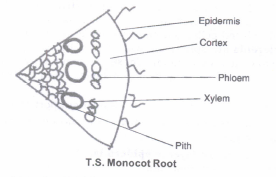
With suitable diagrams explain the structures of dicot and monocot root.
4.
Brassica campestris Linn
(i) Give the common name of the plant.
(ii) What do the first two parts of the name denote?
(iii) Why are they written in italics?
(iv) What is the meaning of Linn written at the end of the name?
5.
Name the tissue that makes up the following in a dicot stem:
(a) Hypodermis
(b) Pith.
6.
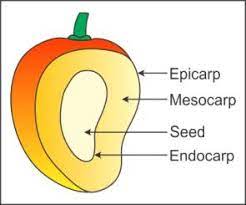
Draw a labelled diagram of a mango fruit as seen in a V.S.
7.
Give an example of an oviparous mammal
8.
Write the example of urochordates
9.
How do fungi form partnership with most plants?
10.
Describe the following as asked against each:
(a) Gizzard in cockroach: Function
(b) Open type of vascular system: One example
(c) Heart: Name of tissue.
11.
What are root hairs? Which region of the root do they arise from? What is their function?
12.
What are phycocolloids? Name two of them and their respective sources.
13.
Differentiate between the gametophyte and sporophyte of plants. What is meant by alternation of generations?
14.
On the basis of which characters you can say that Aschelminthes are more advanced compared to Platyhelminthes?
15.
Write the floral formula of an actinomorphic, bisexual and hypogynous flower with five united sepals, five free petals, five free stamens and two united carpels with superior ovary and axile placentation.
16.
Organ system in different groups of animals exhibits various patterns of complexities. Explain
17.
18.
19.
20.
21.
Selaginella and Salviniaare considered representing a significant step towards evolution of seed habit because ______.
female gametophyte is free and gets dispersed like seeds
female gametophyte lacks archegonia
megaspores possess endosperm and embry surrounded by seed coat
embryo develops in female gametophyte which is retained on parent sporophyte
22.
In racemose inflorescence, flowers are arranged in _______.
centrifugal order
centripetal order
acropetal order
basipetal order
23.
Radial symmetry is found in the flowers of _______.
Cassia
Trifolium
Pisum
Brassica
24.
Go through the statements given below and choose the option with all incorrect statements.
I. Classification is not a single step process, but involves hierarchy of steps in which each step represents a rank or category.
II. Vernacular names are easier to pronounce.
III. Common name ' touch-me-not ' is given to two species, i.e. Nigella and Mimosa.
IV. Vernacular names often have no significance.
I and II
Only II
I, II and II
Only III
25.
The cells of squamous epithelium are _______.
flat and scale-like
polygonal and cuboidal
polygonal and columnar
scale-like and cuboidal
26.
Companion cells in anglesperms are associated with _____.
xylem vessels
guard cells
xylem tracheids
sieve tubes
27.
Roots developed from parts of the embryo other than the radicle are called _______.
taproots
fibrous roots
adventitious roots
nodular roots
28.
Frog shows which kind of excretion?
Ammonotelic
Ureotelic
Uricotelic
Ammonotelic in water and ureotelic on land
29.
What is the name of modified root in turnip?
Prop root
Tap root
Tubour
Pneumatophore
30.
31.
A student observed polluted water bodies. He found green gelatinous organisms which spread the all over the water. He studied some of these organisms under microscope and discussed with his teacher.
(i) What are these green gelatinous organism?
(ii) What is heterocysts?
(ii) Write any two features of the cyanobacteria.
(iv) Write any one similarity between cyanobacteria and plants.
(v) What is the other name of cyanobacteria?
32.
33.
34.
1.
| Chordates | Non-chordates |
| a. They have a notochord. | a. They never have a notochord. |
| b. Central nervous system includes a single, dorsal, hollow, nerve cord. | b. Central nervous system includes a double, ventral and solid nerve cord. |
| c. Heart is ventral; haemoglobin is present in erythrocytes (cells). | c.Heart is dorsal; haemoglobin is dissolved in the plasma and not in cells |
| d. Pharynx is perforated by gill slits. | d. Gill slits are absent |
| e. A post-anal tail is present at some stage of the life. | e.A post-anal tail is absent. |
2.
Differences between blood and lymph are given below
| Blood | Lymph |
| It contains plasma, erythrocytes, leucocytes and platelets | It contains plasma and leucocytes |
| The presence of haemoglobin imparts red colour to it. | It is colourless as haemoglobin is absent. |
| Its plasma contains more protein, calcium and phosphorus as compared to lymph. | Its plasma has fewer protein and less calcium and phosphorus than blood |
| Contains moderate amount of CO2 and other metabolic wastes. | Contains excessive amount of CO2 and other metabolic wastes. |
3.
Dicotyledonous Root
Epidermis. The outermost layer is epidermis. Many of the epidermal cells protrude in the form of unicellular root hairs.
Cortex. The cortex consists of several layers of thin-walled parenchyma cells with intercellular spaces.
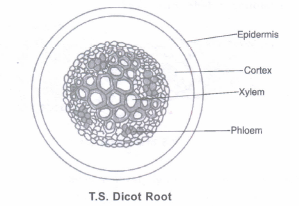
Endodermis. The innermost layer of the cortex is called endodermis. It comprises a single layer of barrel-shaped cells without any intercellular spaces. The tangential, as well as radial walls of the endodermal cells, have a deposition of water impermeable, waxy material suberin in the form of Casparian strips. Next to endodermis lies a few layers of thick-walled parenchymatous cells referred to as pericycle. Initiation of lateral roots and vascular cambium during the secondary growth takes place in these cells. The pith is small or inconspicuous. The parenchymatous cells which lie between the xylem and the phloem are called conjuctive tissue. There are usually two to four xylem and phloem patches. Later, a cambium ring develops between the xylem and phloem. All tissues on the inner side of the endodermis such as pericycle, vascular bundles and pith constitute the stele.
Monocotyledonous Root
The anatomy of the monocot root is similar to the dicot root in many respects. It has epidermis, cortex, endodermis, pericycle, vascular bundles and pith. As compared to the dicot root which have fewer xylem bundles, there are usually more than six (polyarch) xylem bundles in the monocot root. Pith is large and well developed. Monocotyledonous roots do not undergo any secondary growth.
4.
(i) Common name: Mustard.
(ii) Parts of the name: First part represents the genus or generic name, while the second part represents the specific name.
(iii) They are written in Italics in order to highlight their Latin origin.
(iv) Linn written at the end of the name, is the abbreviation of the name of scientist Linnaeus, who gave the name to the plant.
5.
(a) Collenchyma
(b) Parenchyma
6.
7.
Oviparous mammal - Duck-billed platypus
8.
Herdmania, Salpa, Doliolum, Ascidia, Oikopleura, etc
9.
Some fungi have evolved essential relationships with the roots of many living plants.
These fungi grow around and into the roots. Both partners benefit so that neither would thrive without the other. This partnership is called mycorrhizal symbiosis.
10.
(a) Grinding of food particles
(b) Cockroach
(c) Cardiac muscle.
11.
a. Root hairs are very fine, delicate, thread-like extensions of the epidermal cells of the root.
b. They arise from the region of maturation.
c. They increase the area: of absorption of water and minerals.
12.
Phycocolloids are the water-holding colloidal substances, present on the surface of certain algae. e.g., Algin-Phaeophyceae, Carrageen-Rhodophyceae.
13.
| Gametophyte | Sporophyte |
| (i) It is the haploid phase in the life cycle. | (i) It is the diploid phase in the life cycle. |
| (ii) It reproduces sexually by the formation of gametes and gives rise to the sporophyte. | (ii) It reproduces asexually by the formation of spores and gives rise to the gametophyte. |
Alternation of generations is the phenomenon in which the sporophytic phase alternates with the gametophytic phase in the life cycle of a plant; the sporophyte reproduces asexually to form the gametophyte and the gametophyte reproduces sexually to form the sporophyte.
14.
(a) Platyhelminthes are acoelomate, while Aschelminthes are pseudocoelomates. This indicates development of mesoderm.
(b) In Platyhelminthes both sexes are on the same animal, while in Aschelminthes there is segregation of sexes. This shows another point of evolution.
15.
Solanaceae.
⊕♂️ K5\(\widehat {A_5 C_5 } \)G2
16.
In animals like annelids, arthropods, molluses, echinoderms and chordates, organs have associated to form functional systems , where each system is concerned with a specific physiological function. This pattern is called organ system level of organisation. Organ systems in different groups of animlas exhibit various patterns of complexities.
For example the digestive system in Platyhelminthes has only a single opening to the outside of the body that serves as both both mouth and anus and is hence called incomplete. A complete digestive system has two separate opening , mouth and anus
17.
(b)
18.
(d)
19.
(b)
20.
(d)
21.
(d)
embryo develops in female gametophyte which is retained on parent sporophyte
22.
(c)
acropetal order
23.
(d)
Brassica
24.
(d)
Only III
25.
(d)
scale-like and cuboidal
26.
(d)
sieve tubes
27.
(c)
adventitious roots
28.
(b)
Ureotelic
29.
(b)
Tap root
30.
31.
(i) Cyanobacteria are generally surrounded by gelatinous sheath. They form blooms in polluted water bodies.
(ii) Some cyanobacteria can fix nitrogen in a specialised cells called heterocysts, e.g. Nostoc.
(iii) Cyanobacteria are unicellular, colonial or filamentous, freshwater/marine or terrestrial algae.
(iv) Cyanobacteria have chlorophyll-a similar to green plants.
(v) Due to the presence of chlorophyll-a in cyanobacteria. These are also called photosynthetic autotrophs.
32.
33.
34.

11th Standard CBSE Syllabus & Materials
11th Standard CBSE
CBSE 11th Business Studies Forms of Business Organisation Sample Question Papers Study Material - QB365 Set A
NEW11th Standard CBSE
CBSE 11th Business Studies Business, Trade and Commerce Sample Question Papers Study Material - QB365 Set A
NEW11th Standard CBSE
CBSE 11th Physics Waves Sample Question Papers Study Material - QB365 Set A
NEW11th Standard CBSE
CBSE 11th Physics Kinetic Theory Sample Question Papers Study Material - QB365 Set A



NCERT Books

Syllabus

Exam Pattern

Sample Question Papers

Previous year Question Papers

Important Notes

MCQ Practice test

NCERT Exemplers

Case study Questions

Image Based Questions

Passage based Questions

HOT Questions

Value Based Questions

Model Questions Papers
NCERT ( Book Back ) Questions

Assertion and Reason
Important Questions And Answers

CBSE 11th Standard CBSE Subjects
CBSE Standards







