
 100% FREE ACCESS
11th Standard CBSE Syllabus & Materials
11th Standard CBSE
CBSE 11th Economics PART-A - Presentation of Data - New Sample Question Papers Study Material - QB365 Set A
NEW11th Standard CBSE
CBSE 11th Economics PART-A - Organisation of Data - New Sample Question Papers Study Material - QB365 Set A
NEW11th Standard CBSE
CBSE 11th Economics PART-A - Collection of Data - New Sample Question Papers Study Material - QB365 Set A
NEW11th Standard CBSE
CBSE 11th Economics PART-A - Introduction to Economics and Statistics - New Sample Question Papers Study Material - QB365 Set A
NEW11th Standard CBSE
CBSE 11th Business Studies International Trade Sample Question Papers Study Material - QB365 Set A
NEW11th Standard CBSE
CBSE 11th Business Studies Evolution and Fundamentals of Business Sample Question Papers Study Material - QB365 Set A

Published on: 21/10/2025
Download CBSE Class 11th Standard CBSE Biology question papers, sample papers, important questions, and previous year solved papers in PDF format. Get free study materials, NCERT solutions, and exam preparation resources for Class 11th Standard CBSE Biology
Questions + Answers key
Take MCQ Biology Test
1.
The process by which anything is grouped into convenient categories based on some easily observable characters is _______.
identification
classification
sorting
grouping
2.
A hormone responsible for normal sleep-wake cycle is ______.
Epinephrine
Gastrin
Melatonin
Insulin
3.
The taxonomic unit 'Phylum' in the classification of animals is equivalent to which hierarchical level in classification of plants _______.
Class
Order
Division
Family
4.
Insulin is produced by which type of cells in the pancreas?
α-cell
β-cell
⋎-cell
δ
5.
The immune system becomes weak in older persons. Which of the following is a cause for this?
Increased secretion of thymus
Decreased secretion of thymus
Increased secretion of thyroid hormone
Decreased secretion of thyroid hormone
6.
Which of the following hormones is secreted by hypothalamus?
Releasing hormone
Inhibitory hormones
Both (a) and (b)
Neither (a) nor (b)
7.
Genus represents ______.
an individual plant or animal
a collection of plants or animals
a group of closely related species of plants or animals.
None of the above
8.
Which hormonal deficiency is responsible for the following:
(a) Diabetes mellitus
(b) Cretinism
(c) Dwarfism
Write one symptom for each also.
9.
Mangifera indica Linn is the scientific name of mango.
(a) What do the first two parts represent?
(b) What does Linn indicate?
(c) Why are the first two words written in italics?
10.
Describe binomial nomenclature with an example.
11.
What are secondary sexual characters?
12.
Write short notes on following: Phylum, Order, Genus and Species.
13.
Write the relation between taxonomic category and taxonomic hierarchy.Fill in the missing category in following hierarchical arrangement in ascending order.
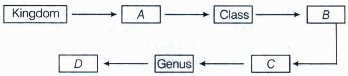
14.
George has comes on a vacation to India from US. The long journey disturbs his biological clock and he suffers from jet lag. What is the cause of his discomfort?
15.
Name the hormones secreted by α-cells and β-cells of pancreas. How is glucose homeostasis in our blood maintained by these hormones?
16.
What is acromegaly? What happens in this disorder?
17.
Name the two hormones secreted by the follicular cells of thyroid.
18.
Which hormonal deficiency is responsible for the following:
(a) Diabetes mellitus
(b) Goitre
(c) Cretinism
19.
Define species.
20.
What is biodiversity?
21.
Mention any five hormones secreted by anterior pituitary and mention their functions.
22.
List the hormones secreted by the following:
(a) Hypothalamus
(b) Pituitary
(c) Thyroid
(d) Parathyroid
(e) Adrenal
(f) Pancreas
(g) Testis
(h) Ovary
(i) Thymus
(j) Atrium
(k) Kidney
(l) G-I Tract
23.
What are the general rules for nomenclature?
24.
1.
(b)
classification
2.
(c)
Melatonin
3.
(c)
Division
4.
(b)
β-cell
5.
(b)
Decreased secretion of thymus
6.
(c)
Both (a) and (b)
7.
Genus represents a group of closely related species of plants or animals.
8.
(a) Deficiency of insulin
(i) Loss of glucose in urine.
(b) Deficiency of thyroid hormones (thyroxine) during pregnancy in the mother.
(i) Mental retardation.
(ii) Stunted growth
(c) Deficiency of growth hormone during childhood.
(i) Stunted growth.
9.
(a) The first part is the generic name and the second part is the specific name.
(b) Linn indicates Linnaeus, who had first described this species.
(c) Because they are in Latin.
10.
(i) It is a method of naming the organisms, in which every organism is given a scientific name, which has two parts (words); the first is the name of the genus (generic name) and the second part is the name of the species (specific epithet). e.g., Mangifera indica.
(ii) In this, Mangifera is the name of the genus while indica is the name of the species (specific epithet) belonging to the genus Mangifera.
11.
Characters which do not play direct role in sexual reproduction but are basically means of sexual differentiation are called secondary sexual characters. For example, facial hair and deep voice in males and thin voice in females are secondary sexual characters
12.
Phylum:
Phylum comes next to Kingdom in the taxonomical hierarchy. All broad characteristics of an animal or plant are defined in a phylum. For example, all chordates have a notochord and gill at some stage of life cycle. Similarly, all arthopods have jointed legs made of chitin.
Order:
Order further zeroes down on characteristics and includes related genera. For example, humans and monkeys belong to the order Primates. Both humans and monkeys can use their hands to manipulate objects and can walk on their hind legs.
Genus:
Comprises a group of related species which has more characters in common in comparison to species of other genera. We can say that genera are aggregates of closely related species. For example, potato, tomato and brinjal are three different species but all belong to the genus Solanum. Lion (Panthera leo), leopard (P. Pardus) and tiger (P. Tigris) with several common features, are all species of the genus Panthera. This genus differs from another genus Felis which includes cats.
Species:
Taxonomic studies consider a group of individual organisms with fundamental morphological similarities as a species. One should be able to distinguish one species from the other closely related species based on the distinct morphological differences.
13.
The category is a part of overall taxonomic arrangement called taxonomic category. All the categories together constitute the taxonomic hierarchy.
A - Phylum, B - Order, C - Family and D - Species
14.
Jet lag is caused by the disruption of the body cock as it out of synchronisation with the unfarmíliar time zone of the two different parts of the world. The body experiences differentpatterns of light and dark than it is normally used to which disrupts the natural sleep-wake cycle.
Melatonin is a hormone that plays a key role in body rhythms and jet lag. After the sun sets, the eyes perceive darkness and alert the hypothalamus to begin releasing melatonin,which promotes sleep. Conversely, when the eyes perceive sunlight, they tell the hypothalamus to with-hold melatonin production. However, the hypothalamus cannot read just its schedule instantly, it takes several days.
His sleep-wake cycle is disturbed; it is controlled by melatonin.
15.
(i) α-cells secrete glucagon; it increases the level of blood glucose by stimulating glycogenolysis and gluconeogenesis, leading to hyperglycemia.
(ii) β-cells secrete insulin; it enhances cellular uptake and utilisation of glucose and stimulates glycogenesis.
(iii) Thus, the two hormones maintain the glucose homeostasis.
16.
Acromegalyrefersto the severedisfigurement,especially of the face, due to excess secretion of growth hormone in adults.
It may lead to death, if not treated.
17.
Triiodothyronine (T3) and Tetraiodothyronine (T4) or thyroxine
18.
(a) Insulin
(b) Thyroid
(c) Thyroid
19.
Species is the lowermost taxonomic category in biological classification. Members of a species are similar in physical characteristics and are able to interbreed.
20.
The number of species of flora and fauna present in a given geographical location is called biodiversity.
21.
The hormones secreted by anterior pituitary and their functions are as follows:
(i) Growth hormone (GH)
It regulates the growth of the body; its excess secretion leads to gigantism and low secretion causes dwarfism.
(ii) Adrenocorticotropic hormone (ACTH)
It stimulates the synthesis and secretion of hormones from adrenal cortex.
(iii) Thyroid stimulatmg hormone ( TSH)
It stimulates the thyroid gland to synthesize and secrete thyroid hormones.
(iv) Follicle stimulatmg hormone (FSH)
(a) Along with the androgens, it regulates spermatogenesis in mole.
(b) In females, it stimulates the growth and development of ovarian follicles and secretion of FSH from them
(v) Luteinismg hormone (LH)
(a) In males, it acts on the Leydig cells of testes and stimulates the synthesis and secretion of androgens, mainly testosterone.
(b) In females, it stimulates ovulation, formation of corpus luteum and secretion of progesterone from it.
(vi) Prolactin (PRI )
It regulates the growth of mammary glands and formation of milk in them during pregnancy.
22.
(a) Hypothalamus - Releasing hormone and Inhibiting hormone.
(b) Pituitary - Growth hormone, Prolactin, Thyroid stimulating hormone, Adrenocorticotrophic hormone, Luteinizing hormone, Follicle stimulating hormone, Melatonin.
(c) Thyroid - Tetraiodothyronine, Triiodothyronine.
(d) Parathyroid - Parathyroid hormone.
(e) Adrenal - Adrenalin or Epinephrine, Noradrenaline or norepinephrine Corticoids.
(f) Pancreas - Glucagon, Insulin.
(g) Testis - Testosterone.
(h) Ovary - Estrogen, Progesterone.
(i) Thymus - Thymosin.
(j) Atrium - Atrial Natriuretic Factor
(k) Kidney - Erythropoietin.
(l) GI Tract - Gastrin, Secretin, Cholecystokinin (CCK)Gastric Inhibitory Peptide (GIP)
23.
General Rules for Nomenclature:
i) Biological names are generally in Latin and written in italics. They are Latinised or derived from Latin irrespective of their origin.
ii) The first word in a biological name represents the genus.
iii) The second component denotes the species.
iv) Both the words in a biological name, when handwritten, are separately underlined or printed in italics to indicate their Latin origin.
v) The first word denoting the genus starts with a capital letter while the second word denoting species starts with a small letter.
24.

11th Standard CBSE Syllabus & Materials
11th Standard CBSE
CBSE 11th Business Studies Forms of Business Organisation Sample Question Papers Study Material - QB365 Set A
NEW11th Standard CBSE
CBSE 11th Business Studies Business, Trade and Commerce Sample Question Papers Study Material - QB365 Set A
NEW11th Standard CBSE
CBSE 11th Physics Waves Sample Question Papers Study Material - QB365 Set A
NEW11th Standard CBSE
CBSE 11th Physics Kinetic Theory Sample Question Papers Study Material - QB365 Set A



NCERT Books

Syllabus

Exam Pattern

Sample Question Papers

Previous year Question Papers

Important Notes

MCQ Practice test

NCERT Exemplers

Case study Questions

Image Based Questions

Passage based Questions

HOT Questions

Value Based Questions

Model Questions Papers
NCERT ( Book Back ) Questions

Assertion and Reason
Important Questions And Answers

CBSE 11th Standard CBSE Subjects
CBSE Standards







