
 100% FREE ACCESS
11th Standard CBSE Syllabus & Materials
11th Standard CBSE
CBSE 11th Economics PART-A - Presentation of Data - New Sample Question Papers Study Material - QB365 Set A
NEW11th Standard CBSE
CBSE 11th Economics PART-A - Organisation of Data - New Sample Question Papers Study Material - QB365 Set A
NEW11th Standard CBSE
CBSE 11th Economics PART-A - Collection of Data - New Sample Question Papers Study Material - QB365 Set A
NEW11th Standard CBSE
CBSE 11th Economics PART-A - Introduction to Economics and Statistics - New Sample Question Papers Study Material - QB365 Set A
NEW11th Standard CBSE
CBSE 11th Business Studies International Trade Sample Question Papers Study Material - QB365 Set A
NEW11th Standard CBSE
CBSE 11th Business Studies Evolution and Fundamentals of Business Sample Question Papers Study Material - QB365 Set A

Published on: 30/11/2018
In this post Class 11 Biology Chapter 22 - Chemical Coordination and integration solved by Expert Teachers as per NCERT (CBSE) Book guidelines. All Chapter 22 - Chemical Coordination and integration Exercise Questions with Solutions to help you to revise complete Syllabus and Score More marks.
Get 100 percent accurate NCERT Solutions for Class 11 Biology Chapter 22 (Chemical Coordination and integration) solved by expert Biology teachers. We provide solutions for questions given in Class 11 Biology text-book as per CBSE Board guidelines from the latest NCERT book for Class 11 Biology.
NCERT Grade 11 Biology Chapter 22, Chemical Coordination and Integration are from Unit 5, Human Physiology. This chapter enlightens the statement that the neural system and the endocrine system jointly coordinate and regulate the physiological functions in the body. Endocrine system, hormones, coordination and integration of these is discussed in this chapter.
Endocrine Glands and Hormones, Human Endocrine System, The Hypothalamus, The Pituitary Gland, The Pineal Gland, Thyroid Gland, Parathyroid Gland, Thymus, Adrenal Gland, Pancreas, Testis, Ovary, Hormones of Heart, Kidney And Gastrointestinal Tract and Mechanism Of Hormone Action are the topics dealt with in this chapter.
NCERT Grade 11 Biology, Chapter 22, Chemical Coordination and Integration is a part of Unit 5, Human Physiology. Unit 5 is a combination of 7 chapters and holds a total weightage of 20% in the NEET examination and 18 marks in the final examination.
Download CBSE Class 11th Standard CBSE Biology question papers, sample papers, important questions, and previous year solved papers in PDF format. Get free study materials, NCERT solutions, and exam preparation resources for Class 11th Standard CBSE Biology
Questions + Answers key
Take MCQ Biology Test
1.
What happens in case of deficiency of antidiuretic hormone?
2.
Which hormones are secreted by the thyroid gland?
3.
old people have a weak immune system. What could be the reason?
4.
A milkman is very upset one morning as his cow refuses to give any milk. The milkman's wife gets the calf from the shed. On fondling by the calf, the cow gave sufficient milk.
Describe the role of endocrine gland and pathway associated with this response.
5.
There are many endocrine glands in human body. Name the gland, which is absent in male and the one absent in female.
6.
Name the hormone and its source, which produces change in secondary sex organs in human female to prepare for anticipated pregnancy?
7.
A patient complains of constant thirst excessive passing of urine and low blood pressure. When the doctor checked the patient's blood glucose and blood insulin level, the level were normal or slightly low The doctor diagnosed the conditions as diabetes insipidus. But he decides to measure on more hormone in patient's blood Which hormone does the doctor intend to measure?
8.
Name the hormone which can suppress immune response? What is its chemical nature?
9.
What is the role of second messenger in protein hormone action?
10.
What do you understand by the term ANF.
11.
What is acromegaly?
12.
How does parathyroid hormone influences calcium uptake in the body?
13.
Justify the name endocrine gland.
14.
Diagrammatically indicate the location of the various endocrine glands in our body.
15.
How do you justify the statement that hormones of adrenal medulla are emergency hormones?
16.
Give a detail explanation of pituitary gland
17.
Calcium plays a very important role in the formation of bones. Write about the role of endocrine glands and hormones responsible for maintaining calcium homoeostasis.
18.
Melanotrophin (MSH) : _______.
19.
Gonadotrophins (LH, FSH) : _______.
20.
Corticotrophin (ACTH) : _______.
21.
Thyrotrophin (TSH) : ______.
22.
Hypothalamic hormones : ______.
23.
Secretion of pancreas and gall bladder is influenced by which hormone?
Gastrin
Secretin
Cholecystokinin
Gastric Inhibitory Peptide
24.
What is the function of Atrial Natriuretic Factor (ANF)?
Decreased blood pressure
Increased blood pressure
Decreased heart rate
Increased heart rate
25.
The immune system becomes weak in older persons. Which of the following is a cause for this?
Increased secretion of thymus
Decreased secretion of thymus
Increased secretion of thyroid hormone
Decreased secretion of thyroid hormone
26.
Which hormone is responsible for the development of corpus luteum in the uterus?
FSH
GH
LH
MSH
27.
Deficiency of iodine causes which of the following conditions?
Hyperthyroidism
Hypothyroidism
Goitre
Both (b) and (c)
1.
Deficiency of ADH can lead to diminished ability of the kidney to conserve water leading to water loss and dehydration. This disease is known as Diabetes insipidus.
2.
Tetraiodothyronin and Triiodothyronine
3.
Thymus is degenerated in old individuals resulting in a decreased production of thymosins. Due to which the immune responses of old persons become weak.
4.
The fondling by the calf stimulates the release of oxytocin brings about contraction of the smooth muscles of the mammary glands that causes ejection of milk.
5.
The glands, which are asbsent in male are ovaries and which are absent in female are tests.
6.
Oestrogen secreted by granulosa cells of developing ovarian follicle.
7.
It is also known as hyperglycaemia hormone, and its action is opposite to that of insulin Excess of glucose in blood suppress the secretion of glucose. whereas fall in glucose level starts glucose production (since, doctor fend the slight line level of blood glucose)
8.
Cortisol is responsible for the suppression of immune response. Chemically it is a steroid.
9.
Hormones which do not enter the target cells, interact with specific receptors located on the surface of the target cell membarances and generates second messengers (e.g., cAMP) on the inner side of the plasma membrance. The second messenger, in turn, carries out all the hormonal functions.
10.
A trial wall of human heart secreates a peptide hormone called artial natriuretic factor which decreases blood pressure by dilation of the blood vessels.
11.
Excess secretion of growth hormone in adults, especially in middle age can result in severe disfigurement (especially of the face). This is called acromegaly. This can lead to serious complications and even death; if unchecked. The disease is hard to diagnose in the early stages and is frequently missed for many years, until changes in external features become noticeable
12.
Parathyroid hormone (PTH) increases the Ca2+ levels in the blood. PTH acts on bones and stimulates the process of bone resorption (dissolution/ demineralisation). PTH also stimulates reabsorption of Ca2+ by the renal tubules and increases Ca2+ absorption from the digested food. It is, thus, clear that PTH is a hypercalcemic hormone, i.e., it increases the blood Ca2+ levels. Along with TCT, it plays a significant role in calcium balance in the body
13.
Endocrine glands are tubeless glands and their secretion is directly released on the target site. Because of the absence of tubes the hormone is secreted in the gland itself hence the name endocrine gland is given for them.
14.
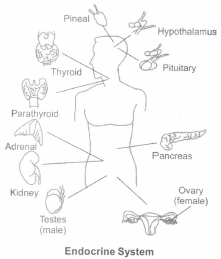
15.
Hormones of adrenal medulla, adrenaline and noradrenaline are secreted in response to any kind of stress, danger and during emergency situations like fall in blood pressure or sugar, increase respiratory rate and heartbeat. CNS at the time of stress or danger. All these conditions need more energy for their action. Thus, because these hormones prepare the body to face stress or danger hence, are called emergency hormones.
16.
The Pituitary Gland. The pituitary gland is located in a bony cavity called sella tursica and is attached to hypothalamus by a stalk. It is divided anatomically into an adenohypophysis and a neurohypophysis. Adenohypophysis consists of two portions, pars distalis and pars intermedia.
The pars distalis region of pituitary, commonly called anterior pituitary, produces following hormones.
a. Growth hormone (GH). Over-secretion of GH stimulates abnormal growth of the body leading to gigantism and low secretion of GH results in stunted growth resulting in pituitary dwarfism.
b. Prolactin (PRL). Prolactin regulates the growth of the mammary glands and formation of milk in them
c. Thyroid stimulating hormone (TSH). TSH stimulates the synthesis and secretion of thyroid hormones from the thyroid gland.
d. Adrenocorticotrophic hormone (ACTH).ACTH stimulates the synthesis and secretion of steroid hormones called glucocorticoids from the adrenal cortex.
e. Luteinizing hormone (LH). LH and FSH stimulate gonadal activity and hence are called gonadotrophins. In males, LH stimulates the synthesis and secretion of hormones called androgens from testis. In females, LH induces ovulation of fully mature follicles (graafian follicles) and maintains the corpus luteum, formed from the remnants of the graafian follicles after ovulation.
f. Follicle stimulating hormone (FSH). In males, FSH and androgens regulate spermatogenesis. FSH stimulates growth and development of the ovarian follicles in females. MSH acts on the melanocytes (melanin containing cells) and regulates pigmentation of the skin.
Pars intermedia secretes only one hormone called melanocyte stimulating hormone (MSH). However, in humans, the pars intermedia is almost merged with pars distalis.
g. Neurohypophysis (pars nervosa) also known as posterior pituitary, stores and releases two hormones called oxytocin and vasopressin, which are actually synthesised by the hypothalamus and are transported axonally to neurohypophysis. Oxytocin acts on the smooth muscles of our body and stimulates their contraction. In females, it stimulates a vigorous contraction of uterus at the time of child birth, and milk ejection from the mammary gland. Vasopressin acts mainly at the kidney and stimulates re-absorption of water and electrolytes by the distal tubules and thereby reduces loss of water through urine (diuresis). Hence, it is also called as anti-diuretic hormone (ADH).
17.
The endocrine glands and hormones that are responsible for maintaining calcium homeostasis, are thyroid and parathyroid glands and their associated hormones an calcitonin and Parathyroid Hormone (PTH).
(i) Parathyroid glands are the glands developed from the endoderm of the embryo The cells of parathyroid glands are of two types, i.e., chief cells and oxyphil cells. Thr chief cells of the parathyroid glands secrete parathyroid hormone (PTH).
This hormone (PTH) is involved in regulating calcium and phosphate balance betweer the blood and other tissue. It mobilises the release of calcium into the blood from bones. PTH increases calcium reabsorption by the body organs like intestine anc kidneys.
(ii) Thyroid gland is the largest endocrine gland located anterior to the thyroid cartilage o. the larynx in the neck. This gland plays a vital role in maintaining calcium homeostasis It releases thyroculcitonin hormone produced by the parafollicular cells, also called 'C cells.
This hormone is secreted when the calcium level in blood gets high. It is a 32 aminc acid peptide hormone that lowers the calcium level by suppressing release of catciurr ions from the bones. Thus, calcitonin has an action opposite to that of the parathyroic hormone on calcium homeostasis.

18.
()
Melanocytes
19.
()
Testis and Ovaries
20.
()
Adrenal cortex
21.
()
Thyroid Gland
22.
()
Pituitary gland
23.
(c)
Cholecystokinin
24.
25.
(b)
Decreased secretion of thymus
26.
(c)
LH
27.
(d)
Both (b) and (c)

11th Standard CBSE Syllabus & Materials
11th Standard CBSE
CBSE 11th Business Studies Forms of Business Organisation Sample Question Papers Study Material - QB365 Set A
NEW11th Standard CBSE
CBSE 11th Business Studies Business, Trade and Commerce Sample Question Papers Study Material - QB365 Set A
NEW11th Standard CBSE
CBSE 11th Physics Waves Sample Question Papers Study Material - QB365 Set A
NEW11th Standard CBSE
CBSE 11th Physics Kinetic Theory Sample Question Papers Study Material - QB365 Set A



CBSE 11th Standard CBSE Subjects
CBSE Standards









