
 100% FREE ACCESS
11th Standard Syllabus & Materials
11th Standard
TN 11th Tamil இயற்கை வேளாண்மை,சுற்றுச்சூழல் -செய்யுள் - மனோன்மணீயம் Important Questions And Answers Study Material - QB365 Set A
NEW11th Standard
TN 11th Tamil என்னுயிர் என்பேன் -துணைப்பாடம் - இசைத்தமிழர் இருவர் Important Questions And Answers Study Material - QB365 Set A
NEW11th Standard
TN 11th Tamil மொழி கலை -செய்யுள் - ஒவ்வொரு புல்லையும் Important Questions And Answers Study Material - QB365 Set A
NEW11th Standard
TN 11th Tamil பீடு பெற நில் - இலக்கணம் - பகுபத உறுப்புகள் Important Questions And Answers Study Material - QB365 Set A
NEW11th Standard
TN 11th Tamil பீடு பெற நில் - துணைப்பாடம் - வாடிவாசல் Important Questions And Answers Study Material - QB365 Set A
NEW11th Standard
TN 11th Tamil பீடு பெற நில் - செய்யுள் - குறுந்தொகை Important Questions And Answers Study Material - QB365 Set A

Published on: 13/03/2019
11th Public Exam March 2019 Important 5 Marks Questions
Download Tamil Nadu 11th Standard Business Maths and Statistics question papers, model tests, one-mark questions, important questions, and public exam papers in PDF format. Free study materials and answer keys for TN State Board students.
Questions + Answers key
Take MCQ Business Maths and Statistics Test
1.
Resolve into partial fractions for the following : \(\frac{x-2}{(x+2)(x-1)^2}\)
2.
If cosA =\(\frac{4}{5}\)and cosB =\(\frac{12}{13}\),
3.
Find the values of A, B and C if \(\frac{x}{(x-1)(x+1)^2}=\frac{A}{x-1}+\frac{B}{x+1}+\frac{C}{(x+1)^2}\)
4.
Solve by using matrix inversion method:
\(3 x-2 y+3 z=8 ; 2 x+y-z=1\)
\(4 x-3 y+2 z=4\)
5.
If \(u=tan^{-1} \left(x^2+y^2\over x+y\right)\), then using Euler's theorem, prove that \(x{∂u\over ∂x}+y{∂u\over ∂y}={1\over 2}sin2u\)
6.
For the cost function C= 2000 + 1800x - 75x2 + x3, discuss the behaviour of the marginal cost function.
7.
The relationship between Profit P and advertising cost x is given by \(P={4000x\over 500+x}-x\) . Find x which maximises P.
8.
A computer while calculating the correlation co-efficient between two variables x and y from 25 pairs of observations, obtained the following results. \(\sum\)x=125, \(\sum\)x2=650, \(\sum\)y=100, \(\sum\)y2=460, xy=508. It was later found out that it had copied down two pairs as while the correct values are
| x | y |
| 6 | 14 |
| 8 | 6 |
| x | y |
| 8 | 12 |
| 6 | 8 |
Obtain the correlation co-efficient for the correct value.
9.
Calculate the earliest start time, earliest finish time, latest start time and latest finish time of each activity of the project given below and determine the critical path of the project and duration to complete the project.
| Activity | 1-2 | 1-3 | 1-5 | 2-3 | 2-4 | 3-4 | 3-5 | 3-6 | 4-6 | 5-6 |
| Duration (in week) | 7 | 6 | 11 | 3 | 9 | 2 | 4 | 9 | 6 | 3 |
10.
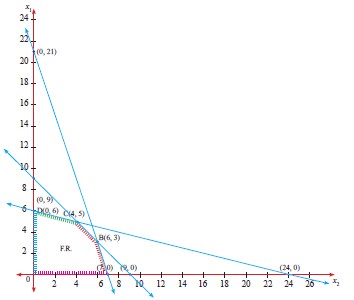
Every gram of wheat provides 0.1 g of proteins and 0.25 g of carbohydrates. The corresponding values of rice are 0.05 g and 0.5 g respectively. Wheat cost Rs.4 per kg and rice cost Rs.6 per kg. The minimum daily requirements of proteins and carbohydrate for an average child are 50 g and 200 g respectively. In what quantities should wheat and rice be mixed in the daily diet to provide minimum daily requirements of proteins and carbohydrate at minimum cost. Frame an LPP and solve it graphically.
11.
A factory has 3 machines A1, A2, A3 producing 1000, 2000, 3000 bolts per day respectively. A1 produces 1% defectives, A2 produces 1.5% and A3 produces 2% defectives. A bolt is chosen at random and found defective. What is the probability that it comes from machine A1?
12.
Reshma wishes to mix two types of food P and Q in such a way that the Vitamin contents of the mixture contain at least 8 units of vitamin A and 11 units of vitamin B. Food P costs Rs.60/kg and Food Q costs Rs.80/kg. Food P contains 3 units 1 kg of vitamin A and 5 units 1 kg of vitamin B while food Q contains 4 units 1 kg of vitamin A and 2 units 1 kg of vitamin B. Determine the minimum cost of the mixture.
13.
A man, deposits Rs.75 at the end of 6 months in a bank which pays interest at 8% compounded semiannually. How much is to his credit at the end of 10 years?
14.
Bag I contains 3 Red and 4 Black balls while another Bag II contains 5 Red and 6 Black balls. One ball is drawn at random from one of the bags and it is found to be red. Find the probability that it was drawn from Bag I.
15.
A man invests Rs. 13,500 partly in 6% of Rs. 100 shares at Rs. 140 and the remaining in 5% of Rs. 100 shares at Rs 125. If his total income is Rs. 560, how much has he invested in each?
16.
Find the equation of the regression line of Y on X, if the observations ( Xi, Yi) are the following (1, 4) (2, 8) (3, 2) ( 4, 12) (5, 10) (6, 14) (7, 16) ( 8, 6) (9, 18).
17.
Calculate the two regression equations of X on Y and Y on X from the data given below, taking deviations from a actual means of X and Y.
| Price (Rs) | 10 | 12 | 13 | 12 | 16 | 15 |
| Amount demanded | 40 | 38 | 43 | 45 | 37 | 43 |
Estimate the likely demand when the price is Rs.20.
18.
Let u = log\(\frac { { x }^{ 4 }+{ y }^{ 4 } }{ x+y } \). By using Euler’s theorem show that \(x.\frac { \partial u }{ \partial x } +y.\frac { \partial u }{ \partial y } =3\) .
19.
The following table use the activities in a construction projects and relevant information.
| Activity | 1-2 | 1-3 | 2-3 | 2-4 | 3-4 | 4-5 |
| Duration (in days) | 22 | 27 | 12 | 14 | 6 | 12 |
Draw the network for the project, calculate the earliest start time, earliest finish time, latest start time and latest finish time of each activity and find the critical path. Compute the project duration.
20.
Find the extremum values of the function f(x) = 2x3 + 3x2 – 12x.
21.
22.
Verify the relationship of elasticity of demand, average revenue and marginal revenue for the demand law p = 50 - 3x.
23.
Prove that cos 6x = 32 cos6x - 48 cos4x + 18 cos2x - 1.
24.
Prove that \(\frac { 4tan\ x(1-{ tan }^{ 2 }x) }{ 1-6{ tan }^{ 2 } x+{ tan }^{ 4 } x } =tanx\)
25.
If \(y={ e }^{ a\cos ^{ -1 }{ x } }\) , show that \(\left( 1-{ x }^{ 2 } \right) \frac { { d }^{ 2 }y }{ { dx }^{ 2 } } -x\frac { dy }{ dx } -{ a }^{ 2 }y=0\)
26.
Evaluate \(\begin{matrix} \underset { x\rightarrow 1 }{ lim } & \frac { { x }^{ 7 }-2{ x }^{ 5 }+1 }{ { x }^{ 3 }-{ 3x }^{ 2 }+2 } \end{matrix}\)
27.
Using binomial theorem, find the value of \({ \left( \sqrt { 2 } +1 \right) }^{ 5 }+{ \left( \sqrt { 2 } -1 \right) }^{ 5 }\)
28.
Resolve into partial fractions : \(\frac { { x }^{ 2 }+x+1 }{ { x }^{ 2 }+2x+1 } \)
29.
Prove that \(\frac { \sin { \left( { 180 }^{ o }+A \right) \cos { \left( { 90 }^{ o }-A \right) \tan { \left( { 270 }^{ o }-A \right) } } } \quad \quad }{ \sec { \left( { 540 }^{ o }-A \right) \cos { \left( { 360 }^{ o }+A \right) \ cosec { \left( { 270 }^{ o }+A \right) } } } } =-\sin { A } \cos ^{ 2 }{ A } \)
30.
By the principle of mathematical induction, prove the following.
1.2 + 2.3 + 3.4 + ..... + n(n + 1) = \(\frac { n(n+1)(n+2) }{ 3 } \), for all \(n\in N\).
31.
The sum of three numbers is 20. If we multiply the first by 2 and add the second number and subtract the third we get 23. If we multiply the first by 3 and add second and third to it, we get 46. By using matrix inversion method find the numbers.
32.
Show that the matrices A =\(\left[ \begin{matrix} 2 & 2 & 1 \\ 1 & 3 & 1 \\ 1 & 2 & 2 \end{matrix} \right] \)and B =\(\left[ \begin{matrix} \frac { 4 }{ 5 } & -\frac { 2 }{ 5 } & -\frac { 1 }{ 5 } \\ -\frac { 1 }{ 5 } & \frac { 3 }{ 5 } & -\frac { 1 }{ 5 } \\ -\frac { 1 }{ 5 } & -\frac { 2 }{ 5 } & \frac { 4 }{ 5 } \end{matrix} \right] \) are inverses of each other.
33.
Solve by matrix inversion method: 3x - y + 2z = 13 ; 2x + y - z = 3 ; x + 3y - 5z = - 8.
34.
If \(A=\left[ \begin{matrix} 1 & tan\quad x \\ -tan\quad x & \quad \quad \quad 1 \end{matrix} \right] \), then show that ATA-1 = \(\left[ \begin{matrix} cos\quad 2x & -sin2x \\ sin\quad 2x & cos2x \end{matrix} \right] .\)
35.
Without expanding show that \(\Delta =\left| \begin{matrix} { cosec }^{ 2 }\theta & { cot }^{ 2 }\theta & 1 \\ { cot }^{ 2 }\theta & { cosec }^{ 2 }\theta & -1 \\ 42 & 40 & 2 \end{matrix} \right| =0\)
36.
Show that the equation 12x2 - 10xy + 2y2 + 14x - 5y + 2 = 0 represents a pair of straight lines and also find the separate equations of the straight lines.
37.
Solve by using matrix inversion method: x - y + z = 2; 2x - y = 0 , 2y - z = 1.
38.
39.
If A = \(\begin{bmatrix}1 & 1 & 1 \\ 3 & 4 & 7\\1 & -1 & 1 \end{bmatrix}\) verify that A ( adj A ) = ( adj A ) A = |A| I3.
40.
Evaluate:\(\begin{vmatrix} 1&a&a^2-bc\\1&b&b^2-ca\\1&c&c^2-ab \end{vmatrix}\)
41.
Evaluate the left hand and right hand limits of the function \(f(x)=\left\{\begin{aligned} \frac{|x-3|}{x-3} & \text { if } x \neq 3 \\ 0 & \text { if } x=3 \end{aligned} \right.\) at x = 3.
42.
Show that the given lines 3x - 4y - 13 = 0, 8x - 11y = 33 and 2x - 3y - 7 = 0 are concurrent and find the concurrent point.
43.
Find adjoint of \(A=\left[ \begin{matrix} 1 & -2 & -3 \\ 0 & 1 & 0 \\ -4 & 1 & 0 \end{matrix} \right] \)
44.
Compute coefficient of quartile deviation from the following data
| Marks | 10 | 20 | 30 | 40 | 50 | 60 |
| No. of Students | 4 | 7 | 15 | 8 | 7 | 2 |
45.
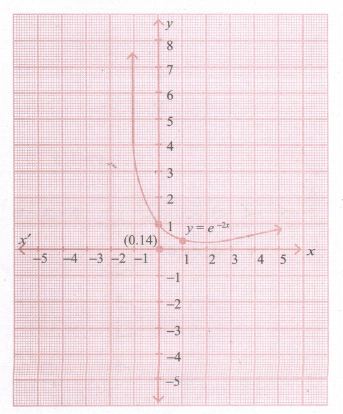
Draw the graph of the following function f(x) = e-2x
1.
\({{x-2}\over{(x+2){(x-1)}^{2}}}={{A}\over{x+2}}+{{B}\over{x-1}}+{{C}\over{{(x-1)}^{2}}}\)
\(\frac{x-2}{(x+2)(x-1)^2}=\frac{A(x-1)^2+B(x+2)(x-1)+C(x+2)}{(x+2)(x-1)^2}\)
x - 2 = A(x - 1)2+ B(x + 2)(x - 1)+ C(x + 2) ..(1)
x = -2 in (1) we get,
-2 - 2 = A (-3)2 \(\Rightarrow\) - 4 = 9 A \(\Rightarrow\) A = \({{-4}\over{9}}\)
x = 1 in (1) we get,
1- 2 = C(1 + 2) \(\Rightarrow\) -1 = 3C \(\Rightarrow\) C = \({{-1}\over{3}}\)
Equate coefficient of x2 on both sides of (1)
0 = A + B
\(B=-A=\frac{4}{9}\)
\(\therefore\) \({{x-2}\over{(x+1){(x-1)}^{2}}}-{{-{{4}\over{9}}}\over{x+2}}+{{{{4}\over{9}}}\over{x-1}}+{{-{{1}\over{3}}}\over{{(x-1)}^{2}}}+{{-4}\over{9(x+2)}}+{{4}\over{9(x-1)}}-{{1}\over{3{(x+1)}^{2}}}\)
2.
Since \(\cfrac { 3\pi }{ 2 } <\left( A,B \right) <2\pi \) ,both A and B lie in the fourth quadrant,
\(\therefore \) sinA and sinB are negative
Given \(\cos A=\frac{4}{5} \text { and } \cos B=\frac{12}{13}\)
Therefore, \(\sin A=-\sqrt{1-\cos ^2 A}\)
\(=-\sqrt{1-\frac{16}{25}}\)
\(=-\sqrt{\frac{25-16}{25}}\)
\(=-\frac{3}{5}\)
\(\operatorname{Sin} \mathrm{B}=-\sqrt{1-\cos ^2 B}\)
\(=-\sqrt{1-\frac{144}{169}}\)
\(=-\sqrt{\frac{169-144}{169}}\)
\(=-\frac{5}{13}\)
\( \cos (A+B)= \cos A \cos B- \sin A \sin B \)
\(=\frac{4}{5} \times \frac{12}{13}-\left(\frac{-3}{5}\right) \times\left(\frac{-5}{13}\right)\)
\(=\frac{48}{65}-\frac{15}{65}=\frac{33}{65}\)
3.
\(\frac{x}{(x-1)(x+1)^2}=\frac{A}{x-1}+\frac{B}{x+1}+\frac{C}{(x+1)^2}\)
x = A(x + 1)2 + B(x - 1)(x + 1) + C(x - 1) ... (1)
Put x = 1 in (1)
\(1=A{ (1+1) }^{ 2 }+B(0)+C(0)\)
\(\therefore \ A=\frac { 1 }{ 4 } \)
Put x = –1 in (1)
-1 = A(0) + B(0) + C(-1-1)
\(\therefore C=\frac { 1 }{ 2 } \)
Equating the constant term on both sides of (1),we get
A - B - C = 0
\(\Rightarrow B=A-C\)
\(\therefore B=-\frac { 1 }{ 4 } \)
4.
The given system can be written as
\(\left[ \begin{matrix} 3 & -2 & 3 \\ 2 & 1 & -1 \\ 4 & -3 & 2 \end{matrix} \right] \left[ \begin{matrix} x \\ y \\ z \end{matrix} \right] =\left[ \begin{matrix} 8 \\ 1 \\ 4 \end{matrix} \right] \)
i.e., AX = B
X = A–1B
Here \(A=\left[ \begin{matrix} 3 & -2 & 3 \\ 2 & 1 & -1 \\ 4 & -3 & 2 \end{matrix} \right] ,X=\left[ \begin{matrix} x \\ y \\ z \end{matrix} \right] \)and \( B=\left[ \begin{matrix} 8 \\ 1 \\ 4 \end{matrix} \right] \)
\(|A|=\left[ \begin{matrix} 3 & -2 & 3 \\ 2 & 1 & -1 \\ 4 & -3 & 2 \end{matrix} \right] \)
= -17 ≠ 0
A–1 exists
A11 = –1 A12 = –8 A13 = –10
A21 = –5 A22 = –6 A23 = 1
A31 = –1 A32 = 9 A33 = 7
\(|A_{ij}|=\left[ \begin{matrix} -1 & -8 & -10 \\ -5 & -6 & 1 \\ -1 & 9 & 7 \end{matrix} \right] \)
adj A = [Aij]T
\(=\left[ \begin{matrix} -1 & -5 & -1 \\ -8 & -6 & 9 \\ -10 & 1 & 7 \end{matrix} \right] \)
A–1 = \(\frac{1}{|A|}adjA\)
\(=-\frac{1}{17}\left[ \begin{matrix} -1 & -5 & -1 \\ -8 & -6 & 9 \\ -10 & 1 & 7 \end{matrix} \right] \)
X = A-1B
\(=-\frac{1}{17}\left[ \begin{matrix} -1 & -5 & -1 \\ -8 & -6 & 9 \\ -10 & 1 & 7 \end{matrix} \right] \)\(\left[ \begin{matrix} 8 \\ 1 \\ 4 \end{matrix} \right] \)
\(=-\frac{1}{17}\left[ \begin{matrix} -17 \\ -34 \\ -51 \end{matrix} \right] =\left[ \begin{matrix} 1 \\ 2 \\3 \end{matrix} \right] \)
\(\left[ \begin{matrix}x\\ y \\ z \end{matrix} \right] =\left[ \begin{matrix} 1 \\ 2 \\ 3 \end{matrix} \right] \)
x = 1, y = 2 and z = 3.
5.
Given \(u=tan^{-1}, \left(x^2+y^2\over x+y\right)\)
\(⇒\ tan\ u={x^2+y^2\over x+y}\)
Let f= tan u = \(x^2+y^2\over x+y\)
\(f(tx, ty)={(tx)^2+(ty)^2\over tx+ty}={t^2(x^2+y^2)\over t(x+y)}=t\left(x^2+y^2\over x+y\right)=t^1f(x,y)\)
∴ f is a homogeneous function of degree 1.
By Euler's theorem
\(x{∂f\over ∂x}+y{∂f\over ∂y}=nf\)
\(⇒\ x{∂f\over ∂x}+y{∂f\over ∂y}=1f\)
\(⇒x.{∂\over ∂ x}(tan\ u)+y.{∂\over ∂y}(tan\ u)=tan\ u\)
\(⇒\ x.sec^2u.{∂u\over ∂x}+y.sec^2u.{∂u\over ∂y}=tan\ u\)
Dividing throughout by sec2u we get,
\(x.{∂u\over ∂x}+y.{∂u\over ∂y}={tan\ u\over sec^2u}={sinu\over cosu}/{1\over cos^2u}={sinu\over cosu}\times cos^2u=sinu\ cosu\)
\(={2sinu\ cosu\over 2}={1\over 2}sin2u\) [∵ sin2x=2sinx cosx]
\(x.{∂u\over ∂ x}+y.{∂u\over ∂y}={1\over 2}sin 2u\)
Hence Proved.
6.
Given C= 2000 + 1800x - 75x2 + x3
\(MC={dC\over dx}={d\over dx}( C = 2000 + 1800x - 75x^2 + x^3)=1800-150x+3x^2\)
Let y = 3x2 - 150x+ 1800
Differentiating w.r.t 'x' we get,
\({dy\over dx}=6x-150\)
\({dy\over dx}=0⇒6x-150 = 0\)
⇒ x=25
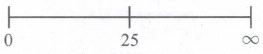
| Intervals | Sign of \({dy\over dx}\) | Nature of Function |
|---|---|---|
| (0,25) say x =1 | 6(1) - 150 = -144 (Negative) | Decreasing function |
| (25, ∞) say x = 30 | 6(30) - 150 = 30 (Positive) | Increasing function |
Hence, marginal cost function is decreasing in (0, 25) and increasing in (25, ∞).
7.
Given \(P={4000x\over 500+x}-x\)
Differentiating w.r.t. 'x' we get
\(\frac { dp }{ dx } =\frac { { (500+x)(4000)-(4000x)(1) } }{ (50+x)^{ 2 } } -1\)
\(={4000(500+x-x)\over (500+x)^2}-1={2000000\over(500+x)^2}-1\)
Profit is maximum when \({dP\over dx}=0\) and \({d^2P\over dx}<0\)
\({dP\over dx}=0⇒{2000000\over (500+x)^2}-1=0\)
\(⇒{2000000\over (500+x)^2}=1⇒(500+x)^2=2000000\)
\(⇒500+x=1000\times\sqrt2=1000\times1.414\)
⇒ x = 1414 - 500 = 914
Also \({d^2P\over dx^2} = -{4000000\over (500+x)^3}\)
When x = 914 \({d^2P\over dx^2}<0\)
∴ Profit is maximum, when x = 914
8.
We will find the correct values of \(\sum\)x, \(\sum\)x2, \(\sum\)y2, and \(\sum\)xy by delecting the old values and adding new ones.
\(\therefore\)\(\sum\)x=125-(6+8)+(6+8)=125
\(\sum\)y=100-(14+6)+(12+8)=100
x2=650-(62+82)+(82+62)=650
y2=460-(142+62)+(122+82)=436
and xy =508-(14x6+8x6)+(12x8+6x8)=520
\(\therefore\) Correlation Co-efficient
r(x,y)=\(\frac { N\sum { xy } -(\sum { x } )(\sum { y } ) }{ \sqrt { N{ \sum { x } }^{ 2 }-{ (\sum { x } ) }^{ 2 } } \sqrt { N{ \sum { y } }^{ 2 }-{ (\sum { y } ) }^{ 2 } } } \)
\(\Rightarrow\)\(\frac { 25(520)-125(100) }{ \sqrt { 25(650)-{ (125) }^{ 2 } } \sqrt { 25(436)-{ (100) }^{ 2 } } } \)
\(\Rightarrow\) r(x,y)=0.66
9.
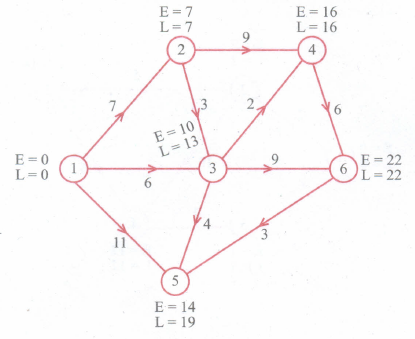
| E1 =0 | L6 =22 |
| E2 = 0+7=7 | L5 =(22 - 3) = 19 |
| E3 =(7 + 3) or (0 + 6) Whichever is maximum = 0 |
L4 =22 - 6 = 16 . |
| E4 =(7 + 9) or (10 + 2) Whichever is maximum=16 |
L3 =(22 - 9) or (16 - 8) Whichever is minimum=13 |
| E5 =(0+ 11)or(10+4) Whichever is maximum=14 |
L2 =16 - 9 = 7 |
| E6 =(16 + 6) or (10 + 9) or (14 + 3) Whichever is maximum = 22 |
L1 =7-7=0 |
| Activity | Duration | EST | EFT=EST+tij | LST | LFT |
|---|---|---|---|---|---|
| 1-2 | 7 | 0 | 7 | 7-7=0 | 7 |
| 1-3 | 6 | 0 | 6 | 13-6=7 | 13 |
| 1-5 | 11 | 0 | 11 | 19-11=8 | 19 |
| 2-3 | 3 | 7 | 10 | 13-3=10 | 13 |
| 2-4 | 9 | 7 | 16 | 16-9=7 | 16 |
| 3-4 | 2 | 13 | 15 | 19-4=15 | 16 |
| 3-5 | 4 | 13 | 17 | 19-4=15 | 19 |
| 3-6 | 9 | 10 | 19 | 22-9=13 | 22 |
| 4-6 | 6 | 16 | 22 | 22-6=16 | 22 |
| 5-6 | 3 | 14 | 17 | 22-3=19 | 22 |
EFT and LFT are same in the activity, 1 - 2, 2 - 4 and 4 - 6.
Hence the critical path is 1 - 2 - 4 - 6 and the project completion time is 22 Weeks.
10.
Let x1 g of wheat and x2 g of rice be mixed in the daily diet. Let Z be the minimum cost of diet.
| Proteins | Carbohydrates | Cost | |
|---|---|---|---|
| 1 g of Wheat | 0.1 g | 0.25 g | Rs.4/kg |
| 1 g of Rice | 0.05 g | 0.5 g | Rs.6/kg |
| Minimum Requirement |
50 g | 200 g |
Thus, the mathematical formulation of the LPP
Minimize \(Z=\frac { 4{ x }_{ 1 } }{ 1000 } +\frac { 6{ x }_{ 2 } }{ 1000 } \quad \Rightarrow \quad Z=\frac { { x }_{ 1 } }{ 250 } +\frac { 3{ x }_{ 2 } }{ 500 } \)
Subject to the constraints
\(0.1{ x }_{ 1 }+0.05{ x }_{ 2}\ge 50 \Rightarrow 2{ x }_{ 1 }+{ x }_{ 2 }\ge 1000\)
\( 0.25{ x }_{ 1 }+0.5{ x }_{ 2\quad }\ge 200 \Rightarrow { x }_{ 1 }+2{ x }_{ 2 }\ge 800\)
\(and\ { x }_{ 1 },{ x }_{ 2 }\ge 0\)
Consider the equation
\(2{ x }_{ 1 }+{ x }_{ 2 }= 1000\)
| \({ x }_{ 1 }\) | 0 | 500 |
| \({ x }_{ 2 }\) | 1000 | 0 |
\({ x }_{ 1 }+2{ x }_{ 2 }= 800\)
| \({ x }_{ 1 }\) | 0 | 500 |
| \({ x }_{ 2 }\) | 1000 | 0 |
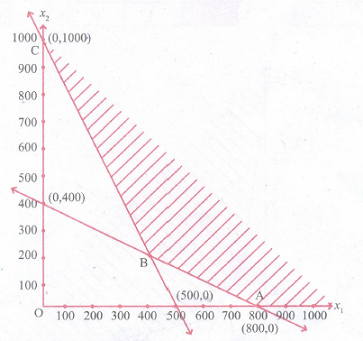
The feasible region is ABC an its co-ordinates are A(800, 0), C(0, 1000) and B is the point of intersection of the lines 2x1+ x2 = 1000 ... (1) x1+ 2x2 = 800 ... (2)
Verification of B:
\(\Rightarrow (1)\times 2 4{ x }_{ 1 }+2{ x }_{ 2 }=2000\)
\(\quad (-)\quad (-)\quad \quad (-)\)
\(\Rightarrow (2) 15{ x }_{ 1 }+6{ x }_{ 2 }=30 \Rightarrow { x }_{ 1 }=400\)
\(--------------\)
Substracting, \(3{ x }_{ 1 }=2000\)
From (2), \(\quad 400+2{ x }_{ 2 }=800\)
\(2{ x }_{ 2 }=400\quad \Rightarrow \quad { x }_{ 2 }=200\)
| Corner Points | \( Z=\frac { { x }_{ 1 } }{ 250 } +\frac { 3{ x }_{ 2 } }{ 500 } \) |
|---|---|
| A(800,0) | \(\frac { 800 }{ 250 } =3.2\) |
| B(400, 200) | \(\frac { 400 }{ 250 } +\frac { 600 }{ 500 } =2.8\) |
| C(0,1000) | \(\frac { 3000 }{ 500 } =6\) |
Minimum of Z occurs at B(400, 200). Hence, the solution is x1= 400, x2 = 200 and Zrnin = 2.8
11.
Total Number of bolts produced = 1000 + 2000 + 3000 = 6000
\(P({ A }_{ 1 })=\frac { 1000 }{ 6000 } =\frac { 1 }{ 6 } \)
\(P({ A }_{ 2 })=\frac { 2000 }{ 6000 } =\frac { 1 }{ 3 } \)
\(P({ A }_{ 3 })=\frac { 3000 }{ 6000 } =\frac { 1 }{ 2 } \)
Let B be the event of selecting defective bolts.
\(\therefore \) P(B/A1) = 1% = \(\frac { 1 }{ 100 } \) = 0.01
P(B/A2) = 1.5% = 0.015
and (P(B/A3) = 2% = 0.02
\(\therefore P(A_{ 1 }/B)=\frac { P({ A }_{ 1 }).P\left( B/{ A }_{ 1 } \right) }{ P({ A }_{ 1 }).P(B/{ A }_{ 1 })+P({ A }_{ 2 }).P\left( B/{ A }_{ 2 } \right) +P({ A }_{ 3 }).P\left( B/{ A }_{ 3 } \right) } \)
\(=\frac { \frac { 1 }{ 6 } \times 0.01 }{ \frac { 1 }{ 6 } \times 0.01+\frac { 1 }{ 3 } \times 0.015+\frac { 1 }{ 2 } \times 0.02 } =\frac { 1 }{ 600 } \times 60=\frac { 1 }{ 10 } \)
\(\therefore P(A_{ 1 }/B)=0.1\)
12.
Let Reshma mix x1 kg of food P and x2 kg of food Q to make the mixture.
Let Z be the total cost of mixture
| Food P | Food Q | Minimum requirement | |
|---|---|---|---|
| Vitamin A | 3 | 4 | 8 |
| Vitamin B | 5 | 2 | 11 |
| Cost | Rs.60 | Rs.80 |
Thus, the mathematical formation of the given LPP is minimize Z = 60x1+ 80x2
Subject to the constraints
\(3{ x }_{ 1 }+4{ x }_{ 2 }\ge 8\quad 5{ x }_{ 1 }+2{ x }_{ 2 }\ge 11\quad and\quad { x }_{ 1 },{ x }_{ 2 }\ge 0\)
Consider the equations
\(3{ x }_{ 1 }+4{ x }_{ 2 }=8\)
| \({ x }_{ 1 }\) | 0 | 8/3 |
| \({ x }_{ 2 }\) | 2 | 0 |
\(5{ x }_{ 1 }+2{ x }_{ 2 }=11\)
| \({ x }_{ 1 }\) | 0 | 8/3 |
| \({ x }_{ 2 }\) | 2 | 0 |
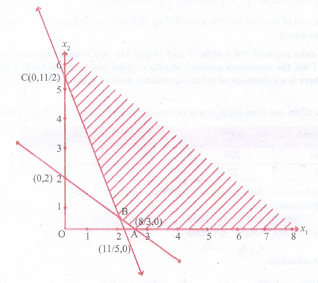
The feasible region is ABC and its co-ordinates are A\(\left( \frac { 8 }{ 3 } ,0 \right) \), C\(\left( 0,\ \frac { \pi }{ 2 } \right) \)and B is the point of intersection of the lines 3x1 + 4x2 = 8 ..... (1) and 5x1 + 2x2 = 11 .... (2)
Verification of B:
\((1) \Rightarrow 3{ x }_{ 1 }+4{ x }_{ 2 }=8\)
\( (-)\quad (-)\quad \quad (-)\)
\((2)\times 2\Rightarrow 10{ x }_{ 1 }+4{ x }_{ 2 }=22\)
\(--------------\)
\( -7x_{ 1 }=-14 \Rightarrow { x }_{ 1 }=2\)
\(From(1), 3(2)+4{ x }_{ 2 }=8\)
\(4{ x }_{ 2 }=8-6=2\Rightarrow { x }_{ 2 }=\frac { 1 }{ 2 } \)
\( \therefore \ B\ is\ \left( 2,\frac { 1 }{ 2 } \right) \)
| Corner Points | Z = 60x1+ 80x2 |
|---|---|
| A(8/3,0) | \(60\times \frac { 8 }{ 3 } =160\) |
| B (2, 1/2) | \(120+80\times \frac { 1 }{ 2 } =160\) |
| C(0,11/2) | \(80\times \frac { 11 }{ 2 } =440\) |
Minimum of Z occurs at \(A\left( \frac { 8 }{ 3 } ,0 \right) and\quad B\left( 2,\frac { 1 }{ 2 } \right) \)
Hence, least cost of mixture is n60 when 8/3 kg of food P and 0 kg of food Q and 2 kg of food P and 112kg of food Q are mixed
13.
Given a = Rs.75, i=\(\cfrac { 8 }{ 12 } \)% = 4% = 0.004,n = 10 X 2 =20
A = \(\cfrac { a }{ i } \left[ \left( 1+i \right) ^{ n }-1 \right] \)
=\(\cfrac { 75 }{ 0.04 } \) [(1.04)20-1]
=1875 (2.1878-1)
= 1875(1.878)
= Rs.2227
(1.04)40 = 20 log (1.04)
= 20(0.0170)
= 0.34
Antilog of 0.34 is 2.1878
14.
Let E1, E2 and A be defined as
E1 = First bag is drawn
E2 = Second bag is drawn
A = Red ball is drawn
\(\therefore\) P(E1) = P(E2) = \(\frac{1}{2}\)
P(A/E1) = \(\frac{3}{7}\), P(A/E2) = \(\frac{5}{11}\)
By Baye's theorem,
\(P({ E }_{ 1 }/A)=\frac { P({ E }_{ 1 })P(A/{ E }_{ 1 }) }{ P({ E }_{ 1 })P(A/{ E }_{ 1 })+P({ E }_{ 2 })P(A/{ E }_{ 2 }) } \)
\(=\frac { 1/2\times 3/7 }{ 1/2\times 3/7+1/2\times 5/11 } \)
\(=\frac { 3/7 }{ 3/7+5/11 } =\frac { 3/7 }{ \frac { 33+35 }{ 77 } } =\frac { 3}{7 }\times \frac { 77 }{ 68 } =\frac { 33 }{ 68 } \)
15.
Let investment in 6% stock be x
\(\therefore\) Investment in 5% stock = 13,500 - x.
At 6% stock
If Investment = 140, Income = 6
If Investment = x, Income \(=\frac { 6x }{ 140 }=\frac { 3x }{ 70 } \)
At 5% stock
If Investment = 125, Income = 5
If Investment = 13,500 - x,
Income = \(\frac { 5(13,500-x )}{ 125 } \)
\(=\frac { 13,500 -x}{ 25 } =540-\frac { x }{ 25 } \)
Total income = 560
\( \frac { 3x }{ 70 } +540-\frac { x }{ 25 } =560\)
\(\frac { 3x }{ 70 } -\frac { x }{ 25 } =20\)
\(\frac { 15x-14x }{ 350 } =20\)
x = 350 x 20 = Rs. 7000
\(\therefore\) Amount invested in 6% stock = Rs. 7000
Amount invested in 5% stock = 13500 - 7000
= Rs. 6500
16.
| X | Y | X2 | Y2 | XY |
|---|---|---|---|---|
| 1 | 4 | 1 | 16 | 4 |
| 2 | 8 | 4 | 64 | 16 |
| 3 | 2 | 9 | 4 | 6 |
| 4 | 12 | 16 | 144 | 48 |
| 5 | 10 | 25 | 100 | 50 |
| 6 | 14 | 36 | 196 | 84 |
| 7 | 16 | 49 | 256 | 112 |
| 8 | 6 | 64 | 36 | 48 |
| 9 | 18 | 81 | 324 | 162 |
| \(\Sigma X\) = 45 | \(\Sigma Y\) = 90 | \(\Sigma X^2\) = 285 | \(\Sigma Y^2\) = 1140 | \(\Sigma XY\) = 530 |
\(\bar{X} =\frac{45}{9}=5 \quad \bar{Y}=\frac{90}{9}=10 \)
\(b_{y x} =\frac{N \Sigma X Y-\Sigma X \Sigma Y}{N \Sigma X^2-(\Sigma X)^2} \)
\(=\frac{9(530)-4050}{9(285)-2025}=\frac{720}{540}=1.33\)
Regression equation of Y on X
\(Y-\overset{-}{Y}=b_{yx}(X-\overset{-}{X})\)
Y - 10 = 1.33(X - 5)
Y = 1.33X - 6.65 + 10
Y = 1.33X + 3.35
17.
Calculation of Regression equation
| X | x = (X-13) | x2 | Y | y = (Y-41) | y2 | xy |
| 10 | -3 | 9 | 40 | -1 | 1 | 3 |
| 12 | -1 | 1 | 38 | -3 | 9 | 3 |
| 13 | 0 | 0 | 43 | 2 | 4 | 0 |
| 12 | -1 | 1 | 45 | 4 | 16 | -4 |
| 16 | 3 | 9 | 37 | -4 | 16 | -12 |
| 15 | 2 | 4 | 43 | 2 | 4 | 4 |
| ΣX = 78 | Σx = 0 | Σx2 = 24 | ΣY = 246 | Σy = 0 | Σy2 = 50 | Σxy = -6 |
(i) Regression equation of X on Y
\(X-\bar { X } =r\frac { { \sigma }_{ x } }{ { \sigma }_{ y } } (Y-\bar { Y } )\)
\(\bar { x } =\frac { 78 }{ 6 } \)=13, \(\bar { Y } =\frac { 246 }{ 6 } \) = 41
bxy = \(r\frac { { \sigma }_{ x } }{ { \sigma }_{ y } } =\frac { \Sigma xy }{ \Sigma { y }^{ 2 } } =\frac { -6 }{ 50 } \) = -0.12
X–13 = –0.12 (Y–41 )
X–13 = –0.12Y + 4.92
X = –0.12Y + 17.92
(ii) Regression Equation of Y on X
\(Y-\bar { Y } =r\frac { { \sigma }_{ y } }{ { \sigma }_{ x } } (X-\bar { X } )\)
byx = \(r\frac { { \sigma }_{ y } }{ { \sigma }_{ x } } =\frac { \Sigma xy }{ \Sigma x^{ 2 } } =-\frac { 6 }{ 24 } \) = -0.25
Y–41 = –0.25 (X–13 )
Y–41 = –0.25 X + 3.25
Y = –0.25 X + 44.25
When X is 20, Y will be
Y = –0.25 (20)+44.25
= –5 + 44.25
= 39.25 (when the price is Rs. 20, the likely demand is 39.25)
18.
u = log\(\frac { { x }^{ 4 }+{ y }^{ 4 } }{ x+y } \)
eu = \(\frac { { x }^{ 4 }+{ y }^{ 4 } }{ x+y } \) = f(x, y) ... (1)
Consider f(x, y) = \(\frac { { x }^{ 4 }+{ y }^{ 4 } }{ x+y } \)
f(tx, ty) = \(\frac { { t }^{ 4 }{ x }^{ 4 }+{ t }^{ 4 }{ y }^{ 4 } }{ tx+ty } ={ t }^{ 3 }\left( \frac { { x }^{ 4 }+{ y }^{ 4 } }{ x+y } \right) ={ t }^{ 3 }f(x,y)\)
\(\therefore\) f is a homogeneous function of degree 3.
Using Euler’s theorem we get
\(x.\frac { \partial u }{ \partial u } +y.\frac { \partial u }{ \partial y } =3f\)
Consider f(x, y) = eu
\(x.\frac { \partial u }{ \partial u } +y.\frac { \partial u }{ \partial y } =3e\)u
\(∴ { e }^{ u }x.\frac { \partial u }{ \partial u } +{ e }^{ u }y.\frac { \partial u }{ \partial y } =3{ e }^{ u }\)
\(x.\frac { \partial u }{ \partial u } +y.\frac { \partial u }{ \partial y } =3\)
19.
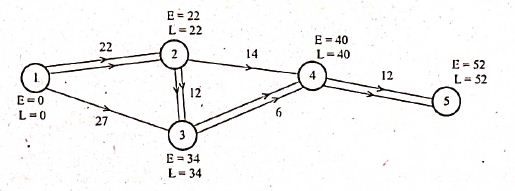
| E1 = 0 | L5 = 32 |
| E2 = 22 + 0 = 22 | L4 = 52 - 12 = 40 |
| E3 = max of {0 + 27, 22 + 12} = 34 | L3 = (40 - 6) = 34 |
| E4 = max of {22 + 14, 34 + 6} = 40 | L2 = min of {34 - 12, 40 14} = 22 |
| E5 = 40 + 12 = 52 | L1 = 0 |
| Activity | Duration tij | EST | EFT = EST + tij | LST = LFT - tij | LFT |
|---|---|---|---|---|---|
| 1 -2 | 22 | 0 | 22 | 22 - 22 = 0 | 22 |
| 1 - 3 | 27 | 0 | 27 | 34 -27 = 7 | 34 |
| 2 - 3 | 12 | 22 | 34 | 34 - 12 = 22 | 34 |
| 2 - 4 | 14 | 22 | 36 | 40 - 14 = 26 | 40 |
| 3 - 4 | 6 | 34 | 40 | 40 - 6 = 34 | 40 |
| 4 -5 | 12 | 40 | 52 | 52 - 12 = 40 | 52 |
\(\because \) EFT and LFT are same in 1 - 2, 2 - 3, 3 - 4 and 4 - 5. the Critical path 1-2-3-4-5 and duration time taken is 52 days.
20.
Given f(x) = 2x3 + 3x2 – 12x … (1)
f'(x) = 6x2 + 6x – 12
f"(x) = 12x + 6
f'(x) = 0 \(\Rightarrow\)6x2 + 6x – 12 = 0
\(\Rightarrow\) 6(x2 + x – 2) = 0
\(\Rightarrow\) 6(x + 2)(x – 1) = 0
\(\Rightarrow\) x = –2 ; x = 1
When x = –2, f''(–2) = 12(–2) + 6 = –18 < 0
\(\therefore\) f(x) attains local maximum at x = – 2 and local maximum value is obtained from (1) by substituting the value x = – 2
f(–2) = 2 (–2)3 + 3(–2)2 – 12(–2)
= –16 + 12 + 24 = 20.
When x = 1, f"(1) = 12(1) + 6 = 18.
f(x) attains local minimum at x = 1 and the local minimum value is obtained by substituting x = 1 in (1).
f(1) = 2(1) + 3(1) – 12 (1) = –7
Extremum values are – 7 and 20.
21.
22.
p = 50 – 3x
\({dp\over dx}=-3\) ⇒ \({dx\over dp}=-{1\over 3}\)
Elasticity of demand: \(η_d=-{p\over x}.{dx\over dp}\)
\(=-{50-3x\over x}\left(-{1\over3}\right)\)\(={50-3x\over 3x}\ \ ...(1)\)
Now, Revenue: R = px
= (50 - 3x)x = 50x - 3x2
Average revenue: AR = p = 50 - 3x
Marginal revenue: \(MR={dR\over dx} = 50 - 6x\)
\({AR\over AR-MR}={50-3x\over (50-3x)-(50-6x)}\)
\(={50-3x\over 3x}\ \ ...(2)\)
From (1) and (2), we get
\(η_d={AR\over AR-MR}\), Hence verified.
23.
LHS = cos 6x
= cos 3(2x) = 4 cos32x- 3cos2x [∴ cos 3\(\theta\) = 4 cos3\(\theta\) - 3 cos\(\theta\)]
= 4 (2cos2x - 1)3- 3(2cos2x - 1) [∴ cos2x = 2cos2x - 1]
= 4 (8 cos6x-12 cos4x + 6 cos2x-1) - 6 cos2x + 3
= 32 cos6x - 48 cos4x + 18 cos2x - 1
= RHS. Hence proved.
24.
RHS = tan 4x = tan2(2x)
= \(\frac { 2\quad tan\quad 2x }{ 1-{ tan }^{ 2 }2x } \left[ \because tan2x=\frac { 2\quad tan\quad x }{ 1-{ tan }^{ 2 }x } \right] \)
= \(\frac { 2.\frac { 2\quad tan\quad x }{ 1-{ tan }^{ 2 }x } }{ 1-\left( \frac { 2\quad tan\quad x }{ 1-{ tan }^{ 2 }x } \right) ^{ 2 } } =\frac { \frac { 4\quad tan\quad x }{ 1-{ tan }^{ 2 }x } }{ \frac { (1-{ tan }^{ 2 }x)^{ 2 }-4{ tan }^{ 2 }x }{ (1-{ tan }^{ 2 }x)^{ 2 } } } \)
= \(\frac { 4\quad tan\quad x }{ 1-{ tan }^{ 2 }\quad x } \times \frac { (1-{ tan }^{ 2 }\quad { x })^{ 2 } }{ 1+{ tan }^{ 4 }x-2\quad { tan }^{ 2 }x-4{ tan }^{ 2 }x } \)
= \(\frac { 4 tanx(1-{ tan }^{ 2 }\quad x) }{ 1+{ tan }^{ 4 }x-6\ { tan }^{ 2 }x } \) = LHS
25.
Given y = ea cos-1 x ...(1)
Differentiating with respect to 'x' we get,
\({{dy}\over{dx}}={e}^{a\ {cos}^{-1}x}.{{d}\over{dx}}\left( a\ {\cos}^{-1}x \right)={e}^{a\ {cos}^{-1}x}.\left( {{-a}\over{\sqrt{1-{x}^{2}}}} \right)\)
\(={{-ay}\over{\sqrt{1-{x}^{2}}}}\) [ using (1) ]
\(\Rightarrow\sqrt{1-x^2}.{{dy}\over{dx}}=-ay\)
Squaring both sides we get,
\((1-x^2).{\left( {{dy}\over{dx}} \right)}^{2}=a^2y^2\)
Differentiating again with respect to 'x' we get,
\(\left( (1-x^2).2\left( {{dy}\over{dx}} \right)\left({{d^2y}\over{dx^2}} \right) +{\left({{dy}\over{dx}} \right)}^{2}(-2x)=a^2(2y)\left( {{dy}\over{dx}} \right) \right)\)
Dividing throughout by 2 \(\left({{dy}\over{dx}} \right)\) we get,
\((1-x^2).\left({{d^2y}\over{dx^2}} \right)-x\left( {{dy}\over{dx}} \right)=a^2 y\Rightarrow(1-x^2)\left( {{d^2y}\over{dx^2}} \right)-x\left( {{dy}\over{dx}} \right)-a^2y=0.\)
Hence proved.
26.
\(\lim _{ x\rightarrow 1 }{ \frac { { x }^{ 7 }-{ 2x }^{ 5 }+1 }{ { x }^{ 3 }-{ 3x }^{ 2 }+2 } } =\lim _{ x\rightarrow 7 }{ \frac { { x }^{ 7 }-{ x }^{ 5 }-{ x }^{ 5 }+1 }{ { x }^{ 3 }-{ x }^{ 2 }-{ 2x }^{ 2 }+2 } } \)
\(=\lim _{ x\rightarrow 7 }{ \frac { { x }^{ 5 }({ x }^{ 2 }-1)-1({ x }^{ 5 }-1) }{ { x }^{ 2 }(x-1)-2({ x }^{ 2 }-1) } } \)
Dividing the numerator and denominator by (x-1),
\(\\ =\lim _{ x\rightarrow 1 }{ \frac { \frac { { x }^{ 5 }({ x }^{ 2 }-1) }{ x-1 } -1\frac { { (x }^{ 5 }-1) }{ x-1 } }{ \frac { { x }^{ 2 }(x-1) }{ x-1) } -2\frac { ({ x }^{ 2 }-1) }{ x-1 } } } \)
\(=\frac { \lim _{ x\rightarrow 1 }{ { x }^{ 5 }(x+1)-\lim _{ x\rightarrow 1 }{ \frac { { x }^{ 5 }-{ 1 }^{ 5 } }{ x-1 } } } }{ \lim _{ x\rightarrow 1 }{ { x }^{ 2 } } -\lim _{ x\rightarrow 1 }{ 2(x+1) } } \)
\(=\frac { 1(1+1)-5(1)^{ 4 } }{ { 1 }^{ 2 }-2(1+1) } \left[ \because \lim _{ n\rightarrow a }{ \frac { { x }^{ n }-{ a }^{ n } }{ x-a } =n.{ a }^{ n-1 } } \right] \)
\(=\frac { 2-5 }{ 1-2(2) } =\frac { -3 }{ -3 } =1\)
27.
Given \(({\sqrt{2}+1})^{5}+{(\sqrt{2}-1)}^{5}\)
=[\({ \left( \sqrt { 2 } \right) }^{ 5 }\)+ 5CI \({ \left( \sqrt { 2 } \right) }^{ 4}\) (1)1 + 5C2 \({ \left( \sqrt { 2 } \right) }^{ 3 }\) .(1)2 + 5C3 \({ \left( \sqrt { 2 } \right) }^{ 2 }\) . (1)3+ 5C4 \({ \left( \sqrt { 2 } \right) }^{ 1}\) .(1)4 + (1)5] +[\({ \left( \sqrt { 2 } \right) }^{ 5 }\) - 5CI \({ \left( \sqrt { 2 } \right) }^{ 4}\) (l)1 + 5C2 \({ \left( \sqrt { 2 } \right) }^{ 3 }\) (1)2 - 5C3 \({ \left( \sqrt { 2 } \right) }^{ 2 }\) (1)3+ 5C4 \({ \left( \sqrt { 2 } \right) }^{ }\) (1)4 -15 ]
=2[\({ \left( \sqrt { 2 } \right) }^{ 5 }\) + 10\({ \left( \sqrt { 2 } \right) }^{ 3 }\) +5 \({ \left( \sqrt { 2 } \right) }^{ }\)] = 2[ 4\(\sqrt { 2 } \) + 20\(\sqrt 2\) + 5.\(\sqrt 2\)] = 2[29.\( \sqrt { 2 } \)] = 58\( \sqrt 2\)
28.
Since the numerator degree is equal to the degree of the denominator, let us divide.
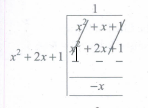
\(\therefore\) \({{x^2+x+1}\over{x^2+2x+1}}=1-{{x}\over{x^2+2x+1}}\) ...(1)
Consider \({{x}\over{x^2+2x+1}}={{x}\over{(x+1)^2}}={{A}\over{x+1}}+{{B}\over{{(x+1)}^{2}}}\)
\(\therefore\ {{x}\over{x^2+2x+11}}={{A(x+1)+B}\over{{(x+1)}^{2}}}\)
\(\Rightarrow\) x = A(x+ 1) + B ..(2)
Putting x = - 1 in (2) we get
-1 = 0 + B \(\Rightarrow\ \ \boxed{B=-1}\)
Putting x = 0 in (2) we get,
0 = A+B \(\Rightarrow\) A - 1 = 0 \(\Rightarrow\) \(\boxed{A=1}\)
\(\therefore\) \({{x}\over{{(x+1)}^{2}}}={{1}\over{x+1}}-{{1}\over{{(x+1)}^{2}}}\) ..(2)
Substituting (2) in (1) we get,
\({{x^2+x+1}\over{x^2+2x+1}}=1-{{1}\over{x+1}}+{{1}\over{{(x+1)}^{2}}}\)
29.
\(\frac { \sin { \left( { 180 }^{ o }+A \right) \cos { \left( { 90 }^{ o }-A \right) \tan { \left( { 270 }^{ o }-A \right) } } } \quad \quad }{ \sec { \left( { 540 }^{ o }-A \right) \cos { \left( { 360 }^{ o }+A \right) \csc { \left( { 270 }^{ o }+A \right) } } } } \)
\(=\frac{(-\sin A)(\sin A)(\cot A)}{\sec (360+180-A) \cos A(-\sec A)} \)
\(=\frac{(-\sin A)(\sin A) \frac{\cos A}{\sin A}}{(-\sec A) \cos A(-\sec A)} \)
\(=-\frac{\sin A \cos A}{\frac{1}{\cos A} \cos A \frac{1}{\cos A}} \)
\(=-\sin A \cos ^2 A\)
= R.H.S
Hence proved.
30.
Let P(n) denote the statement 1.2 + 2.3 + 3.4 + ..... + (n + 1) = \(\frac { n(n+1)(n+2) }{ 3 } \)
Put n = 1
LHS = 1 (2) = 2
\(=\frac { 1(2)(3) }{ 3 } \Rightarrow 2=2\)
LHS = RHS
\(\therefore\) P(1) is true.
Let us assume that P(k) IS true i.e, to prove 1.2 + 2.3 + 3.4 + ...... + k(k + 1)
= \(\frac { k(k+1)(k+2) }{ 3 } \) ......(1)
To prove that P(k+1) is true i.e to prove 1.2 + 2.3 + 3.4 + .... + k(k + 1) + (k + 1)(k + 2)
= \(\frac { k(k+2)(k+2) }{ 3 } \) + (k + 1)(k + 2)
\(=\frac{k(k+1)(k+2)+3(k+1)(k+2)}{3}\)
\(=\frac { (k+1)(k+2)(k+3) }{ 3 } \) = RHS
\(\therefore\) P(k + 1) is true whenever P(k) is true.
\(\therefore\) p(n) is true for all \(n\in N\).
31.
Let the 3 numbers be x, y and z.
Given x + y + z = 20
2x + y - z = 23
3x+ y + z = 46
It can be rewritten as
\(\begin{bmatrix} 1&1&1\\2&1&-1\\3&1&1 \end{bmatrix}\begin{bmatrix} x\\y\\z \end{bmatrix}=\begin{bmatrix} 20\\23\\46 \end{bmatrix}\)
\(\Rightarrow\) \(A X=B \Rightarrow X=A^{-1} B\)
Where \(A=\begin{bmatrix} 1&1& 1\\2&1&-1\\3&1&1 \end{bmatrix},X=\begin{bmatrix} x\\y\\z \end{bmatrix},B=\begin{bmatrix} 20\\23\\46 \end{bmatrix}\)
= 1 ( 1 + 1 ) - 1 ( 2 + 3 ) + 1 ( 2 - 3)
= 2 - 5 - 1 = 2 - 6 = - 4 \(\neq \) 0
\(\therefore\) A-1 exists.
\(\text {Co-factor matrix }=\left(\begin{array}{ccc} 2 & -5 & -1 \\ 0 & -2 & 2 \\ -2 & 3 & -1 \end{array}\right)\)
\(\therefore{A}^{-1}={{1}\over{|A|}}adj\ A={{-1}\over{4}}\begin{bmatrix} 2&0&-2\\-5&-2&3\\-1&2&-1 \end{bmatrix}\)
\(X={A}^{-1}B={{-1}\over{4}}\begin{bmatrix}2&0&-2\\5&-2&3\\-1&2&-1 \end{bmatrix}\begin{bmatrix} 20\\23\\46 \end{bmatrix}\)
\(= \begin{bmatrix} x\\y\\z \end{bmatrix},={{-1}\over{4}}\begin{bmatrix} 40+0-92\\-100-46+138\\-20+46-46 \end{bmatrix}={{-1}\over{4}}\begin{bmatrix} -5\\-8\\-20 \end{bmatrix}\)
\(X=\begin{bmatrix} 13\\2\\5 \end{bmatrix}\)
\(x=13, y=2, z=5\)
\(\therefore\) The 3 numbers are 13, 2 and 5.
32.
Now AB = \(\begin{bmatrix} 2&2&1\\1&3&1\\1&2&2 \end{bmatrix} \begin{bmatrix} {{4}\over{5}} &{{-2}\over{5}}&-{{1}\over{5}}\\-{{1}\over{5}}&{{3}\over{5}} &-{{1}\over{5}} \\ -{{1}\over{5}}&-{{2}\over{5}} &{{4}\over{5}}\end{bmatrix}\)
\(=\frac{1}{5}\left(\begin{array}{lll} 2 & 2 & 1 \\ 1 & 3 & 1 \\ 1 & 2 & 2 \end{array}\right)\left(\begin{array}{ccc} 4 & -2 & -1 \\ -1 & 3 & -1 \\ -1 & -2 & 4 \end{array}\right)\)
\(=\frac{1}{5}\left(\begin{array}{lll} 8-2-1 & -4+6-2 & -2-2+4 \\ 4-3-1 & -2+9-2 & -1-3+4 \\ 4-2-2 & -2+6-4 & -1-2+8 \end{array}\right)\)
\(=\frac{1}{5}\left(\begin{array}{lll} 5 & 0 & 0 \\ 0 & 5 & 0 \\ 0 & 0 & 5 \end{array}\right)=\left(\begin{array}{lll} 1 & 0 & 0 \\ 0 & 1 & 0 \\ 0 & 0 & 1 \end{array}\right)=I\)
\(\mathrm{BA}=\frac{1}{5}\left(\begin{array}{ccc} 4 & -2 & -1 \\ -1 & 3 & -1 \\ -1 & -2 & 4 \end{array}\right)\left(\begin{array}{lll} 2 & 2 & 1 \\ 1 & 3 & 1 \\ 1 & 2 & 2 \end{array}\right)\)
\(=\frac{1}{5}\left(\begin{array}{ccc} 8-2-1 & 8-6-2 & 4-2-2 \\ -2+3-1 & -2+9-2 & -1+3-2 \\ -2-2+4 & -2-6+8 & -1-2+8 \end{array}\right)\)
\(=\frac{1}{5}\left(\begin{array}{lll} 5 & 0 & 0 \\ 0 & 5 & 0 \\ 0 & 0 & 5 \end{array}\right)=\left(\begin{array}{lll} 1 & 0 & 0 \\ 0 & 1 & 0 \\ 0 & 0 & 1 \end{array}\right)=I\)
\(\mathrm{AB}=\mathrm{BA}=\mathrm{I}\)
\(\therefore\) A and B are inverse of each other
33.
\(3 x-y+2 z=13 ; 2 x+y-z=3\)
\(x+3 y-5 z=-8\)
The given system can be written as
\(\left(\begin{array}{ccc} 3 & -1 & 2 \\ 2 & 1 & -1 \\ 1 & 3 & -5 \end{array}\right)\left(\begin{array}{l} x \\ y \\ z \end{array}\right)=\left(\begin{array}{c} 13 \\ 3 \\ -8 \end{array}\right)\)
\(A X=B \Rightarrow X=A^{-1} B\)
\(\text {Where } A=\left(\begin{array}{ccc} 3 & -1 & 2 \\ 2 & 1 & -1 \\ 1 & 3 & -5 \end{array}\right), X=\left(\begin{array}{l} x \\ y \\ z \end{array}\right)\)
\(B=\left(\begin{array}{c} 13 \\ 3 \\ -8 \end{array}\right)\)
\(|A|=3(-5+3)+1(-10+1)+2(6-1)\)
\(=-6-9+10=-5 \neq 0\)
\(\therefore A^{-1} exists\)
\(\mathrm{A}_{11}=\text {Co-factor of } 3=(-5+3)=-2 \)
\(\mathrm{A}_{12}=\text {Co-factor of }-1=-(-10+1)=9 \)
\(\mathrm{A}_{13}=\text {Co-factor of } 2=(6-1)=5\)
\(\mathrm{A}_{21}=\text { Co-factor of } 2=-(5-6)=1\)
\(\mathrm{A}_{22}=\text { Co-factor of } 1=-15-2=-17 \)
\(\mathrm{A}_{23}=\text { Co-factor of }-1=-(9+1)=-10\)
\(\mathrm{A}_{31}=\text {Co-factor of } 1=1-2=-1\)
\(\mathrm{A}_{32}=\text {Co-factor of } 3=-(-3-4)=7 \)
\(\mathrm{A}_{33}=\text {Co-factor of }-5=3+2=5\)
\(\text {Co-factor matrix }=\left(\begin{array}{ccc} -2 & 9 & 5 \\ 1 & -17 & -10 \\ -1 & 7 & 5 \end{array}\right)\)
\(A^{-1}=\frac{1}{|A|} \operatorname{adj} A=\frac{1}{-5}\left(\begin{array}{ccc} -2 & 1 & -1 \\ 9 & -17 & 7 \\ 5 & -10 & 5 \end{array}\right)\)
\(X=A^{-1} B=\frac{-1}{5}\left(\begin{array}{ccc} -2 & 1 & -1 \\ 9 & -17 & 7 \\ 5 & -10 & 5 \end{array}\right)\left(\begin{array}{c} 13 \\ 3 \\ -8 \end{array}\right)\)
\(=\frac{-1}{5}\left(\begin{array}{ccc} -26 & 3 & 8 \\ 117 & -51 & -56 \\ 65 & -30 & -40 \end{array}\right)\)
\(=\frac{-1}{5}\left(\begin{array}{c} -15 \\ 10 \\ -5 \end{array}\right)\)
\(\left(\begin{array}{l} x \\ y \\ z \end{array}\right)=\left(\begin{array}{c} 3 \\ -2 \\ 1 \end{array}\right)\)
\(x=3, \mathrm{y}=-2, \mathrm{z}=1\)
34.
\(|A|=\left| \begin{matrix}1 & tan\quad x \\ -tan\quad x & 1 \end{matrix} \right| =1+{ tan }^{ 2 }x={ sec }^{ 2 }x\neq 0\)
\(\Rightarrow\) A-1 exists
Let Cij be the cofactor of aij in A
C11 = (-1)1+1 M11 = (-1)2(1) = 1
C12 = (-1)1+2 (-tan x) = tan x
C21 = (-1)2+2(1) = 1
\(\therefore \quad adj\quad A={ \left[ \begin{matrix} 1 & tan\quad x \\ -tan\quad x & 1 \end{matrix} \right] }^{ T }=\left[ \begin{matrix} 1 & -tan\quad x \\ tan\quad x & 1 \end{matrix} \right] \)
\({ A }^{ -1 }=\frac { 1 }{ |A| } adjA=\frac { 1 }{ 1+{ tan }^{ 2 }x } \left[ \begin{matrix} 1 & -tan\quad x \\ tan\quad x & 1 \end{matrix} \right] =\left[ \begin{matrix} \frac { 1 }{ 1+{ tan }^{ 2 }x } & \frac { -tan\quad x }{ 1+{ tan }^{ 2 }x } \\ \frac { tan\quad x }{ 1+{ tan }^{ 2 }x } & \frac { 1 }{ 1+{ tan }^{ 2 }x } \end{matrix} \right] \)
\(\therefore \quad { A }^{ T }{ A }^{ -1 }=\left[ \begin{matrix} 1 & -tan\quad x \\ tan\quad x & 1 \end{matrix} \right] \left[ \begin{matrix} \frac { 1 }{ 1+{ tan }^{ 2 }x } & \frac { -tan\quad x }{ 1+{ tan }^{ 2 }x } \\ \frac { tan\quad x }{ 1+{ tan }^{ 2 }x } & \frac { 1 }{ 1+{ tan }^{ 2 }x } \end{matrix} \right] =\left[ \begin{matrix} \frac { 1 }{ 1+{ tan }^{ 2 }x } \frac { -tan\quad x }{ 1+{ tan }^{ 2 }x } & \frac { -tan\quad x }{ 1+{ tan }^{ 2 }x } \frac { -tan\quad x }{ 1+{ tan }^{ 2 }x } \\ \frac { tan\quad x }{ 1+{ tan }^{ 2 }x } +\frac { tan\quad x }{ 1+{ tan }^{ 2 }x } & \frac { -{ tan }^{ 2 }x }{ 1+{ tan }^{ 2 }x } \frac { 1 }{ 1+{ tan }^{ 2 }x } \end{matrix} \right] \)
\(=\left[ \begin{matrix} \frac { 1-tan\quad x }{ 1+{ tan }^{ 2 }x } & \frac { -2tan\quad x }{ 1+{ tan }^{ 2 }x } \\ \frac { 2tan\quad x }{ 1+{ tan }^{ 2 }x } & \frac { 1-{ tan }^{ 2 }x }{ 1+{ tan }^{ 2 }x } \end{matrix} \right] =\left[ \begin{matrix} cos\quad 2x & -sin2x \\ sin\quad 2x & cos\quad 2x \end{matrix} \right] \) (Using multiple angle formula)
35.
Given \(\Delta =\left| \begin{matrix} { cosec }^{ 2 }\theta & { cot }^{ 2 }\theta & 1 \\ { cot }^{ 2 }\theta & { cosec }^{ 2 }\theta & -1 \\ 42 & 40 & 2 \end{matrix} \right| =0\)
Applying C1\(\rightarrow\)C1 - C2, we get,
\(\Delta =\left| \begin{matrix} { cosec }^{ 2 }\theta -{ cot }^{ 2 }\theta & { cot }^{ 2 }\theta & 1 \\ { cot }^{ 2 }\theta -{ cosec }^{ 2 }\theta & { cosec }^{ 2 }\theta & -1 \\ 42-40 & 40 & 2 \end{matrix} \right| \)
\(=\left| \begin{matrix} 1 & { cot }^{ 2 }\theta & 1 \\ -1 & { cosec }^{ 2 }\theta & -1 \\ 2 & 40 & 2 \end{matrix} \right| \) [\(\because\) cosec2 \(\theta\) - cot2 \(\theta\) =1]
= 0
\(\Delta =0\) [\(\because\) C1 \(\equiv \) C3]
36.
Compare the equation
12x2 - 10xy + 2y2 + 14x - 5y + 2 = 0 with
ax2 + 2hxy + by2 + 2gx + 2fy + c = 0
We get a = 12, 2h = -10, b = 2, 2g = 14, 2f = -5
\(h=-5\quad g=7\quad f=-\frac { 5 }{ 2 } ,c=2\)
\(\left|\begin{array}{lll} a & h & g \\ h & b & f \\ g & f & c \end{array}\right|=\left|\begin{array}{ccc} 12 & -5 & 7 \\ -5 & 2 & \frac{-5}{2} \\ 7 & \frac{-5}{2} & 2 \end{array}\right|\)
\(=12\left(4-\frac{25}{4}\right)+5\left(-10+\frac{35}{2}\right)+7\left(\frac{25}{2}-14\right)\)
\(=48-75-50+\frac{175}{2}+\frac{175}{2}-98\)
= -175 + 175 = 0
Hence the given equations represent a pair of straight lines.
To find separate equation
\(12 x^2-10 x y+2 y^2 =12 x^2-6 x y-4 x y+2 y^2 \)
\(=6 x(2 x-y)-2 y(2 x-y) \)
\(=(6 x-2 y)(2 x-y)\)
\(12 x^2-10 x y+2 y^2+ 14 x-5 y+2 =(6 x-2 y+l)(2 x-y+\mathrm{m})\)
Comparing the coefficient of x and y
14 = 6m + 2l
divided by 2
7 = 3m + l .........(1)
-5 = -2m - l .......(2)
Solving (1) and (2) we get m = 2, 1 = 1
The separate equations are
6x - 2y + 1 = 0
2x - y + 2 = 0
37.
\(x-y+z=2\)
\(2 x-y=0 \)
\(2 y-z=1\)
The given equations can be written in matrix form as
\(\begin{bmatrix} 1&-1&1\\2&-1&0\\0&2&-1 \end{bmatrix}\begin{bmatrix} x \\ y\\z \end{bmatrix}=\begin{bmatrix} 2\\0\\1 \end{bmatrix} \)
\(A X=B \Rightarrow X=A^{-1} B\)
Where \(A=\left[ \begin{matrix} 1 & -1 & 1 \\ 2 & -1 & 0 \\ 0 & 2 & -1 \end{matrix} \right] ,\ X=\left[ \begin{matrix} x \\ y \\ z \end{matrix} \right] ,\ B=\left[ \begin{matrix} 2 \\ 0 \\ 1 \end{matrix} \right] \)
\(|A|=\begin{vmatrix} 1&-1&1\\2&-1&0\\0&2&-1 \end{vmatrix}=-1\begin{vmatrix} -1&0\\2&-1\end{vmatrix}+1\begin{vmatrix} 2&0\\0&-1 \end{vmatrix}+1\begin{vmatrix} 2&-1\\0&2 \end{vmatrix}\)
\(|A|=1(1-0)+1(-2-0)+1(4-0)\)
\(=1-2+4=3\neq0\)
\(\therefore\) A-1 exists.
\(\text {Co-factor matrix }=\left(\begin{array}{ccc} 1 & 2 & 4 \\ 1 & -1 & -2 \\ 1 & 2 & 1 \end{array}\right)\)
\(\therefore\ {A}^{-1}={{1}\over{|A|}}adj\ A={{1}\over{3}}\begin{bmatrix} 1&1&1\\2&-2&2\\4&-2&1 \end{bmatrix}\)
Now \(X={A}^{-1}B={{1}\over{3}}\begin{bmatrix} 1&1&1\\2&-1&2\\4&-2&1 \end{bmatrix}\begin{bmatrix} 2\\0\\1 \end{bmatrix}=\frac{1}{3}\left(\begin{array}{l} 2+0+1 \\ 4+0+2 \\ 8+0+1 \end{array}\right)=\frac{1}{3}\left(\begin{array}{l} 3 \\ 6 \\ 9 \end{array}\right)\)
\(\left(\begin{array}{l} x \\ y \\ z \end{array}\right)=\left(\begin{array}{l} 1 \\ 2 \\ 3 \end{array}\right)\)
\(x=1, y=2, z=3\)
38.
39.
Given A \(=\begin{bmatrix} 1&1&1\\3&4&7\\1&-1&1 \end{bmatrix}\)
\(=(4+7)-1(3-7)+1(-3-4)\)
\(=11+4-7=8\)
\(\text {Co-factor matrix }=\left(\begin{array}{ccc} 11 & 4 & -7 \\ -2 & 0 & +2 \\ 3 & -4 & 1 \end{array}\right)\)
\(\operatorname{adj} A=\left(\begin{array}{ccc} 11 & -2 & 3 \\ 4 & 0 & -4 \\ -7 & 2 & 1 \end{array}\right)\)
\(\mathrm{A}(\operatorname{adj} A)=\left(\begin{array}{ccc} 1 & 1 & 1 \\ 3 & 4 & 7 \\ 1 & -1 & 1 \end{array}\right)\left(\begin{array}{ccc} 11 & -2 & 3 \\ 4 & 0 & -4 \\ -7 & 2 & 1 \end{array}\right)\)
\(=\left(\begin{array}{ccc} 11+4-7 & -2+0+2 & 3-4+1 \\ 33+16-49 & -6+0+14 & 9-16+7 \\ 11-4-7 & -2+0+2 & 3+4+1 \end{array}\right)\)
\(=\left(\begin{array}{lll} 8 & 0 & 0 \\ 0 & 8 & 0 \\ 0 & 0 & 8 \end{array}\right)=8\left(\begin{array}{lll} 1 & 0 & 0 \\ 0 & 1 & 0 \\ 0 & 0 & 1 \end{array}\right)=|A| I_3\)
\((adj\ A)\ A=\begin{bmatrix}11&-2&3\\4&0&-4\\-7&2&1\end{bmatrix}\begin{bmatrix} 1&1&1\\3&4&7\\1&-1&1 \end{bmatrix}\)
\(=\begin{bmatrix} 11-6+3&11-8-3&11-14+3\\4+0-4&4+0+4&4+0-4\\-7+6+1&-7+8-1&-7+14+1 \end{bmatrix}=\begin{bmatrix} 8&0&0\\0&8&0\\0&0&8 \end{bmatrix}\) ...(2)
\(|A|.{I}_{3}=8\begin{bmatrix}1&0&0\\0&1&0\\0&0&1 \end{bmatrix}=\begin{bmatrix} 8&0&0\\0&8&0\\0&0&8\end{bmatrix}\) ...(3)
From (1), (2) and (3)
A (adj A) = (adj A) A = |A|I3.
40.
Let A \(=\begin{vmatrix} 1 & a&a^2&-bc \\1 &b&{b}^{2}&-ca\\1&c&c^2&-ab \end{vmatrix}\)
\(=\left|\begin{array}{lll} 1 & a & a^2 \\ 1 & b & b^2 \\ 1 & c & c^2 \end{array}\right|+\left|\begin{array}{ccc} 1 & a & -b c \\ 1 & b & -c a \\ 1 & c & -a b \end{array}\right|\)
\(A=\begin{vmatrix} 1 & a&{a}^{2} \\ 1 &b&b^2\\1&c&c^2 \end{vmatrix}-\begin{vmatrix} 1 & a&bc \\1 &b&ca\\1&c&ab \end{vmatrix}\)
\(=\left|\begin{array}{lll} 1 & a & a^2 \\ 1 & b & b^2 \\ 1 & c & c^2 \end{array}\right|-\frac{1}{a b c}\left|\begin{array}{ccc} a & a^2 & a b c \\ b & b^2 & a b c \\ c & c^2 & a b c \end{array}\right|\)
(Multiplying R1, R2 and R3 of the determinant by a, b, c respectively)
\(=\left|\begin{array}{lll} 1 & a & a^2 \\ 1 & b & b^2 \\ 1 & c & c^2 \end{array}\right|-\frac{a b c}{a b c}\left|\begin{array}{lll} a & a^2 & 1 \\ b & b^2 & 1 \\ c & c^2 & 1 \end{array}\right|\)
\(\left|\begin{array}{lll} 1 & a & a^2 \\ 1 & b & b^2 \\ 1 & c & c^2 \end{array}\right|-\left|\begin{array}{lll} 1 & a & a^2 \\ 1 & b & b^2 \\ 1 & c & c^2 \end{array}\right|=0\)
41.
\(L\left[ f\left( x \right) \right] _{ x=3 }=\underset { x-{ 3 }^{ - } }{ lim } f\left( x \right) \)
\(=\lim _{h \rightarrow 0} f(3-h), x=3-h\)
\( =\underset { h\rightarrow 0 }{ lim } \cfrac { \left| (3-h)-3 \right| }{ \left( 3-h \right) -3 }\)
\(=\underset { h\rightarrow 0 }{ lim } \cfrac { \left| -h \right| }{ h } \)
\(=\underset { h\rightarrow 0 }{ lim } \cfrac { h }{ -h } \)
\(=\underset { h\rightarrow 0 }{ lim } −1 =−1
\)
\(R\left[ f(x) \right] _{ x=3 }=\underset { x\rightarrow { 3 }^{ + } }{ lim } f(x)\)
\(=\underset { h\rightarrow 0 }{ lim } f\left( 3+h \right) \)
\(=\underset { h\rightarrow 0 }{ him } \cfrac { \left| \left( 3+h \right) -3 \right| }{ \left( 3+h \right) -3 } \)
\(=\underset { h\rightarrow 0 }{ lim } \cfrac { \left| h \right| }{ h } \)
\(=\underset { h\rightarrow 0 }{ lim } 1 = 1
\)
42.
Given lines 3x - 4y - 13 = 0...(1)
8x - 11y = 33 ...(2)
2x - 3y - 7 = 0 ...(3)
Conditon for concurrent lines is
\(\left| \begin{matrix} { a }_{ 1 } & { b }_{ 1 } & { c }_{ 1 } \\ { a }_{ 2 } & { b }_{ 2 } & { c }_{ 2 } \\ { a }_{ 3 } & { b }_{ 3 } & { c }_{ 3 } \end{matrix} \right| =0\)
i.e.,\(\left| \begin{matrix} 3 & -4 & -13 \\ 8 & -11 & -33 \\ 2 & -3 & -7 \end{matrix} \right| =3\left( 77-99 \right) +4\left( 56+44 \right) -13\left( -24+22 \right) \)
= -66 + 40 + 26 = 0
\(\Rightarrow \) Given lines are concurrent. To get the point of concurrency solve the equations (1) and (3)
| Equation (1) \(\times\) 2 | \(\Rightarrow \) | 6x | - 8y | = 26 |
| Equation (3) \(\times\) 3 | \(\Rightarrow \) | 6x | - 9y | = 21 |
| y | = 5 |
When y = 5 from (2) 8x = 88
x = 11
Point of concurrency is (11, 5)
43.
Aij = (–1)i+jMij
A11 = (–1)1+1M11 = \(\left| \begin{matrix} 1 & 0 \\ 1 & 0 \end{matrix} \right| \) = 0
A12 = (–1)1+2M12 = \(-\left| \begin{matrix} 0 & 0 \\ -4 & 0 \end{matrix} \right| \) = 0
A13 = (–1)1+3M13 = \(\left| \begin{matrix} 0 & 1 \\ -4 & 1 \end{matrix} \right| \)= 0 - (-4) = 4
A21 = (–1)2+1M21 = \(-\left| \begin{matrix} -2 & -3 \\ 1 & 0 \end{matrix} \right| \)= -(0 - (-3)) = -3
A22 = (–1)2+2M22 = \(\left| \begin{matrix} 1 & -3 \\ -4 & 0 \end{matrix} \right| \) = 0 - 12 = -12
A23 = (–1)2+3M23 = \(-\left| \begin{matrix} 1 & -2 \\ -4 & 1 \end{matrix} \right| \) = -(1-8) = 7
A31 = (–1)3+1M31 = \(\left| \begin{matrix} -2 & -3 \\ 1 & 0 \end{matrix} \right| \) = 0 - (-3) = 3
A32 = (–1)3+2M32 = \(-\left| \begin{matrix} 1 & -3 \\ 0 & 0 \end{matrix} \right| \) = 0 - 0 = 0
A33 = (–1)3+3M33 = \(\left| \begin{matrix} 1 & -2 \\ 0 & 1 \end{matrix} \right| \) = 1 - 0 = 1
\(\left[ { A }_{ ij } \right] =\left[ \begin{matrix} 0 & 0 & 4 \\ -3 & -12 & 7 \\ 3 & 0 & 1 \end{matrix} \right] \)
Adj A = [Aij]T
\(=\left[ \begin{matrix} 0 & -3 & 3 \\ 0 & -12 & 0 \\ 4 & 7 & 1 \end{matrix} \right] \)
44.
| Marks | Frequency | Cumulative Frequency |
| X | f | cf |
| 10 | 4 | 4 |
| 20 | 7 | 11 |
| 30 | 15 | 26 |
| 40 | 8 | 34 |
| 50 | 7 | 41 |
| 60 | 2 | 43 |
| N=\(\sum\)f=43 |
Q1 = Size of \({ \left( \frac { N+1 }{ 4 } \right) }^{ th }\)value = Size 11th value = 20
Q3 = Size of \(\left( \frac { 3\left( N+1 \right) }{ 4 } \right) ^{ th }\)value = Size of 33rd value = 40
\(QD=\frac { 1 }{ 2 } \left( { Q }_{ 3 }-{ Q }_{ 1 } \right) \frac { 40-20 }{ 2 } =10\)
Coefficient of QD \(=\frac { { Q }_{ 3 }-{ Q }_{ 1 } }{ { Q }_{ 3 }+{ Q }_{ 1 } } =\frac { 40-20 }{ 40+20 } =\frac { 20 }{ 60 } \)
= 0.333
45.
If x = 0, y = 1. The curve cuts the y axis at (0,1)
The curve will not meet the x axis for all real values of x

11th Standard Syllabus & Materials
11th Standard
TN 11th Tamil பீடு பெற நில் - செய்யுள் - காவடிச்சிந்து Important Questions And Answers Study Material - QB365 Set A
NEW11th Standard
TN 11th Tamil பீடு பெற நில் - உரைநடை - மலை இடப்பெயர்கள் : ஓர் ஆய்வு Important Questions And Answers Study Material - QB365 Set A
NEW11th Standard
TN 11th Tamil மாமழை போற்றுதும் - துணைப்பாடம் - யானை டாக்டர் Important Questions And Answers Study Material - QB365 Set A
NEW11th Standard
TN 11th Tamil மாமழை போற்றுதும் - செய்யுள் - ஐங்குறுநூறு Important Questions And Answers Study Material - QB365 Set A



Tamilnadu Stateboard 11th Standard Subjects

Maths

Commerce

Economics

Biology
Business Maths and Statistics

Accountancy

Computer Science

Physics

Chemistry
Maths
Biology
Economics
Physics
Chemistry

History
Business Maths and Statistics

Computer Science
Accountancy

Computer Applications
History
Computer Technology
Commerce
Computer Applications
Computer Technology

Tamil

English

French
Tamilnadu Stateboard Standards
