
 100% FREE ACCESS
11th Standard Syllabus & Materials
11th Standard
TN 11th Tamil இயற்கை வேளாண்மை,சுற்றுச்சூழல் -செய்யுள் - மனோன்மணீயம் Important Questions And Answers Study Material - QB365 Set A
NEW11th Standard
TN 11th Tamil என்னுயிர் என்பேன் -துணைப்பாடம் - இசைத்தமிழர் இருவர் Important Questions And Answers Study Material - QB365 Set A
NEW11th Standard
TN 11th Tamil மொழி கலை -செய்யுள் - ஒவ்வொரு புல்லையும் Important Questions And Answers Study Material - QB365 Set A
NEW11th Standard
TN 11th Tamil பீடு பெற நில் - இலக்கணம் - பகுபத உறுப்புகள் Important Questions And Answers Study Material - QB365 Set A
NEW11th Standard
TN 11th Tamil பீடு பெற நில் - துணைப்பாடம் - வாடிவாசல் Important Questions And Answers Study Material - QB365 Set A
NEW11th Standard
TN 11th Tamil பீடு பெற நில் - செய்யுள் - குறுந்தொகை Important Questions And Answers Study Material - QB365 Set A

Published on: 24/08/2026
Download Tamil Nadu 11th Standard English question papers, model tests, one-mark questions, important questions, and public exam papers in PDF format. Free study materials and answer keys for TN State Board students.
Questions + Answers key
Take MCQ English Test
1.
When snaps the knee and cracks the
wrist….
Identify and explain the use of the literary device in this line.
2.
3.
Well, ego it might be pleased enough
But zealous athletes play so rough…
i. What pleases the ego?
ii. Why are athletes often rough during play?
4.
5.
‘Most of all, I want to relearn
How to laugh, for my laugh in the mirror
Shows only my teeth like a snake’s bare fangs!’
a) Why does the poet want to relearn how to laugh?
b) Whom does the poet want to relearn from?
c) Mention the figure of speech used here.
6.
‘But now they only laugh with their teeth,
While their ice-block-cold eyes…’
a) Who are ‘they’?
b) Explain ice-block-cold eyes
c) Identify the figure of speech used here.
7.
If this belief from heaven be sent,
If such be Nature's holy plan.
a) What does 'heaven' refer to?
b) Why does the poet call it 'holy'?
8.
And I must think, do all I can,
That there was pleasure there .....
a) What did the poet notice about the twigs?
b) What was the poet's thought about then?
9.
And 'tis my faith that every flower
Enjoys the air it breathes......
a) What is the poet's faith?
b) What trait of Nature do we see here?
10.
v. to unlearn all these muting things
11.
iv. hands search my empty pockets
12.
iii. like a fixed portrait smile
13.
ii. shake hands without hearts
14.
Why did K.C's words shock Sletherby?
15.
Describe Honario Saltpen-Jago.
16.
What caught his attention about the car door?
17.
What was Sletherby's response to Bertie's request?
18.
Compare the two crests
19.
'There was a tinge of coldness in his voice.’ Why?
20.
Describe Bertie's problem
21.
Why did his travel companion curse and mutter?
22.
How would Sletherby gain from his friendship with Honoria Saltpen-Jago?
23.
Why did Philip Sletherby visit Brill Manor?
24.
Why does the poet prefer to buy ticket worth their weight in radium? Bring out the significance of the metal referred to here.
25.
Why would the referee ask whether there was a doctor in the stands? What stands is he referring to?
26.
Are the athletes conscious of the feelings of others? Why do you say so?
27.
The poet does not wish to exchange position with the runners. Why?
28.
The poet is satisfied just watching the heroic deeds of others. What could be the reason?
29.
Do you think the narrator is heroic? Why?
30.
Why does the poet feel glad that he does not play any game?
31.
i. laugh with their eyes
32.
What did he give Bob?
33.
Who was the tall man?
34.
When and how did Bob realise that the tall man was not his friend?
35.
Why did the friends part ways?
36.
Describe the man awaiting the arrival of his friend.
37.
What used to be there in the place of that shop twenty years ago?
38.
What story did the man standing near the hardware store tell the passing cop?
39.
Why were the streets devoid of people?
40.
What did he keep doing while on his rounds?
41.
Describe the appearance of the policeman on the beat.
42.
Mention the qualities the child in the poem symbolises.
43.
What does the poet long for?
44.
How is the poet's laugh reflected in the mirror?
45.
What does he desire to unlearn and relearn?
46.
What pleasantries does the poet use to fake cordiality?
47.
What does the poet mean when he says 'good bye'?
48.
How does the poet compare his face with dresses?
49.
Pick out the expressions that indicate conflicting ideas.
50.
What happens to the poet when he visits someone for the third time?
51.
What is the relationship between the narrator and the listener?
52.
What do you associate with the title of the poem?
53.
What is common about the 'angler' and the 'poet'?
54.
Who are the citizens of 'dreamland'? Why?
55.
What are the articles the writer forgets most often?
56.
What does the author mean when he says the letter in his pocket leads an unadventurous life?
57.
What is the commonest type of forgetfulness, according to lynd?
58.
How do psychologists interpret forgetfulness?
59.
Name a few things that a person remembers easily.
60.
What does Lynd actually wonder at?
61.
Bring out the poet's thoughts, while comparing Nature with human behaviour?
62.
The poet finds joy in the various objects of Nature. Explain.
63.
Why does the poet think that the birds were happy?
64.
How do people bring grief and sorrow to one another?
65.
Does Nature affect a person's thoughts and feelings? Explain
66.
How does the poet feel while enjoying the beauty of Nature?
67.
What was the happiest time of the day for grandmother?
68.
Why didn't the grandmother feel sentimental when the author went abroad for higher education?
69.
70.
Why did the grandmother accompany the author to school?
71.
Where did the author study in his childhood?
72.
Why was the author left with his grandmother in the village?
73.
Describe the grandfather as seen in the portrait.
74.
What Man has made of Man?
75.
And 'tis my faith that every flower. ..
Enjoys the air it breathes.
76.
i. To her works did Nature link
ii. The human soul that through me ran…
77.
What did she consider her greatest achievement? Why?
78.
How was she felicitated on her return to India?
79.
What difficulty did she experience while eating Chinese food?
80.
What made her feel confident about the competitive players? Explain.
81.
According to Mary Kom, what was the reason for her losing in the finals?
82.
Why did she call herself 'lucky'?
83.
What was her first impression of America?
84.
Why did Mary Kom think that she should not return empty-handed?
85.
How did Mary Kom manage to get the financial support for her trip to the USA?
86.
Who do you think has been more successful between the two? Give reasons.
87.
Why didn't Jimmy Wells, being a cop himself, arrest Bob?
88.
Bob's life in the West was not a bed of roses. Give reasons.
89.
How did the cop come to understand that Bob had been successful in the West?
90.
Was Bob hopeful of his friend's arrival? How do you know?
91.
What are the strengths and weaknesses of Jimmy Wells from Bob's point of view?
92.
What did Bob share with the cop about their friendship?
93.
What had really happened in the dentist's room?
94.
Why do patients leave the clinic without meeting the dentist?
95.
How did Woman 5 move ahead in the waiting list of patients?
96.
Woman 5 was not aware of what was happening. Why?
97.
Why did Woman 1 panic more than the others?
98.
Why did they sympathize with the first patient?
99.
Bring out the people's reaction to the noises from the surgery
100.
What were the strange instruments the nurse carried to the surgery? How did the waiting patients interpret her act?
101.
Are children afraid of visiting the dentist? Give reasons.
102.
How did the other Women react to Woman 5?
103.
How did Woman 5 spend her time in the waiting hall?
104.
Who were the patients waiting for?
105.
Narrate the plight of the baby on its day out.
106.
What kind of absent-mindedness is regarded as a virtue by Lynd?
107.
The list of articles lost in trains suggests that sportsmen have worse memories than their ordinary serious-minded fellows. Why does Lynd say this?
108.
109.
Why, according to Lynd, should taking medicines be one of the easiest actions to remember?
110.
When does human memory work with less than its usual capacity?
111.
What are our memories filled with?
112.
What made people wonder about the absentmindedness of their fellow beings?
113.
How did the grandmother spend the last few hours of her life?
114.
115.
The grandmother appreciated the value of education. Give instances in support of your answer.
116.
How is school education in the village different from that in the city?
117.
What was the daily routine of the grandmother at home?
118.
Describe the author’s grandmother
119.
Why was Mary Korn named the 'Queen of Boxing' and 'Magnificent Mary'?
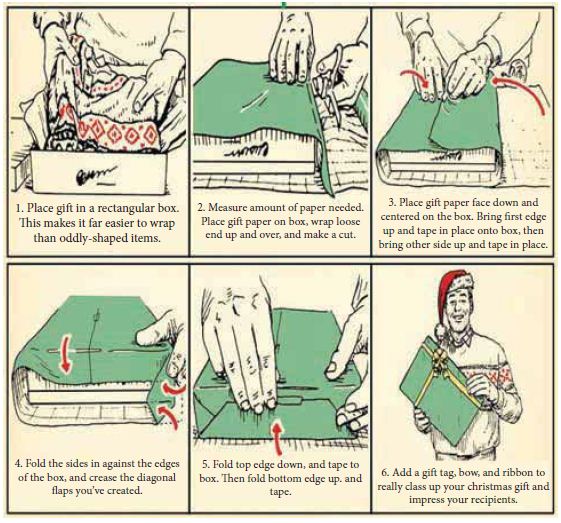
120.
Lack of adequate financial resources and sponsorships often affect sportspersons. How is this evident from Mary Korn's life?
121.
Describe Mary Kom’s personal experiences during her first International Championship match from the time of selection to winning the medal.
122.
Will you sympathise or ridicule someone who is intensely forgetful? Write an essay justifying your point of view.
123.
Kahlil Gibran states 'Forgetfulness is a form of freedom'. Write an article for your school magazine, linking your ideas logically and giving appropriate examples
124.
You have borrowed a branded cricket bat from your reluctant friend for an outstation match. After returning home you realize you have absent-mindedly left it in the hotel room. Write a letter of apology and regret to your friend.
125.
Animals are capable of empathy. Substantiate this statement with examples from the story as well as your own experiences.
126.
As young Khushwant Singh, write a letter to your parents describing your daily routine expressing your thoughts and feelings about staying in the village.
127.
The grandmother played a vital role in the author’s formative years. Give your own example of how elders have a positive influence on the younger generation. Include examples from the story also.
128.
The poem speaks of _______________
(i) Man's plan to shape destiny
(ii) Man seeking pleasure and riches
(iii) Man indulging in wars and acts of destruction
(iv) Man's fear of Nature
129.
The poem is set in a _______________
(i) city
(ii) village
(iii) grove
(iv) park
130.
The poet experiences sadness because ___________
(i) the blended notes are jarring
(ii) Nature is filled with negativity
(iii) he is worried about the destruction caused to Nature
(iv) natural calamities occur frequently
131.
You are the School Pupil Leader. Mention some qualities that can be drawn from the field of sports to improve your leadership skills.
132.
What sort of encouragement should an athlete in India be given? Give a few suggestions.
133.
Would you like to exchange your place with someone else? Why / why not?
134.
Everybody is special and everybody is a hero. Each one has a story to tell. In the light of this observation, present your views.
135.
Why do accidents usually happen in the playground? Give your own examples and explain.
136.
According to the poet what contributes most to the injuries sustained by the athletes?
137.
The poet does not wish to exchange places with the athletes. How does he justify his view?
138.
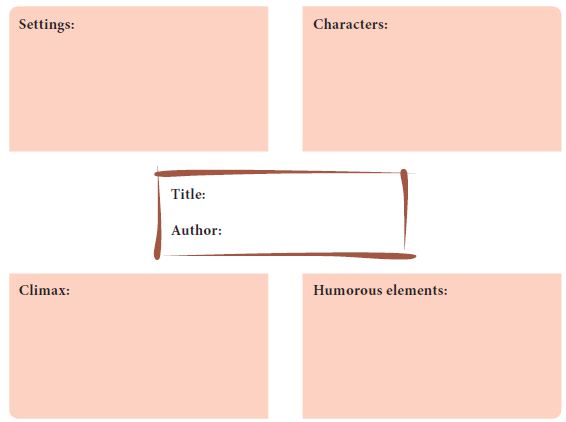
How does the poet establish the victory of common sense over ego?
139.
'Face is the index of the mind.' Does this adage concur with the views of the poet?
140.
This poem is nothing but a criticism of modern life. Justify this statement.
141.
Explain the things the poet has learnt when he grew into an adult.
142.
Write a letter to the Councillor of your Ward, explaining why a park is necessary in your locality.
143.
When humanity fails to live in harmony with Nature, its effects are felt around the world. Why and how?
144.
'Nature can nurture'. Describe how this process happens.
145.
Do you think the poet wants to say that man is unhappy because he has lost his link with nature and forgotten how to enjoy nature or because man is cruel to other men?
146.
| A | |
| amateur | |
| compulsory | |
| traditional | |
| expensive | |
| hopeful | |
| accepted | |
| B | ||
| professional | leader | eccentric |
| respective | elusive | cheap |
| unnecessary | supportive | ancillary |
| hateful | desperate | trivial |
| modern | fanciful | repulsive |
| fulfilled | refused | showered |
| invaluable | novice | optional |
| complex | antique | determined |
147.
monotonous
interesting
tiresome
fragrant
satisfying
148.
scattered
sprinkled
multiplied
gathered
covered
149.
serenity
simplicity
anxiety
absurdity
stupidity
150.
protest
promote
apprehend
accept
project
151.
omitted
isolated
rejected
contracted
included
152.
frivolous
serious
sad
furious
happy
153.
moist
marshy
arid
slimy
sultry
154.
The chain that I presented to my sister was not made of gold; it was just__________ I am suffering from a sense of __________ (guilt / gilt)
155.
The ________ dancer turned __________after the final performance. (weary/wiry)
156.
The stranger ___________ for a few minutes before he ___________my house. (paused / passed)
157.
Explain the ________ 'Cut your ___________according to your cloth'. (coat/quote)
158.
When the pole vaulter cleared 28 __________ it was declared a record ____________ (feet/feat)
159.
We found a ________ of biscuits in the old man's shirt _________ (pocket/packet)
160.
You ring is _____________Do not _____________ it. (loose / lose)
161.
Nobody can say __________ there will be an improvement in the ___________.
(whether / weather)
162.
corps / corpse
a) The ___________ was covered with a shroud.
b) A five-day annual training camp for the senior cadets of the National Cadet ___________ has been organised.
163.
through / threw
a) Ravi picked the banana peel and ___________ it in the dustbin.
b) The soldiers had to pass ___________ a dark tunnel.
164.
pale / pail
a) The child looks very sick and ___________.
b) I need a ___________ of water to wash these cups
165.
lesson / lessen
a) This medicine will ___________ your pain.
b) Finally, the manager learnt a ___________ the hard way.
166.
bread / bred
a) Turtles should be ___________ in a healthy environment.
b) I like to have toasted ___________ for breakfast.
167.
principle / principal
a) Oxygen is the ___________ element present in the earth’s crust.
b) Both these machines work on the same ___________.
168.
waste / waist
a) Shivani wears a belt around her ___________.
b) We should never misuse or ___________natural resources.
169.
brake / break
a) We have a short ___________ between the sessions
b) The car skidded to a halt when I applied the ___________.
170.
Have you ever found yourself in such a situation? Discuss in groups and act out such a situation.
171.
What would you do in this situation, if you were Jimmy Wells? Substantiate your reason.
172.
To your shock, you find out that your close friend is indulging in some wrong activity. Will you avoid him/her or try to correct him/her? Give reasons for your answer.
173.
‘Tell me who your friends are and I shall tell you who you are’. How will you explain this statement in the light of Jimmy’s and Bob’s friendship?
174.
'Means should justify the end.’ Explain this adage with reference to O. Henry’s story.
175.
Compare and contrast the character of Jimmy Wells and Bob with suitable references from the story to support your view.
176.
'Seeing is believing'. How is this humorously disproved in this story? Bring out the irony in the situation.
177.
As Sletherby, would you apologise to Bertie for your rude behaviour? Give reasons.
178.
How did Sletherby's judgement of Bertie turn out to be a wrong one?
179.
One has to be cautious and not be carried away by stories. How did Sletherby exhibit caution?
180.
Describe the youth’s strange behaviour when he was in the train.
181.
Based on your understanding of the play, explain how a mistaken understanding of events can lead to confusion. How has the author used this unexpected combination of events in the situation to create humour?
182.
You are Mani/Megalai of class XI, President of the English Club of your school. Draft a speech of the topic ‘Reading Maketh a Complete Man’ to be delivered in the school assembly.
183.
You are the School Pupil Leader. Your school organized an Inter-School Sports event at Nehru Stadium. Write a report on the special events conducted in about 100 - 120 words for the school souvenir.
184.
REPORT WRITING
You have recently attended a seminar on 'Science and Literature' in which writers presented papers on Science Fiction and literature and focused on the creativity of young writers. Write a short report about it for a leading newspaper in about 100 - 120 words
185.
Given below are hints about a renowned British science fiction writer Arthur C. Clarke. Write a biographical sketch on the author in not more than 80-100 words based on the information given below.
| Name | Arthur C. Clarke |
|---|---|
| Pen names | Charles Willis, E.G.O’Brien |
| Birth | 16 Dec 1917, England |
| Career | Novelist, Television host, inventor and film screen writer. |
| Genre | Science Fiction,Television series, film screen play |
| Awards and Honours | 1961, Kalinga Prize - an award given by UNESCO for popularising science Hugo and Nebula Awards Chairman of the Interplanetary Society Highest Civil Honour of Sri Lanka – ‘Sri Lankabhimanya 2005’ |
| Titles | Clarke, Robert Heinlein, and Isaac Asimov – ‘Big Three’ of Science Fiction ‘The Prophet of the Space Age’ |
| Famous Works | Childhood’s End 2001: A Space Odyssey Rendezvous with Rana |
186.
Explain the following phrases selected from the story in your own words and work with a partner to make sentences using these phrases:
a) on approval
b) a rustic holiday
c) a double-distilled idiot
d) a tinge of coldness
e) making up for lost time
187.
Bear
188.
File
189.
Light
190.
Wind
191.
Tear
192.
Train
193.
Reeta hurried along the road, dressed in her __ (1)__ new dress towards the bus stop. Before __ (2)__ , she had to reach the house of her __ (3)__ . But the first __ (4)__ of her travel was slow due to traffic jam. Her __ (5)__ would be regarded with joy. She was __ (6)__ herself to reach the place. When she finally stepped into the __ (7)__ , she was received with a big hug by her kind aunt. She was in time to join the __ (8)__ at the village, for a __ (9)__ .
194.
| A | B | C |
| mantel | lashes | |
| eye | wheel | |
| water | gate | |
| bee | knob | |
| toll | piece | |
| door | proof | |
| spinning | hive |
195.
Complete the following dialogue between a doctor and a patient with ten sets of utterances for the following situation in which a person goes to a doctor for treatment. The doctor wishes to give him/ her an injection. The person is scared. The doctor convinces the patient and administers the injection. Now, in pairs, enact the dialogue in the classroom.
196.
Work in groups of 4−6. Discuss how you would preserve the environment and protect Nature. One or two representatives may share their ideas with the class.
197.
What scene in nature gives you pleasure? Talk for a minute describing a natural scene that gave you a lot of joy. What did you see, hear, smell or feel that gave you joy?
198.
Your friend competes with you in academics and sports. Think of the situation wherein you would not be affected by his/her victory and the ways in which you would encourage your friend to succeed.
199.
Tell the class about your ambition in life and the way you are working towards achieving your goal.
200.
Is there a link between intelligence and absent-mindedness? Share your views on this subject.
201.
‘Forgetfulness is the beginning of happiness.’ Do you agree or disagree? Discuss in the class.
202.
You forget to wish your friend on his/her birthday. He gets very angry. How will you try to pacify him/her? Construct a dialogue of about 4 to 5 exchanges and enact a role play!
203.
You are travelling in a train. When the Train Ticket Examiner enters your compartment, much to your shock, you realise you have forgotten to bring your train ticket. How will you handle the situation?
204.
Every member contributes to forming a happy family. Share your views for a minute or two with your class.
205.
Build a conversation of eight to ten sets of exchange, with your grandmother discussing the incidents that happened in your school that day.
206.
Work in pairs and arrive at five points that bring out the benefits and challenges of living in either a nuclear family or a joint family. Share your views with your class.
207.
The speaker says that while sitting in a (1)__________, his mind is filled with both (2)__________ and sad thoughts. He could associate himself with (3)__________. But he feels (4)__________ at the fact that human beings are exploiting Nature. The atmosphere around is (5)__________ and pleasant with flowers in the sweet (6)__________. The air is (7)__________ and everything seems to be happy. When Nature desires such (8)__________, it is only the irresponsible act of human beings that brings (9)__________ to other human beings and to Nature.
| bower | grove | distressed |
| pleasant | breezy | peace |
| sorrow | Nature | calm |
208.
In the poem 'Confessions of a Born Spectator', Ogden Nash talks about how people choose different sports in their lives or decide to become athletes. While admiring the talents of athletes and sportsmen, the poet ____(i)____ that he is glad that he is neither a sportsman nor an athlete. Children have different _____(ii)______ and wish to play various games. Each child has in mind something in particular, but the narrator is ______(iii)______ he is not one of the players. Though the narrator ______(iv)______ the talent of all athletes, he derives satisfaction from watching them, but does not wish to _______(v)________ places with them. He also sometimes regrets that ______(vi)_______ athletes play rough games without caring for the feelings of their sporting rivals. He feels that good sense and caution win over ego. The narrator wholeheartedly offers _____(vii)_____ to the modest _______(viii)_______ of athletes. Ultimately the narrator is (ix) that he himself is not an athlete
209.
The water should be boiled in a vessel. Then tea leaves and milk ____________(1)___________to the water. The vessel _________ (2)_________ with a lid. The tea ___________ (3)___________ and _____________ (4)____________ into the cups. Sugar ____________ (5)_____________ and __________ (6)____________ well. The tea _____________ (7)_____________hot.
210.
A number of patients wait at the (1)______________ of a dentist's clinic. Everybody is tensed at the thought of a painful ______________ (2) being extracted. One of the women is bent on showing everyone her ______________ (3). After the arrival of the dentist, Joe, the tirst ____________ (4) is called in. Sometime later, the nurse comes out and goes in with a ______________ (5). Everyone is _______________ (6) at this, imagining Joe being subjected to a lot of hammering in the process of his tooth being pulled out. Once again the nurse comes out to fetch a large pair of ______________ (7) and later on she takes in a (8)______________. A little boy confesses that he pretended to have (9)_____________, because he did not wish to go to school. The loud _____________ (10) and screeching from within the room makes everyone leave the (11)______________ , one by one. Finally, there are only two women in the waiting room, one of them being Joe's wife. She weeps ____________ (12)___________ about her husband. But Joe comes out and explains that he had shifted his _______________ (13) ___________ to the evening and had been given some pills for the pain. After they leave, the dentist comes out and locates the key of his tool ____________(14)________________. He had been trying to open it using the hammer, the pliers and the hacksaw only in vain. The woman with the photographs is surprised to see that the ______________ (15) had moved quickly and she was the next patient to go in.
211.
To Autumn
O Autumn, laden with fruit, and stained
With the blood of the grape, pass not, but sit
Beneath my ____________, there thou may’st rest,
And tune thy jolly voice to my ____________;
And all the daughters of the year shall dance!
Sing now the ____________ of fruits and flowers.
“The ____________ opens her beauties to
The sun, and love runs in her ____________;
Blossoms hang round the brows of morning, and
Flourish down the ____________ of modest eve,
Till clust’ring Summer breaks forth into singing,
And ____________ strew flowers round her head.
The spirits of the air live on the smells
Of fruit; and joy, with ____________, roves round
The gardens, or sits singing in the trees.”
Thus sang the ____________ as he sat,
Then rose girded himself, and o’er the bleak
Hills fled from our sight; but left his ____________.
-William Blake
212.
The poet Okara in this narrative monologue painfully condemns the _____(a)____ displayed by adults, both in their words and actions. Here, a father laments to his son about the negative changes that creep into the attitude and behaviour of humans, when they grow into ______(b)_______. He says that people used to be _______(c)______ when they laugh and the honesty would be reflected in their eyes. But, people of modern times laugh ________(d)________ . Their handshakes used to be warm and happy conveying a sense of togetherness, but nowadays the handshakes have become a mere ________(e)_______. He warns his son that people are not trust-worthy and have become so selfish that they are concerned only about their own ________(f)_______ benefits.
People utter words of welcome and exchange ________(g)_______, but those words come only from the tip of their tongues and not from the depth of their hearts. Humans have learnt the art of changing their ______(h)______ expressions according to situations merely to ensure social acceptance. They wear ________(i)_______ and exhibit multiple faces. The narrator admits that he has also changed into a hypocrite. However, he tells his son that though he ______(j)_____ his expressions, he does all these against his will. He says he wants to become a ________(k)______ again and laugh genuinely. He wants to ________(l)______ the unreal things and _______(m)_____ how to laugh as he had done once upon a time. When he laughs before the _______(n)______, he sees no expression. His teeth are bare like that of the (o) of a snake. So, he asks his son to show him how to laugh the way he used to laugh, when he was a kid like him.
213.
frivolous rebukes
214.
accepted her seclusion with resignation
215.
a turning point
216.
an expanse of pure white serenity
217.
the thought was almost revolting
218.
necessary
219.
finite
220.
aware
221.
regular
222.
legitimate
223.
decent
224.
continue
225.
obedient
226.
agree
227.
active
228.
regular
229.
comfortable
230.
direct
231.
rational
232.
respect
233.
fortunate
234.
“Her silver locks were scattered untidily over her pale, puckered face, and her lips constantly moved in inaudible prayer.”
In the above sentence, the word ‘inaudible’ is formed by adding the prefix in- to the root/base word ‘audible’.
A prefix is a letter or a group of letters which is added to the beginning of a root word in order to modify it. Usually, the new word formed is the opposite of the given word.
In the above sentence, we also come across the word ‘constantly’. Here the suffix –ly is added to the root word ‘constant’.
A suffix is a letter or a group of letters added to the end of a root word. By adding suffixes, the grammatical function of the word changes.
Words that are derived or formed from the base word by adding prefixes and suffixes are called derivatives
Form two derivatives from each of the following words
e.g. honest- dishonest, honesty
| manage | differ | beauty |
| peace | arrange | collect |
| approve | narrate | class |
235.
slender woody shoots growing from branches or stems of trees
236.
make out or understand
237.
spread over the surface of ground in a straggling manner
238.
connected together
239.
Athletes, I'll drink to you,
Or eat with you
Or anything except compete with you...
240.
They do not ever in their dealings
Consider one another's feelings...
241.
I am just glad as glad can be
That I am not them, that they are not me…
242.
I want to be what I used to be.
243.
I have learned to wear my faces
Like dresses …
244.
There will be no thrice.
245.
Once upon a time, son
They used to laugh with their eyes:
246.
Have I not reason to lament
What Man has made of Man?
247.
248.
In that sweet mood when pleasant thoughts
Bring sad thoughts to the mind.
249.
plainclothes man:
i) a man who wears simple clothes for grand occasions
ii) a policeman in civilian clothes while on duty
iii) a cine artist in ordinary costumes
250.
arm in arm:
i) with arms linked together
ii) with weapons in hands
iii) with handcuffs on wrists
251.
a guardian of peace:
i) a watchman
ii) a holy man
iii) a policeman
252.
on the beat:
i) moving around hitting every one with a stick
ii) on duty walking around the assigned area
iii) marching with his heart beating fast
253.
| UNCLIPPED | CLIPPED |
|---|---|
| chimpanzee | |
| photo | |
| mike | |
| cafeteria | |
| gas | |
| helicopter | |
| telephone | |
| varsity | |
| memo | |
| influenza | |
| hippo | |
| bridegroom | |
| fan | |
| demonstration | |
| refrigerator |
254.
| 1. | IELTS | |
| 2. | GST | |
| 3. | TNPSC | |
| 4. | STD | |
| 5. | ISD | |
| 6. | MBA | |
| 7. | MHRD | |
| 8. | GPS | |
| 9. | NSS | |
| 10. | PTA | |
| 11. | NGO | |
| 12. | ICU | |
| 13. | IIM | |
| 14. | MRI | |
| 15. | ECG | |
| 16. | NCC | |
| 17. | LED | |
| 18. | CPU | |
| 19. | CBSE | |
| 20. | GDP | |
| 21. | LCD | |
| 22. | NRI | |
| 23. | IIT | |
| 24. | ITI |
255.
Now, read the following passage on “Laughter Therapy” and answer the questions that follow.
1. Laughing is an excellent way to reduce stress in our lives; it can help you to cope with and survive a stressful life. Laughter provides full-scale support for your muscles and unleashes a rush of stress busting endorphins. Since our body cannot distinguish between real and fake laughter, anything that makes you giggle will have a positive impact.
2. Laughter Therapy aims to get people laughing, in groups and individual sessions and can help reduce stress, make people and employees happier and more committed, as well as improve their interpersonal skills. This laughter comes from the body and not the mind.
3. Laughter Yoga (Hasya yoga) is a practice involving prolonged voluntary laughter. It aims to get people laughing in groups. It is practised in the early mornings in open-parks. It has been made popular as an exercise routine developed by Indian physician Madan Kataria, who writes about the practice in his 2002 book ‘Laugh for no reason’. Laughter Yoga is based on the belief that voluntary laughter provides the same physiological as well as psychological benefits as spontaneous laughter.
4. Laughter yoga session may start with gentle warm up techniques which include stretching, chanting, clapping, eye contact and body movements to help break down inhibitions and encourage a sense of playfulness. Moreover, laughter is the best medicine. Breathing exercises are used to prepare the lungs for laughter followed by a series of laughter exercises that combine a method of acting and visualization techniques. Twenty minutes of laughter is sufficient to augment physiological development.
5. A handful of small scale scientific studies have indicated that laughter yoga has some medically beneficial effects, including cardiovascular health and mood. This therapy has proved to be good for depressed patients. This laughter therapy also plays a crucial role in social bonding.
‘Laughter therapy also plays a crucial role in social bonding.’ How?
256.
Now, read the following passage on “Laughter Therapy” and answer the questions that follow.
1. Laughing is an excellent way to reduce stress in our lives; it can help you to cope with and survive a stressful life. Laughter provides full-scale support for your muscles and unleashes a rush of stress busting endorphins. Since our body cannot distinguish between real and fake laughter, anything that makes you giggle will have a positive impact.
2. Laughter Therapy aims to get people laughing, in groups and individual sessions and can help reduce stress, make people and employees happier and more committed, as well as improve their interpersonal skills. This laughter comes from the body and not the mind.
3. Laughter Yoga (Hasya yoga) is a practice involving prolonged voluntary laughter. It aims to get people laughing in groups. It is practised in the early mornings in open-parks. It has been made popular as an exercise routine developed by Indian physician Madan Kataria, who writes about the practice in his 2002 book ‘Laugh for no reason’. Laughter Yoga is based on the belief that voluntary laughter provides the same physiological as well as psychological benefits as spontaneous laughter.
4. Laughter yoga session may start with gentle warm up techniques which include stretching, chanting, clapping, eye contact and body movements to help break down inhibitions and encourage a sense of playfulness. Moreover, laughter is the best medicine. Breathing exercises are used to prepare the lungs for laughter followed by a series of laughter exercises that combine a method of acting and visualization techniques. Twenty minutes of laughter is sufficient to augment physiological development.
5. A handful of small scale scientific studies have indicated that laughter yoga has some medically beneficial effects, including cardiovascular health and mood. This therapy has proved to be good for depressed patients. This laughter therapy also plays a crucial role in social bonding.
Given below is a set of activities. Which of these are followed in the ‘Laughter Yoga’ technique?
sitting on the ground with legs crossed
1. body movements
2. clapping
3. closed eyes
4. breathing exercises
5. chanting
6. stretching of arms and legs
7. bending backwards
8. running/jogging
9. eye contact
257.
Now, read the following passage on “Laughter Therapy” and answer the questions that follow.
1. Laughing is an excellent way to reduce stress in our lives; it can help you to cope with and survive a stressful life. Laughter provides full-scale support for your muscles and unleashes a rush of stress busting endorphins. Since our body cannot distinguish between real and fake laughter, anything that makes you giggle will have a positive impact.
2. Laughter Therapy aims to get people laughing, in groups and individual sessions and can help reduce stress, make people and employees happier and more committed, as well as improve their interpersonal skills. This laughter comes from the body and not the mind.
3. Laughter Yoga (Hasya yoga) is a practice involving prolonged voluntary laughter. It aims to get people laughing in groups. It is practised in the early mornings in open-parks. It has been made popular as an exercise routine developed by Indian physician Madan Kataria, who writes about the practice in his 2002 book ‘Laugh for no reason’. Laughter Yoga is based on the belief that voluntary laughter provides the same physiological as well as psychological benefits as spontaneous laughter.
4. Laughter yoga session may start with gentle warm up techniques which include stretching, chanting, clapping, eye contact and body movements to help break down inhibitions and encourage a sense of playfulness. Moreover, laughter is the best medicine. Breathing exercises are used to prepare the lungs for laughter followed by a series of laughter exercises that combine a method of acting and visualization techniques. Twenty minutes of laughter is sufficient to augment physiological development.
5. A handful of small scale scientific studies have indicated that laughter yoga has some medically beneficial effects, including cardiovascular health and mood. This therapy has proved to be good for depressed patients. This laughter therapy also plays a crucial role in social bonding.
‘Laughter is the best medicine’. Explain.
258.
Now, read the following passage on “Laughter Therapy” and answer the questions that follow.
1. Laughing is an excellent way to reduce stress in our lives; it can help you to cope with and survive a stressful life. Laughter provides full-scale support for your muscles and unleashes a rush of stress busting endorphins. Since our body cannot distinguish between real and fake laughter, anything that makes you giggle will have a positive impact.
2. Laughter Therapy aims to get people laughing, in groups and individual sessions and can help reduce stress, make people and employees happier and more committed, as well as improve their interpersonal skills. This laughter comes from the body and not the mind.
3. Laughter Yoga (Hasya yoga) is a practice involving prolonged voluntary laughter. It aims to get people laughing in groups. It is practised in the early mornings in open-parks. It has been made popular as an exercise routine developed by Indian physician Madan Kataria, who writes about the practice in his 2002 book ‘Laugh for no reason’. Laughter Yoga is based on the belief that voluntary laughter provides the same physiological as well as psychological benefits as spontaneous laughter.
4. Laughter yoga session may start with gentle warm up techniques which include stretching, chanting, clapping, eye contact and body movements to help break down inhibitions and encourage a sense of playfulness. Moreover, laughter is the best medicine. Breathing exercises are used to prepare the lungs for laughter followed by a series of laughter exercises that combine a method of acting and visualization techniques. Twenty minutes of laughter is sufficient to augment physiological development.
5. A handful of small scale scientific studies have indicated that laughter yoga has some medically beneficial effects, including cardiovascular health and mood. This therapy has proved to be good for depressed patients. This laughter therapy also plays a crucial role in social bonding.
Why do you think voluntary laughter provides the same physiological as well as psychological benefits as spontaneous laughter?
259.
Now, read the following passage on “Laughter Therapy” and answer the questions that follow.
1. Laughing is an excellent way to reduce stress in our lives; it can help you to cope with and survive a stressful life. Laughter provides full-scale support for your muscles and unleashes a rush of stress busting endorphins. Since our body cannot distinguish between real and fake laughter, anything that makes you giggle will have a positive impact.
2. Laughter Therapy aims to get people laughing, in groups and individual sessions and can help reduce stress, make people and employees happier and more committed, as well as improve their interpersonal skills. This laughter comes from the body and not the mind.
3. Laughter Yoga (Hasya yoga) is a practice involving prolonged voluntary laughter. It aims to get people laughing in groups. It is practised in the early mornings in open-parks. It has been made popular as an exercise routine developed by Indian physician Madan Kataria, who writes about the practice in his 2002 book ‘Laugh for no reason’. Laughter Yoga is based on the belief that voluntary laughter provides the same physiological as well as psychological benefits as spontaneous laughter.
4. Laughter yoga session may start with gentle warm up techniques which include stretching, chanting, clapping, eye contact and body movements to help break down inhibitions and encourage a sense of playfulness. Moreover, laughter is the best medicine. Breathing exercises are used to prepare the lungs for laughter followed by a series of laughter exercises that combine a method of acting and visualization techniques. Twenty minutes of laughter is sufficient to augment physiological development.
5. A handful of small scale scientific studies have indicated that laughter yoga has some medically beneficial effects, including cardiovascular health and mood. This therapy has proved to be good for depressed patients. This laughter therapy also plays a crucial role in social bonding.
Which word in the text (para 2) means the same as ‘dedicated’?
260.
Now, read the following passage on “Laughter Therapy” and answer the questions that follow.
1. Laughing is an excellent way to reduce stress in our lives; it can help you to cope with and survive a stressful life. Laughter provides full-scale support for your muscles and unleashes a rush of stress busting endorphins. Since our body cannot distinguish between real and fake laughter, anything that makes you giggle will have a positive impact.
2. Laughter Therapy aims to get people laughing, in groups and individual sessions and can help reduce stress, make people and employees happier and more committed, as well as improve their interpersonal skills. This laughter comes from the body and not the mind.
3. Laughter Yoga (Hasya yoga) is a practice involving prolonged voluntary laughter. It aims to get people laughing in groups. It is practised in the early mornings in open-parks. It has been made popular as an exercise routine developed by Indian physician Madan Kataria, who writes about the practice in his 2002 book ‘Laugh for no reason’. Laughter Yoga is based on the belief that voluntary laughter provides the same physiological as well as psychological benefits as spontaneous laughter.
4. Laughter yoga session may start with gentle warm up techniques which include stretching, chanting, clapping, eye contact and body movements to help break down inhibitions and encourage a sense of playfulness. Moreover, laughter is the best medicine. Breathing exercises are used to prepare the lungs for laughter followed by a series of laughter exercises that combine a method of acting and visualization techniques. Twenty minutes of laughter is sufficient to augment physiological development.
5. A handful of small scale scientific studies have indicated that laughter yoga has some medically beneficial effects, including cardiovascular health and mood. This therapy has proved to be good for depressed patients. This laughter therapy also plays a crucial role in social bonding.
How does laughter help one to cope with stress?
261.
Do you read general books and novels? Do you buy them or borrow them from a library? When you go to a library, you will see different genres of books. Libraries classify books following the Dewey decimal system or the Library of Congress System. The important sections of a library are:
(i) The Reference section where Dictionaries, Encyclopaedias, Yearbooks, Atlases, and Gazetteers are kept; (ii) The Stack where all books except those in the reference “Some books are to be tasted, others to be swallowed, and some few to be chewed and digested; that is, some books are to be read-only in parts; others to be read, but not curiously; and some to be read wholly, and with diligence and attention.” Francis Bacon “Of Studies” section are kept; (iii) The Journal Section where journals, both current and back issues are kept; (iv) The Electronic section where computers, xerox machines (reprography), DVDs and CDs are kept. Most libraries have an online catalogue of holdings (e.g) books, journals, electronic publications, and audio-visual materials) available with them. An online catalogue is a list of the materials available in the library, and this list can be accessed through the computer. You can make use of the online catalogue to locate books and other materials. The most common ways of locating a book are by (i) author’s name (ii) title (iii) subject. If you type the author’s name, e.g. Shakespeare, William, the computer produces a list of all works written by Shakespeare that are available in that library. Genres of literature are important to learn about. The two main categories separating the different genres of literature are fiction and nonfiction. Nonfiction includes Narratives Nonfiction, Essays, Biography, Autobiography, etc. Fiction includes Drama, Poetry, Fantasy, Humour, Fables, Science fiction, Short Story, etc. Now, read the following biographical extract on Sujatha Rangarajan, a Sciencefiction writer, and answer the questions that follow. 1. Sujatha is the allonym of the Tamil author S. Rangarajan and it is this name that is recognized at once by the Tamil Sci-Fi reading community. You might have heard of Chitti and his extraordinary exhibition of different qualities in an incredible manner. The robot could excel a human being in any act beyond one’s imagination. Jeeno, a robotic dog which appeared in Sujatha’s science fiction novel “En Iniya Iyandhira” (My Dear Robot) formed the basis of Chitti’s character. Like Chitti, Jeeno was an all-rounder who could cook, clean and fight. Very high tech computer technology terms are used in the story. Jeeno, a pet robot, plays an important role throughout the story. As the story proceeds, it behaves and starts to think on its own like a human and instructs Nila, a human being, on how to carry on further. 2. In the preface of ‘En Iniya Iyandhira’, the writer states the reason for his attraction to the genre: “Science gives us the wonderful freedom to analyze thousands and thousands of alternative possibilities. While using it, and while playing with its new games, a writer needs to be cautious only about one thing. The story should draw some parallels or association from the emotions and desires of the present humankind. Only then it becomes interesting. Jeeno, the robot dog, was intelligent. But the character became popular only because of the robot’s frequently displayed human tendencies. It is no wonder that his works echo these words about him and will reflect in the minds of the readers who enjoy reading his novels to have a lifetime experience. 3. It was Sujatha, who set the trend in sci-fi stories. He had tracked the origin from Mary Shelly’s Frankenstein to his short stories. He has written 50 sci-fi short stories published in various Tamil magazines. His stories have inspired many readers to extend their reading to English sci-fi writers like Isaac Asimov. The themes were bold even if there was a dependence on very well - established characterisation of English fiction. Sujatha opened up a new world to us with his writings on holograms, computers and works like ‘En Iniya Iyanthira’, inspire many to study computer science. 4. He has been a great writer for more than four decades. He combined reasoning and science in his writings. Being a multifaceted hi-fi and sci-fi humanistic author, he expressed his views distinctively. He was the one who took Tamil novels to the next level. As an MIT alumnus and an engineer at BHEL, he was very good at technology. So, he narrated sci-fi stories impressively. His readers always enjoyed reading all his detective and sci-fi novels which featured the most famous duo Ganesh and Vasanth. 5. Sujatha has played a crucial role as a playwright for various Tamil movies which have fascinated movie lovers. Hence, it is fathomable that the writer’s perspective of future India enthuses every reader and paves a new way to reading sci-fi stories in English.
i) difficult to believe (para 1)
ii) a style or category of art, music or literature (para 2)
iii) having many sides (para 4)
iv) capable of being understood (para 5)
262.
Do you read general books and novels? Do you buy them or borrow them from a library? When you go to a library, you will see different genres of books. Libraries classify books following the Dewey decimal system or the Library of Congress System. The important sections of a library are:
(i) The Reference section where Dictionaries, Encyclopaedias, Yearbooks, Atlases, and Gazetteers are kept; (ii) The Stack where all books except those in the reference “Some books are to be tasted, others to be swallowed, and some few to be chewed and digested; that is, some books are to be read-only in parts; others to be read, but not curiously; and some to be read wholly, and with diligence and attention.” Francis Bacon “Of Studies” section are kept; (iii) The Journal Section where journals, both current and back issues are kept; (iv) The Electronic section where computers, xerox machines (reprography), DVDs and CDs are kept. Most libraries have an online catalogue of holdings (e.g) books, journals, electronic publications, and audio-visual materials) available with them. An online catalogue is a list of the materials available in the library, and this list can be accessed through the computer. You can make use of the online catalogue to locate books and other materials. The most common ways of locating a book are by (i) author’s name (ii) title (iii) subject. If you type the author’s name, e.g. Shakespeare, William, the computer produces a list of all works written by Shakespeare that are available in that library. Genres of literature are important to learn about. The two main categories separating the different genres of literature are fiction and nonfiction. Nonfiction includes Narratives Nonfiction, Essays, Biography, Autobiography, etc. Fiction includes Drama, Poetry, Fantasy, Humour, Fables, Science fiction, Short Story, etc. Now, read the following biographical extract on Sujatha Rangarajan, a Sciencefiction writer, and answer the questions that follow. 1. Sujatha is the allonym of the Tamil author S. Rangarajan and it is this name that is recognized at once by the Tamil Sci-Fi reading community. You might have heard of Chitti and his extraordinary exhibition of different qualities in an incredible manner. The robot could excel a human being in any act beyond one’s imagination. Jeeno, a robotic dog which appeared in Sujatha’s science fiction novel “En Iniya Iyandhira” (My Dear Robot) formed the basis of Chitti’s character. Like Chitti, Jeeno was an all-rounder who could cook, clean and fight. Very high tech computer technology terms are used in the story. Jeeno, a pet robot, plays an important role throughout the story. As the story proceeds, it behaves and starts to think on its own like a human and instructs Nila, a human being, on how to carry on further. 2. In the preface of ‘En Iniya Iyandhira’, the writer states the reason for his attraction to the genre: “Science gives us the wonderful freedom to analyze thousands and thousands of alternative possibilities. While using it, and while playing with its new games, a writer needs to be cautious only about one thing. The story should draw some parallels or association from the emotions and desires of the present humankind. Only then it becomes interesting. Jeeno, the robot dog, was intelligent. But the character became popular only because of the robot’s frequently displayed human tendencies. It is no wonder that his works echo these words about him and will reflect in the minds of the readers who enjoy reading his novels to have a lifetime experience. 3. It was Sujatha, who set the trend in sci-fi stories. He had tracked the origin from Mary Shelly’s Frankenstein to his short stories. He has written 50 sci-fi short stories published in various Tamil magazines. His stories have inspired many readers to extend their reading to English sci-fi writers like Isaac Asimov. The themes were bold even if there was a dependence on very well - established characterisation of English fiction. Sujatha opened up a new world to us with his writings on holograms, computers and works like ‘En Iniya Iyanthira’, inspire many to study computer science. 4. He has been a great writer for more than four decades. He combined reasoning and science in his writings. Being a multifaceted hi-fi and sci-fi humanistic author, he expressed his views distinctively. He was the one who took Tamil novels to the next level. As an MIT alumnus and an engineer at BHEL, he was very good at technology. So, he narrated sci-fi stories impressively. His readers always enjoyed reading all his detective and sci-fi novels which featured the most famous duo Ganesh and Vasanth. 5. Sujatha has played a crucial role as a playwright for various Tamil movies which have fascinated movie lovers. Hence, it is fathomable that the writer’s perspective of future India enthuses every reader and paves a new way to reading sci-fi stories in English.
Why were Sujatha's sci-fi stories impressive?
263.
Do you read general books and novels? Do you buy them or borrow them from a library? When you go to a library, you will see different genres of books. Libraries classify books following the Dewey decimal system or the Library of Congress System. The important sections of a library are:
(i) The Reference section where Dictionaries, Encyclopaedias, Yearbooks, Atlases, and Gazetteers are kept; (ii) The Stack where all books except those in the reference “Some books are to be tasted, others to be swallowed, and some few to be chewed and digested; that is, some books are to be read-only in parts; others to be read, but not curiously; and some to be read wholly, and with diligence and attention.” Francis Bacon “Of Studies” section are kept; (iii) The Journal Section where journals, both current and back issues are kept; (iv) The Electronic section where computers, xerox machines (reprography), DVDs and CDs are kept. Most libraries have an online catalogue of holdings (e.g) books, journals, electronic publications, and audio-visual materials) available with them. An online catalogue is a list of the materials available in the library, and this list can be accessed through the computer. You can make use of the online catalogue to locate books and other materials. The most common ways of locating a book are by (i) author’s name (ii) title (iii) subject. If you type the author’s name, e.g. Shakespeare, William, the computer produces a list of all works written by Shakespeare that are available in that library. Genres of literature are important to learn about. The two main categories separating the different genres of literature are fiction and nonfiction. Nonfiction includes Narratives Nonfiction, Essays, Biography, Autobiography, etc. Fiction includes Drama, Poetry, Fantasy, Humour, Fables, Science fiction, Short Story, etc. Now, read the following biographical extract on Sujatha Rangarajan, a Sciencefiction writer, and answer the questions that follow. 1. Sujatha is the allonym of the Tamil author S. Rangarajan and it is this name that is recognized at once by the Tamil Sci-Fi reading community. You might have heard of Chitti and his extraordinary exhibition of different qualities in an incredible manner. The robot could excel a human being in any act beyond one’s imagination. Jeeno, a robotic dog which appeared in Sujatha’s science fiction novel “En Iniya Iyandhira” (My Dear Robot) formed the basis of Chitti’s character. Like Chitti, Jeeno was an all-rounder who could cook, clean and fight. Very high tech computer technology terms are used in the story. Jeeno, a pet robot, plays an important role throughout the story. As the story proceeds, it behaves and starts to think on its own like a human and instructs Nila, a human being, on how to carry on further. 2. In the preface of ‘En Iniya Iyandhira’, the writer states the reason for his attraction to the genre: “Science gives us the wonderful freedom to analyze thousands and thousands of alternative possibilities. While using it, and while playing with its new games, a writer needs to be cautious only about one thing. The story should draw some parallels or association from the emotions and desires of the present humankind. Only then it becomes interesting. Jeeno, the robot dog, was intelligent. But the character became popular only because of the robot’s frequently displayed human tendencies. It is no wonder that his works echo these words about him and will reflect in the minds of the readers who enjoy reading his novels to have a lifetime experience. 3. It was Sujatha, who set the trend in sci-fi stories. He had tracked the origin from Mary Shelly’s Frankenstein to his short stories. He has written 50 sci-fi short stories published in various Tamil magazines. His stories have inspired many readers to extend their reading to English sci-fi writers like Isaac Asimov. The themes were bold even if there was a dependence on very well - established characterisation of English fiction. Sujatha opened up a new world to us with his writings on holograms, computers and works like ‘En Iniya Iyanthira’, inspire many to study computer science. 4. He has been a great writer for more than four decades. He combined reasoning and science in his writings. Being a multifaceted hi-fi and sci-fi humanistic author, he expressed his views distinctively. He was the one who took Tamil novels to the next level. As an MIT alumnus and an engineer at BHEL, he was very good at technology. So, he narrated sci-fi stories impressively. His readers always enjoyed reading all his detective and sci-fi novels which featured the most famous duo Ganesh and Vasanth. 5. Sujatha has played a crucial role as a playwright for various Tamil movies which have fascinated movie lovers. Hence, it is fathomable that the writer’s perspective of future India enthuses every reader and paves a new way to reading sci-fi stories in English.
What inspired Sujatha's themes?
264.
Do you read general books and novels? Do you buy them or borrow them from a library? When you go to a library, you will see different genres of books. Libraries classify books following the Dewey decimal system or the Library of Congress System. The important sections of a library are:
(i) The Reference section where Dictionaries, Encyclopaedias, Yearbooks, Atlases, and Gazetteers are kept; (ii) The Stack where all books except those in the reference “Some books are to be tasted, others to be swallowed, and some few to be chewed and digested; that is, some books are to be read-only in parts; others to be read, but not curiously; and some to be read wholly, and with diligence and attention.” Francis Bacon “Of Studies” section are kept; (iii) The Journal Section where journals, both current and back issues are kept; (iv) The Electronic section where computers, xerox machines (reprography), DVDs and CDs are kept. Most libraries have an online catalogue of holdings (e.g) books, journals, electronic publications, and audio-visual materials) available with them. An online catalogue is a list of the materials available in the library, and this list can be accessed through the computer. You can make use of the online catalogue to locate books and other materials. The most common ways of locating a book are by (i) author’s name (ii) title (iii) subject. If you type the author’s name, e.g. Shakespeare, William, the computer produces a list of all works written by Shakespeare that are available in that library. Genres of literature are important to learn about. The two main categories separating the different genres of literature are fiction and nonfiction. Nonfiction includes Narratives Nonfiction, Essays, Biography, Autobiography, etc. Fiction includes Drama, Poetry, Fantasy, Humour, Fables, Science fiction, Short Story, etc. Now, read the following biographical extract on Sujatha Rangarajan, a Sciencefiction writer, and answer the questions that follow. 1. Sujatha is the allonym of the Tamil author S. Rangarajan and it is this name that is recognized at once by the Tamil Sci-Fi reading community. You might have heard of Chitti and his extraordinary exhibition of different qualities in an incredible manner. The robot could excel a human being in any act beyond one’s imagination. Jeeno, a robotic dog which appeared in Sujatha’s science fiction novel “En Iniya Iyandhira” (My Dear Robot) formed the basis of Chitti’s character. Like Chitti, Jeeno was an all-rounder who could cook, clean and fight. Very high tech computer technology terms are used in the story. Jeeno, a pet robot, plays an important role throughout the story. As the story proceeds, it behaves and starts to think on its own like a human and instructs Nila, a human being, on how to carry on further. 2. In the preface of ‘En Iniya Iyandhira’, the writer states the reason for his attraction to the genre: “Science gives us the wonderful freedom to analyze thousands and thousands of alternative possibilities. While using it, and while playing with its new games, a writer needs to be cautious only about one thing. The story should draw some parallels or association from the emotions and desires of the present humankind. Only then it becomes interesting. Jeeno, the robot dog, was intelligent. But the character became popular only because of the robot’s frequently displayed human tendencies. It is no wonder that his works echo these words about him and will reflect in the minds of the readers who enjoy reading his novels to have a lifetime experience. 3. It was Sujatha, who set the trend in sci-fi stories. He had tracked the origin from Mary Shelly’s Frankenstein to his short stories. He has written 50 sci-fi short stories published in various Tamil magazines. His stories have inspired many readers to extend their reading to English sci-fi writers like Isaac Asimov. The themes were bold even if there was a dependence on very well - established characterisation of English fiction. Sujatha opened up a new world to us with his writings on holograms, computers and works like ‘En Iniya Iyanthira’, inspire many to study computer science. 4. He has been a great writer for more than four decades. He combined reasoning and science in his writings. Being a multifaceted hi-fi and sci-fi humanistic author, he expressed his views distinctively. He was the one who took Tamil novels to the next level. As an MIT alumnus and an engineer at BHEL, he was very good at technology. So, he narrated sci-fi stories impressively. His readers always enjoyed reading all his detective and sci-fi novels which featured the most famous duo Ganesh and Vasanth. 5. Sujatha has played a crucial role as a playwright for various Tamil movies which have fascinated movie lovers. Hence, it is fathomable that the writer’s perspective of future India enthuses every reader and paves a new way to reading sci-fi stories in English.
What precaution should one take while writing Science fiction stories?
265.
Do you read general books and novels? Do you buy them or borrow them from a library? When you go to a library, you will see different genres of books. Libraries classify books following the Dewey decimal system or the Library of Congress System. The important sections of a library are:
(i) The Reference section where Dictionaries, Encyclopaedias, Yearbooks, Atlases, and Gazetteers are kept; (ii) The Stack where all books except those in the reference “Some books are to be tasted, others to be swallowed, and some few to be chewed and digested; that is, some books are to be read only in parts; others to be read, but not curiously; and some to be read wholly, and with diligence and attention.” Francis Bacon “Of Studies” section are kept; (iii) The Journal Section where journals, both current and back issues are kept; (iv) The Electronic section where computers, xerox machines (reprography), DVDs and CDs are kept. Most libraries have an online catalogue of holdings (e.g) books, journals, electronic publications and audio-visual materials) available with them. An online catalogue is a list of the materials available in the library, and this list can be accessed through the computer. You can make use of the online catalogue to locate books and other materials. The most common ways of locating a book are by (i) author’s name (ii) title (iii) subject. If you type the author’s name, e.g. Shakespeare, William, the computer produces a list of all works written by Shakespeare that are available in that library. Genres of literature are important to learn about. The two main categories separating the different genres of literature are fiction and nonfiction. Nonfiction includes Narratives Nonfiction, Essays, Biography, Autobiography etc. Fiction includes Drama, Poetry, Fantasy, Humour, Fables, Science fiction, Short Story etc. Now, read the following biographical extract on Sujatha Rangarajan, a Sciencefiction writer, and answer the questions that follow. 1. Sujatha is the allonym of the Tamil author S. Rangarajan and it is this name that is recognized at once by the Tamil Sci-Fi reading community. You might have heard of Chitti and his extraordinary exhibition of different qualities in an incredible manner. The robot could excel a human being in any act beyond one’s imagination. Jeeno, a robotic dog which appeared in Sujatha’s science fiction novel “En Iniya Iyandhira” (My Dear Robot) formed the basis of Chitti’s character. Like Chitti, Jeeno was an all-rounder who could cook, clean and fight. Very high tech computer technology terms are used in the story. Jeeno, a pet robot, plays an important role throughout the story. As the story proceeds, it behaves and starts to think on its own like a human and instructs Nila, a human being, on how to carry on further. 2. In the preface of ‘En Iniya Iyandhira’, the writer states the reason for his attraction to the genre: “Science gives us the wonderful freedom to analyze thousands and thousands of alternative possibilities. While using it, and while playing with its new games, a writer needs to be cautious only about one thing. The story should draw some parallels or association from the emotions and desires of the present humankind. Only then it becomes interesting. Jeeno, the robot dog, was intelligent. But the character became popular only because of the robot’s frequently displayed human tendencies. It is no wonder that his works echo these words about him and will reflect in the minds of the readers who enjoy reading his novels to have a lifetime experience. 3. It was Sujatha, who set the trend in sci-fi stories. He had tracked the origin from Mary Shelly’s Frankenstein to his short stories. He has written 50 sci-fi short stories published in various Tamil magazines. His stories have inspired many readers to extend their reading to English sci-fi writers like Isaac Asimov. The themes were bold even if there was a dependence on very well - established characterisation of English fiction. Sujatha opened up a new world to us with his writings on holograms, computers and works like ‘En Iniya Iyanthira’, inspire many to study computer science. 4. He has been a great writer for more than four decades. He combined reasoning and science in his writings. Being a multifaceted hi-fi and sci-fi humanistic author, he expressed his views distinctively. He was the one who took Tamil novels to the next level. As an MIT alumnus and an engineer at BHEL, he was very good at technology. So, he narrated sci-fi stories impressively. His readers always enjoyed reading all his detective and sci-fi novels which featured the most famous duo Ganesh and Vasanth. 5. Sujatha has played a crucial role as a playwright for various Tamil movies which have fascinated movie lovers. Hence, it is fathomable that the writer’s perspective of future India enthuses every reader and paves a new way to reading sci-fi stories in English.
How was Jeeno different from other robots?
266.
Rare plants / find / in this valley.
267.
English / speak / all over the world.
268.
The clerk / transfer / to Trichy / yesterday.
269.
The experiments / have / be / stop / due to power failure.
270.
Metals / replace / plastics.
271.
Trees / cut down / last week.
272.
Gas stoves / distribute / to people / last month.
273.
Financial aid / give / to people / next month.
274.
This dam / build / in 1960.
275.
One thousand connections / give / in / May.
276.
Write the process of wrapping a Christmas gift in a paragraph in passive form, with the help of the pictures given below.
277.
Here is a recipe to make chocolate cake in a pressure cooker. Rewrite the instructions in passive voice. The first one has been done for you.
278.
12 INJURED AS BUSES COLLIDE
About ___________ at the Dindigul bus terminus here today.
279.
NEET CLASSES TO BEGIN ON SEPT 20TH
The Centre co-ordinator informed the candidates ___________Sept. 20th.
280.
Look at the newspaper items given below. Use the information in the headlines to complete the sentence. Look at the newspaper items given below. Use the information in the headlines to complete the sentence.
HEAVY RAINS LASH CHENNAI
____________ threw normal life out of gear.
281.
Indian Airlines / set up / 1953
282.
First passenger train / inaugurated / India /1853
283.
Chattisgarah / form / 2000
284.
IIM Ahmedabad / establish / 1961
285.
Make sentences using the passive forms of the verbs.
Tagore / award / Nobel prize
286.
The team was trained by the coach.
287.
Let the door not be slammed.
288.
A house is being constructed by them
289.
May God bless you with happiness!
290.
Who wrote this complaint?
291.
Magdalene is singing the prayer
292.
Mohan has completed the course.
293.
Change the voice of the following sentences.
Mohammed follows the rules.
294.
The bananas were eaten by the monkey.
295.
Identify the changes in these pairs of active and passive constructions.
The pilot flew the airplane to Bengaluru.
296.
square off: Facing each other at the beginning of a match.
297.
below the belt: Hits below the beltline are generally considered illegal in boxing
298.
on the ropes: Boxing rings are typically enclosed by four ropes. As a boxer when your opponent has forced you against the ropes with his/her attack, you are in trouble.
299.
in our corner: In a boxing match, the comers are the two opposite angles of a boxing ring where the boxers rest between rounds.
300.
throw in the towel: Wet towels are kept near a boxing ring to wipe the sweat of boxers between rounds. When a boxer was getting badly beaten, his manager would throw a towel in the ring to end the fight.
301.
INDIA BEAT PAKISTAN TO WIN BLIND CRICKET WORLD CUP
Chasing a huge target of 308 runs, India romped home in the penultimate over of the match to defeat Pakistan and win the Blind Cricket World Cup. India started off their chase in a cracking manner, but had lost two quick wickets. Sunil Ramesh rose to the occasion as he played a great knock to help India beat Pakistan and had scored 93 runs. Earlier India won the toss and had decided to bowl first. Pakistan amassed a huge score of 307 for eight in 40 overs. Their openers had given them a brisk start which the later batsmen capitalized on.
302.
"And now tell me how Laura is. The old model was quite interested in her." "You don’t mean to say you talked to him about her?" said Hughie. "Certainly I did. He knows all about the relentless colonel, the lovely Laura, and the £10,000." "You told that old beggar all my private affairs?" cried Hughie, looking very red and angry. "My dear Alan," cried Hughie, "I shall probably find him waiting for me when I go home."
303.
That night he strolled into the Palette Club about eleven o’clock, and found Trevor sitting by himself in the long room. “Well, Alan, did you get the picture finished all right? ” he said, as he lit his cigarette. “Finished and framed, my boy!” answered Trevor, “and by-the-bye, you have made a conquest. That old model you saw is quite devoted to you. I had to tell him all about you — who you are, where you live, what your income is, what prospects you have.”
304.
Unless one is upright there is no use in being a charming fellow. Sometimes it is better to be honest than attractive. These are the great truths of modern life which Shyam never realised. He never said an ill-natured word in his life. He was always polite and spoke softly to everybody.
305.
The Prime Minister (leave) for America to meet the delegates tomorrow.
306.
She always (make) excuses for coming late.
307.
We (hear) a lot of noise because the new buildings (transmit) sound vacant.
308.
They firmly (believe) in the existence of God.
309.
At the moment they (wait) at the busstop. But I (not know) their plans for the journey.
310.
He (is) likely to miss the train. He (run) up to the station.
311.
I (like) to spend time with my friend, whenever I (be) free.
312.
Either of these (is, are) suitable.
313.
Everybody (enjoy, enjoys) a good song.
314.
Our team (is, are) the best.
315.
The committee (decide, decides) when to adjourn.
316.
Measles (is, are) very serious.
317.
A lady with ten cats (live, lives) in that big house.
318.
One of the cookies (is, are) missing
319.
My classmates (study, studies) before a test.
320.
Ravi (doesn't, don't) like sports.
321.
The girl and her sisters (watch, watches) television everyday.
322.
Games and sports helps in recreation. Soccer, cricket, lawn tennis or wrestling is eagerly watched by millions of fans all over a world. It helps one got a temporary relief from the tensions of a day. The dedication displayed by all player in the field indicates the mental and spiritual development of the player.
323.
Rajan slowly settle down in his retired life. His pension plus what his wife bring from the household work she does helped them to meet their requirements. Life is easy until one Sunday. His granddaughter Madhu come crying. The clay doll in her hand had broken into two. Rajan pacify her and promise to mend it. This small repair work become the founding stone of a very prosperous venture into making clay dolls which earn him great respect.
324.
Where does the deer and the antelope play? One place is Yellowstone National Park. It were created in 1872. Parts of the park is in Wyoming, Montana and Idaho. The park are a safe place for many animals. Bears, moose, buffalo, deer and antelope lives there. Beavers, otters, fish and eagles also enjoys the park. For them, Yellowstone is ‘home sweet home.’
325.
326.
| e.g. enter | center |
| hockey | |
| admire | |
| romp | |
| deeds | |
| score | |
| please | |
| wrist | |
| demands | |
| stadium |
327.
Read the poem once again. Identify the rhyme scheme and pick out the rhyming pairs of words
328.
They do not ever in their dealings .......
329.
For this most modest physiques…
330.
Find out the rhyme scheme of the given stanza.
One infant grows up and becomes a jockey
Another plays basketball or hockey
This one the prize ring hates to enter
That one becomes a tackle or center…
331.
Philip Sletherby was travelling by train to Brill Manor.
a. The young man introduced himself as Bertie, the son of Saltpen Jago.
b. Bertie needed three pounds desperately and asked Sletherby to lend it to him.
c. All the time Sletherby was gazing at the door panel of the car, on which were the two crests – a demi-lion and a greyhound courant.
d. He was received by Claude People. K.C., who had kept on talking about various things.
e. Bertie had left his purse behind, after sealing an envelope with the crest on the purse.
f. Bertie stated that it was the Jago crest. He further added that his mother’s hair was dark brown similar to his.
g. While describing the appearance of Honario Saltpen-Jago, K.C. referred to her altered hairstyle.
h. Sletherby realized that Bertie had not lied to him, but that he had mistaken him for a fraud.
i. He explained that the Saltpen crest was that of a demi-lion.
j. Sletherby sat dumbstruck on learning that Mrs. Honario Saltpen Jago had changed her dark brown hair to a blonde, just five weeks ago.
k. Sletherby pointed out to him that his mother’s letter had a greyhound courant crest.
l. His companion in the train was a young man who was searching for something frantically.
m. Suspecting foul play, Sletherby did not give him any money, as he knew Mrs. Saltpen-Jago was a blonde.
332.
Kabbadi is called by different names in different parts of India. Do you know how Pallankuzhi is called in Karnataka, Andhra Pradesh and Kerala?
333.
Can a player be revived when he/she is out of the game? Explain your answer
334.
When does a raider concede a point to the opponent team?
335.
How does a raider score points for his team?
336.
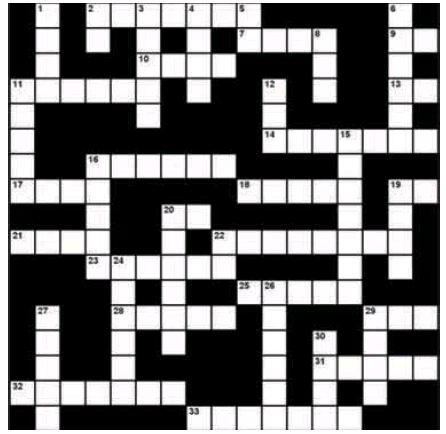
Across
2. We fought _________ the measure.(7)
7. The cat jumped _________ the table.(4)
9. The cat climbed _________ the tree.(2)
10. My story is shorter _________ yours.(4)
11. Cats are _________ dogs.(6)
13. Put the cookie _________ the jar.(2)
14. Let’s walk _________ the park.(7)
16. The vegetables were planted ________ the apple tree.(6)
17. Banu sings _________ a bird.(4)
18. My story is _________ my pets.(5)
19. Subash is the president _________ our class.(2)
20. We live _________ the river.(2)
21. Let’s walk _________ class together.(4)
22. The bank is _________ the park.(8)
23. We live _________ the city limits.(6)
25. I saw John waving _________ the crowd.(5)
28. I am more cautious _________ the fall.(5)
29. I have a present _________ you.(3)
31. We strolled _________ the river.(5)
32. He ran _________ us.(7)
33. The leaves had collected _______ the trees(7)
Down
1. I put the book _______ the table.(4)
2. Please treat us _______ equals.(2)
3. Desert will be served _______ dinner. (5)
4. My house is _______ the school.(4)
5. We walked _______ the store.(2)
6. No eating _______ class.(6)
8. The book fell _______ my desk.(3)
11. I will not leave _______ the speech is finished.(5)
12. The store is open everyday _______ Sunday.(3)
15. The dog is _______ the house.(7)
16. The cat is hiding _______ my bed.(5)
19. The cat jumped _______ the dog.(4)
20. He is hiding _______ the bookcase.(6)
22. Dinner is _______ the table.(2)
24. I put my hands _______ my Pockets.(6)
26. We will eat _______ the play.(6)
27. The cat is sleeping _______ the bed.(5)
29. This letter is _______ my aunt.(4)
30. We ran _______ the other kids.(4)
337.
Represent the other paragraphs in a visual form of your choice.(flow chart, mind-map, pie-chart etc.)
338.
Read and understand the data presented in the pie-chart below on factors affecting health, and write an article for your school magazine highlighting the fact that it’s our lifestyle that determines how healthy we remain. Write your article in about 150 words. Give a suitable title too.
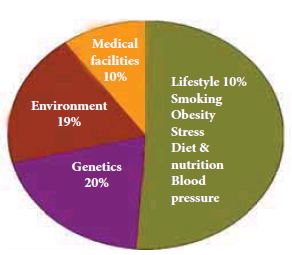
The factors which affect health are given percentage-wise in the pie-chart.
339.
Do you know what happened to the Titanic, the largest ship to sail then? She hit an iceberg and sank into the Atlantic Ocean. Now choose the right word and complete the paragraph. Read the paragraph aloud.
The wreck __ (1)__ (up/of) the RMS Titanic lies ___ (2)___ (in/at) a depth of___ (3)___ (about! above) 12,500 feet about 370 miles southeast___ (4)___ (of/off) the coast of Newfoundland. It lies ___(5)___ (inion) two main pieces about, a third ___ (6)___ (of/off) a mile apart. The bow is still largely recognizable ___ (7)___ (with/within) many preserved interiors, despite the damage it sustained hitting the sea floor. A debris field ___ (8)_ (of/for) the wreck contains thousands ___ (9)___ (on/of) items spilled ___ (10)___ (from/of) the ship as it sank. She sank___(11)___ (in/at) the year 1912.
340.
Complete the following paragraph by filling in the blanks with suitable prepositions and read the paragraph aloud for better understanding of the use of prepositions.
Mr. Beek of New Jersey has invented a floating life-preserver, which gives complete protection ____ (1)____ people who have been shipwrecked. The upper section is large enough ____ (2)____ the wearer to be able to move his head and arms ____ (3)___, and a month's supply ____ (4)____ food and drinking water can also be stored ____ (5)____ it. The cover can be closed in rough weather, and the wearer can see ____ (6)____ the window in the front, and breathe ____ (7)____ a curved pipe. The life preserver is made ____ (8)____ water proof cloth attached ____ (9)____ circular metal tubes, which protect the wearer____ (10)____ sharp rocks and hungry fish.
341.
Read the following passage adapted from 'Three Menin a Boat' and fill in the blanks with appropriate modals and read the paragraph aloud.
I thought I will go to British Museum today to read the treatment for some slight ailment of which I had a touch. I _ (1)_ read all I wanted to read and then felt I _ (2)_ begin to study diseases. I started to generally turn the leaves idly. I came to typhoid fever, read the symptoms and discovered I _ (3)_ be having it for months without knowing it. Cholera, I had severe complications. Diphtheria, I _ (4)_ have been born with. I was relieved to find that Bright's disease I had only in a modified form as so far as that was concerned, I _ (5)_live for years. The only disease I _ (6)_ conclude I had not got was a housemaid's knee. I sat and pondered. I tried to feel my heart. I _ (7)_ (not feel) my heart. I walked into the reading room as a happy healthy man but crawled out as decrepit wreck.
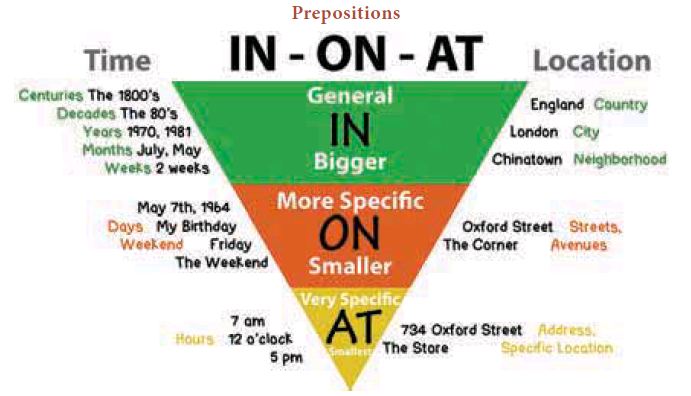
342.
In our family, we have planned to take children to zoo next Sunday. Van has been arranged and we are sure to have comfortable journey. Zoo is interesting place for children who enjoy watching animals and want to know more about them. Even youngsters love to visit zoo.
343.
atm without security guard to close
344.
card license to replace paper driving license
345.
telephone customers to get video phone
346.
municipal elections in december
347.
You are the School Pupil Leader. Your school organised an Inter-School Sports event at Nehru Stadium. Write a report on the special events conducted in 100-120 words for the school souvenir.
348.
You have recently attended a seminar on ‘Science and Literature’ in which writers presented papers on Science Fiction and Literature and focused on the creativity of young writers. Write a short report about it for a leading newspaper in about 100-120 words.
349.
To Autumn
O Autumn, laden with fruit, and stained
With the blood of the grape, pass not, but sit
Beneath my ____________, there thou may’st rest,
And tune thy jolly voice to my ____________;
And all the daughters of the year shall dance!
Sing now the ____________ of fruits and flowers.
“The ____________ opens her beauties to
The sun, and love runs in her ____________;
Blossoms hang round the brows of morning, and
Flourish down the ____________ of modest eve,
Till clust’ring Summer breaks forth into singing,
And ____________ strew flowers round her head.
The spirits of the air live on the smells
Of fruit; and joy, with ____________, roves round
The gardens, or sits singing in the trees.”
Thus sang the ____________ as he sat,
Then rose, girded himself, and o’er the bleak
Hills fled from our sight; but left his ____________.
William Blake
1.
Onomatopoeia.
The fact of words containing sounds similar to the noises they describe. The words, ‘snaps’ and ‘cracks’ refer to the sounds.
2.
3.
i. The success in a game pleases the ego.
ii. The athletes have only success in their mind. They are often rough because they do not think about the feelings of the opponents.
4.
5.
a) Now the poet has realised that he has only a fake laughter. But he wants to give real laughter. So he wants to relearn how to laugh.
b) He wants to relearn from his son.
c) Simile.
6.
a) ‘They’ are the people of the modern world.
b) ‘Ice-block-cold-eyes’ means people laugh without feeling of warmth or endearing expression.
c) Metaphor.
7.
a) ‘Heaven’ refers to God.
b) As this is the plan of God, he calls it ‘holy’.
8.
a) The twigs try to catch the breezy air.
b) The poet’s thought was that they were all very happy.
9.
a) The poet’s faith is that every flower enjoys its life.
b) We see the happiness of Nature here.
10.
The poet wants his laughter to be real. But now he has learnt to smile like others with false face. Now he wants to unlearn whatever he has learnt from the modern world.
11.
To show that the handshake of the modern man is fake the poet gives this line. When he shakes hands he tries to find out the financial and social worth of the other person.
12.
The smile in a portrait is a meaningless smile. The smile of the modern time people is compared with the smile in a portrait.
13.
In the modern world handshake is fake and it does not come from the heart.
14.
Sletherby was shocked because K.C told him that Saltpen-Jogo changed her dark brown hair to brilliant blonde.
15.
A car was waiting for Sletherby to go to Saltpen-Jago. The car showed the richness and the elegance of the lady. She was a brilliant and level-headed woman. She was a clear thinker and an influential woman. Now she had changed her dark brown hair to brilliant blonde.
16.
On the car door there were two crests – one greyhound and the other a demi-lion holding in its paw a cross-crosslet.
17.
Bertie requested Sletherby to lend him two or three pounds and he would return it when he reached his home. Sletherby first accepted. Then because of the confusion about the crests he was not ready to believe him. So he refused to lend him money.
18.
One crest had a demi-lion holding a cross-crosslet in its paw. The other was just a greyhound. The first one was for Saltpen and other was for Jago. The Saltpen-Jago used both the crests.
19.
Bertie said that his crest was a demi-lion holding a cross-crosslet in its paw. Sletherby told him that his family crest was a greyhound. This he learnt from his mother’s letter to him. Bertie explained that they had both in his family but Sletherby did not believe him. So there was a tinge of coldness in his voice.
20.
Bertie was the travel companion of Sletherby. He had left behind his sovereign-purse in which he had his money and crest. Now he needed at least three pounds to spend in Brondquay for three days’ fishing. But he was left with only six pence.
21.
His travel companion cursed and muttered because he had left behind his sovereign-purse. He had money and his crest in that purse.
22.
There was a re-election in Chalkshire for the Parliament. Sletherby might get the seat with the help of his new friendship with Honoria Saltpen-Jago.
23.
Philip Sletherby visited Brill Manor to meet Mrs. Saltpen-Jago. She was his new acquaintance and he wanted to get a favour from her.
24.
Though the poet does not want to play, he appreciates the players. So he buys tickets of high denominations. The metal referred here is to mean the high value.
25.
In some games like boxing one player may break the knee or cracks the wrist of the other so the referee would ask some help from a doctor to give first aid. The gallery where the spectators are sitting is referred to as ‘stands’.
26.
The athletes are not conscious of the feeling of others. The enthusiastic athletes play roughly without considering others’ feelings.
27.
The poet does not wish to exchange the position with the runners because they attack each other to win the race.
28.
The poet does not want to get hurt. His prudence does not allow his ego to come up to do some heroic deeds. So he is satisfied at watching the heroic deeds of others.
29.
The narrator is not heroic because he never wants to be an athlete. He does not want to take any risk.
30.
The poet feels glad that he need not suffer like other athletes. He need not satisfy his ego.
31.
In the olden days people had real laughter, not fake laughter. Their eyes could reflect the reality in their laughter.
32.
He gave a note from Wells to Bob.
33.
The tall man was a policeman in plainclothes who was sent by Wells, the patrolman.
34.
When they came to a bright electric lamp, Bob looked at the other man. The other man’s nose was different from his friend’s nose. So he realised that the tall man was not his friend.
35.
The friends parted ways to find their livelihood in their own way. One went to the West and the other stayed in New York.
36.
The man awaiting the arrival of his friend had a pale squire-jawed face. He had keen eyes and a little white scar near his right eye brow. His scarf pin was a large diamond.
37.
A restaurant named Big Joe Brady’s used to be there in the place of the shop twenty years ago.
38.
The man standing near the hardware store told the passing cop that he was waiting for his friend Jimmy Wells. Both of them had made a promise twenty years ago to meet at the same time.
39.
The streets were devoid of people because of the chilly gusts of wind with imminent rain.
40.
He was looking at the doors of the shops and turning now and then to watch the traffic carefully.
41.
The policeman on the beat moved in the street impressively. He was twisting his club with some complicated movement. He was a physically strong man.
42.
The child in this poem symbolises good qualities of human life without hypocrisy.
43.
The poet longs for the old life with human values where we had real laughter and real concern for others.
44.
The mirror reflects the poet’s laugh as a laughter with the teeth; fake laughter.
45.
He desires to unlearn all the hypocritical behaviour and relearn real human relationship.
46.
The poet uses pleasantries like “Feel at home”, and “come again” to fake cordiality.
47.
When the poet says ‘goodbye’, he means ‘good-riddance’. It means that the poet is relieved of an unwanted person.
48.
As we change the dresses according to different occasions, we change our face according to different people and occasions.
49.
Laugh with their teeth, ice-block-cold-eyes, shake hands without hearts, cocktail face, portrait smile, to say “goodbye” to mean ‘good-riddance
50.
When the poet visits someone for the third time he is not welcomed by the other.
51.
Narrator is the father and the listener is the son.
52.
Once upon a time people were true to their words and deeds. Now-a-days people are hypocrites.
53.
The common thing about the ‘angler’ and the ‘poet’ is that they forget about their things. It is because their mind is filled with some serious and glorious matters.
54.
The players are the citizens of ‘dreamland’. After the game they think about what happened in the playground.
55.
Books, walking sticks and umbrella are the articles the author forgets most often.
56.
The letter is kept in the pocket and it is totally forgotten and it stays in the pocket for a long time till someone asks about the letter.
57.
According to Lynd the commonest type of forgetfulness is to post letters.
58.
Psychologists say that people forget things because they want to forget them. If we have aversion for something we forget it.
59.
A person easily remembers telephone numbers, addresses of his friends, dates of a good vintage, appointments of lunch and dinner, names of actors, actresses, cricketers, football players and murderers.
60.
Lynd actually wonders at the efficiency of human memory.
61.
Nature gives its best to the human beings but Man does not treat Nature well. He is responsible for the destruction of Nature and Man.
62.
The poet sits in a grove which is full of plants. Then he finds joy in different flowers. He enjoys looking at the birds which are jumping and playing.
63.
Birds were jumping and playing around him. So the poet thinks that birds were happy.
64.
People do not think about the welfare of others. They plan to destroy others. Thus people bring grief and sorrow to one another.
65.
Nature affects a person’s thoughts and feeling. He feels happy to be in the midst of plants and flowers. Nature is connected to the soul of Man.
66.
The poet feels happy and sad while enjoying the beauty of Nature.
67.
In the afternoon the grandmother felt relaxed to feed the sparrows with bits of bread. That was the happiest time of the day for grandmother.
68.
The grandmother was old but she believed that she would live to see the author after his completion of studies abroad. So she was not sentimental.
69.
70.
The grandmother accompanied the author to school because she had a chance to feed the stray dogs with stale chapattis. Moreover she had time to read scriptures inside the temple.
71.
The author studied in the village in his childhood. His school was attached to a temple and the priest was their teacher.
72.
The author was left with his grandmother in the village because his parents went to live in the city.
73.
In the portrait the grandfather was found wearing a big turban and loose fitting clothes. He had a long white beard which covered the major portion of his chest and he looked as if he was hundred years old.
74.
Alliteration, Rhetorical Question.
75.
Personification.
76.
Personification.
77.
She retained her world title in 2006 in New Delhi. This she considered her greatest achievement because she did it in India, in front of her own people.
78.
She was greeted with garlands, drumbeats and dancing. There was a victory ride across the town. A felicitation programme was held in Langol. There was a thanks-giving prayer and people showered words of praises on her.
79.
She found it difficult to use the chopsticks to eat Chinese food.
80.
She realised that the boxers were not unbeatable. Though she lost her finals in the USA, the matches gave her confidence that she could oppose any competitive players.
81.
She was not used to the American food. So she could not eat well and she lost her weight. She thought that it was the reason for her loss.
82.
The Indian team was the last to arrive in Pennsylvania. They had to go straight to the sporting arena. She found that she did not have any match on that day. So she was lucky to take some rest.
83.
America was pleasing to her eye and the people were enormously nice to her.
84.
She received Rs. 10000 from others to make her trip to USA to participate in World Women’s Boxing Championship. So she thought that she should not return empty handed after the efforts taken for her trip to USA.
85.
Her father collected Rs. 2000. Two MPs donated Rs. 5000 and Rs. 3000 respectively. Thus she got financial support for her trip to the USA.
86.
Jimmy Wells has been more successful than Bob. He is now a respectable police man though his earning may not be as big as what Bob has. Bob has become a criminal and has earned huge money. But he could not lead a peaceful life.
87.
Jimmy Wells gave a letter to Bob through the plainclothes man. He wrote that when he saw Bob’s face he understood he was the wanted criminal in Chicago. But he himself could not arrest him because he was once his best friend.
88.
Bob said that the life in the west was not that easy. The West had put him into many critical situations. He had to compete with many people to earn his livelihood.
89.
Bob had an expensive large diamond scarf pin which an ordinary man could not wear. When Bob took out his watch to see the time the cop noticed that it was a handsome watch with the attachment of small diamonds. Thus he came to understand that Bob had been successful in the West.
90.
Bob was hopeful that his friend would come to meet him. He told the policeman that his friend would never forget his promise. He was ready to wait for half an hour more than the appointed time.
91.
Jimmy would not go out of New York. He could not earn as much as Bob. Jimmy was slow in his dealings but a good fellow. He would surely keep his promise of meeting him at the particular place though he had taken the promise twenty years ago.
92.
Bob said that he and his Jimmy lived together in New York. They were good friends. Twenty years back they had dined in Big Joe Brady’s restaurant. They decided to find their own ways for the livelihood. After the dinner they had taken a promise that they would meet in the place at the same time after twenty years. Bob went to the West and Jimmy stayed in New York.
93.
The dentist had lost his key to the tool cabinet. So he could not open the cabinet. In order to open the tool cabinet he used the hammer, the pliers and the hacksaw. The hammering and screeching noises came from the surgery because the dentist was trying to open the tool cabinet with those instruments.
94.
The patients were listening to the hammering and screeching noises from the surgery. They felt scared. Moreover it was getting late as the dentist was trying to find out his key to the tool cabinet. The patients lost their patience and they left one by one.
95.
The patients were listening to the hammering and screeching noises from the surgery. They felt scared. Moreover it was getting late as the dentist was trying to find out his key to the tool cabinet. The patients lost their patience and they left one by one. Woman 5 was unaware of that because she was interested in showing her photographs to others. Thus she moved ahead in the waiting list.
96.
Woman 5 was not aware of what was happening because she was only interested in showing her photographs to others.
97.
Woman 1 was more panic than the others because she was the wife of Joe who was inside the surgery. She thought her husband was in great pain.
98.
The first patient was Joe. When he was inside, the nurse carried a hammer, a pair of pliers and a hacksaw. Those who were waiting in the waiting room thought that the dentist was using the instruments on the first patient. So they sympathised with the first patient.
99.
The waiting people heard the hammering and the screeching noise from the surgery. Woman 1, Joe’s wife thought that the dentist was using the instruments on her husband and the noises were coming from the use of those instruments. So she was trying to go inside. Woman 2 pulled her back and tried to pacify her. Man 4 was confident that the dentist knew how to use the instruments.
100.
The nurse carried a hammer, a pair of pliers and a hacksaw. The waiting patients interpreted that the dentist was using those instruments on the patient Joe.
101.
Children are afraid of visiting the dentist. They are afraid of the pain they may undergo when the dentist treats their teeth.
102.
The other Woman did not show much interest to see her photographs.
103.
Woman 5 had a bunch of photographs of hers which she had taken during her holidays. She spent her time by showing the photographs to others.
104.
The patients were waiting for the dentist.
105.
The baby was taken out in a perambulator by its father. On his way home he wanted to get into a store. So he left the pram outside and entered the store. After finishing his work he came out through another door and went back home forgetting the child. The mother happened to come that way and was shocked to see the abandoned baby. She pushed the pram home thinking that the father would be worried about the missing baby. But when he came home he asked her what she had for lunch. He totally forgot about the baby.
106.
The anglers and poets fill their mind with more glorious matters than the ordinary things. Such absentmindedness is considered a virtue. They often make the best of their life so they do not remember the ordinary things.
107.
When the sportsmen return from the games their imagination is still filled with the vision of the playing-field. They recall their exploits in their mind. They are not connected with the outside world. So they forget to take the ball and bat with them when they leave the train.
108.
109.
Taking medicine should be one of the easiest actions to remember. Medicine is supposed to be taken during, before or after meal. The meal itself should be a reminder for taking medicine.
110.
Human memory works less than its usual capacity when it comes to the case of taking medicine. It is easy to remember because medicine is connected to our food. But we forget it many a time.
111.
Our memories are filled with the names of actors, actresses, cricketers, football players and murderers. Moreover we remember the name of the hotel where we had an unpleasant meal and all the items of our dress. Normally we do not forget to shut the door when we leave the house.
112.
A list of articles lost by railway travellers was published. When people read the list they wondered about the absentmindedness of their fellow beings.
113.
When the grandmother realised that her end had come, she stopped her prayer. She gathered some women. She got an old drum and sang the home-coming of warriors. The next morning she was taken ill. The doctor said that it was not serious. But she said that her end was near. She stopped talking to her people. She lay peacefully in bed praying and saying her beads. In a short time she died.
114.
115.
According to the grandmother children should be taught prayer and scriptures. She was very upset to know that in city school there was no teaching about God. She did not think that the subjects taught in the school would teach any value to the children.
116.
The village school was attached to a temple. The priest acted as the teacher and taught the children alphabet and morning prayer. In the city, children are taught English, Western Science and music. There is no teaching about God and the scriptures.
117.
The grandmother walked about the house in neat white dress. She always had a rosary with her. Every morning she woke the author up for the school. While she bathed him, she said her prayer. Then she went to school with him. She had some stale chapattis with her to feed the stray dogs.
118.
The author’s grandmother was an old woman with wrinkled skin. She had been like that for twenty years. Once she had been young and pretty.
119.
| Title | The Queen of boxing |
| Author | M. C. Mary Kom |
| Theme | Single - minded pursuit of an Indian woman boxer |
| With this hat-trick of World Championship wins, the media christened me ‘Queen of Boxing’ and Magnificent Mary’. |
‘The Queen of Boxing’ is an excerpt from Mary Kom’s autobiography ‘Unbeatable’. She received silver medal from World Women’s Boxing Championship in 2001. She was greeted well in India. From 2001 to 2004 she won several golds in Senior Women’s Boxing Championships. Even after her marriage she participated in matches and won medals. She won gold in the Third and Fourth World Women’s Boxing Championship in 2005 and 2006. The fourth championship was held in Delhi and that victory was the greatest for her because she won gold in front of her own people. The other boxers also did well in the championship. That was the hat-trick World Championship win for India. So the media named her ‘Queen of Boxing, and ‘Magnificent Mary’.
| Success belongs to only to those who are willing to work harder than anyone else. |
120.
| Title | The Queen of boxing |
| Author | M. C. Mary Kom |
| Theme | Single - minded pursuit of an Indian woman boxer |
| Two MPs donated Rs. 5000 and Rs. 3000 respectively and I suddenly had Rs. 10000 in my hand |
‘The Queen of Boxing’ is an excerpt from Mary Kom’s autobiography ‘Unbreakable’. Here she describes her experiences when she got selected for World Women’s Boxing Championship. After her performance in Bangkok Championship she was selected for the International Boxing Association World Women’s Boxing Championship in Pennsylvania, USA. She had financial difficulties to take up her trip to the USA. All sports persons are not rich enough to go to different countries to participate in matches. They need financial support from others. Some games have sponsorship from big companies. But Boxing is not that much supported in India. Her father could collect only Rs. 2000 and she got donations from two MPs – Rs.5000 and Rs.3000. Thus she went to the USA with Rs.10000. If she had not got the money from the MPs she would not have participated in the Championship matches and India would have lost a successful boxer.
| If you practice hard, you can win every battle |
121.
| Title | The Queen of boxing |
| Author | M. C. Mary Kom |
| Theme | Single - minded pursuit of an Indian woman boxer |
| My father managed to collect only 2000 for my trip |
‘The Queen of Boxing’ is an excerpt from Mary Kom’s autobiography ‘Unbreakable’. Here she describes her experiences when she got selected for World Women’s Boxing Championship. After her performance in Bangkok Championship she was selected for the International Boxing Association World Women’s Boxing Championship in Pennsylvania, USA in November – December 2001. She had financial difficulties to take up her trip to the USA. Her father could collect only Rs.2000 and she got donations from two MPs – Rs.5000 and Rs.3000. Thus she went to the USA with Rs.10000. She stayed in the sports arena because it was cold and snowing outside. Since she did not have match on the first day she could take rest. She reached the finals and thought she could win the gold. But she lost the finals to Hula Sahin of Turkey. She was not used to the food of that place so she could not eat well and lost weight. That must have been the reason for her loss.
| Life is like a boxing match defeat is declared not when you fall, but when you refuse to stand again |
122.
The people who forget very often are normally ridiculed because they lose many opportunities in life to grow. In public life they are not treated well. Even in his family, others will not have confidence in him. He may not be entrusted with any serious work. In some cases highly intelligent people who have some great ideas in their mind forget trivial things. The trivial things may affect the family. For example a wife entrusts on her husband to pay the electricity bill on the last day; but he comes back home without paying the bill. He must have been thinking about something great in his mind. But the family will suffer because of his forgetfulness. In such cases the family people should have good understanding of the person and they should not depend on him for doing such things like paying electricity, or telephone bill. Here a question arises – whether such people should be sympathised with or ridiculed. If his forgetfulness is due to the preoccupied mind it is a case to be sympathised with but if it is a habit it is a case to be ridiculed.
123.
| Title | Forgetting |
| Author | Robert Lynd |
| Theme | Forgetfulness is a form of freedom |
| A man who is a perfect remembering machine is seldom a man of the first intelligence |
‘Forgetfulness is a form of freedom’. It may sound little funny because we curse ourselves if we forget something. Good memory power is always appreciated. In the period of our study we always want to remember what we learn. We feel sorry if we forget our lessons in the exam hall. But in many other cases, forgetfulness is a blessing. Certain unpleasant experience in our memory will be a thorn to us. It will be pricking us all the time. If we forget that we will be free of that unpleasant experience. Such situation occurs very often in our life. It may be a failure in our life and this will be spoiling our happiness. It will be a block for further positive thinking. Some family may lose one of the members and it will be a trying experience for the whole family. They cannot go on living with that sad experience throughout their life. Slowly they will be free of that sad feeling. Loss of a job will also give some problem. But when we forget this we will be free to search for a job. We might land up in a better job. So Gibran is right in saying ‘Forgetting is a form of freedom.’
| The advantage of a bad memory is that one enjoys several times the same good things for the first time |
124.
27, Nethaji Road,
Nagerkoil.
7th August 2020.
Dear Raju,
Thank you so much for having given me your cricket bat. I played well with your bat and I am sure your bat was a lucky bat to me. As you know, we won the match and my contribution was great. After the prize distribution we went to our hotel room and took rest for some time. Then we were talking about our exploits and we were enjoying ourselves. We packed everything and were waiting for our cab to take us to the railway station. Within a short time the cab came and we all ran happily to get our places. In the cab also we were talking about the match. When I got into the train it started moving. Then I realised my blunder. I forgot to pick up your bat from the hotel room. Immediately I tried to contact the manager and told him about this. He promised me to help. I really feel sorry for this. I know how much you love that bat and you gave it to me just to help me. I hope we will get back the bat. I request you to forgive me for this. When I reach our village I will meet you. Sorry for the trouble I have created.
Your loving friend,
Selva.
125.
| Title | The Portrait of a Lady |
| Author | khushwant Singh |
| Theme | Sympathetic lady and empathetic animals |
| When we carried my grandmother’s corpse off, they flew away quietly. |
Animals are capable of empathy. Their love towards their owners cannot be described. Dogs will always follow their owners even if they beat them. Sometimes they follow their cars or two-wheelers. In this story the little sparrows were fed by the grandmother every day. They sat on her legs, shoulders and head. She also enjoyed that. Every day they waited for her. On her death day the sparrows came but refused to eat the little crumbs. When her body was lifted they flew away quietly. My uncle had a big dog. When he died, all of us totally forgot about the dog. When his body was lifted for cremation, the dog gave a groaning voice. Then we realised that the dog did not eat anything the whole day. After the ceremony, my aunty gave some food but it refused to eat. It died the next day.
| Love of animals is deeper than that of man. |
126.
Ayothiapattanam,
Salem,
28 June 2020.
Dear Appa and Amma,
I am doing well here. I hope you both are fine there. My grandma takes care of me well. Everyday morning she wakes me up with her prayer song. Though it is in a monotonous tone, I like it. She bathes me and gets me ready to go to school. Then she will get my slate, a small tiny earthen ink-pot and a red pen. She will tie them all in a bundle and give it to me. She will take some stale chapattis with her and accompany me to the school. My school is attached to a temple and the priest teaches us alphabet and morning prayer while we sit in the verandah. Grandma will sit inside and read the scriptures. In the evening many stray dogs will follow us and grandma will feed them with the stale chapattis. I enjoy my life in the village. But I always miss you both. When will you come here?
Your loving son,
Khushwant Singh.
127.
| Title | The Portrait of a Lady |
| Author | khushwant Singh |
| Theme | Orthodox Grand mother’s bonding with grandson |
| My grandmother always went to school with me because the school was attached to the temple. |
In the lesson ‘The Portrait of a Lady’, Khushwant Singh describes the importance of the grandmother in shaping the life of the author. When the author was a child, his whole life was filled with the activities of his grandmother. When the author was left to the care of the grandmother, he was led by her from morning till evening. In his formative period, she taught him the importance of prayer and God. Usually the elders play a vital role in the life of children. Elders are experienced people who understand what is good for the future of the children. So they could have a positive influence on the younger generation. In this story the grandmother took him to a school which was attached to the temple. There children were taught good values. She showed her strong will to the author which must have influenced him.
| Kids don’t remember what you try to teach them. They remember what you are. |
128.
(iii) Man indulging in wars and acts of destruction
129.
(iii) grove
130.
(iii) he is worried about the destruction caused to Nature
131.
The School Pupil Leader should have leadership qualities. The sports field can give a lot in this regard. The first and foremost quality he gains from the sports field is the team spirit. He has to lead the students of the school and he has to cooperate with many students – his classmates and schoolmates. He has to consult the management and the teachers for the success of a programme. Next quality is tolerance which is also important for a School Pupil Leader. Punctuality is another quality he can get from the sports field. The sports field teaches him co-operation and accommodative spirit.
132.
All athletes need some support and appreciation. Especially when they win some medals they expect their country to recognise their feat. They need sponsorship also because we cannot expect all the athletes to be rich enough to meet out their expenses. If they play for some clubs, the particular club should take charge of their expenses. If they play for their school or college, the particular institution should spend money on their behalf. The club or school or college should recognise them when they come back with medals.
133.
I will never exchange my place with anybody. God has given my life and my life will never fit into others. My life depends on my goal in life and the way I take my goal seriously. How can my life fit into others? Moreover my study system may be different from others. I cannot study like others. My favourite subject or sports may be different from others. I cannot change my favourite for someone else.
134.
Life has different openings for different people. So everyone has a special area for him/her to play. The success depends on how the role is played. In this way everybody is a hero in his own area. It depends on his family and society. Sometime the economic status also affects the individuals. In their views the life has different arena. Each one has his/her own story to tell others. Some will have success stories and other may have failure stories. Some will be suffering heroes and other will be successful heroes.
135.
Accidents happen in the playground usually because of the rough game of the players. Each game has its own way of accidents. In cricket, the bowler may be ruthless and it may hit the batsman. It has become fatal in some cases. In football the players play rough game without following the rules properly. In games like volleyball where the team will not have any physical contacts, the accident will happen because of fall on the ground. In athletes one player may cross his line and hit the other and the victim will fall and break his bones.
136.
| Poem | Confession of a Born Spectator |
| Poet | Frederic Ogden Nash |
| Theme | A spectator can be as enthusiastic as a performer |
| But zealous athletes play so rough They do not ever in their dealings Consider one another’s feelings |
Ogden Nash (1902-1971) was an American poet well-known for his light verse, of which he wrote over 500 pieces. With his unconventional rhyming schemes, he was declared the country’s best-known producer of humourous poetry.
In the poem ‘Confessions of a Born Spectator,’ Ogden Nash talks about how people choose different sports in their lives or decide to become athletes. While admiring the talents of the athletes and sportsmen, the poet confesses that he is neither a sportsman nor an athlete. The players get injuries while playing. It mostly happens because they play rough and noisy game. When a player runs to get his point the opponent will try to knock him down. He may fall to the ground and break his backbone. They sweat for fun or hire. To show their prowess, they maim each other. Thus the athletes sustain injuries because they are zealous enough to play rough games.
| Athletes who sweat for fun or hire, who take the field in gaudy pomp, And main each other as they comp |
137.
| Poem | Confession of a Born Spectator |
| Poet | Frederic Ogden Nash |
| Theme | A spectator can be as enthusiastic as a performer |
| I am just glad as glad can be What I am not them, that they are not me |
Ogden Nash (1902-1971) was an American poet well-known for his light verse, of which he wrote over 500 pieces. With his unconventional rhyming schemes, he was declared the country’s best-known producer of humourous poetry.
In the poem ‘Confessions of a Born Spectator,’ Ogden Nash talks about how people choose different sports in their lives or decide to become athletes. While admiring the talents of the athletes and sportsmen, the poet confesses that he is neither a sportsman nor an athlete. As a spectator he watches the rough games of the players. When a player runs to get his point the opponent will try to knock him down. He may fall to the ground and break his backbone. Then he will become invalid in this world. So he does not want to become an athlete and he is contented to be a spectator.
| You’d think my ego it would please To swap positions with one of these |
138.
| Poem | Confession of a Born Spectator |
| Poet | Frederic Ogden Nash |
| Theme | A spectator can be as enthusiastic as a performer |
| I am just glad as glad can be What I am not them, that they are not me |
Ogden Nash (1902-1971) was an American poet well-known for his light verse, of which he wrote over 500 pieces. With his unconventional rhyming schemes, he was declared the country’s best-known producer of humourous poetry.
In the poem ‘Confessions of a Born Spectator,’ Ogden Nash talks about how people choose different sports in their lives or decide to become athletes. While admiring the talents of the athletes and sportsmen, the poet confesses that he is neither a sportsman nor an athlete. The success in an athlete meet may please the ego of the player. But the player plays the game without considering the feelings of the opponents. The zealous athlete plays rough game with an eye upon success. Sometimes he feels a struggle between his prudence and ego and he is happy his prudence wins over his ego. So he is happy to be a spectator.
| I’m glad that when my struggle begins ‘Twist prudence and ego, prudence wins |
139.
| Poem | Once Upon a Time |
| Poet | Gabriel Okara |
| Theme | Duplicity displayed by modern man |
| I have learned to wear many faces Like dresses – home face Office face, street face, host face |
Gabriel Okara (born 1921) is a Nigerian poet and novelist. His verse has been translated into several languages. Okara’s typical poem transits from everyday reality to moments of delight and moves back to reality making a complete circle.
The poet Okara in his poem ‘Once Upon a Time’ painfully condemns the duplicity displayed by adults both in their words and actions. The poet laments about the negative changes that have come upon the modern society. It is an old saying ‘Face is the index of the mind’. It means that face can reflect the real mind of a person. But because of the changes brought into the modern world this proverb has lost its meaning. People laugh concealing their real intention. People’s handshakes do not come from their hearts. So the face does not show reality. In the same way people give words of welcome only from the lips. In the modern world people change their face as they change their dress. Now, in no way does the face show the real mind of a person.
| And I have learned too To laugh with only my teeth |
140.
| Poem | Once Upon a Time |
| Poet | Gabriel Okara |
| Theme | Duplicity displayed by modern man |
| There will be no thrice – For then I find doors shut on me |
Gabriel Okara (born 1921) is a Nigerian poet and novelist. His verse has been translated into several languages. Okara’s typical poem transits from everyday reality to moments of delight and moves back to reality making a complete circle.
The poet Okara in his poem ‘Once Upon a Time’ painfully condemns the duplicity displayed by adults both in their words and actions. The poet laments about the negative changes that have come upon the modern society. In the modern world people do not have real laughter; they have only fake laughter. Their eyes do not show any feeling when they laugh. The handshakes have become mere duplicity. People do not have the warmth when they shake hands with others. The words of welcome come only from the lips, not from the heart. Nowadays people change their faces as they change their dresses. The facial expressions change according to the situation. Thus the poet criticises the modern life.
| Without being glad; and to say “It’s been Nice talking to you”, after being bored |
141.
| Poem | Once Upon a Time |
| Poet | Gabriel Okara |
| Theme | Duplicity displayed by modern man |
| But now they only laugh with their teeth While their ice-block-cold eyes Search behind my shadow |
Gabriel Okara (born 1921) is a Nigerian poet and novelist. His verse has been translated into several languages. Okara’s typical poem transits from everyday reality to moments of delight and moves back to reality making a complete circle.
The poet Okara in his poem ‘Once Upon a Time’ painfully condemns the duplicity displayed by adults both in their words and actions. Here, a father laments to his son about the negative changes that creep into the attitude and behaviour of humans when they grow into adults. He used to be genuine when he laughed. But now his laughter is fake. He has learnt to laugh without any feeling. Their handshakes used to be warm and happy conveying a sense of togetherness, but nowadays the handshakes have become a mere falsity. He too has learnt to give such handshakes. He has again learnt how to welcome people with words coming only from the lips. Now he can change the facial expressions according to the situations.
| Cocktail face, with all their confronting smiles Like a fixed portrait smile |
142.
From Date : 13th July 2020
Sunderam P,
227, Nehru Colony,
Kannigapuram,
Tirunelveli - 627 001.
To
The Councillor,
Ward 32,
Tirunelveli Corporation,
Tirunelveli - 627 001.
Sir,
Subject: Need for a park in our locality regarding.
I am a resident of Nehru Colony which falls in your Ward. There are nearly 300 families in this colony with many school-going children and some senior citizens. The colony is well planned and well laid out but it does not have a park for the children to play safely and a walking path for the adults. Now most of the time children are playing on the streets and it leads to accidents. The senior citizens do not have any safe place to have their morning and evening walk. So on behalf of the residents of Nehru colony I request you to create a park in our locality for the larger interests of children and old people.
Thanking you and awaiting a positive step from you,
Yours faithfully,
Sunderam.
143.
Man is meant to live in harmony with Nature. Nature is the creation of God for the benefit of Man. It does not mean he has the right to trouble nature or destroy it. Nature has its own course. If it is disturbed it will create trouble around us. Nature has given its own protection. But now a days Man has become very greedy and he has destroyed nature for his selfish ends. Because of this Ozone layer is punctured and people suffer from global warming. Many natural calamities like tsunami, earthquake and flood are created due to the destruction of nature. Man has started destroying forests and it affects the rain fall. People suffer due to lack of water. This in turn affects agriculture which is the basic need of human beings. Sociologists say that the worst is yet to come. All these problems occur to humanity because we fail to live in harmony with Nature.
144.
Nurture means to help in the development or feed and take care of a child. Nature is a comprehensive term which covers many things. It can give different meanings in different situations. To Wordsworth, Nature means anything which is not made by man. Nature can be plants, birds, fish and even wild animals. The question is whether nature can nurture or help in the growth. An adult man’s development is not merely on food but with many other things around him. Of course nature is one among them. Nature gives a peace of mind and it gives a chance for the positive growth of man. Nature gives a lot of lessons to man how to behave in a society without hypocrisy.
145.
| Poem | Lines Written in Early Spring |
| Poet | William Wordsworth |
| Theme | Nature’s Holy plan is offering joy and peace |
| And much it grieved my heart to think What Man has made of Man |
William Wordsworth (1770-1850) was a major English poet who, with S.T. Coleridge helped to launch the Romantic Age in English Literature with their joint publication, ‘Lyrical Ballads’. He was popularly known as `Nature Poet`.
Wordsworth in his poem ‘Lines Written in Early Spring’ brings out the idea that Nature is connected to Man’s soul. If Man is close with Nature he will find happiness irrespective of whatever happens. Wordsworth sits in a small woodland grove and listens to the birdsong around him. But although happy thoughts are prompted by the birdsong, the same happy thoughts bring sadness to the poet. The sad thought has come to him because Man is not taking care of his fellow beings and nature. Every plant and flower feels happy and it spreads happiness around him. The birds are jumping and playing around him. Though he cannot understand what they think, he is sure that they are showing their happiness. The birds and the twigs on the trees seem to exist in a world of pleasure. Nature’s plan is to make Man happy but because of Man’s destructive nature he brings unhappiness to the world. He clearly says that man is cruel to other men because he is losing his link with nature.
| And it’s my faith that every flower Enjoys the air it breaths |
146.
| Ans | |
| amateur x professional | |
| compulsory x optional | |
| traditional x modern | |
| expensive x cheap | |
| hopeful x desperate | |
| accepted x refused |
147.
(a)
interesting
148.
(c)
gathered
149.
(b)
anxiety
150.
(c)
accept
151.
(d)
included
152.
(a)
serious
153.
(b)
arid
154.
gilt/guilt
155.
weary/wiry
156.
paused / passed
157.
quote/coat
158.
feet/feat
159.
packet / pocket
160.
loose / lose
161.
whether / weather
162.
a. corpse
b. Corps
163.
a. threw
b. through
164.
a. pale.
b. pail
165.
a. lessen
b. lesson
166.
a. bred
b. bread
167.
a. principal
b. principle.
168.
a. waist
b. waste
169.
a. break
b. brake.
170.
Once I accompanied my sister to a private clinic. She was suffering from a severe cold. As we were asked to sit in the waiting-room, the doctor arrived. The nurse called the first patient and took him into the consultation room. Minutes ticked by, and my sister was actually the second to see the doctor. We were at the end of our tether because the first person had not come out and more than one hour was over. I pestered the nurse with enquiry after enquiry. She lost her cool and moved to the other doctor’s surgery. Being curiosity-stricken, I opened the door ajar only to find that both the patient and the doctor were not in the room. I felt dazed, and approached the nurse to know what was happening. The nurse told me very coolly that both of them made their exit through the other door because they wanted to watch the thrilling final world cup soccer match.
171.
If I were Jimmy Wells I must have done the same as Wells has done. Bob had become a hard core criminal. If he had just started slipping form the right attitude there might have been some possibilities to help him pull out of his criminal activities. But in the given situation it is very difficult to change him. Moreover as a responsible patrolman I may not have any other choice. If I avoided arresting him, he would as usual indulge in unlawful activities to hoard wealth. It is likely that he might attempt homicide to rob the hapless people. Moreover, evading duty would prick my conscience as an honest policeman. In my opinion, nobody is above law. Since duty consciousness takes precedence over friendship, I have Hobson’s choice in this case.
172.
If my friend is indulging in some wrong activity surely it will shock me. I will not avoid him but I will try to correct him. I can give many reasons for this. To err is human. Most of the time people fall into some wrong activity because of some unforeseen circumstances. We have to decide whether we should hate the man or the situation. I will hate the sin rather than the sinner. I have the hope that my friend will listen to me if I tell him in the proper way. Moreover my friend is a nice guy and he can change his way of life if he comes to realise the serious consequences of his action. So I will try my best to mend him, not end friendship.
173.
O. Henry in his short story ‘After Twenty Years’ introduces two friends – Jimmy Wells and Bob. They were friends for many years. Both of them lived in New York. When Bob was eighteen and Wells was twenty they parted ways to find their own means to earn money. When they parted, they decided to meet after twenty years in the same place at the same time. Bob went to the West to find his ways but Wells stayed in New York. After twenty years Bob came to the place and he was met by a patrolman. The patrolman was none other than Wells. He realised Bob but he understood that he was the criminal wanted in Chicago. But he did not want to arrest his friend so he sent another policeman in plain clothes to arrest him. In the beginning their friendship might prove the statement true. But at the end it was totally different.
174.
Steps should be right – steps to justify the end – Well and Bob friends – Bob rich with ill gotten money – Wells respectable policeman – Bob rich end – means bad – ill gotten money – no help – end justifies the means
‘Means should justify the end’. It means the steps we take to reach the end should be right socially and morally. The steps should justify the end when we reach it. The end may be to become rich but the steps we take to reach our end should justify the end. If we become rich by foul means, the means will not justify the end. O. Henry, in his short story ‘After Twenty Years’ introduces two characters – Jimmy Wells and Bob. Both were good friends. They parted ways to search for their livelihood. Wells became a respectable policeman but he was not very rich. Bob became very rich but only with ill-gotten money. He was a criminal and he was wanted by the police. His end might be great but his means would never justify the end. At the end of the story the money he had earned through his criminal activities did not help him. Wells’ end is not very great but his means as a professional policeman justify his end.
175.
After Twenty Years written by O. Henry – Jimmy Well and Bob friends – lived in New York – parted – to meet after 20 years – Bob to West – Wells stayed – Bob changed a lot – a criminal – Wells a policeman – Bob came – Couldn’t recognise – Wells identified – respected friendship – sent another policeman – arrested Bob
O. Henry in his short story ‘After Twenty Years’ describes the friendship of two men, Jimmy Wells and Bob. They lived in New York. When Bob was eighteen and Jimmy was twenty, they decided to go their own way to find their livelihood. When they parted, they decided to meet each other after twenty years. On that day they dined in Big Joe Brady’s restaurant and said they would meet in the same place at the same time after twenty years. Bob went to the West and Wells stayed in New York. So far they did not have much difference in their characters. But the West changed Bob a lot. He became a criminal and earned a lot. Wells became a respectable policeman. As they planned, Bob came to the place at the scheduled time. Wells was also in the same place as the patrolman. Wells identified Bob as the wanted criminal from Chicago but Bob could not identify Wells. In the twenty years Bob became very rich with the ill-gotten money. Wells was not that rich in terms of money but he was rich in character. He respected his friendship with Bob so he did not arrest him. He sent another plainclothes man to arrest him.
| Sweet is the memory of distant friends! Like the mellow rays of the departing sun, it falls tenderly, yet sadly, on the heart. - Washington Irking |
176.
smart man – mistakes genuine plea – Sletherby travels – Bertie co-passenger –searched – couold not find – second son of Saltpen – asked him loan – Sletherby promised – doubted him – refused to loan – learned he was mistaken
Hector Hugh Munro in his short story ‘A Shot in the Dark’ describes how a man who considers himself very smart finds that he has mistaken the genuine plea of a stranded youth. Sletherby was travelling to Brill Manor. Bertie was Sletherby’s co passenger and he was frantically searching his bag for something. But he could not find out what he wanted. Then he informed Sletherby that he was the second son of Saltpen-Jago whom Sletherby wanted to meet in Brill Manor. He further told him that he had left behind his crest and money. Sletherby promised him that he would lend him three pounds. But due to certain situation Sletherby doubted him and refused to lend him money. Though he saw the son he did not believe him. When he reached Brill Manor, he realised that what Bertie had told him was right and he only mistook him.
177.
Hector Hugh Munro in his short story ‘A Shot in the Dark’ describes how a man who considers himself very smart finds that he has mistaken the genuine plea of a stranded youth. Sletherby was travelling to Brill Manor. Bertie was Sletherby’s co passenger and he was frantically searching his bag for something. But he could not find out what he wanted. Then he informed Sletherby that he was the second son of Saltpen-Jago whom Sletherby wanted to meet in Brill Manor. He further told him that he had left behind his crest and money. Sletherby promised him that he would lend him three pounds. Then Bertie gave a description of his crest and his mother’s crest. Both did not correspond with the knowledge Sletherby had on Saltpen-Jago. As he doubted Bertie he refused to lend money to him. But when he reached Brill Manor he realised that Bertie was right. If I were Sletherby I would surely ask to pardon me. Doubting a gentleman would have hurt him. Not only that, Bertie was left stranded without money. So because of my rude behaviour I would apologise to him.
178.
‘A Shot in the Dark’ by Munro – man considers smart – mistakes a genuine man – travelling to Brill Manor – meet SaltpenJago – Bertie co-passenger – says second son of SaltpenJago – left his purse – asked for a loan – his crest raises doubt – colour of her hair – refused to lend – reached Brill Manor – have two crest – changed her hair colour – he is wrong
Hector Hugh Munro in his short story ‘A Shot in the Dark’ describes how a man who considers himself very smart finds that he has mistaken the genuine plea of a stranded youth. Sletherby was travelling to Brill Manor to meet Saltpen-Jago to get a personal help from her. His co passenger was Bertie who was a twenty two year old youth. He told Sletherrby that he was the second son of Saltpen-Jago. He further informed Sletherby that he had left behind his purse and he asked him to lend him three pounds. He described his crest as a demi-lion but Sletherby had received a letter from Saltpen-Jago with a different crest – a greyhound. Bertie told him that his mother’s hair was blonde but Sletherby had seen her with dark hair. So he doubted Bertie and refused to lend him money. When he reached Brill Manor he came to know that the family had two crests – one demi lion and another one greyhound. Saltpen-Jago had changed her hair from dark to blonde. Now he realised that his judgement was wrong.
179.
‘A Shot in the Dark’ by Munro – man considers smart – mistakes a genuine man – travelling to Brill Manor – Bertie the co-passenger – searched for something – said second son of SaltpenJago – Sletherby doubted him – crest description confirmed doubt – proved wrong – Sletherby cautious
Hector Hugh Munro in his short story ‘A Shot in the Dark’ describes how a man who considers himself very smart finds that he has mistaken the genuine plea of a stranded youth. Sletherby was travelling to Brill Manor. When we travel usually we avoid talking to any strangers and we will be very cautious even if we talk to strangers. His co passenger was Bertie, a youth of twenty two. He was searching something in his bag. He told Sletherby that he was the second son of Mrs. Saltpen-Jago. But Sletherby had some doubts. Bertie said he had left behind his purse and he asked Sletherby to lend him three pounds. When he described his crest and his mother’s hair Sletherby’s doubt was confirmed. He had been very cautious from the beginning. Though it was proved wrong in the end, we cannot find fault with Sletherby. Everybody should be cautious when we travel with a stranger.
180.
‘A shot in the Dark’ written by Munro – man considers smart – mistakes a genuine man – travelling to Brill Manor – co-passenger – searches something – could not find his purse – left behind with money – described his crest – doubted him – refused to lend money
Hector Hugh Munro in his short story ‘A Shot in the Dark’ describes how a man who considers himself very smart finds that he has mistaken the genuine plea of a stranded youth. Sletherby was travelling to Brill Manor. The youth was his co-passenger. He was about twenty two with dark hair. He was frantically searching something in his bag. He took out many things from the bag and kept them on the seat. But he was not satisfied. It showed that he could not find out what he was searching. Then he had a talk with Sletherby. He told him that he was the second son of Mrs. Saltpen-Jago whom Sletherby was going to meet in Brill Manor. He said that he had left behind his sovereign purse which had some money and his crest. His description of his crest and his mother made Sletherby doubt him. So he refused to lend him three pounds.
181.
dentist arrived – Joe entered – nurse with a hammer – others mistook – nurse with pliers and hacksaw – patients afraid – left – realised their mistake – dentist lost his key
C V Burgess in his play, ‘The First Patient’ displays a dentist’s clinic with some waiting patients. When the dentist arrived, the first patient Joe entered the surgery. After a few minutes the nurse carried a hammer inside the surgery. The waiting patients thought that the dentist would use the hammer on Joe. Then she carried a pair of pliers and a hacksaw. The waiting patients were afraid of the dentist and left the clinic one by one. Then it was clear that they had a mistaken understanding of the situation. The dentist lost his key to his tool cabinet so he had used all the instruments to open the cabinet. But he could not succeed. After fruitless search, he found it under the telephone directory. All the patients except one left the clinic so the dentist lost his one day business.
182.
“Reading makes a full man” said English philosopher Sir Francis Bacon and no truer words were said than these. Reading nourishes the intellect and nurtures the imagination. There is nothing more relaxing and soothing than sitting in the corner of a room with a book in your hands. Without travelling, without even moving an inch, the reader is transported to a new world and is exposed to a new culture and new ideas.
Good books are storehouses of human knowledge and wisdom. Anyone who has the key can enter these storehouses and enrich himself. What is the key? Simply the readiness to read. He who can read can store his mind with the noble thoughts of the great thinkers of the world. The man who never opens a book has a comparatively empty mind. He, no doubt, learns something from his own experience and from others; but to what mankind has learnt and thought and done, his mind is blank. But he who reads widely and judiciously has a full mind.
The aim of education is to draw out or develop our faculties. Reading is one of the means by which we educate ourselves; hence reading has the same aim as education, namely development of our faculties. Man is born imperfect and by life-long endeavour he tries to perfect himself. Reading the thoughts of great men fills him with nobility and inspiration, and acquaintance with current history, science and literature fits him for the struggles of life. No doubt reading books gives you a cutting edge. It equips you with all the requisites to make you emerge successful in the field chosen by you. It infuses in you the skills to solve any problem and make an informed decision.
Certainly, reading makes a full man.
183.
A report on Inter-school Sports Event
My school Balan Memorial Higher Secondary School conducted an Inter-School Sports event on 15th August 2018 in Nehru Stadium. The schools of Chennai region participated in it. All the events were conducted in three levels – junior, senior and super senior. Nearly 70 schools participated in it. We had track and field events and few games. We had 100m, 200m and 400m long jump, high jump, triple jump, relay and shot put. In the games side there were volleyball, football, badminton and cricket (15 overs). It started with the flag hoisting and inauguration function. School children gave programme in dancing and martial arts. Our District Collector was the chief guest. After two hours of programme the sports items were started in one place and games were started in another place. We had very tough competition in most of the items. All the programmes came to an end on 16th forenoon. Afternoon was left for the prize distribution and valedictory function. We were very happy that our school got the championship cup.
184.
A report on a seminar on Science and Literature
A seminar on Science and Literature was conducted on 11th June 2018 by the Science Forum of Chennai sponsored by the Writer’s Club. It was well attended by many known people from all over India. It was inaugurated by Tamil Nadu Science Forum President Dr. Subarayan. He welcomed all those who were ready to present papers in the seminar and asked the other participants to get the maximum benefit from the presentations. In total eighty seven papers were selected from more than 500 papers submitted. All the papers pertained to the topic Science Fiction and Literature. In the modern era many writers are highly imaginative enough to write science fiction. Though it is an oxymoron for many years many writers are attempting to write fiction based on certain scientific concepts. So it has become a separate genre in literature. This has helped many scientists to try to materialise some ideas given by the writers. Young writers are very creative in this regard. The seminar focused on the creative mind of the writers. It was a very successful seminar.
185.
Arthur C. Clarke wrote under his pen names Charles Wills and E.G.O’ Brain. He was born on 16th December 1917 in England. He played different roles in literature, as a novelist, television host, inventor and film screen writer. He wrote different genres like science fiction, television series and film screen play. He received many awards and honours. In 1961 he received Kalinga Prize, an award given by UNESCO for popularising science. Other awards are Hugo and Nebula awards. He was the chairman of the Interplanetary Society. He received the highest civil honour of Sri Lanka, ‘Sri Lankabhimanya 2005’. Clarke, Robert Heinlein and Isaac Asimov are called ‘Big Three’ of Science Fiction. He is also called ‘The Prophet of the Space Age.’ His famous works are Childhood’s End, 2001: A Space Odyssey and Rendezvous with Rana.
186.
a) an approval
If we buy something on approval, we can return it in case we are not satisfied with that.
I bought a set of electronics goods on approval.
b) a rustic holiday - holiday spent in a rustic way, not in a refined way
The friends decided to go for a rustic holiday to a river side for fishing and bathing.
c) double-distilled idiot - a real idiot of the first order.
I did not go in time to the interview so I lost a good job. I was a double-distilled idiot.
d) a tinge of coldness - a slight seriousness
When she realised that her friend was kidding with her she talked to her in a tinge of coldness.
e) making up for lost time – working hard because of loss of time
Because of long government holidays the workers had to work two days to make up for lost time.
187.
I cannot bear the noise of the bear.
188.
He took the file to file all the papers.
189.
The light was on and I saw a light figure in the room.
190.
When the wind was blowing outside they wind the key of his watch.
191.
When the mother tears open the letter from her son, tears well up in her eyes.
192.
She got into the train to go to the seminar to train the students.
193.
(1) spotless
(2) sunset
(3) grandmother
(4) half-hour
(5) homecoming
(6) overstraining
(7) courtyard
(8) gentlefolk
(9) singsong
194.
| A | B | C |
| mantel | lashes | mantelpiece |
| eye | wheel | eyelashes |
| water | gate | waterproof |
| bee | knob | beehive |
| toll | piece | tollgate |
| door | proof | doorknob |
| spinning | hive | spinningwheel |
195.
Doctor : Good evening.
Patient : Good evening sir.
Doctor : What is your problem?
Patient : I have fever for two days doctor.
Doctor : Do you have body pain?
Patient : Yes doctor, some time I couldn’t sleep because of body pain.
Doctor : Let me check you …….. Yes you have 102° fever. Did you take any medicine?
Patient : No doctor. I can’t eat well for two days.
Doctor : Yes, when you have 102 fever surely you cannot eat.
Patient : I think you may give me some medicine for my problem. You see, I have to attend a meeting tomorrow so I should be alright tomorrow.
Doctor : Tablets will not give you immediate relief.
Patient : So what should I do?
Doctor : It is better to have a prick, I mean an injection.
Patient : Oh! I am sorry I can’t bear the pain.
Doctor : Why do you behave like a small baby sir?
Patient : Doctor I am sorry. Whatever you say, I am not for injection.
Doctor : You see now we have a very thin injection. It will not be painful.
Patient : Anyway you will prick me.
Doctor : That is true, but it will not be painful. Without injection you cannot get immediate relief.
Patient : Ok sir, then go ahead.
196.
Representative A:
We must nurture nature. Because it maintains and sustains ecological balance. Mother Nature with fauna and flora fills our world with immense happiness. Immeasurable joy radiates when we come into communion with nature. It will be a matter of surprise if I say that nature understands our moods and thoughts. When a gardener takes his scythe to trim the plants, they shrink. At the same time, when he pours water, the plants spread their wings like birds with exuberance and enthusiasm. So, we must protect Nature to make this world reign joy, peace, wonder and beauty.
Representative B:
We must preserve our environment and make it pollution-free. Our environment is the rocksolid basis on which the edifice of our existence depends. Once it develops cracks, it will collapse like a pack of cards. So it is mandatory that we preserve our environment at any cost. The need of the hour is afforestation. Let us plant ten saplings for every tree cut. We should create awareness among the people about the risks caused to environment by our greed and selfishness. Our motto should be ‘Make our environment clean and green’. Old vehicles that emit gases and smoke should be banned. We must preserve water bodies and prevent chemicals and sewage from mixing with lakes and rivers. Fridge, electrical bulbs and A/cs should be used sparingly. Renewing, recycling and reusing should be given due priority. Preserving environment is the only beautiful gift we can hand over to the next generation.
197.
I went to my village during my summer holidays. As I was walking one day, I came to a place where a small stream was running. I went closer to that and I was happy to see small and big fish swimming here and there. Some were of different colours. Near the stream there was a grove with many trees which gave good shade to sit and enjoy. There I saw many birds twittering and dancing and they seemed to enjoy the very life they have. It was a very pleasant experience for me.
198.
It is an acceptable fact that many will compete with us in school in our studies and sports. I accept my friend who competes with me in studies and sports. Both of us play Basketball and both are in the school team. In any match we both would be the top scorers. Sometimes I will be the first and he will be second. If he becomes first I will be second. We have always a healthy competition. In studies also we both do well. My aim is to join IIT and become a successful engineer. He likes to join medicine. Both of us encourage each other for our success.
199.
I would like to become a Police Officer with IPS. This has been in my mind from my 6th standard onwards. I am very much impressed by the police officers when they walk majestically in the public. Moreover it is a very good public service. I know I have to prepare well for my IPS competitive exam which is conducted by the UPSC. Now I have started reading some books regarding the competitive exam. I will study well and join a good college in Chennai. As I do my college studies I will join a coaching centre and prepare well. I hope that I will be a successful Police Officer.
200.
Yes, there is a link between intelligence and absent-mindedness. Usually absent-minded people are poets, philosophers and scientists. We see such characters in Edison and Einstein. When our mind is filled with some glorious things we forget some trivial things like switching off the lights, posting letters etc. So people with high intelligence become absent-minded. The people with low intelligence cannot remember anything and they should be helped by others.
201.
In certain cases it is true to say forgetfulness is the beginning of happiness. It may sound little funny because we curse ourselves if we forget something. Good memory power is always appreciated. In the period of our study we always want to remember what we learn. We feel sorry if we forget our lessons in the exam hall. But in many other cases forgetfulness is a blessing. Certain unpleasant experience in our memory will be a thorn to us. It will be pricking us all the time. If we forget that we will be free of that unpleasant experience. So forgetfulness is the beginning of happiness.
202.
Shanthi : Hi, Belated happy birthday wishes. Many more happy returns of the day
Nirmala : You are my best friend but you forgot to wish me on my birthday.
Shanthi : I am really sorry for that. I had the visit of my aunt and uncle from the US and they left only at night.
Nimala : I know you did not have any work to do because of that. Don’t give me any excuse.
Shanthi : Really I tell you I was very busy taking care of them especially two children.
Niramla : Yes I remember they have two children; they must be grown up now.
Shanthi : I am happy at least now you understand me.
Nirmals : Still I am angry with you; but anyway you are my best friend. So let us be happy.
203.
It is an embarrassing situation. I spent the money for the ticket and received the ticket also. But I could not produce to the right person at the right time. I will try to explain to him the real situation. The trip chart has my name and the ticket number. I have the identity card to prove I am the person holding that particular ticket. But as a rule I have to show the ticket also to the TTR. It is not an E-ticket so it is not in my mail. The only way is to pay the fine and travel.
204.
Every member ought to contribute to forming a happy family. A spirit of accommodation is essential. Petty quarrels can be avoided by understanding and adjusting. Sharing is strength. By shouldering responsibilities willingly, the members of the family lead a friction-free life. No one should give in to a feeling of superiority. One should treat the other equally, and no room should be given for bias or prejudice. All should work together to make the family a university of values and virtues.
205.
Peter : Hi, grandma. Let me tell you what happened during lunch.
Grandma : Anything unusual?
Peter : Yes. My friend Velan shed tears.
Grandma : Did anyone beat or scold him?
Peter : No, grandma. He belongs to a financially backward family. Today, he came to school without taking breakfast.
Grandma : He did not have anything to eat at lunch.
Peter : Yes, but I sat near him and shared my food with him.
Grandma : Wonderful! Sharing is strengthening.
Peter : Velan shed tears while eating the meal. I told him I would bring extra meal for him daily.
Grandma : I appreciate your gesture of kindness. God bless you and Velan!
206.
NUCLEAR FAMILY
| Benefits | Challenges | |
| 1. | Personalised attention. | Limited role models. |
| 2. | Accommodative spirit. | Limited companions for play. |
| 3. | Financial status satisfactory. | Lack of support from the elders |
| 4. | Sharing and caring. | Lack of personal help during emergency |
| 5. | Good education affordable. | Greater responsibility to shoulder. |
207.
The poet, in a relaxed state of mind, is sitting in a (1) grove. He reflects on how his mood brings (2) pleasant thoughts, which are inevitably followed by (3) sorrowful ones. He feels connected to all of nature, and senses an inherent joy in all (4) creations. He has faith in the fact that all the primroses and periwinkles around him (5) savour the air they breathe. He feels that every bird in the grove moves with (6) ecstasy. As the twigs catch the breezy air, they do so with the same pleasure (7) pervading all life on earth. This joy of nature seems to be heaven-sent. Nature’s holy plan is to offer joy and peace to all forms of life on earth. The poet’s pleasant train of thought slowly leads to the sad reflection of how mankind alone has wrought sorrow and (8) suffering upon itself. He firmly believes that man is meant to spend his days blissfully taking part in the vitality and joy surrounding him in (9) abundance. He therefore concludes rhetorically, emphasizing that he has good reason to (10) lament the distress, man unnecessarily brings upon himself.
208.
(i) confesses
(ii) aims
(iii) glad
(iv) admires
(v) exchange
(vi) zealous
(vii) thanks giving
(viii) physiques
(ix) satisfied
209.
The water should be boiled in a vessel. Then tea leaves and milk are added to water. The vessel is covered with a lid. The tea is filtered and poured into the cups. Sugar is added and stirred. The tea is served hot.
210.
(1) waiting room
(2) tooth
(3) photographs
(4) patient
(5) hammer
(6) frightened
(7) pliers
(8) hacksaw
(9) toothache
(10) sawing
(11) clinic
(12) worried
(13) appointment
(14) cabinet
(15) queue
211.
(1) shady roof
(2) fresh pipe
(3) lusty song
(4) narrow bud
(5) thrilling veins
(6) bright cheek
(7) feather'd clouds
(8) pinions light
(9) jolly Autumn
(10) golden load.
212.
(a) duplicity
(b) adults
(c) genuine
(d) superficially
(e) falsity
(f) personal
(g) pleasantries
(h) facial
(i) masks
(j) fakes
(k) child
(I) unlearn
(m) relearn
(n) mirror
(o) fangs
213.
The children enjoyed the frivolous rebukes from their kind grandmother.
214.
The Sadhu accepted his seclusion with resignation.
215.
A job in an MNC was a turning point in Gita’s life.
216.
Sitting along with the grandchildren, she was like an expanse of pure white serenity.
217.
We proposed to visit Kashmir but the thought was almost revolting.
218.
un
219.
in
220.
un
221.
ir
222.
il
223.
in
224.
dis
225.
dis
226.
dis
227.
in
228.
ir
229.
un
230.
in
231.
ir
232.
dis
233.
un
234.
manage - mismanage, management
differ - indifferent, differential
beauty - beautiful, beautifully
peace - unpeaceful, peacefully
arrange - rearrange, arrangement
collect - recollect, collector
approve - disapprove, approver
narrate - narrator, narration
class - classic, classical
235.
budding twigs
236.
measure
237.
trailed
238.
blended
239.
Reference :
These lines are taken from the poem ‘Confessions of a Born Spectator’ written by Ogden Nash.
Context :
The poet wants to say that he will never be an athlete.
Explanation :
While admiring the talents of the athletes and sportsmen, the poet confesses that he is neither a sportsman nor an athlete. The poet is willing to drink for the good luck of the athletes and ready to celebrate their success. But he will never play with them.
240.
Reference :
These lines are taken from the poem ‘Confessions of a Born Spectator’ written by Ogden Nash.
Context :
The poet wants to convey that some players play rough game without minding the feelings of others.
Explanation :
While admiring the talents of the athletes and sportsmen, the poet confesses that he is neither a sportsman nor an athlete. Most of the players play roughly. They do not consider the feelings of the opponents. They keep only success in their mind. So they are callous.
241.
Reference :
These lines are taken from the poem ‘Confessions of a Born Spectator’ written by Ogden Nash.
Context :
The poet wants to say that he is happy not to be an athlete.
Explanation :
While admiring the talents of the athletes and sportsmen, the poet confesses that he is neither a sportsman nor an athlete. The poet is very glad to say that he is not an athlete and he will never become one.
242.
Reference :
These lines are taken from the poem ‘Once Upon a Time’ written by Gabriel Okara, a Nigerian poet.
Context :
The poet wants to say that he is not happy to be what he is...
Explanation :
In this poem he says that in the olden days people had real human values and in the modern world people have only fake human values. In the modern world people’s laughter, handshakes and pleasantries are fake, not real. The poet also follows this now but he wants to be as real as he was in the past.
243.
Reference :
These lines are taken from the poem ‘Once Upon a Time’ written by Gabriel Okara, a Nigerian poet.
Context :
The poet painfully says people change their faces according to the situation.
Explanation :
In this poem he says that in the olden days people had real human values and in the modern world people have only fake human values. In the modern time people change their facial expressions according to the situation. Thus they become hypocrites. The poet also has learnt to wear many faces just as he changes his dresses.
244.
Reference :
Gabriel Okara utters this line in his poem ‘Once Upon a Time’.
Context :
The poet utters these words when he tries to explain how people meet each other in the modern times.
Explanation :
In this poem he says that in the olden days people had real human values and in the modern world people have only fake human values. In the modern time when people meet others, they say without meaning ‘feel at home’, and ‘come again’. But if we visit them for the third time we will not be welcomed.
245.
Reference :
These lines are taken from the poem ‘Once Upon a Time’ written by Gabriel Okara, a Nigerian poet.
Context :
The poet recalls with anguish how the people in the olden days laughed quite naturally.
Explanation :
In this poem the poet says that in the olden days people had real human values and in the modern world people have only fake human values. In the past the poet used to give real laughter which could be seen in his happy eyes.
246.
Reference :
These lines are taken from the poem ‘Lines Written in Early Spring’ written by Wordsworth.
Context :
The poet says that Man has not done anything to make Man happy.
Explanation :
The poet thinks that mankind alone has caused sorrow to himself. Actually man is meant to spend his days happily. So he laments the sufferings of the man. The poet’s soul is lamenting the miseries of man.
247.
248.
Reference :
These lines are taken from the poem ‘Lines Written in Early Spring’ written by Wordsworth.
Context :
The poet is sitting in a grove and his mind is filled with pleasant and sad thoughts
Explanation :
In an early spring, Wordsworth sat in a small woodland grove and listened to the birdsong around him. The birds’ songs promoted happy thoughts in his mind. But the same happy thoughts brought some sadness to him. Man did not treat Nature well though it created a strong connection with him. So he feels sad.
249.
ii) a policeman in civilian clothes while on duty
250.
i) with arms linked together
251.
iii) a policeman
252.
ii) on duty walking around the assigned area
253.
| UNCLIPPED | CLIPPED |
|---|---|
| chimpanzee | chimp |
| photograph | photo |
| microphone | mike |
| cafeteria | cafe |
| gasoline | gas |
| helicopter | copter |
| telephone | phone |
| university | varsity |
| memorandum | memo |
| influenza | flu |
| hippopotamus | hippo |
| bridegroom | groom |
| fanatic | fan |
| demonstration | demo |
| perambulator | pram |
| refrigerator | fridge |
254.
| 1. | IELTS | International English Language Testing System |
| 2. | GST | Goods and Services Tax |
| 3. | TNPSC | Tamil Nadu Public Service Commission |
| 4. | STD | Subscriber Trunk Dialling |
| 5. | ISD | International Subscriber Dialling |
| 6. | MBA | Master of Business Administration |
| 7. | MHRD | Ministry of Human Resource Development |
| 8. | GPS | Global Positioning System |
| 9. | NSS | National Service Scheme |
| 10. | PTA | Parent-Teacher Association |
| 11. | NGO | Non - Governmental Organisation |
| 12. | ICU | Intensive Care Unit |
| 13. | IIM | Indian Institute of Management |
| 14. | MRI | Magnetic Resonance Imaging |
| 15. | ECG | Electro-cardio gram |
| 16. | NCC | National Cadet Corps |
| 17. | LED | Light Emitting Diode |
| 18. | CPU | Central Processing Unit |
| 19. | CBSE | Central Board of Secondary Education |
| 20. | GDP | Gross Domestic Product |
| 21. | LCD | Liquid Crystal Display |
| 22. | NRI | Non - Resident Indian |
| 23. | IIT | Indian Institute of Technology |
| 24. | ITI | Industrial Training Institute |
255.
Laughter therapy brings many people together. They work together to achieve the same goal. It brings team spirit among the people. So it plays a crucial role in social bonding.
256.
(i) clapping
(ii) breathing exercises
(iii) chanting
(iv) stretching of arms and legs
(v) eye contact
257.
(i) Laughter removes stress from our body. Breathing exercises are used to prepare the lungs for laughter.
(ii) Laughter combines a method of acting and visualization. Laughter helps in psychological development.
258.
Laughter comes from the body, not from the mind. To get the benefit of laughter one need not feel it in mind.
259.
committed.
260.
Laughter provides full support for your muscles. It releases a rush of stress breaking endorphins.
261.
i) incredible
ii) genre
iii) multifaceted
iv) fathomable
262.
Sujatha’s stories were impressive because the themes were bold. He opened up a new world to the readers with his writings on holograms and computers.
263.
Sujatha took inspiration from Mary Shelly’s Frankenstein.
264.
The writer of science fiction should be cautious about one thing. The story should draw some parallels or association from the emotions and desires of the present humankind.
265.
Jeeno was different from other robots because it behaves and thinks like a human and it instructs the humans.
266.
Rare plants are found in this valley.
267.
English is spoken all over the world.
268.
The clerk was transferred to Trichy yesterday.
269.
The experiments have to be stopped due to power failure
270.
Metals are replaced by plastics.
271.
Trees were cut down last week.
272.
Gas stoves were distributed to people last month.
273.
Financial aid will be given to people next month.
274.
This dam was built in 1960.
275.
One thousand connections will be given in May.
276.
Gift is placed in a rectangular box. Thus it is made far easier to wrap than oddly-shaped items. Amount of paper needed is measured. Gift paper is placed on the box, loose end is wrapped up and over and a cut is made. Gift paper is placed face down and centered on the box. First edge is brought up and tapped in place on to box, then the other side is brought up and tapped in place. The sides are folded in against the edge of the box, and the diagonal flaps created by you are creased. Top edge is folded and tapped to the box. Then bottom edge is folded up and tapped. A gift tag, bow and ribbon are added to really class up your Christmas gift. Your recipients will be impressed.
277.
The flour, cocoa powder, and baking powder is first sifted in a mixing bowl. Then the butter, sugar, salt, water, and vanilla are added and beaten using a whisk. The eggs are then added and beaten until the batter is smooth. The batter is then transferred into the baking tin. The pressure cooker is heated, covered with the lid but without the pressure for about 3-4 minutes on high heat, after which the cake tin is placed in the empty cooker. (Water should not be added in the cooker) The lid is closed (without the pressure), the flame is lowered and it is cooked for about 30 minutes.
278.
About twelve people were injured as two private buses collided at the Dindigul bus terminus today.
279.
The centre coordinator informed the candidates that the NEET classes will begin on September 20th.
280.
Heavy rains threw normal life out of gear.
281.
The Indian Airlines was set up in 1953.
282.
The first passenger train was inaugurated in India in 1853.
283.
Chhattisgarh was formed in 2000.
284.
IIM Ahmedabad was established in 1961.
285.
Tagore was awarded the Nobel Prize.
286.
The coach trained the team
287.
Do not slam the door
288.
They are constructing a house
289.
May you be blessed by God with happiness!
290.
By whom was this complaint written?
291.
The prayer is being sung by Magdalene.
292.
The course has been completed by Mohan
293.
The rules are followed by Mohammed
294.
The monkeys ate the bananas.
1st sentence: the bananas - Passive subject
were eaten - Passive verb
the monkeys - Passive object
2nd Sentence: the monkeys - Active subject
ate - Active verb
the bananas - Active object
295.
The airplane was flown to Bengaluru by the pilot.
The first sentence has ‘the pilot’ as its Active subject. The ‘airplane’ is its Active object. The verb ‘flew’ is an Active verb. The importance is given to ‘the doer’ ie. The Active subject
The second sentence has ‘the airplane’ as its Passive subject. The verb ‘was flown’ is the passive verb.
The Active subject becomes the Passive object.
296.
prepare for a conflict
297.
unfair and unsporting behaviour
298.
to give up
299.
on your side in an argument or dispute
300.
state of near collapse or defeat
301.
Chasing a huge target of 308 runs, India romped home in the penultimate over of the match to defeat Pakistan and win the Blind Cricket World Cup. India started off their chase in a cracking manner, but had lost two quick wickets. Sunil Ramesh rose to the occasion as he played a great knock to help India beat Pakistan and had scored 93 runs. Earlier India had won the toss and had decided to bowl first. Pakistan had amassed a huge score of 307 for eight in 40 overs. Their openers had given them a brisk start which the later batsmen capitalized on.
302.
“And now tell me how Laura is . The old model was quite interested in her.” “You don’t mean to say you talked to him about her?”said Hughie. “Certainly I did. He knows all about the relentless colonel, the lovely Laura, and the 10000.” “You told that old beggar all my private affairs?” cried Hughie, looking very red and angry. “My dear Alan,” cried Hughie, “I shall probably find him waiting for me when I go home.”
303.
That night he strolled into the Palette Club about eleven o’clock, and found Trevor sitting by himself in the long room. “Well Alan, did you get the picture finished all right?” he said, as he lit his cigarette. “Finished and framed, my boy!” answered Trevor, “and by-the-bye, you have made a conquest. That old model you saw is quite devoted to you. I had to tell him all about you – who you are , where you live , what your income is , what prospects you have .”
304.
Unless one is upright there is no use in being a charming fellow. Sometimes it is better to be honest than attractive. These are the great truths of modern life which Shyam never realised. He never said an ill-natured word in his life. He was always polite and spoke softly to everybody.
305.
The Prime Minister leaves (leave) for America to meet the delegates tomorrow.
306.
She always makes (make) excuses for coming late.
307.
We hear (hear) a lot of noise because the new buildings transmit (transmit) sound vacant.
308.
They firmly believe (believe) in the existence of God.
309.
At the moment they are waiting (wait) at the bus-stop. But I do not know (not know) their plans for the journey.
310.
He is (is) likely to miss the train. He is running (run) up to the station.
311.
I like (like) to spend time with my friend whenever I am (be) free.
312.
is
313.
enjoys
314.
is
315.
decides
316.
is
317.
lives
318.
is
319.
study
320.
doesn't
321.
watch
322.
Games and sports help in recreation. Soccer, cricket, lawn tennis or wrestling are eagerly watched by millions of fans all over the world. It helps one get temporary relief from the tensions of a day. The dedication displayed by all players in the field indicates the mental and spiritual development of the players.
323.
Rajan slowly settled down to his retired life. His pension plus what his wife brings from the household work she does helped them to meet their requirements. Life was easy until one Sunday. His granddaughter came crying. The clay doll in her hand had broken into two. Rajan pacified her and promised to mend it. This small repair work became the founding stone of a very prosperous venture into making clay dolls which earned him great respect.
324.
Where do the deer and the antelope play? The place is Yellowstone National Park. It was created in 1847. Parts of park are in Wyoming, Montana and Idaho. The park is a safe place for many animals. Bears, moose, buffalo, deer and antelope live there. Beavers, otters, fish and eagles also enjoy the park. For them, Yellowstone is ‘home sweet home’.
325.
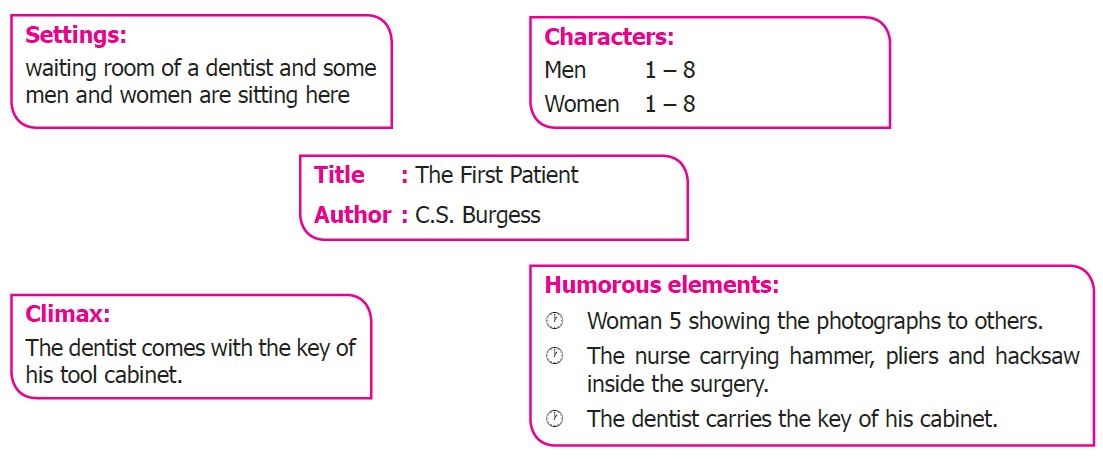
326.
| e.g. enter | center |
| jockey | hockey |
| admire | hire |
| pomp | romp |
| feeds | deeds |
| score | floor |
| please | these |
| first | wrist |
| demands | stands |
| radium | stadium |
327.
Rhyme scheme - ab ab
| notes - thoughts | bower - flower | fan - can |
| reclined - mind | wreaths - breathes | air - there |
| link - think | play’d - made | sent - lament |
| ran - man | measure - pleasure | plan - man |
are the rhyming words found in the poem.
328.
do, dealing.
329.
most, modest.
330.
a,a, b,b
331.
Philip Sletherby was travelling by train to Brill Manor. His companion in the train was a young man who was searching for something frantically. The young man introduced himself as Bertie, the son of Saltpen-Jago. Bertie had left his purse behind, after sealing an envelope with the crest on the purse. He stated that it was the Jago crest. He further added that his mother’s hair was dark brown similar to his. Bertie needed three pounds desperately and asked Sletherby to lend it to him. Sletherby pointed out to him that his mother’s letter had a greyhound courant crest. He explained that the Saltpen crest was that of demi-lion. Suspecting foul play, Sletherby did not give him any money, as he knew Mrs. Saltpen-Jago was a blonde. He was received by Claude People K.C., who had kept on talking about various things. All the time Sletherby was gazing at the door panel of the car on which were the two crests – a demi-lion and a greyhound courant. Sletherby sat dumbstruck on learning that Mrs. Honoria Saltpen Jago had changed her dark brown hair to a blonde just five weeks ago. Sletherby realised that Bertie had not lied to him but that he had mistaken him for a fraud.
332.
Ali guli mane in Karnataka
Vamana Kuntalu in Andhra Pradesh
Kuzhipara in Kerala
333.
Yes, a player can be revived when he/she is out the game. The player can be revived when his/her team scores a point.
334.
The raider concedes a point to the opponent team when the opponent team stops him.
335.
The raider scores points by tagging out the defenders. He gets the point for each player tagged.
336.
| S.No | Across | S.No | Down |
| 2 | We fought against the measures. (7) | 1 | I put the book upon the table. (4) |
| 7 | The cat jumped onto the table. (4) | 2 | Please treat me as equals. (2) |
| 9 | The cat climbed up the tree. (2) | 3 | Dessert will be served after dinner. (5) |
| 10 | My story is shorter than yours. (4) | 4 | My house is near the school. (4) |
| 11 | Cats are unlike the dogs. (6) | 5 | We walked to the store. (2) |
| 13 | Put the cookie in the jar. (2) | 6 | No eating during class. (6) |
| 14 | Let’s walk through the park. (7) | 8 | The book fell off my desk. (3) |
| 16 | The vegetables were planted beside the apple tree. (6) | 11 | I will not leave until the speech is finished. (5) |
| 17 | Banu sings like a bird. (4) | 12 | The store is open every day but Sunday.(3) |
| 18 | My story is about my pets. (5) | 15 | The dog is outside the house. (7) |
| 19 | Subash is the President of our class. (2) | 16 | The cat is hiding beside my bed. (5) |
| 20 | We live by the river. (2) | 19 | The cat jumped over the dog. (4) |
| 21 | Let’s walk into class together. (4) | 20 | He is hiding behind the bookcase. (6) |
| 22 | The bank is opposite the park. (8) | 22 | Dinner is on the table. (2) |
| 23 | We live within the city limits. (6) | 24 | I put my hands inside my pockets. (6) |
| 25 | I saw John waving above the crowd. (5) | 26 | We will eat before the play. (6) |
| 28 | I am more cautious from the fall. (5) | 27 | The cat is sleeping under the bed. (5) |
| 29 | I have a present for you. (3) | 29 | This letter is from my aunt. (4) |
| 31 | We strolled along the river. (5) | 30 | We ran with the other kids. (4) |
| 32 | He ran towards us. (7) | ||
| 33 | The leaves had collected beneath the trees. (7) |
337.
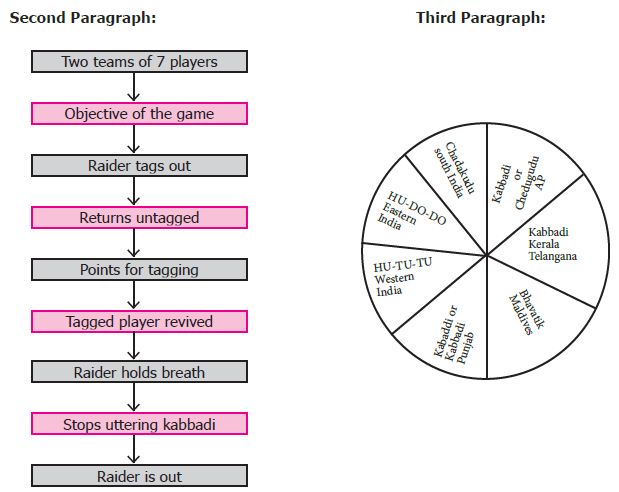
338.
Factors affecting health
The chart gives the factors that affect health. As per the chart the life style of the people contributes a lot to the health problems of the people. Smoking affects the health. Obesity and stress will also do their part in affecting the health. Another big problem is Diet and Nutrition. These days people do not eat the right food. They are taken by the taste and they do not get healthy food. The fast food is a curse to our health. The blood pressure is another problem now. Many people suffer from high or low blood pressure due to wrong food and lack of exercise. Genetics also plays a vital role in health. Our environment is also not healthy for people to live in. Another one is the medical facilities given by our government.
339.
()
(1) of
(2) at
(3) about
(4) off
(5) in
(6) of
(7) with
(8) of
(9) of
(10) from
(11) in
340.
()
(1) to
(2) for
(3) in
(4) of
(5) in
(6) through
(7) into
(8) of
(9) to
(10) from
341.
()
(1) could
(2) should
(3) may
(4) must
(5) would
(6) could
(7) could
342.
In our family, we have planned to take the children to a zoo next Sunday. A van has been arranged and we are sure to have a comfortable journey. The zoo is an interesting place for the children who enjoy watching the animals and want to know more about them. Even the youngsters love to visit the zoo.
343.
The Central Government asked the banks to close down the ATMs without security guard.
344.
Within a short time card license will replace paper driving license.
345.
There is a chance for telephone customers to get video phones.
346.
Municipal elections will be held in December
347.
A report on Inter-school Sports Event
My school Balan Memorial Higher Secondary School conducted an Inter-School Sports event on 15th August 2018 in Nehru Stadium. The schools of Chennai region participated in it. All the events were conducted in three levels – junior, senior and super senior. Nearly 70 schools participated in it. We had track and field events and few games. We had 100m, 200m and 400m long jump, high jump, triple jump, relay and shot put. In the games side there were volleyball, football, badminton and cricket (15 overs). It started with the flag hoisting and inauguration function. School children gave programme in dancing and martial arts. Our District Collector was the chief guest. After two hours of programme the sports items were started in one place and games were started in another place. We had very tough competition in most of the items. All the programmes came to an end on 16th forenoon. Afternoon was left for the prize distribution and valedictory function. We were very happy that our school got the championship cup.
348.
A report on a seminar on Science and Literature
A seminar on Science and Literature was conducted on 11th June 2018 by the Science Forum of Chennai sponsored by the Writer’s Club. It was well attended by many known people from all over India. It was inaugurated by Tamil Nadu Science Forum President Dr. Subarayan. He welcomed all those who were ready to present papers in the seminar and asked the other participants to get the maximum benefit from the presentations. In total eighty seven papers were selected from more than 500 papers submitted. All the papers pertained to the topic Science Fiction and Literature. In the modern era many writers are highly imaginative enough to write science fiction. Though it is an oxymoron for many years many writers are attempting to write fiction based on certain scientific concepts. So it has become a separate genre in literature. This has helped many scientists to try to materialise some ideas given by the writers. Young writers are very creative in this regard. The seminar focused on the creative mind of the writers. It was a very successful seminar.
349.
To Autumn
O Autumn, laden with fruit and stained
With the blood of the grape, pass not, but sit
Beneath my shady roof, there thou mayest rest,
And tune the jolly voice to my fresh pipe,
And all the daughters of the year shall dance!
Sing now the lusty song of fruits and flowers.
“The narrow bud opens her beauties to
The sun, and love runs in her thrilling veins;
Blossoms hang round the brows of Morning and
Flourish down the bright cheek of modest Eve,
Till clust’ring Summer breaks forth into singing,
And feather’d clouds strew flowers round her head.
The spirit of the air live in the smells
Of fruit; and joy, with pinions light roves round
The gardens, or sits singing in the trees,”
Thus sang the jolly Autumn as he sat,
Then rose, girded himself, and o’er the bleak
Hills fled from our sight; but let his golden load.

11th Standard Syllabus & Materials
11th Standard
TN 11th Tamil பீடு பெற நில் - செய்யுள் - காவடிச்சிந்து Important Questions And Answers Study Material - QB365 Set A
NEW11th Standard
TN 11th Tamil பீடு பெற நில் - உரைநடை - மலை இடப்பெயர்கள் : ஓர் ஆய்வு Important Questions And Answers Study Material - QB365 Set A
NEW11th Standard
TN 11th Tamil மாமழை போற்றுதும் - துணைப்பாடம் - யானை டாக்டர் Important Questions And Answers Study Material - QB365 Set A
NEW11th Standard
TN 11th Tamil மாமழை போற்றுதும் - செய்யுள் - ஐங்குறுநூறு Important Questions And Answers Study Material - QB365 Set A



Tamilnadu Stateboard 11th Standard Subjects

Maths

Commerce

Economics

Biology

Business Maths and Statistics

Accountancy

Computer Science

Physics

Chemistry
Maths
Biology
Economics
Physics
Chemistry

History
Business Maths and Statistics

Computer Science
Accountancy

Computer Applications
History
Computer Technology
Commerce
Computer Applications
Computer Technology

Tamil
English

French
Tamilnadu Stateboard Standards


