
 100% FREE ACCESS
11th Standard Syllabus & Materials
11th Standard
TN 11th Tamil இயற்கை வேளாண்மை,சுற்றுச்சூழல் -செய்யுள் - மனோன்மணீயம் Important Questions And Answers Study Material - QB365 Set A
NEW11th Standard
TN 11th Tamil என்னுயிர் என்பேன் -துணைப்பாடம் - இசைத்தமிழர் இருவர் Important Questions And Answers Study Material - QB365 Set A
NEW11th Standard
TN 11th Tamil மொழி கலை -செய்யுள் - ஒவ்வொரு புல்லையும் Important Questions And Answers Study Material - QB365 Set A
NEW11th Standard
TN 11th Tamil பீடு பெற நில் - இலக்கணம் - பகுபத உறுப்புகள் Important Questions And Answers Study Material - QB365 Set A
NEW11th Standard
TN 11th Tamil பீடு பெற நில் - துணைப்பாடம் - வாடிவாசல் Important Questions And Answers Study Material - QB365 Set A
NEW11th Standard
TN 11th Tamil பீடு பெற நில் - செய்யுள் - குறுந்தொகை Important Questions And Answers Study Material - QB365 Set A

Published on: 17/01/2020
Download Tamil Nadu 11th Standard Business Maths and Statistics question papers, model tests, one-mark questions, important questions, and public exam papers in PDF format. Free study materials and answer keys for TN State Board students.
Questions + Answers key
Take MCQ Business Maths and Statistics Test
1.
Calculate mean deviation about median for the following data:
| Class | 0-10 | 10-20 | 20-30 | 30-40 | 40-50 |
| Frequency | 5 | 8 | 15 | 16 | 6 |
2.
If two regression co-efficient are 2 and 0.45, what will be the co-efficient of correlation?
3.
What amount should be deposited annually so that after 16 years a person receives Rs. 1,67,160 if the interest rate is 15% [(1.15)16 = 9.358]
4.
A company has to supply 1000 item per month at a uniform rate and for each time, a production run is started with the cost of Rs. 200. Cost of holding is Rs. 20 per item per month. The number of items to be produced per run has to be ascertained. Determine the total of setup cost and average inventory cost if the run size is 500, 600, 700, 800. Find the optimal production run size using EOQ formula.
5.
A company produces two types of pens A and B. Pen A is of superior quality and pen B is of lower quality. Profits on pens A and B are Rs. 5 and Rs. 3 per pen respectively. Raw materials required for each pen A is twice as that of pen B. The supply of raw material is sufficient only for 1000 pens per day. Pen A requires a special clip and only 400 such clips are available per day. For pen B, only 700 clips are available per day. Formulate this problem as a linear programming problem.
6.
If the lines x + y = 6 and x + 2y = 4 are diameters of the circle, and the circle passes through the point (2, 6) then find its equation.
7.
If \(A=\left[\begin{array}{rr} 2 & 3 \\ 1 & -6 \end{array}\right] \text { and } B=\left[\begin{array}{rr} -1 & 4 \\ 1 & -2 \end{array}\right],\) then verify adj (AB) = (adj B) (adj A).
8.
Find \(\frac{dy}{dx}\) of the following functions: x = a (\(\theta\) - sin \(\theta\)), y = a (1 - cos \(\theta\))
9.
Solve: 2x + 5y = 1 and 3x + 2y = 7 using matrix method.
10.
Evaluate the following using binomial theorem: (101)4
11.
The events A and B are independent if _________.
\(P\left( A\cap B \right) =0\)
\(P\left( A\cap B \right) =P(A)\times P(B)\)
\(P\left( A\cup B \right) =P(A)+P(B)\)
\(P\left( A\cup B \right) =P(A)\times P(B)\)
12.
When an observation in the data is zero, then its geometric mean is
Negative
Positive
Zero
Cannot be calculated
13.
The regression coefficient of X on Y ________.
bxy = \(\frac { N\Sigma dxdy-(\Sigma dx)(\Sigma dy) }{ N\Sigma dy^{ 2 }-(\Sigma dy)^{ 2 } } \)
byx = \(\frac { N\Sigma dxdy-(\Sigma dx)(\Sigma dy) }{ N\Sigma dy^{ 2 }-(\Sigma dy)^{ 2 } } \)
bxy = \(\frac { N\Sigma dxdy-(\Sigma dx)(\Sigma dy) }{ N\Sigma dx^{ 2 }-(\Sigma dx)^{ 2 } } \)
by =\(\frac { N\Sigma xy-(\Sigma x)(\Sigma y) }{ \sqrt { N\Sigma { x }^{ 2 }-(\Sigma x)^{ 2 }\times \sqrt { N\Sigma y^{ 2 }-(\Sigma y)^{ 2 } } } } \)
14.
The correlation coefficient ________.
r = ±\(\sqrt { { b }_{ xy }\times { b }_{ yx } } \)
r = \(\frac { 1 }{ { b }_{ xy }\times { b }_{ yx } } \)
r = bxy x byx
r = ±\(\sqrt { \frac { 1 }{ { b }_{ xy }\times { b }_{ yx } } } \)
15.
Rs. 5000 is paid as perpetual annuity every year and the rate of C.I 10 %. Then present value P of immediate annuity is _______.
Rs. 60,000
Rs. 50,000
Rs. 10,000
Rs. 80,000
16.
A person brought 100 shares of 9% stock of face value Rs. 100, at a discount of 10%, then the stock purchased is _______.
Rs. 9000
Rs. 6000
Rs. 5000
Rs. 4000
17.
if q = 1000 + 8p1 - p2 then, \(\frac { \partial q }{ \partial { p }_{ 1 } } \) is _______.
-1
8
1000
1000 - p2
18.
The demand function is always _______.
Increasing function
Decreasing function
Non-decreasing function
Undefined function
19.
In a network while numbering the events which one of the following statement is false?
Event numbers should be unique
Event numbering should be carried out on a sequential basis from left to right
The initial event is numbered 0 or 1
The head of an arrow should always bear a number lesser than the one assigned at the tail of the arrow
20.
One of the conditions for the activity (i, j) to lie on the critical path is_______.
Ej - Ei = Lj - Li = tij
Ei - Ej = Lj - Li = tij
Ej - Ei = Li - Lj = tij
Ej - Ei = Lj - Li ≠ tij
21.
The range of f(x) = |x|, for all \(x\in R\), is ________.
(0, \(\infty \))
(0, \(\infty \))
(-\(\infty \), \(\infty \))
(1, \(\infty \))
22.
The graph of y = ex intersects the y-axis at _______.
(0,0)
(1,0)
(0,1)
(1,1)
23.
\(\sin\left(\cos^{-1}\frac{3}{5}\right)\) is _____.
\(\frac{3}{5}\)
\(\frac{5}{3}\)
\(\frac{4}{5}\)
\(\frac{5}{4}\)
24.
The value of \(\frac{3 \tan 10^{\circ}-\tan ^3 10^{\circ}}{1-3 \tan ^2 10^{\circ}}\) is _______?
\(\frac{1}{\sqrt3}\)
\(\frac{1}{2}\)
\(\frac{\sqrt3}2\)
\(\frac{1}{\sqrt2}\)
25.
The eccentricity of the parabola is _______.
3
2
0
1
26.
The slope of the line 7x + 5y - 8 = 0 is _______.
7/5
-7/5
5/7
-9/7
27.
If nPr = 720 (nCr), then r is equal to ______.
4
5
6
7
28.
If nC3 = nC2, then the value of nC4 is _______.
2
3
4
5
29.
If \(\triangle=\begin{vmatrix} {a}_{11} & {a}_{12} & {a}_{13} \\ {a}_{21} & {a}_{22} & {a}_{23} \\ {a}_{31} & {a}_{32} & {a}_{33} \end{vmatrix}\) and Aij is cofactor of aij, then value of \(\triangle\) is given by ________.
a11 A31 + a12 A32 + a13 A33
a11 A11 + a12 A21 + a13 A31
a21 A11 + a22 A12 + a23 A13
a11 A11 + a21 A21 + a31 A31
30.
If A is 3 \(\times\) 3 matrix and |A| = 4, then |A-1| is equal to ________.
\({{1}\over{4}}\)
\({{1}\over{16}}\)
2
4
31.
A computer while calculating the correlation co-efficient between two variables x and y from 25 pairs of observations, obtained the following results. \(\sum\)x=125, \(\sum\)x2=650, \(\sum\)y=100, \(\sum\)y2=460, xy=508. It was later found out that it had copied down two pairs as while the correct values are
| x | y |
| 6 | 14 |
| 8 | 6 |
| x | y |
| 8 | 12 |
| 6 | 8 |
Obtain the correlation co-efficient for the correct value.
32.
If z = 4x6 - 8x3 - 7x + 6xy + 8y + x3y5, find
(i) \({\partial^2z\over \partial y^2}\) (ii)\(\partial^2 z\over \partial x\partial y\)(iii) \(\partial^2z\over \partial y\partial x\)
33.
Data on readership of a magazine indicates that the proportion of male readers over 30 years old is 0.30 and the proportion of male reader under 30 is 0.20. If the proportion of readers under 30 is 0.80. What is the probability that a randomly selected male subscriber is under 30?
34.
Equal amounts are invested in 10% stock at 89 and 7% stock at 90 (1% brokerage paid in both transactions). If 10% stock bought Rs. 100 more by way of dividend income than the other, find the amount invested in each stock.
35.
A company buys in lots of 500 boxes which is a 3 month supply. The cost per box is Rs. 125 and the ordering cost in Rs. 150. The inventory carrying cost is estimated at 20% of unit value.
(i) Determine the total amount cost of existing inventory policy
(ii) Determine EOQ in units
(iii) How much money could be saved by applying the economic order quantity?
36.
Solve the following LPP by graphical method Minimize z = 5x1 + 4x2 Subject to constraints 4x1 + x2 ≥ 40 ; 2x1 + 3x2 ≥ 90 and x1, x2 > 0.
37.
If a parabolic reflector is 20 cm in diameter and 5 cm deep, find the focus.
38.
Find the equation of the parabola whose vertex is (0, 0) passing through the point (2, 3) and axis is along X-axis.
39.
As the number of units manufactured increases from 6000 to 8000, the total cost of production increases from Rs. 33,000 to Rs. 40,000. Find the relationship between the cost (y) and the number of units made (x) if the relationship is linear.
40.
Differentiate (sec x -1) (sec x +1)
41.
Differentiate the following with respect to x \(\sqrt { \frac { (x-1)(x-2) }{ (x-3)({ x }^{ 2 }+x+1) } } \)
42.
Prove that: \(\frac { \sin { \left( 180-\theta \right) } \cos { \left( 90+\theta \right) } \tan { \left( 270-\theta \right) \cot { \left( 360-\theta \right) } } }{ \sin { \left( 360-\theta \right) \cot { \left( 360+\theta \right) \sin { \left( 270-\theta \right) \csc { \left( -\theta \right) } } } } } =-1\)
43.
If \(A=\left[ \begin{matrix} 1 & tan\quad x \\ -tan\quad x & \quad \quad \quad 1 \end{matrix} \right] \), then show that ATA-1 = \(\left[ \begin{matrix} cos\quad 2x & -sin2x \\ sin\quad 2x & cos2x \end{matrix} \right] .\)
44.
Resolve into partial fractions for the following : \(\frac{1}{\left(x^2+4\right)(x+1)}\)
45.
Find the equation of the circle with centre at (3, –1) and radius is 4 units.
46.
Show that \(\left[ \begin{matrix} 8 & 2 \\ 4 & 3 \end{matrix} \right] \)is non – singular.
47.
A person purchases tomatoes from each of the 4 places at the rate of 1kg., 2kg., 3kg., and 4kg. per rupee respectively. On the average, how many kilograms has he purchased per rupee?
48.
A person pays Rs 64,000 per annum for 12 years at the rate of 10% per year. Find the annuity [(1.1)12 = 3.3184]
49.
50.
A tour operator charges Rupees 136 per passenger with a discount of 40 paisa for each passenger in excess of 100. The operator requires at least 100 passengers to operate the tour. Determine the number of passenger that will maximize the amount of money the tour operator receives.
51.
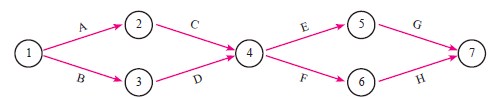
Develop a network based on the following information:
| Activity: | A | B | C | D | E | F | G | H |
| Immediate predecessor: | - | - | A | B | C, D | C, D | E | F |
52.
Evaluate \(\underset { x\rightarrow \frac { 1 }{ 2 } }{ lim } \frac { { 4x }^{ 2 }-1 }{ 2x-1 } \)
53.
If \(\cos x=-\frac{1}{2}\) and \(\pi
54.
If P(n) is the statement "23n -1 is a multiple of 7" then show that P(5) is true.
1.
| Class | Mid value x | f | c.f. | D=|x-28| | f|D| |
|---|---|---|---|---|---|
| 0-10 | 5 | 5 | 5 | 23 | 115 |
| 10-20 | 15 | 8 | 13 | 13 | 104 |
| 20-30 | 25 | 15 | 28 | 3 | 45 |
| 30-40 | 35 | 16 | 44 | 7 | 112 |
| 40-50 | 45 | 6 | 50 | 17 | 102 |
| N = 50 | \(\sum { f|D|=478 } \) |
\(\frac { N }{ 2 } =\frac { 50 }{ 2 } =25\)
\(\therefore\) Median lies in the interval (20, -30) and its corresponding values are
L = 20, f = 15, pcf = 13 and c = 10
\(\therefore Median=L+\left( \frac { \frac { N }{ 2 } -pcf }{ f } \right) \times c=20+\frac { 25-13 }{ 15 } \times 10\)
\(=20+\frac { 120 }{ 15 } =20+8=28\)
Now, mean deviation from median
\(=\frac { \sum { f|D| } }{ N } =\frac { 478 }{ 50 } =9.56\)
2.
Given bxy =2 and byx=0.45
We know r= \(\sqrt { { b }_{ xy }.{ b }_{ yx } } =\sqrt { 2(0.45) } =\sqrt { 0.9 } \)=0.949
\(\therefore\)r=0.949
3.
Here A = 1,67,160, n = 16 i = \(\frac{15}{100}=0.15\) a = ?
To find: a
Now A = \(\frac{a}{i}[(1+i)^n-1]\)
1,67,160 = \(\frac{a}{0.15}[(1+0.15)^{16}-1]\)
= \(\frac{a}{15}[(1.15)^{16}-1]\)
⇒ a = \(\frac{1,67,160\times 0.15}{(1.15)^{16}-1}\)
a = \(\frac{1,67,160\times 0.15}{9.358-1}\)
= \(\frac{1,67,160\times 0.15}{8.358}\)
= 3,000
Therefore a = Rs.3,000
4.
Demand : R = 1000 per month
Setup cost : C3 = Rs.200 per order
Carrying cost: C1= Rs. 20 per item per month
| Run size q | Set up cost \(\frac { q }{ q } \times { C }_{ 3 }\) | Carrying cost \(\frac { q }{ 2 } \times { C }_{ 1 }\) | Total cost (Set up cost + Carrying cost) |
|---|---|---|---|
| 500 | \(\frac { 1000 }{ 500 } \times 200=400\) | \(\frac { 500 }{ 2 } \times 20=5000\) | 5400 |
| 600 | \(\frac { 1000 }{ 600 } \times 200=333.3\) | \(\frac { 600 }{ 2 } \times20= 6000\) | 6333.3 |
| 700 | \(\frac { 1000 }{ 700 } \times 200=285.7\) | \(\frac { 700 }{ 20 } \times20= 7000\) | 7285.7 |
| 800 | \(\frac { 1000 }{ 800 } \times 200=250\) | \(\frac { 800 }{ 2 } \times20= 8000\) | 8250 |
EOQ = \(\sqrt { \frac { 2{ RC }_{ 3 } }{ { C }_{ 1 } } } =\sqrt { \frac { 2\times 1000\times 200 }{ 20 } } \)
= \(\sqrt { 20000 } \) = 141 units (app)
5.
(i) variables: Let x1 and x2 represents the types of pen A and B respectively.
(ii) Objective function:
Profit on x1 pens = 5x1
Profit on x2 pens = 3x2
Total profit = 5x1 + 3x2
Let Z = 5x1 + 3x2 which is the objective function.
Since the total is to be maximized, we have to maximize Z = 5x1 + 3x2
(iii) Constraints:
The supply of raw material is sufficient only for 1000 pens per day.
2x1 + x2 ≤ 1000 [\(\because\) pen A is twice as that of pen B]
clips are available per day, for pen A: x1 ≤ 400
clips are available per day, for pen B: x2 ≤ 700
(iv) Non-negative restrictions: Since the number of pen A and pen B cannot be negative, we have x1 ≥ 0, x2 ≥ 0.
Thus, the mathematical formulation of the LPP is
Max Z = 5x1 + 3x2
Subject to the constraints
2x1 + x2 ≤ 1000
x1 ≤ 400
x2 ≤ 700
x1, x2 ≥ 0 (non-negative constraints)
6.
x + y = 6 .....(1)
x + 2y = 4 .....(2)
On solving (1) and (2) we get the centre of the circle
C(-h, - k) = (8, - 2)
Equation of circle is \((x-h)^2+(y-k)^2=r^2\)
\((x-8)^2+(y+2)^2=r^2\)
It passes through (2, 6)
\((2-8)^2+(6+2)^2=r^2\)
\(36+64=r^2 \Rightarrow r^2=100\)
Required equation is \((x-8)^2+(y+2)^2=100\)
\(x^2-16 x+64+y^2+4 y+4=100\)
\(x^2+y^2-16 x+4 y-32=0\)
7.
\(A B=\left(\begin{array}{cc} 2 & 3 \\ 1 & -6 \end{array}\right)\left(\begin{array}{cc} -1 & 4 \\ 1 & -2 \end{array}\right)\)
\(=\left(\begin{array}{cc} -2+3 & 8-6 \\ -1-6 & 4+12 \end{array}\right)=\left(\begin{array}{cc} 1 & 2 \\ -7 & 16 \end{array}\right)\)
\(\mathrm{LHS}=\operatorname{adj}(\mathrm{AB})=\left(\begin{array}{cc} 16 & -2 \\ 7 & 1 \end{array}\right)\)
\(\mathrm{RHS}=(\operatorname{adj} B)(\operatorname{adj} \mathrm{A})\)
\(=\left(\begin{array}{cc} -2 & -1 \\ -1 & -1 \end{array}\right)\left(\begin{array}{cc} -6 & -3 \\ -1 & 2 \end{array}\right)\)
\(=\left(\begin{array}{cc} 12+4 & 6-5 \\ 6+1 & 3-2 \end{array}\right)=\left(\begin{array}{cc} 16 & -2 \\ 7 & 1 \end{array}\right)\)
\(a d j(A B)=(a d j\ B)(a d j\ A)\)
8.
x = a (\(\theta\) - sin \(\theta\)), y = a (1 - cos \(\theta\))
Differentiating with respect to 'x' we get,
\(\frac { dx }{ d\theta } =a\left( 1-\cos { \theta } \right) \)
\(=a\left( 2\sin ^{ 2 }{ \frac { \theta }{ 2 } } \right) \)
Now, \(\frac { dy }{ dx } =\frac { \frac { dy }{ d\theta } }{ \frac { dx }{ d\theta } } \)
\(=\frac { 2a\sin { \frac { \theta }{ 2 } } \cos { \frac { \theta }{ 2 } } }{ 2a\sin ^{ 2 }{ \frac { \theta }{ 2 } } } =\frac { \cos { \frac { \theta }{ 2 } } }{ \sin { \frac { \theta }{ 2 } } } =\cot { \left( \frac { \theta }{ 2 } \right) } \)
9.
Given equations are 2x + 5y = 1; 3x + 2y = 7
This system of equations can be written in matrix form as \(\begin{pmatrix}2 & 5 \\3 & 2 \end{pmatrix}\begin{pmatrix} x \\ y \end{pmatrix}=\begin{pmatrix} 1\\7 \end{pmatrix}\Rightarrow Ax=B\)
where A = \(\begin{pmatrix} 2 & 5 \\3 & 2 \end{pmatrix},X=\begin{pmatrix} x\\y \end{pmatrix}\) and B = \(\begin{pmatrix} 1 \\ 7 \end{pmatrix}\)
\(\therefore\) X = A-1 B.
\(|A|=\begin{vmatrix} 2 &5 \\3 & 2 \end{vmatrix}=4-15=-11\)
A11 = 2, A12 = -3, A21 = -5, A22 = 2
\(\therefore\) adj A = \(\begin{bmatrix} 2 & -3 \\ -5 & 2 \end{bmatrix}^{T}=\begin{bmatrix} 2 & -5 \\-3 & 2 \end{bmatrix}\)
\(\therefore\) \({A}^{-1}={{1}\over{|A|}}\) . adj A = \({{-1}\over{11}}\begin{bmatrix} 2 & -5\\ -3& 2 \end{bmatrix}\)
X = A- 1 B \(={{-1}\over{11}}\begin{bmatrix} 2 & -5\\ -3&2 \end{bmatrix}\begin{bmatrix} 1\\7 \end{bmatrix}\)
\(=\frac { 1 }{ 11 } \left[ \begin{matrix} +2-35 \\ -3+14 \end{matrix} \right] ={{-1}\over{11}}\begin{bmatrix} -33\\11 \end{bmatrix}=\begin{bmatrix} 3\\-1 \end{bmatrix}\)
\(\therefore\) x = 3.and y = -1.
10.
(101)4 = (100 + 1)4
= 4C0 (100)4 + 4C1 (100)3 (1)1 + 4C2 (100)2 (1)2 + 4 C3 (100)1 (1)3 + 4 C4(1)4
= 100,000,000 + 4 (1,000,000) + 6 (10000) + 4 (100) + 1
= 10,40,60,401
11.
(b)
\(P\left( A\cap B \right) =P(A)\times P(B)\)
12.
(c)
Zero
13.
(a)
bxy = \(\frac { N\Sigma dxdy-(\Sigma dx)(\Sigma dy) }{ N\Sigma dy^{ 2 }-(\Sigma dy)^{ 2 } } \)
14.
(a)
r = ±\(\sqrt { { b }_{ xy }\times { b }_{ yx } } \)
15.
\(P=\frac{a}{i}=\frac{5000}{0.1}=50,000\)
16.
If F.V = 100, Investment = 90
FV 10,000,
Investment \(= \frac{ 90 \times 10,000}{100} = 9000\)
17.
(b)
8
18.
(b)
Decreasing function
19.
(d)
The head of an arrow should always bear a number lesser than the one assigned at the tail of the arrow
20.
(a)
Ej - Ei = Lj - Li = tij
21.
(b)
(0, \(\infty \))
22.
(c)
(0,1)
23.
\(\sin \left(\cos ^{-1} \frac{3}{5}\right)=\sin \left(\sin ^{-1} \frac{4}{5}\right)=4 / 5\)
24.
\(\frac{3 \tan 10^{\circ}-\tan ^3 10^{\circ}}{1-3 \tan ^2 10^{\circ}} =\tan 3(10) =\tan 30^{\circ}=\frac{1}{\sqrt{3}} \)
25.
(d)
1
26.
\(m=\frac{-a}{b}=\frac{-7}{5}\)
27.
\(n P_r =720(\mathrm{nCr}) \)
\(\frac{n !}{(n-r) !} =720\left(\frac{n !}{r !(n-r) !}\right) \)
\(r ! =720 \)
\(r ! =6 ! \)
r = 6
28.
x + y = n
3 + 2 = 5 = n
nC4 = 5C4 = 5C1 = 5
29.
(Corresponding co-factor)
30.
(Since \(\left|A^{-1}\right|=\frac{1}{|A|}\))
31.
We will find the correct values of \(\sum\)x, \(\sum\)x2, \(\sum\)y2, and \(\sum\)xy by delecting the old values and adding new ones.
\(\therefore\)\(\sum\)x=125-(6+8)+(6+8)=125
\(\sum\)y=100-(14+6)+(12+8)=100
x2=650-(62+82)+(82+62)=650
y2=460-(142+62)+(122+82)=436
and xy =508-(14x6+8x6)+(12x8+6x8)=520
\(\therefore\) Correlation Co-efficient
r(x,y)=\(\frac { N\sum { xy } -(\sum { x } )(\sum { y } ) }{ \sqrt { N{ \sum { x } }^{ 2 }-{ (\sum { x } ) }^{ 2 } } \sqrt { N{ \sum { y } }^{ 2 }-{ (\sum { y } ) }^{ 2 } } } \)
\(\Rightarrow\)\(\frac { 25(520)-125(100) }{ \sqrt { 25(650)-{ (125) }^{ 2 } } \sqrt { 25(436)-{ (100) }^{ 2 } } } \)
\(\Rightarrow\) r(x,y)=0.66
32.
Given Z = 4x6 - 8x3 - 7x + 6xy + 8y + x3y5
(i) Differentiating partially w.r.t. 'y' we get,
\({\partial z\over \partial y^2}=0-0-0+6x(1)+8+x^3(5y^4)\)
= 6x + 8 + 5x3y4
Differentiating again partially w.r.t. 'y' we get
\({\partial^2z\over \partial y^2}=.0 + 0 + 5x^3( 4y^3)\)
=20x3,y3
(ii) We know that \({\partial z\over \partial y}=6x+8+5x^3y^4\)
Differentiating partially w.r.t. 'x' we get,
\({\partial^2z\over \partial x \partial y}=6(1)+0+5y^4(3x^2)\)
= 6+15x2y4
(iii) \({\partial z\over \partial x}=4( 6x^5) - 8 (3x^2) - 7 + 6y(1) + 0 + y^5(3x2^)\)
= 24x5 - 24x2 - 7 + 6y + 3x2y5
Differentiating again partially w.r.t. 'y' we get,
\({\partial^2z\over \partial y \partial x}=0+ 0 - 0 + 6(1) + 3x^2 (5y^4)\)
= 6 + 15x2y4
33.
Let the events E1, E2 and A be defined as
E1 - event that male subscriber is under 30
E2 - event that male subscriber is above 30
A is event that subscriber is male
P(E1) = 0.80 and P(E2) = 1 - 0.8 = 0.2
P(B/E1) = 0.20, P(B/E2) = 0.30
\(P({ E }_{ 1 }/B)=\frac { P({ E }_{ 1 }).P\left( \frac { B }{ { E }_{ 1 } } \right) }{ P({ E }_{ 1 }).P\left( \frac { B }{ { E }_{ 1 } } \right) +P({ E }_{ 2 }).P\left( \frac { B }{ { E }_{ 2 } } \right) } \)
\(=\frac { 0.8\times 0.2 }{ 0.8\times 0.2+0.2\times 0.3 } \)
\(=\frac { 0.16 }{ 0.16+0.06 } =\frac { 16 }{ 22 } =0.727\)
34.
Let x be the amount invested in each stock
Income on 10% stock at 89:
F.V. = Rs. 100, M.V. = Rs. 90
Number of shares = \(\frac{Investments}{M.V}\) = \(\frac{x}{90}\)
Annual income = \(\frac{x}{90}\times \frac{10}{100}\times 100\)
= \(\frac{x}{9}\) .......(1)
Income on 7% stock at 90:
M.V. = Rs. 91
Number of shares = \(\frac{Investments}{M.V}\) = \(\frac{x}{91}\)
Annual income = \(\frac{x}{91}\times \frac{7}{100}\times 100\)
= \(\frac{x}{13}\) .....(2)
Given: \(\frac{x}{9}-\frac{x}{13}=100\) ⇒ x = Rs. 2925
\(\therefore\) The amount invested in each stock ≈ Rs. 2,925
35.
Given
Ordering cost per order : C3 = Rs. 150 per order.
Number of units per order: q = 500 units
Annual demand = 500 × 4 = 2000 units
∴ Demand rate : R = 2000 per year
Carrying cost : C1 = 20% of unit value
C1 = \(\frac { 20 }{ 100 } \times 125=Rs25\)
(i) Total annual cost of due existing inventory policy
= \(\frac { R }{ q } \times { C }_{ 3 }+\frac { q }{ 2 } { C }_{ 1 }\) = \(\frac { 2000 }{ 500 } \times 150+\frac { 500 }{ 2 } \times 25\)
= Rs. 6850
(ii) EOQ = \(\sqrt { \frac { 2Rc_{ 3 } }{ { c }_{ 1 } } } \)
= \(\sqrt { \frac { 2\times 2000\times 150 }{ 25 } } \)
= \(\sqrt { 12\times 2000 } \)
= 155 units (app.)
(iii) Minimum annual cost \(= \sqrt { { 2Rc_{ 3 } }{ { c }_{ 1 } } } \)
= \(\sqrt { 2\times 2000\times 150\times 25 } \)
= Rs. 3873.
By applying the economic order quantity, money saved by a company = 6850 – 3873 = Rs. 2977.
36.
Since both the decision variables x1 and x2 are non-negative, the solution lies in the first quadrant of the plane.
Consider the equations 4x1 + x2 = 40 and 2x1 + 3x2 = 90
4x1 + x2 = 40 is a line passing through the points (0,40) and (10,0). Any point lying on or above the line 4x1 + x2 = 40 satisfies the constraint 4x1 + x2 ≥ 40.
2x1 + 3x2 = 90 is a line passing through the points (0,30) and (45,0). Any point lying on or above the line 2x1 + 3x2 = 90 satisfies the constraint 2x1 + 3x2 ≥ 90.
Draw the graph using the given constraints.
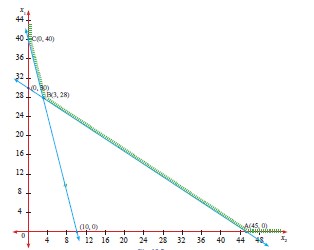
The feasible region is ABC (since the problem is of minimization type we are moving towards the origin.
| Corner points | z = 5x1 + 4x2 |
| A(45,0) | 225 |
| B(3,28) | 127 |
| C(0,40) | 160 |
The minimum value of Z occurs at B(3,28).
Hence the optimal solution is x1 = 3, x2 = 28 and Zmin = 127.
37.
Taking vertex of the parabola as reflector at origin, x-axis along the axis of the parabola, equation of the parabola is y2 = 4ax
Given depth = 5 cm, diameter = 20 cm
\(\therefore\) (5, 10) lies on the parabola
\(\therefore\) 102 = 4a(5) ⇒ 100 = 20a ⇒ a = \(\frac{100}{20}\) = 5
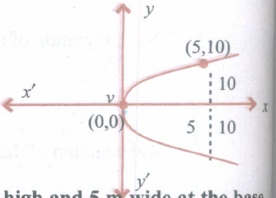
\(\therefore\) Focus is (a, 0) = (5, 0) which is the mid-point of the given diameter
38.
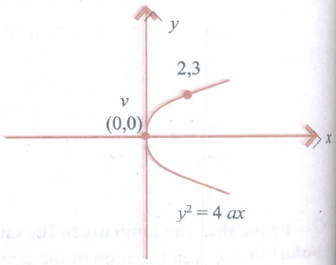
Since the parabola is symmetric about X-axis and has its vertex at (0,0), its equation will be of the form y2 = 4ax or y2 = -4ax.
But the parabola passes through (2, 3) which is in the I quadrant, its equation will be of the form y2 = 4ax, which is open rightward.
Substituting (2,3) in y2 = 4ax, we get
9 = 4a(2) ⇒ 8a = 9
⇒ a = \(\frac{9}{8}\)
\(\therefore\) Equation of the parabola is y2 = 4(\(\frac{9}{8}\))x
⇒ y2 = \(\frac{9}{2}\)x
⇒ 2y2 = 9x ⇒ 2y2 - 9x = 0
39.
Let x represent the number of units and y its cost.
By the given data,
x1(6000) y1(33,000)
x2(8000) y2(40,000)
Using two point form, \(\frac { y-{ y }_{ 1 } }{ { y }_{ 2 }-{ y }_{ 1 } } =\frac { x-{ x }_{ 1 } }{ { x }_{ 2 }-{ x }_{ 1 } } \)
⇒ \(\frac { y-33000 }{ 40,000-33000 } =\frac { x-6000 }{ 8000-6000 } \)
⇒ \(\frac { y-33000 }{ 7000 } =\frac { x-6000 }{ 2000 } \)
⇒ \(\frac { y-33000 }{ 7 } =\frac { x-6000 }{ 2 } \)
⇒ 2y - 66000 = 7x - 42000
⇒ 2y = 7x - 42000 + 66000
2y = 7x + 24000, which is the required linear function.
40.
Let y = (sec x -1) (sec x +1)
y = sec2 x -1 \(\left[ \therefore (a+b)(a-b)={ a }^{ 2 }-{ b }^{ 2 } \right] \)
\(\therefore\)y =tan2x
Differentiating with respect to 'x' we get
\(\frac { dy }{ dx } =2tanx\frac { d }{ dx } (tan x)\) \([\therefore 1+tan^{ 2 }x=sec^{ 2 }x]\)
=2tan x.sec2 x
41.
Let y = \(\sqrt { \frac { (x-1)(x-2) }{ (x-3)({ x }^{ 2 }+x+1) } }\)
log y = \(\frac { 1 }{ 2 } \)[log (x - 1) + log (x - 2) -log (x - 3) -log (x2 + x + 1]
\( \frac{1}{y} \frac{d y}{d x}=\frac{1}{2}\left[\begin{array}{l} \left.\frac{1}{x-1}+\frac{1}{x-2}-\frac{1}{x-3}\right] \\ -\frac{1}{x^2+x+1}(2 x+1) \end{array}\right]\)
⇒ \(\frac { dy }{ dx } =\frac { 1 }{ 2 } \sqrt { \frac { (x-1)(x-2) }{ (x-3)(x^{ 2 }+x+1) } } \left[ \frac { 1 }{ x-1 } +\frac { 1 }{ x-2 } -\frac { 1 }{ x-3 } -\frac { (2x+1) }{ { x }^{ 2 }+x+1 } \right] \)
42.
(i) \(\frac { \sin { \left( 180-\theta \right) } \cos { \left( 90+\theta \right) } \tan { \left( 270-\theta \right) \cot { \left( 360-\theta \right) } } }{ \sin { \left( 360-\theta \right) \cot { \left( 360+\theta \right) \sin { \left( 270-\theta \right) \csc { \left( -\theta \right) } } } } } =-1\)
\(=\frac{(\sin \theta)(-\sin \theta)(\cot \theta)(-\cot \theta)}{(-\sin \theta)(\cos \theta)(-\cos \theta)(-\operatorname{cosec} \theta)}\)
\(=\frac{\sin \theta\left(-\cot ^2 \theta\right)}{\cos ^2 \theta(\operatorname{cosec} \theta)}\)
\(=\frac{\sin \theta\left(\frac{-\cos ^2 \theta}{\sin ^2 \theta}\right)}{\cos ^2 \theta\left(\frac{1}{\sin \theta}\right)}\)
= -1 = RHS.
Hence proved.
43.
\(|A|=\left| \begin{matrix}1 & tan\quad x \\ -tan\quad x & 1 \end{matrix} \right| =1+{ tan }^{ 2 }x={ sec }^{ 2 }x\neq 0\)
\(\Rightarrow\) A-1 exists
Let Cij be the cofactor of aij in A
C11 = (-1)1+1 M11 = (-1)2(1) = 1
C12 = (-1)1+2 (-tan x) = tan x
C21 = (-1)2+2(1) = 1
\(\therefore \quad adj\quad A={ \left[ \begin{matrix} 1 & tan\quad x \\ -tan\quad x & 1 \end{matrix} \right] }^{ T }=\left[ \begin{matrix} 1 & -tan\quad x \\ tan\quad x & 1 \end{matrix} \right] \)
\({ A }^{ -1 }=\frac { 1 }{ |A| } adjA=\frac { 1 }{ 1+{ tan }^{ 2 }x } \left[ \begin{matrix} 1 & -tan\quad x \\ tan\quad x & 1 \end{matrix} \right] =\left[ \begin{matrix} \frac { 1 }{ 1+{ tan }^{ 2 }x } & \frac { -tan\quad x }{ 1+{ tan }^{ 2 }x } \\ \frac { tan\quad x }{ 1+{ tan }^{ 2 }x } & \frac { 1 }{ 1+{ tan }^{ 2 }x } \end{matrix} \right] \)
\(\therefore \quad { A }^{ T }{ A }^{ -1 }=\left[ \begin{matrix} 1 & -tan\quad x \\ tan\quad x & 1 \end{matrix} \right] \left[ \begin{matrix} \frac { 1 }{ 1+{ tan }^{ 2 }x } & \frac { -tan\quad x }{ 1+{ tan }^{ 2 }x } \\ \frac { tan\quad x }{ 1+{ tan }^{ 2 }x } & \frac { 1 }{ 1+{ tan }^{ 2 }x } \end{matrix} \right] =\left[ \begin{matrix} \frac { 1 }{ 1+{ tan }^{ 2 }x } \frac { -tan\quad x }{ 1+{ tan }^{ 2 }x } & \frac { -tan\quad x }{ 1+{ tan }^{ 2 }x } \frac { -tan\quad x }{ 1+{ tan }^{ 2 }x } \\ \frac { tan\quad x }{ 1+{ tan }^{ 2 }x } +\frac { tan\quad x }{ 1+{ tan }^{ 2 }x } & \frac { -{ tan }^{ 2 }x }{ 1+{ tan }^{ 2 }x } \frac { 1 }{ 1+{ tan }^{ 2 }x } \end{matrix} \right] \)
\(=\left[ \begin{matrix} \frac { 1-tan\quad x }{ 1+{ tan }^{ 2 }x } & \frac { -2tan\quad x }{ 1+{ tan }^{ 2 }x } \\ \frac { 2tan\quad x }{ 1+{ tan }^{ 2 }x } & \frac { 1-{ tan }^{ 2 }x }{ 1+{ tan }^{ 2 }x } \end{matrix} \right] =\left[ \begin{matrix} cos\quad 2x & -sin2x \\ sin\quad 2x & cos\quad 2x \end{matrix} \right] \) (Using multiple angle formula)
44.
\(\frac{1}{\left(x^2+4\right)(x+1)}=\frac{A}{x+1}+\frac{B x+C}{x^2+4}\)
(Since x2 + 4 cannot be factorised into linear factors)
\(\frac{1}{\left(x^2+4\right)(x+1)}=\frac{A\left(x^2+4\right)+(B x+C)(x+1)}{x^2+4}\)
\(1=A\left(x^2+4\right)+(B x+C)(x+1)\) ...(1)
putting x = -1 in (1) we get
1 = c(5) \(\Rightarrow\) \(c=\frac { 1 }{ 5 } \)
Equate co-efficient of x2 on both sides of (1)
0 = A + B \(\Rightarrow\) \(B= -A = \frac { -1 }{ 5 } \)
Putting x = 0 in (1) we get,
1 = 4A + C
\(1=\frac{4}{5}+C\)
\(C=1-\frac{4}{5}=\frac{1}{5}\)
\(\frac{1}{\left(x^2+4\right)(x+1)}=\frac{1}{5(x+1)}+\frac{\frac{-1}{5} x+\frac{1}{5}}{x^2+4}\)
\(=\frac{1}{5(x+1)}+\frac{1-x}{5\left(x^2+4\right)}\).
45.
Equation of circle is
\(\left( x-h \right) ^{ 2 }+\left( y-k \right) ^{ 2 }={ r }^{ 2 }\)
Here \(\left( h,k \right) =(3,-1)\) and r = 4
Equation of circle is
\(\left( x-3 \right) ^{ 2 }+\left( y+1 \right) ^{ 2 }=16\)
\({ x }^{ 2 }-6x+9+{ y }^{ 2 }+2y+1=16\)
\({ x }^{ 2 }+{ y }^{ 2 }-6x+2y-6=0\)
46.
Let A = \(\left[ \begin{matrix} 8 & 2 \\ 4 & 3 \end{matrix} \right] \)
|A| = \(\left| \begin{matrix} 8 & 2 \\ 4 & 3 \end{matrix} \right| \)
= 24 – 8 = 16 ≠ 0
\(\therefore\) A is a non-singular matrix
47.
Since we are given rate per rupee, harmonic mean will give the correct answer.
\(HM=\frac { n }{ \frac { 1 }{ a } +\frac { 1 }{ b } +\frac { 1 }{ c } +\frac { 1 }{ d } } \)
\(=\frac { 4 }{ \frac { 1 }{ 1 } +\frac { 1 }{ 2 } +\frac { 1 }{ 3 } +\frac { 1 }{ 4 } } \)
\(=\frac { 4\times 12 }{ 25 } \)
= 1.92 kg per rupee.
48.
Here a = 64,000, n = 12 and i = \(\frac{10}{100}=0.1\)
Amount of Ordinary annuity (A) = \(\frac{a}{i}[(1+i)^n-1]\)
= \(\frac{64000}{0.1}[(1+0.1)^{12}-1]\)
= 6,40,000 [(1.1)12 – 1]
= 6,40,000[3.3184 – 1]
= 6,40,000 [2.3184]
= 64 x 23184
∴ A = Rs. 14,83,776.
49.
50.
Let x be the number of passengers.
\(P=136 -\frac{40}{100}(x-100) \text { if } x \geq 100 \)
\(R=p x =136 x-\frac{2 x^2}{5}+40 x \)
\(=176 x-\frac{2 x^2}{5} \)
\(\frac{d R}{d x} =176-\frac{4 x}{5}\)
For max. revenue \(\frac{d R}{d x}=0\)
\(176 =\frac{4 x}{5} \)
\(x =\frac{176 \times 5}{4}=220 \)
\(\frac{d^2 R}{d x^2} =-\frac{4}{5}<0\)
∴ At x = 220,
Revenue is maximum.
51.
Using the immediate precedence relationships and following the rules of network construction, the required network is shown in following figure.
52.
\(\underset { x\rightarrow \frac { 1 }{ 2 } }{ lim } \frac { { 4x }^{ 2 }-1 }{ 2x-1 } =\underset { x\rightarrow \frac { 1 }{ 2 } }{ lim } \frac { \left( { 2x }^{ 2 } \right) -1^{ 2 } }{ 2x-1 } =\underset { x\rightarrow \frac { \pi}{ 2 } }{ lim } \frac { (2x+1)(2x-1) }{ 2x-1 } =\underset { x\rightarrow \frac { \pi }{ 2 } }{ lim } (2x+1)\)
= \(2\left( \frac { 1 }{ 2 } \right) +1=1+1=2\)
53.
Since \(\pi
\(\therefore\) sin x is negative and tan x is positive
\(\therefore\sin x=\pm\sqrt{1-\cos^2x}=-\sqrt{1-\frac{1}{4}}=-\frac{\sqrt3}{2}\)
\(\therefore cosec\ x=-\frac{2}{\sqrt{3}}\)
\(\tan x=\frac{\sin x}{\cos x}=\frac{-\frac{\sqrt3}{2}}{-\frac{1}{2}}=\sqrt3\)
Hence, \(4\tan^2x-3cosec^2x=4\times3-3\times\frac43=12-4=8\)
54.
We have P(n): 23n-1 is a multiple of 7
∴ P (5) : 215 -1 = 32767
= 7 (4681) which is multiple of 7
\(\therefore\) P (5) is true

11th Standard Syllabus & Materials
11th Standard
TN 11th Tamil பீடு பெற நில் - செய்யுள் - காவடிச்சிந்து Important Questions And Answers Study Material - QB365 Set A
NEW11th Standard
TN 11th Tamil பீடு பெற நில் - உரைநடை - மலை இடப்பெயர்கள் : ஓர் ஆய்வு Important Questions And Answers Study Material - QB365 Set A
NEW11th Standard
TN 11th Tamil மாமழை போற்றுதும் - துணைப்பாடம் - யானை டாக்டர் Important Questions And Answers Study Material - QB365 Set A
NEW11th Standard
TN 11th Tamil மாமழை போற்றுதும் - செய்யுள் - ஐங்குறுநூறு Important Questions And Answers Study Material - QB365 Set A



Tamilnadu Stateboard 11th Standard Subjects

Maths

Commerce

Economics

Biology
Business Maths and Statistics

Accountancy

Computer Science

Physics

Chemistry
Maths
Biology
Economics
Physics
Chemistry

History
Business Maths and Statistics

Computer Science
Accountancy

Computer Applications
History
Computer Technology
Commerce
Computer Applications
Computer Technology

Tamil

English

French
Tamilnadu Stateboard Standards
