
 100% FREE ACCESS
11th Standard CBSE Syllabus & Materials
11th Standard CBSE
CBSE 11th Economics PART-A - Presentation of Data - New Sample Question Papers Study Material - QB365 Set A
NEW11th Standard CBSE
CBSE 11th Economics PART-A - Organisation of Data - New Sample Question Papers Study Material - QB365 Set A
NEW11th Standard CBSE
CBSE 11th Economics PART-A - Collection of Data - New Sample Question Papers Study Material - QB365 Set A
NEW11th Standard CBSE
CBSE 11th Economics PART-A - Introduction to Economics and Statistics - New Sample Question Papers Study Material - QB365 Set A
NEW11th Standard CBSE
CBSE 11th Business Studies International Trade Sample Question Papers Study Material - QB365 Set A
NEW11th Standard CBSE
CBSE 11th Business Studies Evolution and Fundamentals of Business Sample Question Papers Study Material - QB365 Set A

Published on: 24/09/2019
Animal Kingdom
Download CBSE Class 11th Standard CBSE Biology question papers, sample papers, important questions, and previous year solved papers in PDF format. Get free study materials, NCERT solutions, and exam preparation resources for Class 11th Standard CBSE Biology
Questions + Answers key
Take MCQ Biology Test
1.
Describe economic importance of the largest phylum.
2.
What are the key features of phylum Porifera? Write in detail.
3.
What are the symmetries based on which animals can be classified? Describe with appropriate diagram.
4.
Diagrammatically show the types of symmetry in animals.
5.
Distinguish between Chordates and Non-Chordates
6.
List any six features of cartilaginous fishes.Give four examples of these.
7.
Differentiate between polyp and medusa
8.
Describe briefly the body wall of sponges.
9.
List out various excretory organs in different animals
10.
Which features make mammals as most successful and dominant animals?
1.
The largest phylum is Arthropoda and its economic importance is as follows:
They are major agents for cross pollination. Insects, like butterflies and honey bee facilitate cross pollination.
Honey is an important food for human.
Many crustaceans, like lobsters and prawns are part of cuisine around the world.
The red dye cochineal, produced from a Central American species of insect, was economically important to the Aztecs and Mayans.
The blood of horseshoe crabs contains a clotting agent Limulus Amebocyte Lysate which is now used to test that antibiotics and kidney machines are free of dangerous bacteria, and to detect spinal meningitis and some cancers.
Maggots of housefly are used to treat those wounds which take time to heal because of absence of blood supply.
The relative simplicity of the arthropods' body plan, allowing them to move on a variety of surfaces both on land and in water, have made them useful as models for robotics.
They are carriers of many human parasite causing diseases like malaria, filaria and sleeping sickness.
Cockroaches are one of the major nuisance as they contaminate food in kitchens.
Termites are major causes of playing havoc with wooden furnitures.
Scorpions are known for their deadly sting, which can kill human and livestock.
2.
Phylum - Porifera
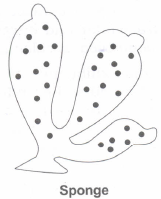
Habit and Habitat. Members of this phylum are commonly known as sponges. They are generally marine and mostly asymmetrical animals. These are primitive
multicellular animals and have cellular level of organization.
Water Transport System in Sponges. Sponges have a water transport or canal system. Water enters through minute pores (ostia) in the body wall into a central
cavity (spongocoel) from where it goes out through the osculum. This pathway of water transport is helpful in food gathering, respiratory exchange and removal of
waste. Choanocytes or collar cells line the spongocoel and the canals. Digestion is intracellular. The body is supported by a skeleton made up of spicules or
sponging fibres.
Reproduction. Sponges are hermaphrodite animals. Sexes are not separate, i.e., eggs and sperms are produced by the same individual. Sponges reproduce asexually by fragmentation and sexually by formation of gametes. Fertilization is internal and development is indirect having a larval stage which is morphologically distinct
from the adult.
Examples: Sycon, Spongilla, Euspongia.
3.
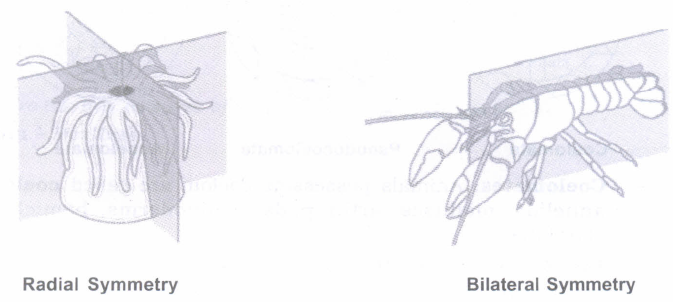
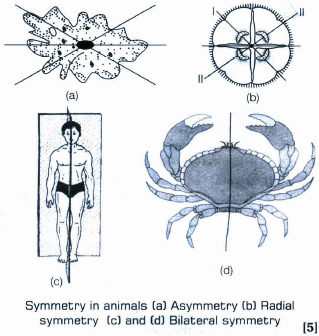
Animals can be categorized on the basis of their symmetry. Sponges are mostly asymmetrical, i.e., any plane that passes through the centre does not divide them into equal halves.
Radial Symmetry. When any plane passing through the central axis of the body divides the organism into two identical halves, it is called radial symmetry. Coelenterates, ctenophores and echinoderms have this kind of body plan.
Bilateral Symmetry. In certain animals the body can be divided into identical left and right halves in only one plane and this type of symmetry is called bilateral symmetry. Examples: Annelids, Arthropods, Mammals
4.
Types of symmetry in animals
5.
Differences between Chordates and Non-Chordates are given below
| Chordates | Non-Chordates |
| Notochord is present atleast in some stages of development | Notochord is absent |
| Central nervous system is dorsal, hollow, single and non-ganglionated | Central nervous system is ventral, solid, double and gangliolated |
| Gill slits present on lateral side of pharynx in sum stages or throughout the life | Gill slits are absent |
| Tail is present in some stages and throughout the life | Tail is generally absent |
| Heart is ventral | Heart is dorsal |
| Haemoglobin is present in RBCs | It is present in plasma |
6.
(i) They are mostly marine called poikilothermic animals(i.e., they have the capacity to regulate their body temperature)
(ii) The body is laterally compressed and spindle-shaped.
(iii) Notochord is persistent throughout the life.
(iv) Mouth is ventral in position, skin is tough containing minute placoid scales and teeth are modified placoid scales. They have strong jaw and predaceous by nature.
(v) Gill slits are generally five pairs and gill cover (operculum) are absent.
(vi) Heart is two-chambered with one auricle and one ventricle.
7.
Differences between poly and medusa are
| Ployp | Medusa |
| a.It is fixed zooid. | a.It is free-swimming. |
| b.It is asexual | b.It is sexual. |
| c.It is cylindrical in outline | c.Medusa is umbrella-shaped. |
| d.Tentacles found at upper end of manubrium. | d.Tentacles occur along the margin of umbrella. |
| e.Mouth is circular and terminal over upright manubrium. | e.Mouth is four sided,lies at the lower end of hanging manubrium. |
| f.Velum and sense organs are absent. | f.Medusa have a circular velum and eight sense organs or statocysts. |
8.
The body wall of a common sponge consists of three layers which are
(i) Pinacoderm (dermal layer) It is an outer cellular layer which consists of
(a) flattened pinacocytes
(b) oval porocytes
(ii) Choanoderm (gastral layer) It is inner cellular layer consisting of highly specialised flagellated cells called choanocytes or collar cells.
(iii) Mesoglial layer (mesenchyme) It is a non-cellular layer found in between pinacoderm and choanoderm.It has fine dispersed spongin fibres and numerous spicules.It also contains amoebocytes of both pinacoderm and choanoderm.
Amoebocytes are modified into following cells
(a) Archaeocytes (totipotent cells)
(b)Trophocytes (nurse cells)
(c) Thesocytes
(d)Gland cells
(e)Collencytes
(f)Myocytes
(g)Germ cells
(h)Chromocytes
(i)Phagocytes
9.
Various excretory organs found in different animals are
| Excretory Organs | Animals |
| Body surface | Sponges, cnidarians and echinoderms |
| Flame cells | Flatworms |
| Intracellular tubes | Roundworms |
| Nephridia | Annelids |
| Green glands | Crustanceans (prawn) |
| Malpighian tubles | Insects |
| Coxal glands | Scorpion and spiders |
| Kidneys | Moluscs and vertebrates |
10.
Features which make mammals as dominant and successful animals are
(i) The presence of an insulating and protective hairy exoskeleton.
(ii) they are warm-blooded so have high rate of metabolism.
(iii) They are viviparous animals and show placentation and intrauterine development which increases the chances for survival of young ones.
(iv) They show high degree of parental care.
(v) They have more developed hearing efficiency due to the presence of pinna, three ear-ossicles and coiled cochlea in the ear.
(vi) They are able to speak through indicative/verbal language.
(vii) They have good power of learning due to the presence of more developed brain.

11th Standard CBSE Syllabus & Materials
11th Standard CBSE
CBSE 11th Business Studies Forms of Business Organisation Sample Question Papers Study Material - QB365 Set A
NEW11th Standard CBSE
CBSE 11th Business Studies Business, Trade and Commerce Sample Question Papers Study Material - QB365 Set A
NEW11th Standard CBSE
CBSE 11th Physics Waves Sample Question Papers Study Material - QB365 Set A
NEW11th Standard CBSE
CBSE 11th Physics Kinetic Theory Sample Question Papers Study Material - QB365 Set A



CBSE 11th Standard CBSE Subjects
CBSE Standards









