
 100% FREE ACCESS
11th Standard CBSE Syllabus & Materials
11th Standard CBSE
CBSE 11th Economics PART-A - Presentation of Data - New Sample Question Papers Study Material - QB365 Set A
NEW11th Standard CBSE
CBSE 11th Economics PART-A - Organisation of Data - New Sample Question Papers Study Material - QB365 Set A
NEW11th Standard CBSE
CBSE 11th Economics PART-A - Collection of Data - New Sample Question Papers Study Material - QB365 Set A
NEW11th Standard CBSE
CBSE 11th Economics PART-A - Introduction to Economics and Statistics - New Sample Question Papers Study Material - QB365 Set A
NEW11th Standard CBSE
CBSE 11th Business Studies International Trade Sample Question Papers Study Material - QB365 Set A
NEW11th Standard CBSE
CBSE 11th Business Studies Evolution and Fundamentals of Business Sample Question Papers Study Material - QB365 Set A

Published on: 04/10/2019
Cell Cycle and Cell Division
Download CBSE Class 11th Standard CBSE Biology question papers, sample papers, important questions, and previous year solved papers in PDF format. Get free study materials, NCERT solutions, and exam preparation resources for Class 11th Standard CBSE Biology
Questions + Answers key
Take MCQ Biology Test
1.
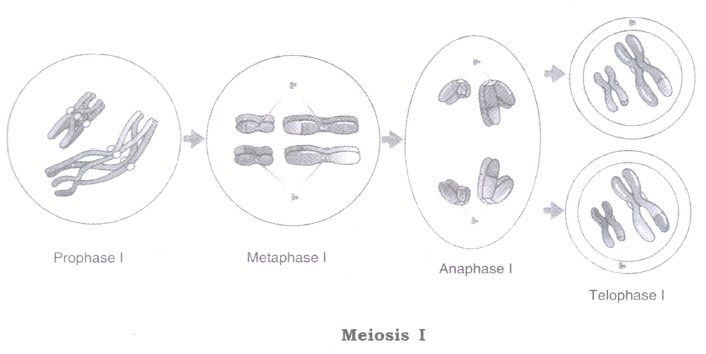
Give diagrammatic representation of the meiotic cell division
2.
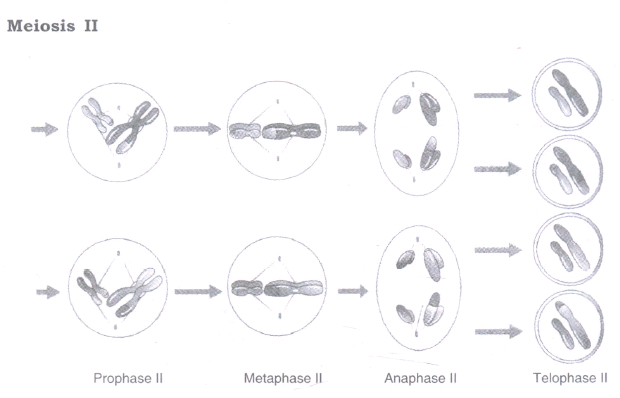
Describe meiosis II with the help of suitable diagrams
3.
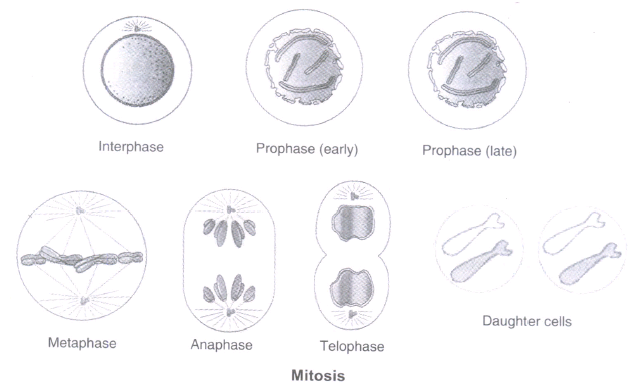
With the help of suitable diagrams describe mitosis
4.
Why does a multicellular organism require two types of cell division? Which of the two, produces the greater number of cells? Describe prophase-I stage.
5.
Explain why a pair of homologous chromosomes is genetically different, but a pair of sister chromatids is genetically identical before crossing over in meiosis.
6.
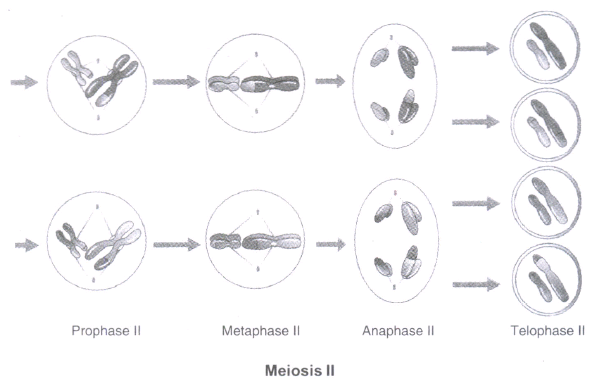
Explain meiosis-II in an animal cell.
7.
Describe briefly the phases of meiotic cell division.
8.
Briefly describe the significance of cell division.
9.
What is the process of cell division in prokaryotes?
10.
Give a description of metaphase I of meiosis
1.
2.
Meiosis II
Prophase II. Meiosis II is initiated immediately after cytokinesis, usually before the chromosomes have fully elongated. In contrast to meiosis I, meiosis II resembles a normal mitosis. The nuclear membrane disappears by the end of prophase II. The chromosomes again become compact
Metaphase II. At this stage the chromosomes align at the equator and the microtubules from opposite poles of the spindle get attached to the kinetochores of sister chromatids.
Anaphase II. It begins with the simultaneous splitting of the centromere of each chromosome (which was holding the sister chromatids together), allowing them to move toward opposite poles of the cell
Telophase II. Meiosis ends with telophase II, in which the two groups of chromosomes once again get enclosed by a nuclear envelope; cytokinesis follows resulting in the formation of tetrad of cells i.e., four haploid daughter cells
3.
Mitosis is divided into the following four stages
Prophase
1.Prophase is marked by the initiation of condensation of chromosomal material. The chromosomal material becomes untangled during the process of chromatin condensation.
2.The centriole, which had undergone duplication during S phase of interphase, now begins to move towards opposite poles of the cell.
3.Cells at the end of prophase, when viewed under the microscope, do not show golgi complexes, endoplasmic reticulum, nucleolus and the nuclear envelope
Metaphase
1.The metaphase is characterised by all the chromosomes coming to lie at the equator.
2.One chromatid of each chromosome connected by its kinetochore to spindle fibres from one pole and its sister chromatid connected by its kinetochore to spindle fibres from the opposite pole.
3.The plane of alignment of the chromosomes at metaphase is referred to as the metaphase plate
Anaphase
1.At the onset of anaphase, each chromosome arranged at the metaphase plate is split simultaneously and make the two daughter chromatids.
2.They are now referred to as chromosomes of the future daughter nuclei, and begin their migration towards the two opposite poles.,
3. As each chromosome moves away from the equatorial plate, the centromere of each chromosome is towards the pole and hence at the leading edge, with the arms of the chromosome trailing behind.
Telophase
This is the stage which shows the following key events:
1.Chromosomes cluster at opposite spindle poles and their identity is lost as discrete elements.
2.Nuclear envelope assembles around the chromosome clusters.
3.Nucleolus, golgi complex and ER reform.
Cytokinesis
Mitosis accomplishes not only the segregation of duplicated chromosomes into daughter nuclei (karyokinesis), but the cell itself is divided into two daughter cells by a separate process called cytokinesis at the end of which cell division is complete.
4.
There are two distinct type of cell divisions taking place in multicellular organisms One is mitosis in somatic cells for growth and healing of wounds and the other is meiosis in reproductive cells for producing gametes having half the number of chromosomes. It is essential to maintain the characters of the species.
More number of cells are produced in meiosis. Each division of mitosis results in the formation of two cells while in meiosis four cells are formed.
5.
A pair of homologous chromosomes is genetically different because in a set of homologous chromosomes, one of the chromosomes belongs to the male parent and the other comes from the female parent. Therefore, one of a pair will contain paternal genes and the other will contain maternal genes. However, a pair of sister chromatids are formed from the replication of DNA during the 'S' phase of interphase. DNA replication ensures that the DNA content is doubled with identical genes being copied from the original DNA. Therefore, there is no genetic variation because there is no exchange of genetic material sister chromatids.
If crossing over occurs, then it would be possible for some genes to be exchanged between the chromatids of homologous chromosomes that have chiasmata, thus leading to genetic variation.
6.
All these happen in the two haploid nuclei simultaneously.
(i) Prophase-II, takes short time. Spindle formation begins and the chromosomes become short. Two chromatids are joined to a single centromere. Nuclear membrane and nucleous disintegrate.
(ii) Metaphase-II At the equator, the chromosomes align at the equator and spindle is formed. The centromere of every chromosome is joined to the spindle fibre and centromere also divides.
(iii) Anaphase-II The daughter chromosomes are formed. Chromatids move towards their poles with the spindle fibres.
(iv) Telophase-II Reaching at the poles, chromosomes form nuclei which are haploid(n) daughter nuclei. Again nuclear membrane is constructed. Nucleous now becomes clearly visible.
Cytokinesis Occurs and four daughter cells are formed which are haploid (n). It may occur once or twice or only after the meiosis-II cell division.
7.
Two phases of meiotic division:
(i) Meiotic cell division is divided into two phases Meiosis I and Meiosis II.
(ii) In the meiotic I division, the homologous chromosomes pair to form bivalents. Exchange of genetic material takes place.
(iii) The chromosomes now separate and get distributed into daughter cells.
(iv) Prophase I is divided into five sub-stages : Leptotene, Zygotene, Pachytene, Diplotene and Diakinesis.
(v) During Metaphase I, the bivalents get arranged on equatorial plate with their arms on the plate but the centromere is directed towards opposite pole. It is followed by Anaphase I.
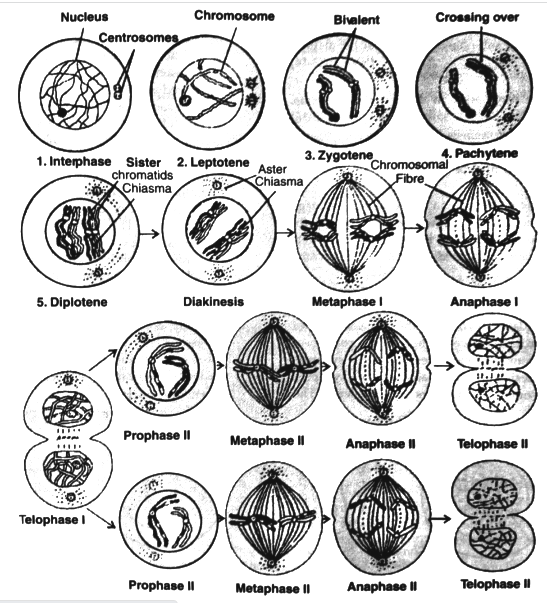
Fig. Stages of meiosis
(vi) Now the homologous chromosomes repel each other, and move to the opposite poles with both their chromatids.
(vii) In this way each pole gets half the chromosomes number of the parent cell.
(viii) In telophase I, the nuclear envelope and nucleolus again appear. Meiosis II is quite similar to mitosis.
(ix) The centromere of each chromosome breaks, separating the chromatids, one each to a daughter cell.
(x) The meiotic cell division maintains the chromosome number of a species.
(xi) As a result of meiotic division, the four daughter cells are formed with half the chromosome number (haploid) in each cell.
8.
Cell division is significant in the following ways
(i) Cell multiplication Cell division is a means of cell multiplication or formation of new cells from pre-existing cells.
(ii) Continuity It maintains continuity of living matter generation after generation.
(iii) Multicellular organisms The body of a multicellular organism is formed of innumerable cells. They are formed by repeated divisions of a single cell or zygote. As the number of cells increases, many of them begin to differentiate, form tissues and organisms.
(iv) Cell size Cell division helps in maintenance of a particular cell size which is essential for efficiency and control of cell activities.
(v) Genetic similarity The common type of cell division or mitosis maintains genetic similarity of all the cells in an individual despite being different, i.e., structurally and functionally.
9.
Prokaryotes do not have nucleus. So, there is no elaborate karyokinesis, as seen in eukaryotes. In prokaryotes the replication of DNA starts the process of cell division. Once genetic material is replicated, it is followed by division of cytoplasm. The process is known as binary fission
10.
Meiosis is a multistep process, and one of the phases within this process is called metaphase I. Metaphase I is when homologous chromosomes line up along the equator of the cell. Homologous chromosomes contain the same genes in the same locations and are often distinguishable based on size.

11th Standard CBSE Syllabus & Materials
11th Standard CBSE
CBSE 11th Business Studies Forms of Business Organisation Sample Question Papers Study Material - QB365 Set A
NEW11th Standard CBSE
CBSE 11th Business Studies Business, Trade and Commerce Sample Question Papers Study Material - QB365 Set A
NEW11th Standard CBSE
CBSE 11th Physics Waves Sample Question Papers Study Material - QB365 Set A
NEW11th Standard CBSE
CBSE 11th Physics Kinetic Theory Sample Question Papers Study Material - QB365 Set A



CBSE 11th Standard CBSE Subjects
CBSE Standards









