
 100% FREE ACCESS
11th Standard CBSE Syllabus & Materials
11th Standard CBSE
CBSE 11th Economics PART-A - Presentation of Data - New Sample Question Papers Study Material - QB365 Set A
NEW11th Standard CBSE
CBSE 11th Economics PART-A - Organisation of Data - New Sample Question Papers Study Material - QB365 Set A
NEW11th Standard CBSE
CBSE 11th Economics PART-A - Collection of Data - New Sample Question Papers Study Material - QB365 Set A
NEW11th Standard CBSE
CBSE 11th Economics PART-A - Introduction to Economics and Statistics - New Sample Question Papers Study Material - QB365 Set A
NEW11th Standard CBSE
CBSE 11th Business Studies International Trade Sample Question Papers Study Material - QB365 Set A
NEW11th Standard CBSE
CBSE 11th Business Studies Evolution and Fundamentals of Business Sample Question Papers Study Material - QB365 Set A

Published on: 19/08/2019
Cell Cycle and Cell Division
Download CBSE Class 11th Standard CBSE Biology question papers, sample papers, important questions, and previous year solved papers in PDF format. Get free study materials, NCERT solutions, and exam preparation resources for Class 11th Standard CBSE Biology
Questions + Answers key
Take MCQ Biology Test
1.
Which stage of meiotic division last for years in some vertebrates. Explain some features of this stage.
2.
What happens when a normal cell turns into a malignant cell?
3.
What is the main role of mitosis?
4.
Division of cytoplasm takes place during which stage?
5.
What is the number of chromosomes in the seed of dicotyledon?
6.
Describe the following - bivalent
7.
What is kinetochore?
8.
What is the term given to multinucleated condition? Explain briefly.
9.
What indicates on the beginning of diplotene stage of prophase-I?
10.
Give the name of the phase between the two successive mitotic cell divisions.
11.
Name a drug that has an inhibitory effect on cell cycle in mitotic stage.
12.
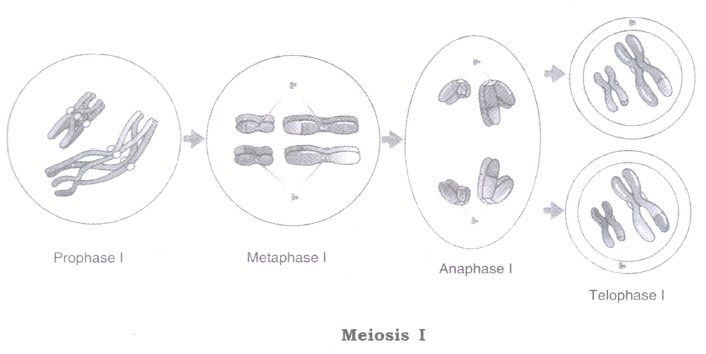
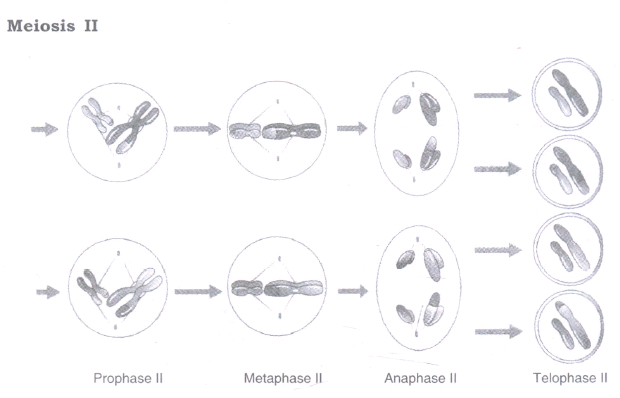
Give diagrammatic representation of the meiotic cell division
13.
Describe briefly the phases of meiotic cell division.
14.
List the main differences between mitosis and meiosis.
15.
(i) Name the stages and type of cell division represented in A and B, repectively.
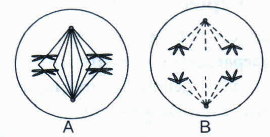
(ii) Also explain any one of them.
16.
State the role of centrioles in cell division.
17.
Describe cell division. List various types of cell division. Also mention about the need of cell division?
18.
Which of the following enzymes is responsible for recombination of genes?
Ribonuclease
Recombinase
Kinetase
Laptotase
19.
During which stage of meiosis the recombination of genes takes place?
Prophase I
Prophase II
Metaphase I
Metaphase II
20.
Which of the following is the longest stage during meiosis?
Prophase I
Prophase II
Metaphase I
Metaphase II
21.
During which stage the cell organelles reappear in cell division?
Prophase
Metaphase
Anaphase
Telophase
22.
Which of the following cells usually do not undergo cell division?
Cells of skin
Cells of buccal cavity
Cells of heart
All of these
1.
Amphibian oocytes can remain for years in the diplotene stage of meiotic prophase. This state resembles the G2 phase of the cell division cycle (see Chapter 8). Resumption of meiosis in the amphibian primary oocyte requires progesterone.
2.
Cells usually stop dividing after certain number of divisions. In malignant or cancerous cells this automatic stoppage of cell division does not work. As a result ma+gnant cells keep on dividing endlessly causing the cancerous growth
3.
It is a type of cell division in which a single cell divides in order to produce two genetically identical “daughter cells”. The purpose of mitosis is: Mitosis is required for growth, repair, and asexual reproduction.
4.
The cell cycle culminates in the division of the cytoplasm by cytokinesis.
5.
We know that, Roots cells are diploid in nature therefore chromosome number of root cell as per the question will be 24 chromosomes.
6.
The complex formed by a pair of synapsed homologous chromosomes is called a bivalent or a tetrad. It consists of four chromatids.
7.
Kinetochores are disc-shaped structures on chromosomes, which help in the attachment of spindle fibres.
8.
Syncytium is the term given to multinucleated condition of the cell.
9.
On the beginning of diplotene stage, synaptonemal complex dissolutes and recombined homologous chromosomes separate from each other.
10.
Interphase is the period between the two successive mitotic cell divisions.
11.
Colchicine is a mitotic inhibitor, so it inhibits the M phase or mitotic phase.
12.
13.
Two phases of meiotic division:
(i) Meiotic cell division is divided into two phases Meiosis I and Meiosis II.
(ii) In the meiotic I division, the homologous chromosomes pair to form bivalents. Exchange of genetic material takes place.
(iii) The chromosomes now separate and get distributed into daughter cells.
(iv) Prophase I is divided into five sub-stages : Leptotene, Zygotene, Pachytene, Diplotene and Diakinesis.
(v) During Metaphase I, the bivalents get arranged on equatorial plate with their arms on the plate but the centromere is directed towards opposite pole. It is followed by Anaphase I.
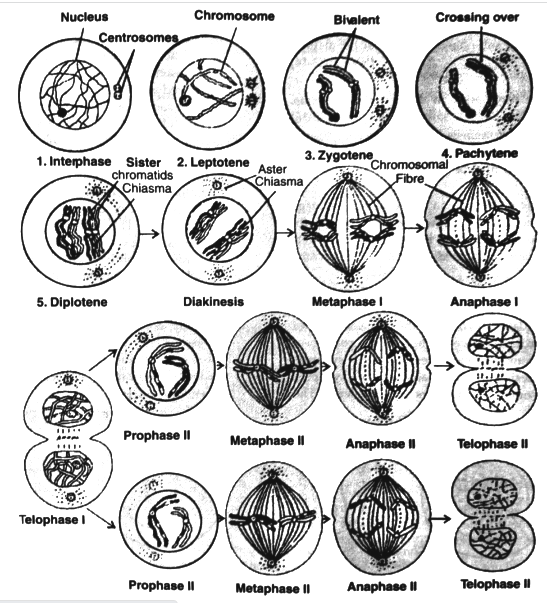
Fig. Stages of meiosis
(vi) Now the homologous chromosomes repel each other, and move to the opposite poles with both their chromatids.
(vii) In this way each pole gets half the chromosomes number of the parent cell.
(viii) In telophase I, the nuclear envelope and nucleolus again appear. Meiosis II is quite similar to mitosis.
(ix) The centromere of each chromosome breaks, separating the chromatids, one each to a daughter cell.
(x) The meiotic cell division maintains the chromosome number of a species.
(xi) As a result of meiotic division, the four daughter cells are formed with half the chromosome number (haploid) in each cell.
14.
Difference between Mitosis and Meiosis
| Mitosis | Meiosis |
|---|---|
| Takes place in somatic cells | Takes place in gametic cells |
| Single division | Double division |
| Two daughter cells are formed in the end and resemble mother cell | Four daughter cells are formed in the end and do not resemble to mother cell |
| Replication of chromsomes occurs before every mitotic division |
Replication of chromsomes occurs only once |
| Number of chromosomes remains same in daughter cells as compared to those in parent cells | Number of chromosomes is halved in daughter cells as compared to those in parent cells |
| Does not intoduce variations | Intoduces variations |
| Cell division happens in simple steps | Cell division involves multiple and longer stages |
15.
(i) Stages and type of cell division are (A) Metaphase -I-meiosis(B) Anaphase-I-meiosis
(ii) For metaphase-I : It is the stage followed by prophase (same as mitosis).
Following changes are observed during this stage
(i) The bivalents during this phase arrange themselves on the two parallel equatorial plates.
(ii) The centromeres project little bit towards periphery.Since, there are two centromeres in each bivalent.Thus, each centromere is joined by chromosomal fibres.
(iii) The fibres of the homologous chromosomes are always in the opposite directions.
16.
Centrioles play an important role in formation of spindle during call division. They organise the mitotic spindle and thus, help in the completion of cytokinesis. They generate the cell's cytoskeleton and help in the formation of the mitotic spindles. In organisms with flagella and cilia, the position of these organelles is determined by the mother centriole, which becomes the basal body.
17.
cell division, cell reproduction or cell multiplication is the process of formation of new daughter cells from the pre-existing cell or parent cell.
It is three types
(i) Amitosis
(ii) Mitosis
(iii) Meiosis.
A cell divides when it attains the size and the nucleocytoplasmic ratio disturbs. The DNA duplication also causes a cell to divide.
18.
(b)
Recombinase
19.
(a)
Prophase I
20.
(a)
Prophase I
21.
(d)
Telophase
22.
(c)
Cells of heart

11th Standard CBSE Syllabus & Materials
11th Standard CBSE
CBSE 11th Business Studies Forms of Business Organisation Sample Question Papers Study Material - QB365 Set A
NEW11th Standard CBSE
CBSE 11th Business Studies Business, Trade and Commerce Sample Question Papers Study Material - QB365 Set A
NEW11th Standard CBSE
CBSE 11th Physics Waves Sample Question Papers Study Material - QB365 Set A
NEW11th Standard CBSE
CBSE 11th Physics Kinetic Theory Sample Question Papers Study Material - QB365 Set A



CBSE 11th Standard CBSE Subjects
CBSE Standards









