
 100% FREE ACCESS
11th Standard CBSE Syllabus & Materials
11th Standard CBSE
CBSE 11th Economics PART-A - Presentation of Data - New Sample Question Papers Study Material - QB365 Set A
NEW11th Standard CBSE
CBSE 11th Economics PART-A - Organisation of Data - New Sample Question Papers Study Material - QB365 Set A
NEW11th Standard CBSE
CBSE 11th Economics PART-A - Collection of Data - New Sample Question Papers Study Material - QB365 Set A
NEW11th Standard CBSE
CBSE 11th Economics PART-A - Introduction to Economics and Statistics - New Sample Question Papers Study Material - QB365 Set A
NEW11th Standard CBSE
CBSE 11th Business Studies International Trade Sample Question Papers Study Material - QB365 Set A
NEW11th Standard CBSE
CBSE 11th Business Studies Evolution and Fundamentals of Business Sample Question Papers Study Material - QB365 Set A

Published on: 03/10/2019
Cell: The Unit of Life
Download CBSE Class 11th Standard CBSE Biology question papers, sample papers, important questions, and previous year solved papers in PDF format. Get free study materials, NCERT solutions, and exam preparation resources for Class 11th Standard CBSE Biology
Questions + Answers key
Take MCQ Biology Test
1.
Give a detail description of plastids with the help of suitable diagram.
2.
With suitable diagram describe animal cell.
3.
What is a centromere? How does the position of centromere form the basis of classification of chromosomes. Support your answer with a diagram showing the position of centromere on different types of chromosomes.
4.
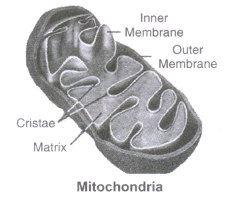
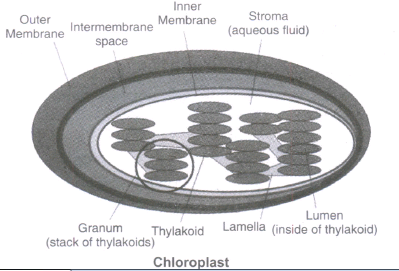
Name two cell-organelles that are double membrane bound. What are the characteristics of these two organelles? State their functions and draw labelled diagrams of both.
5.
Describe the structure of the following with the help of labelled diagrams.
(i) Nucleus
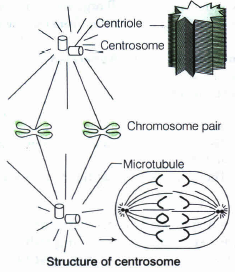
(ii) Centrosome
6.
The diagram shows some of the structures present in an animal cell.
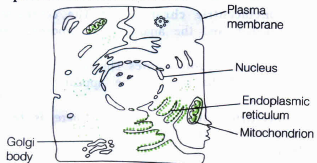
Which of these structures is responsible for
(i) Manufacture of lipids and steroids
(ii) Release of energy
(iii) Manufacture of hormones and digestive enzymes
(iv) Production of spindle fibres in cell division
(v) Endo and exocytosis?
1.
Plastids are found in all plant cells and in euglenoides. These are easily observed under the microscope as they are large. They bear some specific pigments, thus imparting specific colours to the plants. Based on the type of pigments plastids can be classified into chloroplasts, chromoplasts and leucoplasts.
Chloroplasts.
The chloroplasts contain chlorophyll and carotenoid pigments which are responsible for trapping light energy essential for photosynthesis.
Chromoplasts.
In the chromoplasts fat soluble carotenoid pigments like carotene, xanthophylls and others are present. This gives the part of the plant a yellow, orange or red colour.
Leucoplasts.
The leucoplasts are the colourless plastids of varied shapes and sizes with stored nutrients: Amyloplasts store carbohydrates (starch), e.g., potato; elaioplasts store oils and fats whereas the aleuroplasts store proteins.
Shape and Size of Chloroplasts. Majority of the chloroplasts of the green plants are found in the mesophyll cells of the leaves. These are lens-shaped, oval, spherical, discoid or even ribbon-like organelles having variable length (5 - 10 nm) and width (2 - 4 nm). Their number varies from 1 per cell of the Chlamydomonas, a green alga to 20 - 40 per cell in the mesophyll.
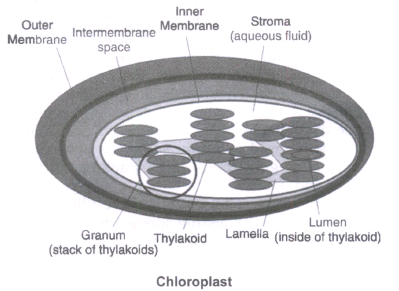
Structure of Chloroplasts. Like mitochondria, the chloroplasts are also double membrane-bound. Of the two, the inner chloroplast membrane is relatively less permeable. The space limited by the inner membrane of the chloroplast is called the stroma. A number of organised flattened membranous sacs called the thylakoids are present in the stroma. Thylakoids are arranged in stacks like the piles of coins called grana (singular: granum) or the intergranal thylakoids. In addition, there are flat membranous tubules called the stroma lamellae connecting the thylakoids of the different grana. The membrane of the thylakoids enclose a space called a lumen. The stroma of the chloroplast contains enzymes required for the synthesis of carbohydrates and proteins. It also contains small, double-stranded circular DNA molecules and ribosomes. Chlorophyll pigments are present in the thylakoids. The ribosomes of the chloroplasts are smaller (70S) than the cytoplasmic ribosomes (80S).
2.
An animal cell has following cell structures:
i) Plasma membrane
ii) Endoplasmic reticulum
iii) Mitochondria
iv)Golgibody
v) Lysosomes
vi) Ribosomes
vii) Vacuoles
viii) Nucleus
ix) Centriole
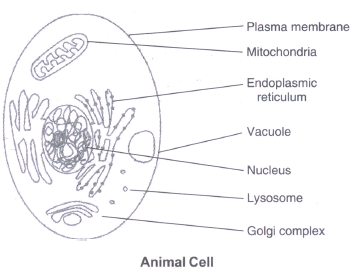
Plasma Membrane.
This is also known as cell membrane. Plasma membrane is made up of lipid and protein. It is semi-permeable in nature. Certain substances are transported through plasma membrane by passive transport. Some substances get transported by osmosis and some by active transport. Active transport involves use of some carrier to facilitate transport. Apart from transport of materials, plasma membrane gives a shape and size to the animal cell.
Endoplasmic Reticulum.
These are networks of fine tubules extending from plasma membrane to nucleus. They work like pipelines and facilitate transport of substances from outside the cell to nucleus and cytoplasm. Depending on presence or absence of ribosomes ER can be either rough or smooth.
Golgi Body.
This is composed of many sack like structures stacked one over another. The function of golgi body is to package different materials, like carbohydrate, protein and lipid.
Lysosome.
Lysosome is small spherical structure filled with digestive enzymes. The digestive enzyme helps in digesting foreign materials and waste products. Sometimes the lysosome digests the contents of cytoplasm which in turn kills the cell itself. That is why lysosome is also known as 'suicide bag of the cell'.
Ribosome.
Ribosomes are small dot like structures. They are made of two subunits. The function of ribosome is to synthesize protein.
Vacuoles.
These are small fluid filled structures. Vacuoles help in maintaining osmotic pressure inside the cell.
Mitochondria.
Mitochondria is double membrane structure. The inner membrane is projected in finger-like structures, called cristae. The presence of cristae helps in increasing the inner surface are of mitochondria. Aerobic respiration takes place in the mitochondria and energy released is stored in the form of ATP (Adenosine triphosphate).
Nucleus.
Nucleus is covered by nuclear membrane. Nucleus contains chromosomes which are genetic materials. Nucleus also controls various functions of the cell.
Centriole.
These are spindle like structures. During cell division they form spindle fibres.
3.
Every chromosome essentially has a primary constriction or the centromere on the sides of which disc-shaped structures called kinetochores are present. Based on the position of the centromere, the chromosomes can be classified into four types.
Metacentric Chromosome : The metacentric chromosome has middle centromere forming two equal arms of the chromosome. Sub-metacentric Chromosome. The sub-metacentric chromosome has centromere nearer to one end of the chromosome resulting into one shorter arm and one longer arm.
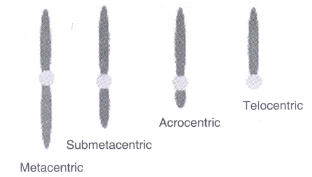
Acrocentric Chromosome : In case of acrocentric chromosome, the centromere is situated close to its end forming one extremely short and one very long arm, Telocentric Chromosome. The telocentric chromosome has a terminal centromere.
4.
Two double membrane-bound cell organelles:
(a) Mitochondria. It has finger-like folds in the inner membrane called cristae. Mitochondria is the place for aerobic respiration.
(b) Chloroplast. Chloroplast is responsible for converting light energy into chemical energy. Chloroplast contains stacked thylakoid in its matrix.
5.
(i) Nucleus: It is a naked, round and slightly irregular structure, which is attached to the chromatin at a specific region. The content of nucleolus is continuous with the rest of the nucleoplasm as it is not a membrane bound structure.
It is a site for active ribosomal RNA synthesis.Larger and more numerous nucleoli are present in cells activitely carrying out protein synthesis.
(ii) Centrosome
6.
Structures responsible are
(i) Smooth endoplasmic Reticulim (SER) is responsible for the manufacture of lipids and steroids.
(ii) Mitochondrion is responsible for the release of energy.
(iii) Ribosomes is responsible for the production of hormones and digestive enzymes.
(iv) Centrioles is responsible for production of spindle fibres.
(v) Plasma membrane is responsible for endo and exocytosis.

11th Standard CBSE Syllabus & Materials
11th Standard CBSE
CBSE 11th Business Studies Forms of Business Organisation Sample Question Papers Study Material - QB365 Set A
NEW11th Standard CBSE
CBSE 11th Business Studies Business, Trade and Commerce Sample Question Papers Study Material - QB365 Set A
NEW11th Standard CBSE
CBSE 11th Physics Waves Sample Question Papers Study Material - QB365 Set A
NEW11th Standard CBSE
CBSE 11th Physics Kinetic Theory Sample Question Papers Study Material - QB365 Set A



CBSE 11th Standard CBSE Subjects
CBSE Standards









