
 100% FREE ACCESS
11th Standard CBSE Syllabus & Materials
11th Standard CBSE
CBSE 11th Economics PART-A - Presentation of Data - New Sample Question Papers Study Material - QB365 Set A
NEW11th Standard CBSE
CBSE 11th Economics PART-A - Organisation of Data - New Sample Question Papers Study Material - QB365 Set A
NEW11th Standard CBSE
CBSE 11th Economics PART-A - Collection of Data - New Sample Question Papers Study Material - QB365 Set A
NEW11th Standard CBSE
CBSE 11th Economics PART-A - Introduction to Economics and Statistics - New Sample Question Papers Study Material - QB365 Set A
NEW11th Standard CBSE
CBSE 11th Business Studies International Trade Sample Question Papers Study Material - QB365 Set A
NEW11th Standard CBSE
CBSE 11th Business Studies Evolution and Fundamentals of Business Sample Question Papers Study Material - QB365 Set A

Published on: 11/10/2019
Transport in Plants
Download CBSE Class 11th Standard CBSE Biology question papers, sample papers, important questions, and previous year solved papers in PDF format. Get free study materials, NCERT solutions, and exam preparation resources for Class 11th Standard CBSE Biology
Questions + Answers key
Take MCQ Biology Test
1.
How do roots absorb water and how does water get transported from root hairs to primary root?
2.
Explain how minerals are transported to various parts of plants?
3.
What are the different mechanisms of transport in plants? Explain with suitable diagrams.
4.
What causes the opening and closing of guard cells of stomata during transpiration?
5.
Explain pressure flow hypothesis of translocation of sugars in plants.
6.
Differentiate between the following -Guttation and Transpiration
7.
Differentiate between the following - Apoplast and Symplast pathways of movement of water in plants
8.
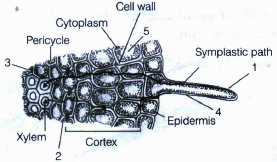
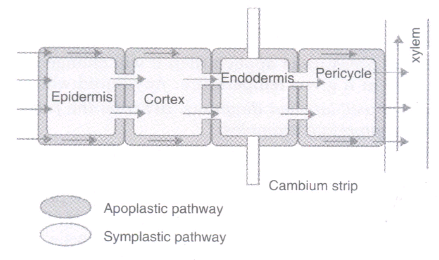
A portion of transverse section of root is shown in the diagram. Label 1-5 and also write the function of parts 2 and 3. Briefly, explain the symplast pathway.
9.
(i) With the help of well-labeled diagrams, describe the process of plasmolysis in plants, giving appropriate examples.
(ii) Explain what will happen to a plant cell if it is kept in a solution having higher water potential.
10.
Define transpiration pull diagrammatically explain the route of transpiration pull and ascent of sap in plants.
1.
Absorption of Water
The responsibility of absorption of water and minerals is more specifically the function of the root hairs that are present in millions at the tips of the roots. Root hairs are thin-walled slender extensions of root epidermal cells that greatly increase the surface area for absorption. Water is absorbed along with mineral solutes, by the root hairs, purely by diffusion. Once water is absorbed by the root hairs, it can move deeper into root layers by two distinct pathways:
1.apoplast pathway
2.symplast pathway
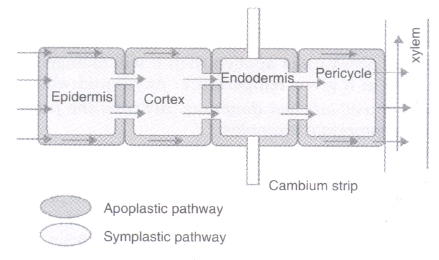
Within a plant, the apoplast is the free diffusional space outside the plasma membrane. It is interrupted by the Casparian strip in roots, air spaces between plant cells and the cuticula of the plant.
Structurally, the apoplast is formed by the continuum of cell walls of adjacent cells as well as the extracellular spaces, forming a tissue level compartment comparable to the symplast. The apoplastic route facilitates the transport of water and solutes across a tissue or organ. This process is known as apoplastic transport.
The symplast of a plant is the inner side of the plasma membrane in which water (and low molecular solutes) can freely diffuse.
The plasmodesmata allow the direct flow of small molecules such as sugars, amino acids, and ions between cells. Larger molecules, including transcription factors and plant viruses, can also be transported through with the help of actin structures.
This allows direct cytoplasm to cytoplasm flowof water and other nutrients along concentration gradients. In particular, it is used in the root systems to bring in nutrients from soil. It moves these solutes from epidermis cells through the cortex into the endodermis and eventually the pericycle, where it can be moved into the xylem for long distance transport. It is contrasted with the apoplastic flow, which uses cell wall transport.
2.
Uptake of Mineral Ions
Unlike water, all minerals cannot be passively absorbed by the roots. Two factors account for this:
1.Minerals are present in the soil as charged particles (ions) which cannot move across cell membranes and
2.The concentration of minerals in the soil is usually lower than the concentration of minerals in the root
Therefore, most minerals must enter the root by active absorption into the cytoplasm of epidermal cells. This needs energy in the form of ATP. The active uptake of ions is partly responsible for the water potential gradient in roots, and therefore for the uptake of water by osmosis. Some ions also move into the epidermal cells passively. Ions are absorbed from the soil by both passive and active transport.
Specific proteins in the membranes of root hair cells actively pump ions from the soil into the cytoplasms of the epidermal cells. Like all cells, the endodermal cells have many transport proteins embedded in their plasma membrane; they let some solutes cross the membrane, but not others
Translocation of Mineral Ions
After the ions have reached xylem through active or passive uptake, or a combination of the two, their further transport up the stem to all parts of the plant is through the transpiration stream. The chief sinks for the mineral elements are the growing regions of the plant, such as the apical and lateral meristems, young leaves, developing flowers, fruits and seeds, and the storage organs. Unloading of mineral ions occurs at the fine vein endings through diffusion and active uptake by these cells
Mineral ions are frequently remobilised, particularly from older, senescing parts. Older dying leaves export much of their mineral content to younger leaves. Similarly, before leaf fall in decidous plants, minerals are removed to other parts. Elements most readily mobilised are phosphorus, sulphur, nitrogen and potassium. Some elements that are structural components like calcium are not remobilised. An analysis of the xylem exudates shows that though some of the nitrogen travels as inorganic ions, much of it is carried in the organic form as amino acids and related compounds. Similarly, small amounts of P and S are carried as organic compounds. In addition, small amount of exchange of materials does take place between xylem and phloem.
3.
Diffusion. Movement by diffusion is passive, and maybe from one part of the cell to the other, or from cell to cell, or over short distances, say, from the intercellular spaces of the leaf to the outside. No energy expenditure takes place. In diffusion, molecules move in a random fashion, the net result being substances moving from regions of higher concentration to regions of lower concentration. Diffusion is a slow process and is not dependent on a 'living system'. Diffusion is obvious in gases and liquids, but diffusion in solids rather than of solids is more likely. Diffusion is very important to plants since it is the only means for gaseous movement within the plant body.
Factors affecting diffusion:
1.Gradient of concentration,
2.Permeability of the membrane separating them,
3.Temperature and
4.Pressure.
Facilitated Diffusion. A gradient must already be present for diffusion to occur. The diffusion rate depends on the size of the substances; obviously smaller substances diffuse faster. The diffusion of any substance across a membrane also depends on its solubility in lipids, the major constituent of the membrane. Substances soluble in lipids diffuse through the membrane faster. Substances that have a hydrophilic moiety, find it difficult to pass through the membrane; their movement has to be facilitated. Membrane proteins provide sites at which such molecules cross the membrane. They do not set up a concentration gradient: a concentration gradient must already be present for molecules to diffuse even if facilitated by the proteins. This process is called facilitated diffusion.
In facilitated diffusion special proteins help move substances across membranes without expenditure of ATP energy. Facilitated diffusion cannot cause net transport of molecules from a low to a high concentration - this would require input of energy. Transport rate reaches a maximum when all of the protein transporters are being used (saturation). Facilitated diffusion is very specific: it allows cell to select substances for uptake. It is sensitive to inhibitors which react with protein side chains.
The proteins form channels in the membrane for molecules to pass through. Some channels are always open; others can be controlled. Some are large, allowing a variety of molecules to cross.
The porins are proteins that form huge pores in the outer membranes of the plastids, mitochondria and some bacteria allowing molecules up to the size of small proteins to pass through molecule bound to the transport protein; the transport protein then rotates and releases the molecule inside the cell, e.g., water channels - made up of eight different types of aquaporins.
Facilitated Diffusion
Passive symports and antiports. Some carrier or transport proteins allow diffusion only if two types of molecules move together. In a symport, both molecules cross the membrane in the same direction; in an antiport, they move in opposite directions. When a molecule moves across a membrane independent of other molecules, the process is called uniport.
Active Transport. Active transport uses energy to pump molecules against a concentration gradient. Active transport is carried out by membrane-proteins. Hence different proteins in the membrane playa major role in both active as well as passive transport. Pumps are proteins that use energy to carry substances across the cell membrane. These pumps can transport substances from a low concentration to a high concentration ('uphill' transport). Transport rate reaches a maximum when all the protein transporters are being used or are saturated. Like enzymes the carrier protein is very specific in what it carries across the membrane. These proteins are sensitive to inhibitors that react with protein side chains.
4.
Opening and Closing of Stomata :
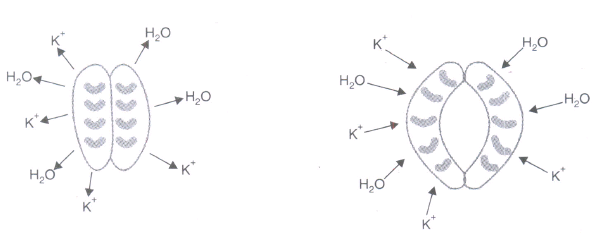
The immediate cause of the opening or closing of the stomata is a change in the turgidity of the guard cells. The inner wall of each guard cell, towards the pore or stomatal aperture, is thick and elastic. When turgidity increases within the two guard cells flanking each stomatal aperture or pore, the thin outer walls bulge out and force the inner walls into a crescent shape. The opening of the stoma is also aided due to the orientation of the microfibrils in the cell walls of the guard cells. Cellulose microfibrils are oriented radially rather than longitudinally making it easier for the stoma to open. When the guard cells lose turgor, due to water loss (or water stress) the elastic inner walls regain their original shape, the guard cells become flaccid and the stoma closes.
5.
The Pressure Flow or Mass Flow Hypothesis
The accepted mechanism used for the translocation of sugars from source to sink is called the pressure flow hypothesis. As glucose is prepared at the source (by photosynthesis) it is converted to sucrose (a dissacharide). The sugar is then moved in the form of sucrose into the companion cells and then into the living phloem sieve tube cells by active transport. This process of loading at the source produces a hypertonic condition in the phloem. Water in the adjacent xylem moves into the phloem by osmosis. As osmotic pressure builds up the phloem sap will move to areas of lower pressure. At the sink osmotic pressure must be reduced. Again active transport is necessary to move the sucrose out of the phloem sap and into the cells which will use the sugar - converting it into energy, starch, or cellulose. As sugars are removed, the osmotic pressure decreases and water moves out of the phloem.
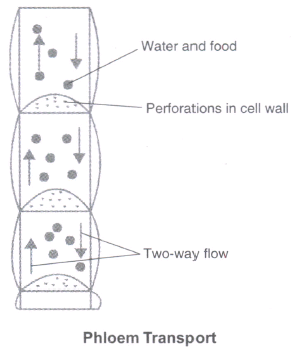
Phloem tissue is composed of sieve tube cells, which form long columns with holes in their end walls called sieve plates. Cytoplasmic strands pass through the holes in the sieve plates, so forming continuous filaments. As hydrostatic pressure in the phloem sieve tube increases, pressure flowbegins, and the sap moves through the phloem. Meanwhile, at the sink, incoming sugars are actively transported out of the phloem and removed as complex carbohydrates. The loss of solute produces a high water potential in the phloem, and water passes out, returning eventually to xylem.
A simple experiment, called girdling, was used to identify the tissues through which food is transported. On the trunk of a tree a ring of bark up to a depth of the phloem layer, can be carefully removed. In the absence of downward movement of food the portion of the bark above the ring on the stem becomes swollen after a few weeks. This simple experiment shows that phloem is the tissue responsible for translocation of food; and that transport takes place in one direction, i.e., towards the roots. This experiment can be performed by you easily.
6.
Guttation and Transpiration:
Guttation is the appearance of drops of xylem sap on the tips or edges of leaves of some vascular plants, such as grasses. Guttation is not to be confused with dew, which condenses from the atmosphere onto the plant surface.
Process :
At night, transpiration usually does not occur because most plants have their stomata closed. When there is a high soil moisture level, water will enter plant roots, because the water potential of the roots is lower than in the soil solution. The water will accumulate in the plant, creating a slight root pressure. The root pressure forces some water to exude through special leaf tip or edge structures, hydathodes, forming drops. Root pressure provides the impetus for this flow, rather than transpirational pull.
Transpiration on the other hand happens because of transpiration pull.
7.
Apoplast and Symplast pathways of movement of water in plants.
Within a plant, the apoplast is the free diffusional space outside the plasma membrane. It is interrupted by the Casparian strip in roots, air spaces between pfant ceITsand the cuticula of the plant.
Structurally, the apoplast is formed by the continuum of cell walls of adjacent cells as well as the extracellular spaces, forming a tissue level compartment comparable to the symplast. The apoplastic route facilitates the transport of water and solutes across a tissue or organ. This process is known as apoplastic transport.
The symplast of a plant is the inner side of the plasma membrane in which water (and low-molecular solutes) can freely diffuse. The plasmodesmata allow the direct flow of small molecules such as sugars, amino acids, and ions between cells. Larger molecules, including transcription factors and plant viruses, can also be transported through with the help of actin structures.
This allows direct cytoplasm to cytoplasm flow of water and other nutrients along concentration gradients. In particular, it is used in the root systems to bring in nutrients from soil. It moves these solutes from epidermis cells through the cortex into the endodermis and eventually the pericycle, where it can be moved into the xylem for long distance transport. It is contrasted with the apoplastic flow,which uses cell wall transport.
8.
Labeling of the parts/ pathways Parts 1 Root hair, 2 Endodermis, 3 Casparian strip,
4 Apoplastic path and 5 Vacuole.
Functions of parts 2 and 3
2. EndodermisIt is a special layer of living cells that enclose the vascular cylinder of the root. The major function of endodermis in roots is to prevent the
loss of water and minerals.
3. Casparian stripThe Casparian strip present in the wall of endodermal cells is made up of lignosuberin, a waxy substance that prevents movement of water
and minerals via cell wall route.
Symplast pathwayWater moves from cell to cell through living cytoplasm and plasmodesmata.
9.
(i) Plasmolysis occurs when water moves out of the cell and the cell membrane of a plant cell shrinks away from its cell wall. This occurs when the cell is kept in a
solution that is hypertonic (has more solutes) to the protoplasm. Water moves out from the cell through diffusion and causes the protoplasm to shrink away from the walls. In such situation, cell becomes plasmolysed.
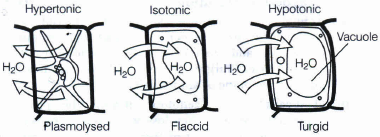
When the cell is placed in an isotonic solution. There is no flow of water towards inside or outside. If the external solution balances the osmotic pressure of the
cytoplasm, it is said to be isotonic. When the water flows into the cell and out of the cell or in equilibrium the cell is called flaccid.
(ii) When the plant cell is kept in a solution having high water potential (hypotonic solution or dilute solution as compared to cytoplasm), water diffuses into the
cell causing the cytoplasm to build up a pressure against the wall, called turgor pressure.
The pressure exerted by the protoplasts due to entry of water against the rigid walls is called pressure potential \(({ \psi }_{ p })\) Because of the rigidity of the cell wall,
the cell does not rupture. This turgor pressure is ultimately responsible for enlargement of cells.
10.
Transpiration pull is the phenomenon which takes place when thousands of transpiring mesophyll cells withdraw water from the xylem by generating a negative pressure in the water column and exerting an upward pull over the water column.This pull is further transmitted to the roots in search of more water.

11th Standard CBSE Syllabus & Materials
11th Standard CBSE
CBSE 11th Business Studies Forms of Business Organisation Sample Question Papers Study Material - QB365 Set A
NEW11th Standard CBSE
CBSE 11th Business Studies Business, Trade and Commerce Sample Question Papers Study Material - QB365 Set A
NEW11th Standard CBSE
CBSE 11th Physics Waves Sample Question Papers Study Material - QB365 Set A
NEW11th Standard CBSE
CBSE 11th Physics Kinetic Theory Sample Question Papers Study Material - QB365 Set A



CBSE 11th Standard CBSE Subjects
CBSE Standards









