
 100% FREE ACCESS
11th Standard CBSE Syllabus & Materials
11th Standard CBSE
CBSE 11th Economics PART-A - Presentation of Data - New Sample Question Papers Study Material - QB365 Set A
NEW11th Standard CBSE
CBSE 11th Economics PART-A - Organisation of Data - New Sample Question Papers Study Material - QB365 Set A
NEW11th Standard CBSE
CBSE 11th Economics PART-A - Collection of Data - New Sample Question Papers Study Material - QB365 Set A
NEW11th Standard CBSE
CBSE 11th Economics PART-A - Introduction to Economics and Statistics - New Sample Question Papers Study Material - QB365 Set A
NEW11th Standard CBSE
CBSE 11th Business Studies International Trade Sample Question Papers Study Material - QB365 Set A
NEW11th Standard CBSE
CBSE 11th Business Studies Evolution and Fundamentals of Business Sample Question Papers Study Material - QB365 Set A

Published on: 20/08/2019
Transport in Plants
Download CBSE Class 11th Standard CBSE Biology question papers, sample papers, important questions, and previous year solved papers in PDF format. Get free study materials, NCERT solutions, and exam preparation resources for Class 11th Standard CBSE Biology
Questions + Answers key
Take MCQ Biology Test
1.
Give one basic difference between antiport and uniport
2.
Mention one similarity between transport proteins and enzymes proteins.
3.
Passive transport across a membrane, when two protein molecules move in opposite direction and independent of each other, is called as
4.
Why does the rate of transport reach maximum or become saturated in facilitated diffusion?
5.
Mention the type of molecular movement which is highly selective and also requires special membrane proteins, but works without the requirement of energy.
6.
Enumerate the importance os osmosis in the life of the plants. (any two points)
7.
Why is osmotic potential given a negative sign?
8.
Mention two factors on which net direction of molecules and rate of osmosis depends
9.
What are proteins? what role do they play in diffusion?
10.
What are the different factors that affect the rate of diffusion?
11.
What is meant by Apoplast pathway? Why does it occur in cortex and not in endodermis?
12.
Enumerate the process of guttation.How is it affected by root pressure?
13.
Name the two theories which explain water movement in stems.Give the explanation of root pressure theory.
14.
What happens when a pressure greater than the atmospheric pressure is applied to pure water or a solution?
15.
Briefly, describe water potential. what are at the factors affecting it?
16.
Various types of transport mechanisms are needed to fulfil the mineral requirements of a plant. Why are they not fulfilled by diffusion alone?
17.
What are the different mechanisms of transport in plants? Explain with suitable diagrams.
18.
(i) With the help of well-labeled diagrams, describe the process of plasmolysis in plants, giving appropriate examples.
(ii) Explain what will happen to a plant cell if it is kept in a solution having higher water potential.
19.
Which of the following is a characteristic of mass flow movement?
Huge mass is moved
Movement is in bulk
Huge pressure is required
Larger porins helps transport large mass
20.
When rajma seeds are soaked in water overnight, they swell. What gives the explanation for this?
Osmosis
Diffusion
Active Transport
Imbibition
21.
When a seed is soaked overnight in water, what happens to its cells?
They become flaccid
They become turgid
They become either flaccid or turgid
No change
22.
Which of the following shows the correct relation at atmospheric pressure?
Water Potential = Solute Potential
Water Potential> Solute Potential
Water Potential < Solute Potential
Water Potential \(\neq \) Solute Potential
23.
Substances which need facilitated diffusion have which kind of moiety?
Hydrophobic
Hydrophilic
Lipophilic
Lipophobic
1.
()
In antiport, both molecules move across the membrane in opposite direction, In uniport, both molecules move across a membrane independent of each other
2.
()
They are specific for a substance.
3.
()
Antiport transport
4.
()
The transport rate reaches a maximum because all the transport proteins are occupied/satured
5.
()
Facilitated passive diffusion
6.
Osmosis is important in the following ways
(i) Helps in maintaining turgidity of the cells
(ii) Affects absorption of water by roots
7.
Osmotic potential is given negative sign because when pure water (zero water potential) has another substance dissolved in it, the water molecules have less potential to move. Due to which osmotic potential of a solution become less than zero. i.e., negative
8.
The two factors responsible are
(i) Pressure gradient
(ii) Concentration gradient
9.
Porins are the proteins that form huge pores in the outer membranes of the plastids, mitochondria and some bacteria. The porins mainly allow the molecules upto the size of small proteins to pass through or they facilitate the process of diffusion
10.
Factors affecting the rate of diffusion are
(i) temperature
(ii) pressure
(iii) gradient of concentration
(iv) permeability of membrane
11.
Passive absorption of water: A force develops during water absorption in the shoot system where transpiration is occurring. The transpiration than create a tension in xylem due to loss of water from its aerial parts. Tension spreads in all the xylem channels of the root. This may be due to:
1. Rate of water absorption.
2. Amount of water absorbed.
3. The shoot may continue to absorb water even in the absence of root.
Apoplast pathway: water moves from soil to cell wall ofroot hair cell, endodermis, pericycle, xylem parenchyma and xylem channels. Water in the xylem channel is under more negative pressure so it draws water from soil through intervening apoplast along the gradient. It takes place trough the cell wall. It does not occur in endodermis because; endodermis cells contain casparian strips which are water resistant
12.
The process of exudation of liquid drops from the margins of the leaves through hydathodes is called guttation.
Guttation is affected by root pressure in the following ways
(i) When root pressure is high and transpiration is low, herbaceous plants may loose small quantities of liquid water in the form of drops.
(ii) The rate of guttation increases with a decrease in root pressure due to less absorption of water.
13.
There are two main theories that explain the movement of water in stems.These are
(i) root pressure theory and
(ii) adhesion-cohesion theory.
14.
If a pressure greater than atmospheric pressure is applied to pure water or a solution, its water potential increases. It is equivalent to pumping water from one place to another. Pressure can be built up in a plant system when water Enters a plant cell due to diffusion against the cell wall. It makes the cell turgid, this increases the pressure potential. Pressure potential is usually positive and denoted by \({ \Psi }_{ p }\).
15.
Water potential is the potential energy of water relative to pure free water (e.g., deionised water). It quantifies the tendency of water to move from one area to another due to osmosis, gravity, mechanical pressure or matrix effects including surface tension. Water potential is measured in units of pressure and is commonly represented by the Greek letter \(\Psi \)(psi). This concept has proved useful especially in understanding the water movement within plants, animals and soil.
Water potential of a cell is affected by both solute and pressure potential. The relationship between them is as follows
\({ \Psi }_{ w }={ \Psi }_{ s }+{ \Psi }_{ p }\)
16.
The organic solutes in plants have to move in various direction. e.g., the food substances synthesised in the leaves are translocated downwards towards the stem and roots. Similarly, the upward movement of solutes from the leaves to the developing buds, flowers and fruits take place. The food materials or minerals are also translocated radially from the cells of pith to those of cortex and epidermis. Thus, the various processes such as active diffusion, electrochemical potential and mass flow, etc., are needed in addition for the transport of minerals and organic solutes.
17.
Diffusion. Movement by diffusion is passive, and maybe from one part of the cell to the other, or from cell to cell, or over short distances, say, from the intercellular spaces of the leaf to the outside. No energy expenditure takes place. In diffusion, molecules move in a random fashion, the net result being substances moving from regions of higher concentration to regions of lower concentration. Diffusion is a slow process and is not dependent on a 'living system'. Diffusion is obvious in gases and liquids, but diffusion in solids rather than of solids is more likely. Diffusion is very important to plants since it is the only means for gaseous movement within the plant body.
Factors affecting diffusion:
1.Gradient of concentration,
2.Permeability of the membrane separating them,
3.Temperature and
4.Pressure.
Facilitated Diffusion. A gradient must already be present for diffusion to occur. The diffusion rate depends on the size of the substances; obviously smaller substances diffuse faster. The diffusion of any substance across a membrane also depends on its solubility in lipids, the major constituent of the membrane. Substances soluble in lipids diffuse through the membrane faster. Substances that have a hydrophilic moiety, find it difficult to pass through the membrane; their movement has to be facilitated. Membrane proteins provide sites at which such molecules cross the membrane. They do not set up a concentration gradient: a concentration gradient must already be present for molecules to diffuse even if facilitated by the proteins. This process is called facilitated diffusion.
In facilitated diffusion special proteins help move substances across membranes without expenditure of ATP energy. Facilitated diffusion cannot cause net transport of molecules from a low to a high concentration - this would require input of energy. Transport rate reaches a maximum when all of the protein transporters are being used (saturation). Facilitated diffusion is very specific: it allows cell to select substances for uptake. It is sensitive to inhibitors which react with protein side chains.
The proteins form channels in the membrane for molecules to pass through. Some channels are always open; others can be controlled. Some are large, allowing a variety of molecules to cross.
The porins are proteins that form huge pores in the outer membranes of the plastids, mitochondria and some bacteria allowing molecules up to the size of small proteins to pass through molecule bound to the transport protein; the transport protein then rotates and releases the molecule inside the cell, e.g., water channels - made up of eight different types of aquaporins.
Facilitated Diffusion
Passive symports and antiports. Some carrier or transport proteins allow diffusion only if two types of molecules move together. In a symport, both molecules cross the membrane in the same direction; in an antiport, they move in opposite directions. When a molecule moves across a membrane independent of other molecules, the process is called uniport.
Active Transport. Active transport uses energy to pump molecules against a concentration gradient. Active transport is carried out by membrane-proteins. Hence different proteins in the membrane playa major role in both active as well as passive transport. Pumps are proteins that use energy to carry substances across the cell membrane. These pumps can transport substances from a low concentration to a high concentration ('uphill' transport). Transport rate reaches a maximum when all the protein transporters are being used or are saturated. Like enzymes the carrier protein is very specific in what it carries across the membrane. These proteins are sensitive to inhibitors that react with protein side chains.
18.
(i) Plasmolysis occurs when water moves out of the cell and the cell membrane of a plant cell shrinks away from its cell wall. This occurs when the cell is kept in a
solution that is hypertonic (has more solutes) to the protoplasm. Water moves out from the cell through diffusion and causes the protoplasm to shrink away from the walls. In such situation, cell becomes plasmolysed.
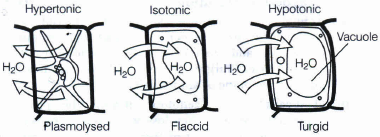
When the cell is placed in an isotonic solution. There is no flow of water towards inside or outside. If the external solution balances the osmotic pressure of the
cytoplasm, it is said to be isotonic. When the water flows into the cell and out of the cell or in equilibrium the cell is called flaccid.
(ii) When the plant cell is kept in a solution having high water potential (hypotonic solution or dilute solution as compared to cytoplasm), water diffuses into the
cell causing the cytoplasm to build up a pressure against the wall, called turgor pressure.
The pressure exerted by the protoplasts due to entry of water against the rigid walls is called pressure potential \(({ \psi }_{ p })\) Because of the rigidity of the cell wall,
the cell does not rupture. This turgor pressure is ultimately responsible for enlargement of cells.
19.
(b)
Movement is in bulk
20.
(d)
Imbibition
21.
(b)
They become turgid
22.
(b)
Water Potential> Solute Potential
23.
(b)
Hydrophilic

11th Standard CBSE Syllabus & Materials
11th Standard CBSE
CBSE 11th Business Studies Forms of Business Organisation Sample Question Papers Study Material - QB365 Set A
NEW11th Standard CBSE
CBSE 11th Business Studies Business, Trade and Commerce Sample Question Papers Study Material - QB365 Set A
NEW11th Standard CBSE
CBSE 11th Physics Waves Sample Question Papers Study Material - QB365 Set A
NEW11th Standard CBSE
CBSE 11th Physics Kinetic Theory Sample Question Papers Study Material - QB365 Set A



CBSE 11th Standard CBSE Subjects
CBSE Standards









