
 100% FREE ACCESS
11th Standard CBSE Syllabus & Materials
11th Standard CBSE
CBSE 11th Economics PART-A - Presentation of Data - New Sample Question Papers Study Material - QB365 Set A
NEW11th Standard CBSE
CBSE 11th Economics PART-A - Organisation of Data - New Sample Question Papers Study Material - QB365 Set A
NEW11th Standard CBSE
CBSE 11th Economics PART-A - Collection of Data - New Sample Question Papers Study Material - QB365 Set A
NEW11th Standard CBSE
CBSE 11th Economics PART-A - Introduction to Economics and Statistics - New Sample Question Papers Study Material - QB365 Set A
NEW11th Standard CBSE
CBSE 11th Business Studies International Trade Sample Question Papers Study Material - QB365 Set A
NEW11th Standard CBSE
CBSE 11th Business Studies Evolution and Fundamentals of Business Sample Question Papers Study Material - QB365 Set A

Published on: 25/07/2019
Biological Classification
Download CBSE Class 11th Standard CBSE Biology question papers, sample papers, important questions, and previous year solved papers in PDF format. Get free study materials, NCERT solutions, and exam preparation resources for Class 11th Standard CBSE Biology
Questions + Answers key
Take MCQ Biology Test
1.
How do fungi form partnership with most plants?
2.
Which type of fungi are also called bracket fungi?
3.
What are bacteriophages and their types? Identify their shape.
4.
In which virus two single strands RNA are present? What is the role of reverse transcriptase?
5.
Plants are autotrophic. Can you think of some plants that are partially heterotrophic?
6.
In which group all prokaryotes were kept in five kingdom system?
7.
Which biologist proposed the kingdom-Monera?
8.
Give the names of the kingdom in three kingdom classification.
9.
Who coined the term Protista?
10.
Who proposed the two kingdom classification?
11.
How the Aristotle divided animals into two groups?
12.
What is the need of a classification system in biology? How did different classification systems develop over a period of time?
13.
Describe various classes of fungi.Give details of their key characteristics.
14.
Describe the cell structure of fungus in details
15.
Which is the most acceptable system of biological classification?
Two Kingdom Classification
Three Kingdom Classification
Five Kingdom Classification
Six Kingdom Classification
16.
Which of the following organisms is a good indicator of pollution in an environment?
Bacteria
Fungi
Algae
Lichens
17.
Which is the correct word for relationship between algae and fungi in lichens?
Parasitism
Symbiosis
Commensals
Pathogens
18.
Write five beneficial usage or effects of bacteria.
19.
What is the role of methanogens?
20.
Differentiate between phycobiont and mycobiont.
21.
Give a diagrammatic representation of classification of Protista.
22.
Write two differences between algae and fungi.
1.
Some fungi have evolved essential relationships with the roots of many living plants.
These fungi grow around and into the roots. Both partners benefit so that neither would thrive without the other. This partnership is called mycorrhizal symbiosis.
2.
Bracket or shelf fungi are lignocolous fungi which produce bracket or shelf-shaped, hard, leathery basidiocarps that are found to come out from the tree trunk on loss of wood, e.g., Fomes tomentarius, etc.
3.
Bacteriophages are viruses which kill bacteria. They are numbered T1 to T7 as their types. The shape of bacteriophages is tadpole - like with a head and a tail.
4.
HIV has two single RNA strands in its nucleoid. Reverse transcriptase enzyme catalyses the formation of DNA from RNA. It is found in some RNA viruses called retroviruses, e.g., HIV
5.
Plants are generally autotrophic.However, some plants like Nepenthes (pitcher plant), Utricularia (bladderwort), Venus fly trap and some parasites like Cuscuta are examples of partially heterotrophic plants. They supplement their nitrogen requirement by capturing and digesting insects.
6.
Monera
7.
Copeland (1956).
8.
Plantae, Protista, and Animalia
9.
Ernst Haeckel (1866)
10.
Linnaeus proposed the two kingdom classification in 1758
11.
Aristotle divided animals in two groups. These are Enaima (with red blood ) and Enaima (without red blood)
12.
There are millions of species on this planet.The largest phylum Arthropoda alone comprises of millions of species. To study all of them properly we need some system for categorizing them, based on some common characteristics.
Apart from that think of the differences in language and you will find different names for the same species in different languages.In the absence of a system of nomenclature it would have been difficult to share scientific knowledge among the scientists of different nations.
To make things easier and systematic the need for classification was felt.Earlier attempts by people like Aristotle segregated living beings into plants and animals.This was good point to start with, but there are certain living beings which do not fit in either of plants or animals.So a three kingdom classification was devised.The three kingdom classification was used for some time.But as none of the scientific theory is permanent so further discoveries led to creation of a five kingdom classification.The five kingdom classification is the most accepted system of classification.
13.
Division of Kingdom Fungi :
The morphology of the mycelium, mode of spore formation and fruiting bodies form the basis for the division of the kingdom into various classes.
a) Phycomycetes :
Habit and Habitat : Members of phycomycetes are found in aquatic habitats and on decaying wood in moist and damp places or as obligate parasites on plants.
Mycelium : The mycelium is aseptate and coenocytic.
Reproduction : Asexual reproduction takes place by zoospores (motile) or by aplanospores (non-motile).
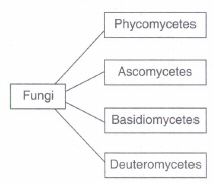
b) Ascomycetes :
Habit and Habitat : Commonly known as sac-fungi,the ascomycetes are unicellular, e.g.yeast (Sacharomyces) or multicellular, e.g.Penicillium.They are saprophytic, decomposers, parasitic or coprophilous (growing on dung).
Mycelium : Mycelium is branched and septate.
Reproduction : The asexual spores are conidia, produced exogenously on the special mycelium called conidiophores.
c) Basidiomycetes :
Habit and Habitat : Commonly known forms of basidiomycetes are mushrooms, bracket fungi or puffballs. They grow in soil, on logs and tree stumps and in living plant bodies as parasites, e.g., rusts and smuts.
Mycelium : The mycelium is branched and septate.
Reproduction : The asexual spores are generally not found, but vegetative reproduction by fragmentation is common.
d) Deuteromycetes :
Habit and Habitat : Some members are saprophytes or parasites while a large number of them are decomposers of litter and help in mineral cycling. Some examples are Alternaria, Colletotrichum and Trichoderma.
Reproduction : The deuteromycetes reproduce only by asexual spores known as conidia. The mycelium is septate and branched.
14.
Fungus cells are eukaryotic. These cells contains all the eukaryotic organelles excepts plastids. Some of the organelles are the nucleus, ribosomes, endoplasmic reticulum, mitochondria, Golgi bodies, etc. A fungal cell wall contains mostly chitin. Plasmalemma bears coiled membranous outgrowths called lomasomes. Nuclei are small and connected to endoplasmic reticulum. Nuclear division involves formation of internal spindle. Vacuoles are small. Near the hyphal tips, the cytoplasm contains small vesicles called chitosomes. Food reserve is in the form of glycogen and oil.
15.
(c)
Five Kingdom Classification
16.
(d)
Lichens
17.
(c)
Commensals
18.
(a) Curdling of milk
(b) Lactobacillus is an important commensal in the gut flora of humans.
(c) Penicillin antibiotics are prepared by bacteria.
(d) Bacteria is a good decomposer, so it assists in completing the energy cycle.
(e) Rhizobium bacteria helps in nitrogen fixation.
19.
Methanogens are a type of bacteria which live in the gut of ruminating animals.They assist those animals in digestion and the byproduct of that digestive process is methane.More number of livestock population results in increased methane level in the environment leading to global warming.So, indirectly methanogens can be responsible for global warming.
20.
| Mycobiont | Phycobiont |
| 1.This is the part of lichen composed of fungal part |
1.This is the part of lichen composed of algal part. |
| 2.Mycobiont is dependent on algae for nutrition. |
2.Phycobiont makes its own food |
| 3.Mycobiont is attached to the substratum. | 3.Phycobiont is not attached to the substratum. |
21.
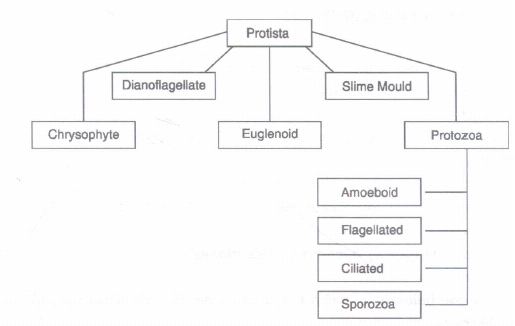
22.
Difference between algae and fungi
(a) Algae is autotrophic, while fungi is heterotrophic.
(b) Algae cannot be a parasite, while fungi can be a parasite.

11th Standard CBSE Syllabus & Materials
11th Standard CBSE
CBSE 11th Business Studies Forms of Business Organisation Sample Question Papers Study Material - QB365 Set A
NEW11th Standard CBSE
CBSE 11th Business Studies Business, Trade and Commerce Sample Question Papers Study Material - QB365 Set A
NEW11th Standard CBSE
CBSE 11th Physics Waves Sample Question Papers Study Material - QB365 Set A
NEW11th Standard CBSE
CBSE 11th Physics Kinetic Theory Sample Question Papers Study Material - QB365 Set A



CBSE 11th Standard CBSE Subjects
CBSE Standards









