
 100% FREE ACCESS
11th Standard CBSE Syllabus & Materials
11th Standard CBSE
CBSE 11th Economics PART-A - Presentation of Data - New Sample Question Papers Study Material - QB365 Set A
NEW11th Standard CBSE
CBSE 11th Economics PART-A - Organisation of Data - New Sample Question Papers Study Material - QB365 Set A
NEW11th Standard CBSE
CBSE 11th Economics PART-A - Collection of Data - New Sample Question Papers Study Material - QB365 Set A
NEW11th Standard CBSE
CBSE 11th Economics PART-A - Introduction to Economics and Statistics - New Sample Question Papers Study Material - QB365 Set A
NEW11th Standard CBSE
CBSE 11th Business Studies International Trade Sample Question Papers Study Material - QB365 Set A
NEW11th Standard CBSE
CBSE 11th Business Studies Evolution and Fundamentals of Business Sample Question Papers Study Material - QB365 Set A

Published on: 30/07/2019
Morphology of Flowering Plants
Download CBSE Class 11th Standard CBSE Biology question papers, sample papers, important questions, and previous year solved papers in PDF format. Get free study materials, NCERT solutions, and exam preparation resources for Class 11th Standard CBSE Biology
Questions + Answers key
Take MCQ Biology Test
1.
Describe the structure of an isobilateral leaf. Differentiate between a moncot and dicot leaf.
2.
Write the description of gynoecium in various plants.
3.
In a typical leaf what kind of cells are usually present in m.esophull?
4.
What are the components of stomata?
5.
Write a short note on two main types of roots.
6.
What is pulvins? Give an example of a plant that has pulvins.
7.
Reticulate venation is found in dicot leaves, while in monocot levaes venation is of parallel type. Biology being a science of exceptions, find out any exception to this generalisation.
8.
Differentiate between reticulate venation and paralleel venation.
9.
Why are velamen tissues present in epiphytic roots?
10.
Why development of root branches is endogenous?
11.
Why some tap roots become swollen and fleshy?
12.
The scutellum obeserved in a grain of wheat or maize is comparable to which part of the seed in other monocots.
13.
Which is the techinical term used for the androecium in a flower of China rose?
14.
What are the differences between meristematic tissues and permanent tissues?
15.
What is periderm? How does periderm formation take place in the dicot stems?
16.
Differentiate between (a) Racemose and cymose inflorescence (b) Apocarpous and syncarpous ovary
17.
Define the term inflorescence. Explain the basis for the different types inflorescence in flowering plants.
18.
Justify the following statements on the basis of external features.
Flower is a modified shoot.
19.
What is the role of the guard cells?
Controls opening and closing of stomata
Protects stomatal opening
Prevents dust from entering leaves
All of the above
20.
Open bundle is found in which of the following?
Monocot stem
Monocot Root
Dicot Stem
Dicot Leaf
21.
Which of the following is a dead tissue?
Sclerenchyma
Chollenchyma
Parenchyma
Cortex
22.
Apical meristem is found at which of the following organs in plant?
Roots Tips
Shoot Tips
Both (a) and (b)
Leaf Tips
1.
Isobilateral (Monocotyledonous) Leaf
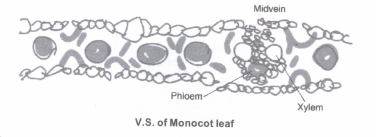
Structure: -
1. Epidermis is composed of single layer of cells.
2. Stomata are present on both surfaces of leaf.
3. Mesophyll is not differentiaited into palisade and spongy parenchyma.
4. In grasses, certain adaxial epidermal cells along the veins modify themselves into large, empty, colourless cells. These are called bulliform cells. When the bulliform cells in the leaves have absorbed water and are turgid, the leaf surface is exposed. When they are flaccid due to water stress, they make the leaves curl inwards to minimise water loss.
5. The parallel venation in monocot leaves is reflected in the near similar sizes of vascular bundles (except in main veins) as seen in vertical sections of the leaves.
Differences between Dicot and Monocot Leaf
| Dicot Leaf | Monocot Leaf |
|---|---|
| 1. Stomata on ventral surface. | 1. Stomata on both surfaces |
| 2. Mesophyll differentiated in Pallisade and spongy parenchyma | 2. Mesophyll is not differentiated |
| 3. Bulliform cells absent. | 3. Bulliform cells present. |
| 4. Vascular bundles are of different sizes. | 4. Vascular bundles are of similar sizes (except in main veins) |
2.
The description of gynoecium in various plants.
(i) Carples Monocarpellary /bi carpellary/ tricarpellary/tetracarpellary /multi-capillary
(ii) Cohestion Apocarpous/Syncarpous
(iii) Overy Superior/semi-inferior/inferior.
(iv) Placentation Marginal/axile/parietal/basal/free-central/superficial.
(v) Style Terminal/lateral/gynobasic/stylopodium
(vi) Stigma number,shape-simpe,lobed,capitate,branched.
3.
Cells containing chlorophylls compose the mesophyll in leaves.
4.
Stomatal opening, guard cells and companion cells.
5.
Two main type of roots is tap root and adventitious root.Taproot develops from radicle of the embryo,e.g., pea,gram, etc. Adventitious root develops from ant part of the plant other than the radicle.,e.g., wheat,rice,etc.
6.
Pulvins is the swollen leaf base. It is found in some plants belong to Legumins e.g. pea,bean etc
7.
Dicot leaves have parallel venation e.g. Corymbium,Calophyllum,Eryngium Monocot leaves have reticulate venation e.g Smilax,Colocasia,Dioscorea.
8.
Differentiate between reticulate venation and paralleel venation are
| Reticulate Venation | Parallel Venation |
| Veins are not oriented parallel to one another | Veins are oriented parallel to one another. |
| Smaller veins produce a network or reticulum. | A reticulum is not produced |
| It is the charactersitic feature of dictyledons. | It is the characterstic feature of monocotyledons. |
9.
The velamens atre spongy tissues, which help epiuphytic roots in absording atmospheric water vapours.
10.
Root branches develop from the interior of the parent root. This orgen is called endogenous.
11.
Tap roots of some plants become fleshy due to storage of reserve food. The main root stores extra food whereas secondary roots are thin and are involved in absorption of minerals from the soil. The swollen roots occur in different shapes.
12.
The scutellum observed in a grain of wheat or maize is comparable to the cotyledon part of the seed in other monocotyledons.
13.
Monadelphy refers to a condition where all the stamens in a given flower are fused to form a single bundle. The androecium in China Rose is monadelphous.
14.
Differences between meristematic tissues and permanent tissues
| Meristematic Tissues | Permanent Tissues |
|---|---|
| 1. Cells keep on dividing. | 1. Cells stop dividing. |
| 2. Growth is the basic function. | 2. Protection is the basic function. |
| 3. Found in tips of roots and stem. | 3. Found in girth and periphery. |
15.
As the stem continues to increase in girth due to the activity of vascular cambium, the outer cortical and epidermis layers get broken and need to be replaced to provide new protective cell layers. Hence, sooner or later, another meristematic tissue called cork cambium or phellogen develops, usually in the cortex region. Phellogen is a couple of layers thick. It is made of narrow, thin-walled and nearly rectangular cells. Phellogen cuts off cells on both sides. The outer cells differentiate into cork or phellem while the inner cells differentiate into secondary cortex or phelloderm. The cork is impervious to water due to suberin deposition in the cell wall. The cells of secondary cortex are parenchymatous. Phellogen, phellem, and phelloderm are collectively known as periderm. Due to activity of the cork cambium, pressure builds up on the remaining layers peripheral to phellogen and ultimately these layers die and slough off.
16.
Differentiate between recemose inflorescene and cymose inflorescene are
| Racemose inflorescene | Cymose inflorescene |
| Flowers are bome laterally. | Flowers are actually terminal |
| Growing point does not end in a flower. | Growing point or terminal bud always ends in a flower. |
| Flowers develop from all sides. | Flowers develop from one or two sides. |
| Opening of flowers occurs at short intervals | Opening of successive flowers takes longer intervals. |
| Young fruits are not protected by flowers | Young fruits are protected by flowers |
(ii) Differentiate between apocarpous and syncarpous ovary is
| Apocarpous Ovary | Syncarpous Ovary |
| It has more than one and free carpels. | It has more than one and fused carpels. |
| e.g lotus,rose | e.g. Hibiscus (Shoe flower), Petunia |
17.
The inflorescence is how the flowers are arranged on the flowering axis. During the flowering season, the vegetative apex of the stem gets converted into a floral meristem. Based on whether the floral axis continues to grow or ends in a flower, the inflorescence is classified into racemose and cymose. In racemose inflorescence, the floral axis continues to grow and produces flowers laterally. On the other hand, in a cymose inflorescence, the main axis terminates into a flower. Hence, it is limited in growth.
Growth : Indefinite (race mose) and definite.
Number of branches : Cymose, uniparous, biparous, multiparous
Pedicel : Presence or absence of pedicel in inflorescene.
Branching of peduncle : Unbranched and branched.
Sex of flowers : Certain types have unisexual flowers. e.g, Catkin.
18.
Flower is a modified shoot consisiting of a highly reduced stem bracnch to form thalamus in which the nodes are borne only towards the trip. The floral parts, i.e. sepals,petals,stamens and carpels are arranged in their respective whorls and arise from nodes.
19.
(a)
Controls opening and closing of stomata
20.
(c)
Dicot Stem
21.
(a)
Sclerenchyma
22.
(c)
Both (a) and (b)

11th Standard CBSE Syllabus & Materials
11th Standard CBSE
CBSE 11th Business Studies Forms of Business Organisation Sample Question Papers Study Material - QB365 Set A
NEW11th Standard CBSE
CBSE 11th Business Studies Business, Trade and Commerce Sample Question Papers Study Material - QB365 Set A
NEW11th Standard CBSE
CBSE 11th Physics Waves Sample Question Papers Study Material - QB365 Set A
NEW11th Standard CBSE
CBSE 11th Physics Kinetic Theory Sample Question Papers Study Material - QB365 Set A



CBSE 11th Standard CBSE Subjects
CBSE Standards









