
 100% FREE ACCESS
11th Standard CBSE Syllabus & Materials
11th Standard CBSE
CBSE 11th Economics PART-A - Presentation of Data - New Sample Question Papers Study Material - QB365 Set A
NEW11th Standard CBSE
CBSE 11th Economics PART-A - Organisation of Data - New Sample Question Papers Study Material - QB365 Set A
NEW11th Standard CBSE
CBSE 11th Economics PART-A - Collection of Data - New Sample Question Papers Study Material - QB365 Set A
NEW11th Standard CBSE
CBSE 11th Economics PART-A - Introduction to Economics and Statistics - New Sample Question Papers Study Material - QB365 Set A
NEW11th Standard CBSE
CBSE 11th Business Studies International Trade Sample Question Papers Study Material - QB365 Set A
NEW11th Standard CBSE
CBSE 11th Business Studies Evolution and Fundamentals of Business Sample Question Papers Study Material - QB365 Set A

Published on: 31/07/2019
Anatomy of Flowering Plants
Download CBSE Class 11th Standard CBSE Biology question papers, sample papers, important questions, and previous year solved papers in PDF format. Get free study materials, NCERT solutions, and exam preparation resources for Class 11th Standard CBSE Biology
Questions + Answers key
Take MCQ Biology Test
1.
Define epiphyllous arrangement of stamens.
2.
List out the significance of secondary growth.
3.
Describe the cortex region of dicot root?
4.
What are the cells that make the leaves curl in plants during water stress?
5.
How the study of anatomy is useful to us ?
6.
How do the bullifrom cells presents in the epidermis help grasses?
7.
How the vessel members in xylems are interconnected ?
8.
What is the composition of collenchyma cells ?
9.
How are the adjacent parenchyma cells are connected to each other?
10.
What is the difference between a mango fruit and a coconut fruit in terms of edible part?
11.
What is the difference and similarity between prop root and stilt root?
12.
Define phyllotaxy
13.
Describe the arrangement of floral members in relation to their insertion on thalamus.
14.
Justify the following statements on the basis of external features:
(i) Underground parts of a plant are not always roots.
(ii) Flower is a modified shoot.
15.
While eating peach or pear, it is usually seen that some stone-like structures get entangled in the teeth. What are these stone-like structures called?
16.
What are the charecteristic difference found in vascular tissu of gymnosperms and angiosperms?
17.
How the arrangement of vascular bundles in monocots differs from dicots?
18.
Make a list of common fruits, their type and their edible parts.
19.
What are the main structures in a monocot seeds? Describe with the help of suitable diagram
20.
Explain the process of secondary growth in the stems of woody angiosperms. What is its significance?
21.
Starting from periphery and going towards centre which is the correct sequence of different whorls of a flower?
Corolla, Calyx, Gynoecium, Androecium
Calyx, Corolla, Gynoecium, Androecium
Calyx, Corolla, Androecium, Gynoecium
Either (b) or (c).
22.
What is the name of the whorl containing colourful parts of flower?
Petal
Sepal
Calyx
Corolla
23.
Which of the following shows modification of stem for food storage?
Carrot
Turnip
Ginger
None of these
24.
What is the name of modified root in turnip?
Prop root
Tap root
Tubour
Pneumatophore
25.
What is the function of adventitious roots?
Anchorage
Vegetative Propagation
Food Storage
Oxygen intake
1.
When stamens are attached to the perianth, it is called epiphyllous arrangement.
2.
Significance of secondary growth are as follows
(i) It adds girth to the plant.
(ii) It produces a corky bark around the tree trunk that protects the interior of the plant.
(iii) It adds new conducting tissues for replacing old non-functioning tissues.
3.
The cortex consists of several layers of thin walled parenchyma cells. Intercellular spaces are small but abundant. The cortical cells can be rounded, oval or angular.
They store food. The major function of the cortex in the root hair zone is conduction of water and minerals from the epiblema to the interior of the root.
4.
Bulliform cells make the leaves curl during the condition of the water stress. The epidermal cell modification in plants that prevents water loss is known as Bulliform Cells.
5.
The study of anatomy helps to us in
(i) solving taxonomic problems.
(ii) analysing the microstructure , adulteration of spice, tea, tobacco, etc.
(iii) extraction of compounds for use as medicine.
(iv) differentiation of inferior quality wood from the superior quality.
6.
The bulliform cells presents in the epidermis of grasses help in folding of leaves during hot summer day and prevent transpiration
7.
The vessel members are interconnected through perforations in their end/common walls.
8.
It is made of cellulose, hemicellulose and pectic substances
9.
By Plasmodesmata or cytoplasmic bridges.
10.
Edible part in mango: Mesocarp
Edible part in coconut: Seed
11.
Difference. Prop roots come out of branches of the main stem and they come from greater heights. Stilt roots come out from the main stem and they come out from just above the ground.
Similarity. Both prop roots and stilt roots give additional mechanical support to the plant.
12.
Phyllotaxy:
1. Phyllotaxy is defined as the patterns of arrangement of leaves on the stem of a plant.
2. Every kind of plant has a different phyllotaxy and that helps in optimizing their photosynthesis output.
3. The phyllotaxy is based on the direction of shoot growth.
4. A phyllotaxy has a central axis or a branch from which the leaves originate around the nodes.
5. The main aim of phyllotaxy is to expose all leaves of the plant to maximum sunlight and air.
6. There are three types of Phyllotaxy namely:
(i) Alternate phyllotaxy- Here, a single leaf develops alternatively at each node.
(ii) Opposite phyllotaxy- Here, a pair of leaves develops opposite each other at each node.
(iii) Whorled phyllotaxy- Here, more than two leaves develop at each node to form a whorl.
13.
Floral members, like calyx, corolla and androecium are arranged differently in relation to ovary on the thalamus. Based on this arrangement flowers can be divided as follows
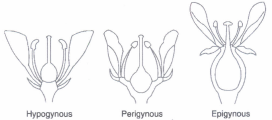
Hypogynous Flower: In hyopgynous flowers, the ovary occupies the highest position. Other floral members are inserted below the ovary, on thalamus. Perigynous Flower: In perigynous flowers, the ovary and other floral members are inserted on the same level on thalamus.
Epigynous Flower: In epigynous flowers, the ovary is at the lowest position on thalamus. Other floral members are inserted above the ovary.
14.
(i) In some plants stems remain underground to carry out some additional functions, like food storage and vegetative reproduction. For example, potatoes are modified form of underground stems.
(ii) When the stem takes on the role of sexual reproduction it is modified into a flower. That is why flower is often called a modified shoot.
15.
Sclereids, a type of sclerenchyma.
16.
In gymnosperms , Vessel elements are not present in xylem, whereas , these are main constituents in angiosperms . In the phloem of gymnosperms, companion cells are not associated with the sieve elements . In angiosperms , companion cells are associated with the sieve elements of phloem.
17.
In dicots, cambium is present between pholem and xylem . These types of vascular bundles are capable to form secondary sylem and pholem tissues.These are konwn as open vascular bundles.In monocots, vascular bundle have no cambium present hence, they do not form secondary tissues.These are known as closed vascular tissues.
18.
| Fruits | Type | Edible Parts |
|---|---|---|
| Apple, Pear | Pome | Fleshy thalamus |
| Banana | Berry | Mesocarp |
| Cashewnut | Nut | Cotyledons, fleshy thalamus |
| Coconut | Drupe | Endosperm |
| Cucumber | Pepo | Mesocarp, endocarp, seeds |
| Date palm | Berry | Pericarp |
| Fig | Synconus | Thalamus |
| Jack fruit | Sorosis | Bracts, perianth & seeds |
| Grapes | Berry | Pericarp and placenta |
| Guava | Berry | Thalamus and pericarp |
| Litchi | Nut | Aril |
| Wheat, maize | Caruopsis | Endosperm |
| Mango | Drupe | Mesocarp |
| Pea, Gram | Legume | Cotyledons |
| Orange | Lemon | Hesperidium Juicy placentae |
| Papaya | Berry | Mesocarp |
| Pineapple | Sorosis | Bracts, receptacle |
| Pomegranate | Balausta | Seed coat |
| Tomato | Berry | Pericarp and placentae |
| Mustard | Siliqua | Seed |
19.
Structure of Monocotyledonous Seed
a. Generally, monocotyledonous seeds are endospermic but some as in orchids are non-endospermic.
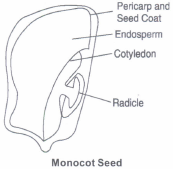
b. In the seeds of cereals such as maize the seed coat is membranous and generally fused with the fruit wall.
c. The endosperm is bulky and stores food. The outer covering of endosperm separates the embryo by a proteinous layer called aleurone layer
d. The embryo is small and situated in a groove at one end of the endosperm. It consists of one large and shield shaped cotyledon known as scutellum and a short axis with a plumule and a radicle.
e. The plumule and radicle are enclosed in sheaths which are called coleoptile and coleorhiza respectively.
20.
Secondary growthg in stems of woody angiosperms occurs by two types of cambia, i.e., vascular cambium and cork cambium
(i) Vascular Cambium Ceratin cdells of medullary rays become meristematic to form interfasicular cambium.The fascicular cambium and the interfasicular join to form a complete ring called cambial ring. The cells of the cambial ring undergo mitotic divisions and produce secondary phloem on its outer side and secondary xylem on its inner side.
At places , vascular cambium possess ray intials.They form vascular rays, phloem rays in seconadry phloem and wood rays in secondary xylem.
As new secondary phloem becomes functional , the previous older phloem gets crushed. Secondary xylem or wood persists.As a result wood grows with age in the form of annual rings.
In each annual ring , there is wide or broader spring or early wood or spring wood and narrow autumn or late wood.
In old stems, the central part of wood becomes non-functional and dark coloured due to presenceof tyloses and deposition of resins , gums, and tannins.It is called duramen or heartwood.The outer functional wood is called sapwood .
(ii) Cork Cambium As the stem continues to increase in grith due to the activity of vascular cambium the ouiter cortical and epidermal layers get broken and need to be replaced to provide new protective cell layers.In this way , cork cambium or phellogen develops in the cortex region .Phellogen cuts of cells on both sides.
The outer cells differentiate into cork or phellem while, the inner cells differentiate into cork or phellem while , the inner cells differentiate into secondary cortex or phelloderm.Due to activity of cork cambium, pressure builds up on the remaining layers peripheral to phellogen and dultimately these layers peripheral to phellogen nad ultimately these layers die and sloghed off.
At places , aerating pores called lenticules develop, which have loosely arranged complementary cells.
Significance of secondary Growth
(i) It repalces old non-functional tissues.
(ii) It provides fireproof, insect proof and insulating cover around the older plant parts.
(iii) Commercail cork is a product of secondary growth .
(iv) Wood is the product of secondary growth.
21.
(c)
Calyx, Corolla, Androecium, Gynoecium
22.
(d)
Corolla
23.
(c)
Ginger
24.
(b)
Tap root
25.
(b)
Vegetative Propagation

11th Standard CBSE Syllabus & Materials
11th Standard CBSE
CBSE 11th Business Studies Forms of Business Organisation Sample Question Papers Study Material - QB365 Set A
NEW11th Standard CBSE
CBSE 11th Business Studies Business, Trade and Commerce Sample Question Papers Study Material - QB365 Set A
NEW11th Standard CBSE
CBSE 11th Physics Waves Sample Question Papers Study Material - QB365 Set A
NEW11th Standard CBSE
CBSE 11th Physics Kinetic Theory Sample Question Papers Study Material - QB365 Set A



CBSE 11th Standard CBSE Subjects
CBSE Standards









