
 100% FREE ACCESS
11th Standard CBSE Syllabus & Materials
11th Standard CBSE
CBSE 11th Economics PART-A - Presentation of Data - New Sample Question Papers Study Material - QB365 Set A
NEW11th Standard CBSE
CBSE 11th Economics PART-A - Organisation of Data - New Sample Question Papers Study Material - QB365 Set A
NEW11th Standard CBSE
CBSE 11th Economics PART-A - Collection of Data - New Sample Question Papers Study Material - QB365 Set A
NEW11th Standard CBSE
CBSE 11th Economics PART-A - Introduction to Economics and Statistics - New Sample Question Papers Study Material - QB365 Set A
NEW11th Standard CBSE
CBSE 11th Business Studies International Trade Sample Question Papers Study Material - QB365 Set A
NEW11th Standard CBSE
CBSE 11th Business Studies Evolution and Fundamentals of Business Sample Question Papers Study Material - QB365 Set A

Published on: 24/09/2019
Business Service
Download CBSE Class 11th Standard CBSE Business Studies question papers, sample papers, important questions, and previous year solved papers in PDF format. Get free study materials, NCERT solutions, and exam preparation resources for Class 11th Standard CBSE Business Studies
Questions + Answers key
Take MCQ Business Studies Test
1.
Write a short note on Indian insurance sector.
2.
Write a short note on GATS.
3.
Explain different types of life insurance policies.
4.
Explain in detail the warehousing services.
5.
Describe various types of insurance and exercise the nature of risks protected by each type of insurance.
6.
Write a detailed note on various facilities offered by Indian Postal Department.
7.
Explain the functions of commercial banks with an example of each.
8.
What are services? Explain their distinct characteristics.
1.
(i) The health of the insurance sector reflects a country's economy. This sector not only generates long term funds for infrastructure development, but also increases a country's risk taking capacity. India's economic growth since the turn of the century is viewed as a significant development in the global economy. This view is helped in no small part by a booming insurance industry.
(ii)The future of the Indian insurance sector looks bright. The sector which stood at a strong US Dollar 72 billion in 2012 has the potential to grow to US Dollar 280 billion by 2020. This growth is driven by India's favourable regulatory environment which guarantees stability and fair play. This environment has given rise to an insurance market which encourages foreign investors to tap into the sector's massive potential. Ever since the Indian government liberalised the insurance sector in 2000 and opened the doors for private participation, the sector has become stronger. The resultant competition has provided the consumer with a never-before-seen range of products and providers, and also enhanced service levels markedly.
Consistent growth in the insurance sector depends on a few factors. Some of these are:
(a) Effective distribution channels: The efficiency and cost of the various distribution strategies used by companies are significant to their success in the insurance business. This particularly holds true for the retail business.
(b) Focus on overall financial inclusion: As time evolves, so must the approach of the insurance sector in India. The objective of the insurance sector should ideally be to offer a broader range of activities to a wider populace.
(c) Consumer needs and preferences: The growth of India's insurance industry can be attributed to product innovation, dynamic distribution channels, and vibrant publicity and promotional campaigns run by insurance companies. Benefits attached to the products and the manner in which they are delivered (through various marketing tie-ups) have helped bring customers and insurance companies closer to each other and made the latter more relevant.
(d) Health Insurance is an up-and-coming segment in this sector: Currently, it caters for 10 per cent of the overall US$ 30 billion healthcare expenditure in India. Consequently, there is plenty of scope for players in this area.
(e) The life insurance segment contributes about 4 per cent to India's gross domestic product (GDP) in terms of total premiums underwritten annually. There are 23 private companies in the segment. The state owned Life Insurance Corporation (LIC) dominates the field, with about 71 per cent of the market share, according to Insurance Regulatory and Development Authority (IRDA).
2.
The creation of the GATS was one of the landmark achievements of the Uruguay be came Round, whose results entered into force in January 1995. While services currently account for over 60 per cent of global production and employment, they represent no more than 20 per cent of total trade (BOP basis). This-seemingly modest-share should not be underestimated, however. Many services, which have long been considered genuine domestic activities, have increasingly become internationally mobile. This trend is likely to continue, owing to the introduction of new transmission technologies (e.g., electronic banking, tele-health or tele-education services), the opening up in many countries of long entrenched monopolies (e.g. voice telephony and postal services), and regulatory reforms in hitherto tightly regulated sectors such as transport. Combined with changing consumer preferences, such technical and regulatory innovations have enhanced the ''tradability'' of services and, thus, created a need for multilateral disciplines. All WTO members, some 140 economies at present, are at the same time members of the GATS and, to varying degrees, have assumed commitments in individual service sectors.
The GATS schedule largely follows a classification. It classifies services into 12 sectors which are as follows:
1. Business services;
2. Communication services;
3. Construction and related engineering services;
4. Distribution services;
5. Educational services;
6. Environmental services;
7. Financial services;
8. Health related and social services
9. Tourism and travel related services;
10. Recreational, cultural and sporting services;
11. Transport services;
12. And other services.
3.
The life insurance policies are of many types. The principal types of policies are discussed below:
(1) Whole life Policy: Under this policy premiums are paid throughout life and the sum insured becomes payable only at the death of the insured. The policy remains in force throughout the life of the assured and he continues to pay the premium till his death. This is the cheapest policy as the premium till his death. This is the cheapest policy as the premium charged is the lowest under this policy. This is also known as 'ordinary life policy'. This policy is suitable to persons who want to provide for payment of estate duty, make bequeathments for charitable purposes and to provide for their families after their death.
(2) Children's Endowment Policy: This policy is taken by the person for his or her children to meet the expenses of education or marriage. The agreement states that a certain sum of money will be paid by the insurer when the children attain a particular age. There will be no need of paying premium if the person entering into the contract dies before maturity.
(3) Endowment Policy: It runs only for a limited period or up to a particular age. Under this policy the sum assured becomes payable if the assured reaches a particular age or after the expiry of a fixed period called the endowment period or at the death of the assured whichever is earlier. The premium under this policy is to be paid up to the maturity of the policy, i.e., the time when the policy becomes payable. Premium is naturally a little higher in the case of this policy than the whole life policy. This is a very popular policy these days as it serves the dual purpose of family and old age pension.
(4) Double Endowment Policy: Under this policy the insurer agrees to pay to the assured double the amount of the insured sum if he lives on beyond the date of maturity of the policy. This policy is suitable for persons with physical disability who are otherwise not acceptable for other classes of assurance at the normal tabular rates. Premiums are to be paid for a selected term of years or until death, if earlier.
(5) Joint Life Policy: This policy covers the risk on two lives and is generally available to partners in business. Policies are however, issued on the lives of husband and wife under specified circumstances. Sum assured becomes payable at the end of the selected term or on the death of either of the two lives assured, if earlier.
(6) Fixed term (marriage) Endowment Policy and Education Annuity Policy: It is a policy suitable for making provisions for the marriage or education of children. Premiums are payable for a selected term or till prior death. The benefits are payable for a selected term or till prior death. The benefits are payable only at the end of selected term. In case of the marriage endowment, the sum assured is paid in lump sum, but in case of the educational annuity, it is paid in equal half-yearly installments over a period of five years.
(7) Annuities: It is a policy under which the insured amount is payable to the assured by monthly or annual installments after he attains a certain age. The assured may pay the premium regularly over a certain period or he may pay the premium regularly over a certain period or he may pay a lump sum of money at the outset. These policies are useful to persons who wish to provide a regular income for themselves and their dependants.
4.
Primary warehousing services include the following:
1. Consolidation: Warehouse receives and consolidates goods from different production stations and dispatches it to customer on a single transportation shipment.
2. Break the Bulk: Warehouse breaks the bulk received according to the requirements of the client.
3. Stockpiling: The next function of warehousing is the seasonal storage of goods to select business.
Secondary Functions of a Warehouse:
1. Protection of goods: A warehouse provides protection to goods from loss or damage due to heat, dust, wind and moisture, etc. It makes special arrangements for different products according to their nature. It cuts down losses due to spoilage and wastage during storage.
2. Risk-bearing: Warehouses take over the risks incidental to storage of goods. Once goods are handed over to the warehousekeeper for storage, the responsibility of, these goods passes on to the warehousekeeper. Thus, the risk of loss or damage to goods in storage is borne by the warehouse keeper. Since it is bound to return the goods in good condition, the warehouse becomes responsible for any loss, theft or damage etc. thus, it takes all precautions to prevent any mishap.
3. Financing: When goods are deposited in any warehouse, the depositor gets a receipt, which acts as a proof about the deposit of goods. The warehouses can also issue a document in favour of the owner of the goods, which is called warehouse-keeper's warrant. This warrant is a document of title and can be transferred by simple endorsement and delivery. So while the goods are in custody of the warehouse-keeper, the businessmen can obtain loans from banks and other financial institutions keeping this warrant as security. In some cases, warehouses also give advances of money to the depositors for a short period keeping their goods as security.
4. Processing: Certain commodities are not consumed in the form they are produced. Processing is required to make them consumable. For example, paddy is polished, timber is seasoned, and fruits are ripened, etc. Sometimes warehouses also undertake these activities on behalf of the owners.
5. Grading and branding: On request warehouses also perform the functions of grading and branding of goods on behalf of the manufacturer, wholesaler or the importer of goods. It also provides facilities for mixing, blending and packaging of goods for the convenience of handling and sale.
5.
There are many types of insurance. Some of them are shown with the help of diagram given below:
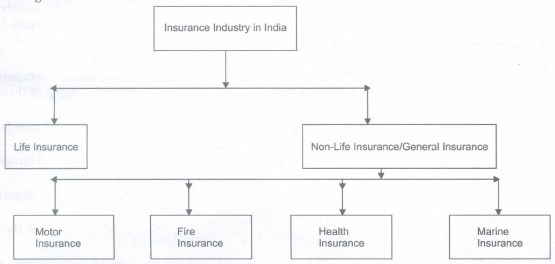
| Type of Insurance | Meaning | Type of Risk Covered |
|---|---|---|
| Life Insurance | Life Insurance is a contract, under which the insurer in consideration of a premium, agrees to pay a specified amount on the death of the assured, or on the expiry of a certain fixed period, whichever is earlier. | It provides protection to the family at the premature death or gives adequate amount at old age when earning capacity is reduced. |
| Fire Insurance | Fire Insurance is a contract whereby the insurer, in consideration of the premium paid, undertakes to compensate the insured for any loss that may result due to the occurrence of fire. | Protects the goods against the risk of fire. |
| Marine Insurance | Marine Insurance is a contract of insurance under which the insurer undertakes to indemnify the insured in the manner and to the extent thereby agreed against marine losses. | Protects the goods against the risk of loss in sea voyage |
| Health Insurance | Health Insurance policy is a contract between an insurer and an individual or group, in which the insurer agrees to provide specified health insurance at an agreed upon price (the premium) | Protects against unseen health problems. |
| Motor Vehicle Insurance | It is a contract whereby the insurer agrees to indemnify the insured, in consideration of a fixed premium, for a loss caused by theft, fire, accident, earthquake etc. | It protects the value of motor vehicles against risk of theft, accident and fire etc. It also covers the owner's liability to compensate who are killed or insured through negligence of the motorist. |
| Burglary Insurance | It is a contract whereby the insurer agrees to indemnify the insured, in consideration of a fixed premium of loss due to theft, burglary, house breaking and acts of similar nature. | It covers the risk of loss due to theft, burglary, house breaking and acts of the similar nature. |
| Cattle insurance | It is a contract whereby a sum of money is secured to the assured in the event of death of animals like bulls, buffaloes, cows and heifers. | It covers risk of death of cattle due to accident, disease or pregnancy. |
| Crop Insurance | It is a contract to provide financial support to farmers in case of crop failure due to drought or flood. | It covers all risks of loss or damages to the crop. |
| Sports Insurance | It assures a comprehensive cover available to amateur sportsmen covering their sporting equipment personal effects, legal liability and personal accident risks. | It is available to the following sports: angling, badminton cricket, golf, lawn tennis squash, use of sporting gun etc. |
6.
Indian Post and Telegraph Department provides various postal services all over India. India has been divided into 22 postal circles for this. There are 1,54,149 post offices in India. It has 5,64,701 letter boxes, which transmits 1575 crore mails every year. 5,01,716 villages have a public telephone and 26000 post offices are connected through the network. It links major 97 countries across the world. It provides speedpost facility for over 1000 destinations in India.
Facilities of postal department are broadly divided into:
(a) Financial Facilities: Post and Telegraph Department provides financial services using post office's saving schemes like Public Provident Fund, Kisan Vikas Patra, National savings Certificate, normal retail banking functions of monthly income schemes, recurring deposit account, savings account, time deposits and money order facility etc.
(b) Mail Facilities: It consists of parcel facilities which consists of transmission of articles from one place to another which can be registered and insured. It also provides facilities for greeting post, (a range of delightful greeting card on all occasions) and Media Post (a way for Indian corporate to advertise their brands through aerograms, telegrams and letterboxes).
(c) International Money Transfers: It enables money transfer from 185 countries in collaboration with Western Union Money Transfer.
(d) Passport Facilities: It has joint hands with Ministry of External Affairs and accepts application for passport.
(e) Speed Post: It has more than 1000 destinations in India. It covers 97 major countries of the world.
(f) E-Bill Post: It is the latest addition in facilities by Indian Post whereby it collects bill payment across the counter for BSNL and Bharti Airtel.
7.
(a)The main functions of commercial banks are accepting deposits from the public and advancing them loans.
(b) However, besides these functions there are many other functions which these banks perform. All these functions can be divided under the following heads:
1. Accepting deposits.
2. Giving loans.
3. Overdraft.
4. Discounting of Bills of Exchange.
5. Investment of Funds.
6. Agency Functions.
1. Accepting Deposits:
(a)The most important function of commercial banks is to accept deposits from the public. Various sections of society, according to their needs and economic condition, deposit their savings with the banks.
(b)For example, fixed and low income group people deposit their savings in small amounts from the points of view of security, income and savings promotion. On the other hand, traders and businessmen deposit their savings in the banks for the convenience of payment.
(c)Therefore, keeping the needs and interests of various sections of society, banks formulate various deposit schemes. Generally, there are three types of deposits which are as follows:
(i) Current Deposits:
(a)The depositors of such deposits can withdraw and deposit money whenever they desire. Since banks have to keep the deposited amount of such accounts in cash always, they carry either no interest or very low rate of interest.
(b)These deposits are called Demand Deposits because these can be demanded or withdrawn by the depositors at anytime they want.
Such deposit accounts are highly useful for traders and big business firms because they have to make payments and accept payments many times in a day.
(ii) Fixed Deposits:
(a)These are the deposits which are deposited for a definite period of time. This period is generally not less than one year and, therefore, these are called as long term deposits. These deposits cannot be withdrawn before the expiry of the stipulated time and, therefore, these are also called as time deposits.
(b)These deposits generally carry a higher rate of interest because banks can use these deposits for a definite time without having the fear of being withdrawn.
(iii) Saving Deposits:
In such deposits, money upto a certain limit can be deposited and withdrawn once or twice in a week. On such deposits, the rate of interest is very less. As is evident from the name of such deposits their main objective is to mobilise small savings in the form of deposits. These deposits are generally done by salaried people and the people who have fixed and less income.
2. Giving Loans:
(a)The second important function of Commercial Banks is to advance loans to its customers. Banks charge interest from the borrowers and this is the main source of their income.
Banks advance loans not only on the basis of the deposits of the public rather they also advance loans on the basis of depositing the money in the accounts of borrowers. In other words, they create loans out of deposits and deposits out of loans. This is called as credit creation by Commercial Banks.
(b)Modern banks give mostly secured loans for productive purposes. In other words, at the time of advancing loans, they demand proper security or collateral. Generally, the value of security or collateral is equal to the amount of loan. This is done mainly with a view to recover the loan money by selling the security in the event of non-refund of the loan.
(c)At times, banks give loan on the basis of personal security also. Therefore, such loans are called unsecured loan. Banks generally give the following types of loans and advances:
(i) Cash Credit:
In this type of credit scheme, banks advance loans to its customers on the basis of bonds, inventories and other approved securities. Under this scheme, banks enter into an agreement with its customers to which money can be withdrawn many times during a 'year. Under this setup banks open accounts of their customers and deposit the loan money. With this type of loan, credit is created.
(ii) Demand Loans:
These are such loans that can be recalled on demand by the banks. The entire loan amount is paid in lump sum by crediting it to the loan account of the borrower, and thus entire loan becomes chargeable to interest with immediate effect.
(iii) Short-term Loan:
These loans may be given as personal loans, loans to finance working capital or as priority sector advances. These are made against some security and entire loan amount is transferred to the loan account of the borrower.
3. Overdraft:
Banks advance loans to its customer's upto a certain amount through over-drafts, if there are no deposits in the current account. For this, banks demand a security from the customers and charge very high rate of interest.
4. Discounting of Bills of Exchange:
This is the most prevalent and important method of advancing loans to the traders for short-term purposes. Under this system, banks advance loans to the traders and business firms by discounting their bills. In this way, businessmen get loans on the basis of their bills of exchange before the time of their maturity.
5. Investment of Funds:
(i)The banks invest their surplus funds in three types of securities-Government securities, other approved securities and other securities. Government securities include both, central and state governments, such as treasury bills, national savings certificate etc.
(ii)Other securities include securities of state associated bodies like electricity boards, housing boards, debentures of Land Development Banks, units of UTI, shares of Regional Rural banks etc.
6. Agency Functions:
Banks function in the form of agents and representatives of their customers. Customers give their consent for performing such functions. The important functions of these types are as follows:
(i) Banks collect cheques, drafts, bills of exchange and dividends of the shares for their customers.
(ii) Banks make payment for their clients and at times accept the bills of exchange: of their customers for which payment is made at the fixed time.
(iii) Banks pay insurance premium of their customers. Besides this, they also deposit loan installments, income tax, interest etc. as per directions.
(iv) Banks purchase and sell securities, shares and debentures on behalf of their customers.
(v) Banks arrange to send money from one place to another for the convenience of their customers.
8.
A service is an act or performance offered by one party to another. They are economic activities that create value and provide benefits for customers at specific times and places as a result of bringing desired change.
According to Sir William B, "Service refers to social efforts which include the Govt. to fight five giant evils - wants, disease, ignorance, squalor and illness in the society".
Characteristics of Services:
Service is an act or performance offered by one party to another. They are economic activities that create value and provide benefits for customers at specific times and places as a result of bringing about a desired change in or on behalf of the recipient of the service. The term, service, is not limited to personal services like medical services, beauty parlors, legal services, etc. According to the marketing experts and management thinkers the concept of services is a wider one. The term services are defined in a number of ways but not a single one is universally accepted. The distinct characteristics of services are mentioned below:
1. Intangibility: Services are intangible. We cannot touch them, it is not a physical object. According to Carman and Uhl, a consumer feels that he has the right and opportunity to see, touch, hear, smell or taste the goods before they buy them. This is not applicable to services. The buyer does not have any opportunity to touch, smell, and taste the services. While selling or promoting a service one has to concentrate on the satisfaction and benefit a consumer can derive having spent on these services.
For example: Railways sells a train ticket from destination-A to destination-B. Here it is the matter of consumer's perception of services than smelling it or tasting it.
2. Inventory: Services too, are perishable like labour. Service has a high degree of perishability. Here the element of time assumes a significant position. There will be a complete loss of labour. If labour stops working, it is a complete waste. It cannot be stored. Utilized or unutilized services are an economic waste. An unoccupied building, an unemployed person, credit unutilized, etc. are economic waste. Services have a high level of perishability.
3. Inseparability: Services are generally created or supplied simultaneously. They are inseparable. For example, the entertainment industry, health experts and other professionals create and offer their services at the same given time. Services and their providers are associated closely and thus, not separable. Donald Cowell states 'Goods are produced, sold and then consumed whereas the services are sold and then produced and consumed'. Therefore inseparability is an important characteristic of services which proves challenging to service management industry.
4. Inconsistency: This character of services makes it difficult to set a standard for any service. The quality of services cannot be standardized. The price paid for a service may either be too high or too low as is seen in the case of the entertainment industry and sports. The same type of services cannot be sold to all the consumers even if they pay the same price. Consumers rate these services in different ways. This is due to the difference in perception of individuals at the level of providers and users. Heterogeneity makes it difficult to establish standards for the output of service firm.
5. Involvement: In the sale of goods, after the completion of process, the goods are transferred in the name of the buyer and he becomes the owner of the goods. But in the case of services, we do not find this. The users have only an access to services. They cannot own the service.
For example: a consumer can use personal care services or medical services or can use a hotel room or swimming pool. However, the ownership remains with the providers. According to Philip Kotler, "A service is an activity or benefit that one party can offer to another that is essentially intangible and does not result in the ownership of anything" From this it is clear that the ownership is not affected in the process of selling the services.

11th Standard CBSE Syllabus & Materials
11th Standard CBSE
CBSE 11th Business Studies Forms of Business Organisation Sample Question Papers Study Material - QB365 Set A
NEW11th Standard CBSE
CBSE 11th Business Studies Business, Trade and Commerce Sample Question Papers Study Material - QB365 Set A
NEW11th Standard CBSE
CBSE 11th Physics Waves Sample Question Papers Study Material - QB365 Set A
NEW11th Standard CBSE
CBSE 11th Physics Kinetic Theory Sample Question Papers Study Material - QB365 Set A



CBSE 11th Standard CBSE Subjects
CBSE Standards









