
 100% FREE ACCESS
11th Standard CBSE Syllabus & Materials
11th Standard CBSE
CBSE 11th Economics PART-A - Presentation of Data - New Sample Question Papers Study Material - QB365 Set A
NEW11th Standard CBSE
CBSE 11th Economics PART-A - Organisation of Data - New Sample Question Papers Study Material - QB365 Set A
NEW11th Standard CBSE
CBSE 11th Economics PART-A - Collection of Data - New Sample Question Papers Study Material - QB365 Set A
NEW11th Standard CBSE
CBSE 11th Economics PART-A - Introduction to Economics and Statistics - New Sample Question Papers Study Material - QB365 Set A
NEW11th Standard CBSE
CBSE 11th Business Studies International Trade Sample Question Papers Study Material - QB365 Set A
NEW11th Standard CBSE
CBSE 11th Business Studies Evolution and Fundamentals of Business Sample Question Papers Study Material - QB365 Set A

Published on: 25/07/2019
Nature and Purpose of Business
Download CBSE Class 11th Standard CBSE Business Studies question papers, sample papers, important questions, and previous year solved papers in PDF format. Get free study materials, NCERT solutions, and exam preparation resources for Class 11th Standard CBSE Business Studies
Questions + Answers key
Take MCQ Business Studies Test
1.
Profits are necessary for:
Expansion
Survival
Innovation
All of the above
2.
Which of the following is a cause of business risk?
Natural causes
Political causes
Economic causes
All of the above
3.
Which of the following is not an insurable risk?
Risk of theft
Risk of fire
Risk of change in pattern of demand
All of these
4.
Which of the following is an economic activity?
Cooking food for self consumption
Cooking food for sale
Cooking food for donation
All of the above
5.
Which of the following cannot be classified as an objective of business?
Investment
Productivity
Innovation
Profit earning
6.
The industries which provides support services to other industries are known as
Primary industries
Secondary industries
Commercial industries
Tertiary industries
7.
The occupation in which people work for others and get remunerations in return is known as
Business
Employment
Profession
None of them
8.
Which of the following cannot be classified as an auxiliary to trade?
Mining
Insurance
Warehousing
Transport
9.
Which of the broad categories of industries covers, oil refinery and sugar mills?
Primary
Secondary
Tertiary
None of them
10.
Which of the following does not characterise business activity?
production of goods and service
Presence of risk
Sale or exchange of goods and service
Salary or wages
11.
What are the functions of commerce?
12.
Differentiate between economic and non-economic activities.
13.
Explain the concept of business.
14.
Why is business considered an economic activity?
15.
If one starts a business, which objective will be of utmost importance to you and why?
16.
Define commerce. Discuss its importance in the business world.
17.
Explain the economic and social objectives of the business.
18.
Define Profession. Discuss its salient features.
19.
What factors are important to be considered while starting a business? Explain.
20.
Describe the activities relating to commerce.
1.
(d)
All of the above
2.
(d)
All of the above
3.
(c)
Risk of change in pattern of demand
4.
(b)
Cooking food for sale
5.
(a)
Investment
6.
(d)
Tertiary industries
7.
(b)
Employment
8.
(a)
Mining
9.
(a)
Primary
10.
(d)
Salary or wages
11.
The functions of commerce are as follows:
1. Removing the hindrance of person and that means lack of information to producer about consumer and to consumer about the producer. It is removed by advertising.
2. Transportation removes hindrance of place.
3. Storage and warehousing activities remove the hindrance of time.
4. Banking removes the hindrance of finance.
5. Insurance removes the hindrance of risk.
6. Advertising removes the hindrance of information
12.
All human beings have different types of needs. So, in order to fulfill those needs, they have to perform some activities. Human activities are classified into economic and non-economic activities.
| Basis | Economic | Non-economic |
| Meaning | Those activities whose aim is to earn money. | Those activities whose aim is not to earn money, and to create wealth, but to satisfy social, psychological and emotional needs. |
| Example | A teacher teaching in a school. People working in factories. | A teacher teaches his/her son/daughter at home. A housewife cooks food for her family. |
13.
Business: An economic activity involving the production and sale of goods and services undertaken with a motive of earning profit by satisfying human needs in society is called business.
Characteristics of Business
1. Economic activity: All business activities are economic activities and are done for the sole purpose of earning money.
2. Production and procurement of goods and services: A business activity involves the production or procurement of goods and services. A manufacturer is involved in production, while a shopkeeper is involved in procurement.
3. Sale and exchange of goods and services for the satisfaction of human needs: Sale and exchange of goods and services is done to satisfy human needs.
4. Dealing in goods and services on a regular basis: One time dealing in goods or services cannot be termed as a business. The business should happen on a regular basis.
5. Profit earning: Profit earning is the fundamental motive of doing a business. Other motives are there, but they depend on profit motive.
6. Uncertainty of returns: Returns can never be certain in business activity. This happens because of external factors which are outside the control of the business organization.
7. Element of risk: An element of risk is always present in business activity.
14.
Any activity is called an economic activity when it is done with a view to earning money. The motive of a business is to earn profit primarily. However, there are some other objectives as well like increasing market share, improvement in productivity, employee satisfaction, consumer satisfaction, social objectives, but the main and basic objective of a business is to make profits. Therefore, it is called economic activity.
15.
If one starts their own business, our social objectives will be of utmost importance to me because:
(a) It will create employment opportunities in the economy. He/she will make use of such methods which are desirable from society point of view.
(b) It will help us to provide good quality product at reasonable prices to customers.
(c) It will keep environment pollution free.
(d) When we will concentrate on these objectives, it will satisfy one consumers and employees. Consumer satisfaction will lead to improvement in these goodwill and market standing. Employee satisfaction will lead to increase in productivity. These two factors will increase profits in the long run automatically.
16.
Commerce is related to the exchange and distribution of goods and services. It involves bade and activities which facilitate trade like transportation, banking, warehousing, and finance, etc. Commerce can be defined as the sum total of all such activities which are related to transfer of goods and services from manufacturer to consumer, i.e., from the place of production to the place of consumption.
Commerce is of great importance in the business world:
1. Removal of Obstacles or Hindrance of Trade:
(a) Removing the hindrance of person: It means lack of information to producer about consumer and to consumer about the producer. It is removed by advertising.
(b) Transportation removes the hindrance of place.
(c) Storage and warehousing activities remove the hindrance of time.
(d) Banking removes the hindrance of finance.
(e) Insurance removes the hindrance of risk.
(f) Advertising removes the hindrance of information.
These functions are divided into:
1. Service Functions
Those activities which help in removing hindrance of place, i.e. distance, knowledge, information and risk are included in service functions. These activities make use of the following means:
(i) Transportation
(ii) Communication
(iii) Insurance
(iv) Advertisement
(v) Entertainment services.
2. Financial Functions
It includes those activities which help in removing hindrance to finance. It includes:
(i) Commercial banks
(ii) Financial institutions like LIC, UTI, etc.
(iii) Stock exchanges
(iv) Private financiers
(v) Lease, hire purchase and installment supply agencies.
3. Marketing Functions
Those activities which help in the removal of the hindrances of exchange and person are included in this category. It includes:
(i) Channels of distribution
(ii) Storing and warehousing facilities
(iii) Packaging, grading and trade marks.
17.
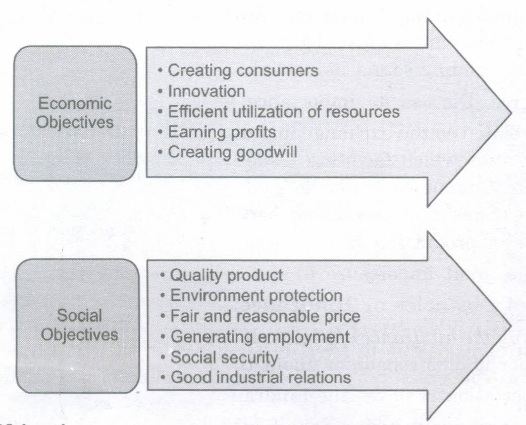
Economic Objectives:
(a) Creating consumers: It means producing and distributing such useful goods and services which satisfy the consumers.
(b) Innovation: Innovation includes production of new products, replacing older products with latest and with new ones, improvement and modernisation in production methods so as to improve quality and/or reduce cost.
(c) Effective utilisation of Resources: A business tries to minimise and optimise its resource usage so as to minimise the cost and maximise the profits. By reducing cost and increasing profits, it ensures survival, growth, expansion and diversification.
(d) Earning profits: According to Dicksee, "Business is a form of activity pursued primarily with the objective of earning profit for the benefit of those on whose behalf activity is conducted.
(e) Creating Goodwill: When a business is able to make good profits and other economic activities, its goodwill amongst investors and competitors goes up.
Social Objectives
(a) Quality product: A business aims at providing quality product so that it has good demand in the market and consumers feel satisfied to consume it. Inferior goods do not satisfy consumers.
(b) Environment protection: Another social objective of a business is protecting the environment from pollution of any kind and to ensure that nonrenewable resources are not depleted.
(c) Fair and reasonable price: Prices must be fair and reasonable. Business aims at maximizing social satisfaction in right sense instead of maximizing profit.
(d) Generating employment: Business activities aim at providing employment opportunities for entrepreneurs and self-employed persons. Who provide some goods and services to businessmen?
(e) Social security: Businessmen follow certain social welfare programmes like group insurance, provident fund, pension fund, medical facilities of employees, etc. it enhances social security.
(f) Good industrial relations: Employees are an important part of an organization. Their problems and grievances must also be considered, while running a business. Business must aim at building sound industrial relations.
18.
When a person is engaged in an occupation which provides services on the basis of specialized knowledge and experience in their respective occupations, it is called profession. For example, Legal (Lawyer), Medical (Doctor), Accountancy (C.A).
An occupation can be called a profession if it has the following features:
1. Membership of a professional body and certificate of practice is required.
2. Personalised services of expert nature.
3. Professional qualification and training are required.
4. Professional fee is charged in lieu of services.
5. The limited capital for establishment is required.
6. The degree of risk is low.
7. Professional code of conduct is to be followed that has been given by the concerned authority.
19.
Following factors are considered while starting a new business:
1. Selecting the line of business: The first thing to be decided by the entrepreneur is the line and type of business to be undertaken.
2. Scale or size of business: After deciding the line of business the businessman must decide whether he/she wants to set up largescale or small scale business.
3. Choice of form of business organization: The next decision must be taken is to finalise the form of business i.e., to set up sale, proprietorship, partnership or joint stock company.
4. Location of business enterprise: The entrepreneur has to decide the place where the business will be located. Before taking this decision he/she must find out availability of raw materials, power, labour, banking, transportation etc.
5. Financial requirement: The businessman must analyse the amount of capital he/ she might require to buy for fixed assets and for working assets). Proper financial planning must be done to determine the amount of funds needed.
6.Physical facilities: It includes machinery, equipment building etc. This decision depends upon the size, scale and type of business activities he/she wants to carry on.
7. Plant layout: Showing the physical arrangement of machines and equipment needed to manufacture a product.
8. Competent and committed workforce: The entrepreneur must find out the requirement of skilled and unskilled workers and managerial staff to perform various activities.
9. Tax planning: The entrepreneur must try to analyse the types of taxes, because there are a number of tax laws in the country which affect the functioning of business.
10. Setting up the enterprise: After analysing the above mentioned points carefully the entrepreneur can start the business which would mean mobilising various resources and completing legal formalities.
20.
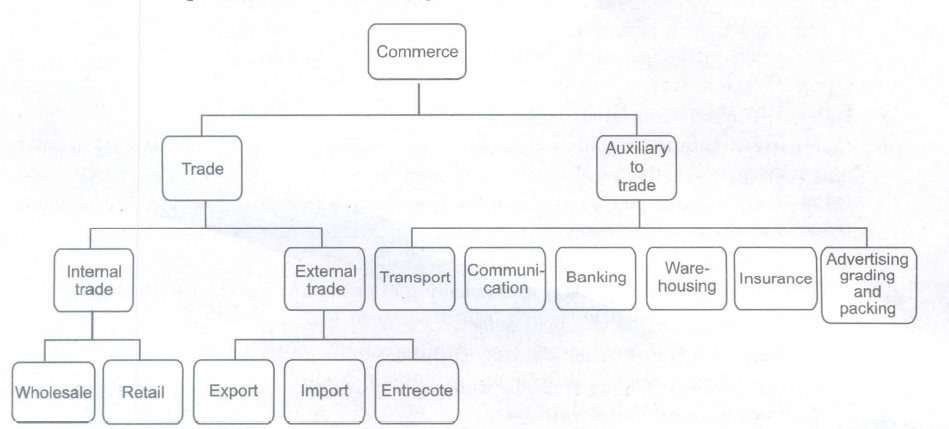
Commerce refers to all those activities which are concerned with the transfer of goods and services from the producers to the consumers. It embraces all those activities which are necessary for maintaining a free flow of goods and services. It includes trade and auxiliary to trade.
Commerce = Trade + Auxiliary to Trade
1. Trade: Trade refers to buying and selling of goods and services with the objective of earning profit. It is classified into two categories.
(i) Internal Trade: It takes place within a country. Internal trade is classified into two categories-retail trade and wholesale trade.
(ii) Retail Trade: It refers to buying of goods and services in relatively small quantities and selling them to the ultimate consumers.
(a) External Trade: It is done between two or more countries. External trade can be classified into three categories.
(b) Import Trade: If goods are purchased from another country, it is called import trade.
(c) Export Trade: If goods are sold to other countries, it is called export trade.
(d) Entrecote Trade: Where goods are imported for export to other countries e.g., Indian firm may import some goods from America and export the same goods to Nepal.
2. Auxiliaries to Trade: All those activities which help in removing various hindrances which arise in connection with the production and distribution of goods are called auxiliaries to trade. An overview of these activities is given below.
1. Transportation and Communication: The production of goods takes place at one place whereas these are demanded in different parts of the country. The obstacle of place is removed by the transport. Along with transport, communication is also an important service. It helps in exchange of information between producers consumers and traders. The common communication services are postal service, telephone, fax, internet etc.
2. Banking and Finance: Business needs funds for acquiring assets, purchasing raw materials and meeting other expenses. Necessary funds can be obtained from a bank.
3. Insurance: It provides a cover against the loss of goods, in the process of transit, storage, theft., fire and other natural calamities.
4. Warehousing: There is generally a time lag between the production and consumption of goods. This problem can be solved by storing the goods in warehouses.
5. Advertising: Advertising brings goods and services to the knowledge of prospective buyers. It is through advertising that the customers come to know about the new products and their utility.

11th Standard CBSE Syllabus & Materials
11th Standard CBSE
CBSE 11th Business Studies Forms of Business Organisation Sample Question Papers Study Material - QB365 Set A
NEW11th Standard CBSE
CBSE 11th Business Studies Business, Trade and Commerce Sample Question Papers Study Material - QB365 Set A
NEW11th Standard CBSE
CBSE 11th Physics Waves Sample Question Papers Study Material - QB365 Set A
NEW11th Standard CBSE
CBSE 11th Physics Kinetic Theory Sample Question Papers Study Material - QB365 Set A



CBSE 11th Standard CBSE Subjects
CBSE Standards









