
 100% FREE ACCESS
11th Standard CBSE Syllabus & Materials
11th Standard CBSE
CBSE 11th Economics PART-A - Presentation of Data - New Sample Question Papers Study Material - QB365 Set A
NEW11th Standard CBSE
CBSE 11th Economics PART-A - Organisation of Data - New Sample Question Papers Study Material - QB365 Set A
NEW11th Standard CBSE
CBSE 11th Economics PART-A - Collection of Data - New Sample Question Papers Study Material - QB365 Set A
NEW11th Standard CBSE
CBSE 11th Economics PART-A - Introduction to Economics and Statistics - New Sample Question Papers Study Material - QB365 Set A
NEW11th Standard CBSE
CBSE 11th Business Studies International Trade Sample Question Papers Study Material - QB365 Set A
NEW11th Standard CBSE
CBSE 11th Business Studies Evolution and Fundamentals of Business Sample Question Papers Study Material - QB365 Set A

Published on: 30/07/2019
Emerging Modes of Business
Download CBSE Class 11th Standard CBSE Business Studies question papers, sample papers, important questions, and previous year solved papers in PDF format. Get free study materials, NCERT solutions, and exam preparation resources for Class 11th Standard CBSE Business Studies
Questions + Answers key
Take MCQ Business Studies Test
1.
In India, ________________ and ______________ are referred to as emerging modes of business.
E-Business and E-Commerce
Outsourcing and E-business
Outsourcing and E-Commerce
Online Trading and Networking.
2.
Which of the following is used to handle data storage risk?
VIRUS
Hacking
Cryptography
All of the Above
3.
Which of the following is a benefit of e-business?
Less Risky
Less Technological Requirements
Convenience
All of the above
4.
When a firm transacts with its employees, it is referred to as:
B2B Commerce
B2E Commerce
C2C Commerce
B2C Commerce
5.
In B2B, B2C, C2C etc B and C stand for:
Business and Corporate
Biding and Customer
Business and Customer
Business and Consumer
6.
When was Electronic Data Interchange (EDI) standardised?
1984
1995
2000
1999
7.
E-business and E-commerce are:
Synonyms
Antonyms
Former is wider than latter
Former is narrow than latter.
8.
It is not an application of e-business:
Online bidding
Online procurement
Online trading
Contract RandD
9.
A Call Centre handles:
Only in-bound voice based business
Only out-bound voice based business
Both voice based and non-voice based business
Both customer facing and back-end business
10.
e-commerce does not include:
A business's interactions with its suppliers
A business's interactions with its customers
Interactions among the various departments within the business
Interactions among the geographically dispersed units of the business
11.
Hackers lack certain values. Which are these?
12.
What resources are required for successful implementation of e-business?
13.
Explain various payment mechanisms under e-business.
14.
What is digital divide? How is it relevant in context of e-business?
15.
Write a short note on the history of e-commerce.
16.
Write a short note on the scope of e-business.
17.
Differentiate between traditional business and e-business.
18.
Describe briefly the data storage and transmission risks in e-business.
19.
What are the ethical concerns involved in outsourcing?
20.
State any three differences between E-business and traditional business.
21.
Discuss utility of E-Commerce in:
(a) Health
(b) Education
(c) Governance
22.
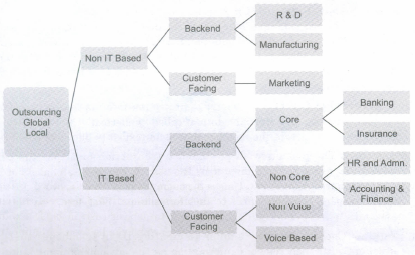
Show the anatomy of outsourcing.
23.
Discuss the limitations of electronic mode of doing business. Are these limitations severe enough to restrict its scope? Give reasons for your answer.
24.
Why are E-business and outsourcing referred to as the emerging modes of business? Discuss the factors responsible for the growing importance of these trends.
1.
(c)
Outsourcing and E-Commerce
2.
(c)
Cryptography
3.
(c)
Convenience
4.
(b)
B2E Commerce
5.
(d)
Business and Consumer
6.
(a)
1984
7.
(c)
Former is wider than latter
8.
(d)
Contract RandD
9.
(d)
Both customer facing and back-end business
10.
(c)
Interactions among the various departments within the business
11.
It will not be wrong to say that hackers lack certain values:
(a) They do not value the importance of other persons' privacy.
(b) They are keen to use others' efforts for their selfish means and even for fun.
(c) They wish to get many things without putting an effort for it using short cuts and illegal means.
But remember in exceptional cases, hacking is also used to find criminals and to solve criminal cases.
12.
Three m's are required for setting up any business: men, money and machines:
For e-business some additional sources are required. It needs a website with allotted cyberspace. More is the cyberspace, more is the cost of website and vice-versa. Space requirement depends on scale of operations and how interactive a website is.
13.
Various payment mechanisms under e-business are described below:
(a) Cash on Delivery: Under this, the payment for goods ordered online may be made in cash at the time of physical delivery of the goods.
(b) Cheque: Another option is that the online vendor may arrange for the pickup of the cheque from the customer's end. Upon realization, goods may be delivered.
(c) Net Banking Transfer: These days banks provide facility to the customers for electronic transfer of funds using internet. Therefore, a buyer can also make use of net banking money transfer to pay for the goods ordered.
(d) Credit or Debit Cards: These are also called plastic money. These cards are most popularly used in payment for online transactions. To accept credit card as an online payment type, the seller first needs a secure means of collecting credit card information from its customer. Payments through credit cards can be processed either manually, or through an online authorization system like SSL Certificate.
(e) Digital Cash: It is a kind of electronic currency which exists only in cyberspace. It has no real physical properties, but offers the ability to use real currency in an electronic format. For this the buyer has to deposit cash in bank account which issues equivalent digital cash to the person which can be used for online trading. It is more secure than credit or debit cards.
14.
It is division of society on the basis of familiarity with digital technology and nonfamiliarity with digital technology.
The digital divide causes a significant problem in many struggling parts of the world. "As of 2003, only seven per cent of the world's 6.4 billion people have had access to the World Wide Web" [Ryder M. 2005]. The parts of the world that have a predominant amount of internet access is the Western World, the United States, Europe and Northern Asia, whereas access is more restricted in the poorer less developed parts of the world such as Africa, India and southern parts of Asia. These poorer nations are unable to afford the initial start up cost to be able to invest into technology to allow their nation to be able to have and maintain internet access. This puts these countries at a competitive and economic disadvantage. This is due to the fact that it impacts on society at many levels. By a country not having internet access, it means that schools are unable to teach IT skills and take advantage of the vast amount of information available on the web. With the lack of IT skills people from these countries are unable to compete at an international level.
15.
The origin of e-commerce dates back to electronic media like telephone, fax, compact disc, cable and personal computer etc. These electronic media had several limitations like speed, accuracy, secrecy, geographical distance, authenticity etc. Business transactions were carried out using electronic devices. Let us look at the history chronologically.
1. In 1984, EDI or Electronic data interchange was standardized through ASC X12. It guaranteed that companies will be able to complete transactions with each other reliably.
2. In 1992, 'Compursive' offered online retail products to its customers.
3. In 1994, Netscape arrived which provided a simple browser to surf the internet and launched a safe online transaction technology called Secure Socket Layer (SSL).
4. In 1995 two of the biggest names in e-commerce were launched namely, amazon.com and e-bay.com.
5. In 1998, Digital Subscribed Line was launched.
6. In 1999, retail spending over the internet reached $820 billion dollar as per business.com.
7. In 2000, the USA government extended moratorium on internet taxes till 2005.
16.
Scope of e-business is very wide. It is summarized below
1. B2B Commerce: Business to Business-Both the parties are business firms, e.g. Manufacturer of an automobile requires assembly of a large number of components which are being manufactured by different firms; Maruti Udyog, Bajaj Auto etc. use B2B commerce.
2. B2C Commerce: Business to Customer-Transaction taking place between business and individual customers. It facilitates promotion of products on line. e.g. music or film. Companies sell products and services on line to customer e.g. Amul.com sell Amul products online.
3. Intra - B. Commerce: Parties involved are from within a given business firm. It makes it possible for the marketing department to interact constantly with the production department to get information about customer requirement
4. C2C Commerce: Consumer to consumer-Business originates from the consumer and the ultimate destination is also consumer. Its area of application is the formation of consumer forum. e.g. selling used books over the internet.
17.
Differences between traditional business and e-business is summarized below:
| Basis | Traditional Business | e-business |
|---|---|---|
| 1. Formation | Difficult | Simple |
| 2. Physical presence | Required | Not required |
| 3. Location requirement | Market | None |
| 4. Cost of setting up | High | Low/no requirement of physical facility |
| 5. Shape of Organizational structure | Vertical due to hierarchy or chain of command | Horizontal due to directness of command and communication |
| 6. Opportunityfor interpersonal touch | More | Less |
| 7. Ease of expansion | More | Less |
| 8. Nature of contact with the suppliers and customers | Indirect through intermediaries | Direct. |
18.
In the present century, information is acting as power. If the relevant information of the business reaches into wrong hands, it may create a lot of loss for the company concerned. There is a risk of enroute being stolen or modified by wrong people for their selfish motives. It is exposed to the risk of VIRUS and hacking. VIRUS stands for Vital Information Under Size. Installing and timely updating antivirus programs and scanning the files and disks with them provides protection to the files, folders and systems from the attack of virus.
Another risk involved is interception of data in the course of transmission. To protect data against this, cryptography is used. Cryptography refers to the art of protecting information by transforming it into an unreadable format called 'cyphertext'. Thereafter only those who have a secret key can decrypt the message into 'plaintext'. It is like coding and decoding.
19.
Following are the major ethical concerns involved in outsourcing:
(a) Confidentiality: When a company outsources any of its functions, it has to share a lot of information and knowledge with outsourcing partner. He may not preserve the confidentiality. If company adopts outsourcing of complete processes or products, there is further risk that outsourcing partner may start his own business which may increase competition.
(b) Sweat Shopping: The firms which opt for outsourcing aim at lowering their costs, try to get maximum benefit from the low cost manpower of the host countries. Secondly, such works are outsourced which do not build much of competency and ability of outsourcing partners. So, they build blue collar workers by handing over doing skills rather than creating white collar workers by transferring thinking skills.
(c) Using Child Labour and not following Labour Laws: Outsourcing is engaging child labour and women in the factories. Moreover, there exists wage discrimination on the basis of sex of the worker. Workers are exploited by giving less than minimum wages.
(d) Resentment in the Countries: When MNCs contract out manufacturing, marketing, accounting, R and D etc. to developing countries, it may create resentment in home country. The people from developed countries may not like that the jobs which they could get have been transferred to developing nations for cost cutting.
20.
The differences between e-business and traditional business can be summarized as below:
1. Logistics: The logistics of e-business typically have lesser constraints than traditional business. E-businesses are not limited to venue; they can be located anywhere and still serve the same customer. Their product capacity is "infinite" in that they are not limited to the space of a brick-and-mortar store. E-businesses mainly depend on shipping methods to deliver and receive items, while traditional stores conduct an instant exchange. This timing difference can be a significant factor for some consumers. For example, refunds would typically take much longer to process for e-businesses than in a neighborhood store.
2. Human Resources: The two types of business differ in talent recruitment. E-businesses significantly emphasize technology and hire more people from the web design and .development fields. In some cases, every employee may be required to have a technical background or receive in-house training for basic web development. On the other hand, traditional businesses are more diverse in hiring for non-technical positions, such as sales representatives and display managers.
3. Marketing and Finance: In marketing for traditional business, marketers can focus on all five human senses to influence the sale. For example, maintaining a proper display keeps the product aesthetically appealing. Consumers can also physically touch the product in a traditional store; this is particularly vital for physically sensitive items such as clothes. E-businesses typically have to rely mainly on sight. The physical display is replaced with digital images. The inability to touch and test the product first hand is replaced with technical text to visualize the details of the product; online retailers may also have the ability to present many more choices because they do not need to have the physical product on hand. The major financial difference between e-business and traditional business is cost. E-businesses usually have lesser start up and operational costs, buying an online domain is much cheaper than renting land and building facilities and buying equipment.
4. Management: E-business management is typically flatter than traditional management. A flat company happens when there are few levels in between top management and the entry-level employee. In most E-businesses, low level management, such as store managers and division managers, is unnecessary. Instead, E-businesses expand horizontally by hiring external consultants and contract web development positions. These entities specialize in a business service, such as e-commerce setup and online marketing. They may work for the company but are not necessarily included in or affected by management decisions.
21.
(a) Changes in Health: E-health is following the same path, with electronic patient records slowly being introduced and health insurance schemes starting to refund e-health services. This will be a userdriven development as it is more likely that the users will be able to adapt to e-health much faster than the healthcare system can deliver it.
This will clear the way for a whole new e-health industry, worth billions of dollars. One has to look at some of the e-health systems linked to the highend private hospitals in the USA to see what is in store. They use their e-health facilities as a major marketing tool to attract customers, not just to the actual hospital, but to all the other facilities around it. The add on revenues are significant.
(b) Progress in e-education: It is moving at an enormous pace and already some schools are limiting the number of printed textbooks - some are going totally e-book. With over a million children now with laptops it is only a matter of time before the education system to switch over. The savings in books and other printed material alone will pay for this digital revolution. South Korean schools will be entirely e-book-based by 2015.
(c) Governance: Many e-government services on offer around the world already provide citizens with relatively sophisticated services and the establishment of a fiberbased broadband network may see governments improve and broaden the range of web services even further. In addition, mobile services are being incorporated in service offerings and computing is becoming integrated. The Internet of Things (IoT) and M2M will also impact upon this sector. Those who are still talking about broadband as an end in itself; do not understand the situation. Broadband is simply the tool that will further enable and advance the digital economy.
22.
Anatomy of outsourcing has been shown with the help of chart given below:
23.
The limitations of electronic mode of doing business are given below:
(a) Low personal Touch: It lacks the warmth of interpersonal interactions. Therefore, such products which need personal touch like beauty products, garments, fashion accessories etc. can't be traded through e-business.
(b) Mismatch between order giving/taking speed and order fulfillment speed: Sometimes websites take a long time to open which may frustrate the user. Even after giving or taking order, it takes enough time to give physical delivery of goods. It also plays on the patience of the customer.
(c) Knowledge of technology is must: For e-commerce both the parties need fairly high degree of familiarity with the world of computers. It divides the society into two parts i.e; one who are familiar with digital technology and other who are not.
(d) Increased risk due to parties being unknown to each other: When two parties are involved in e-business, they are unaware of personal identities of each other. They do not even know the locations of the parties involved. It makes e-business risky. There may also be problems of virus and hacking.
(e) People Resistance: People are resistant to change their ways and adopt new technology. Change is perceived as a source of stress and insecurity by many.
(f) Ethical Concerns: These days companies use an electronic eye to keep track of the websites being used by employees, computer files that they use, their e-mal accounts etc. It is not ethical. But in spite of these limitations, e-business is the way.
No, these limitations are not severe enough to restrict its scope:
(a) Improvement in Information Technology: With the improvement in information technology and emergence of internet the process of outsourcing and e-business is on an expansionary path. Anti virus and improved security measures are increasing to make e-business more secure and safer option.
(b) More and more Interactive Websites: Websites are becoming more and more interactive. It is removing the problem of 'low personal touch'.
(c) Improvement in Communication Technology: Communication technology is continually evolving and increasing the speed and quality of communication through internet so that customer does not get frustrated in processing the order.
(d) Diffusion of E-Commerce in all nooks and corners of the country: An order to diffuse e-commerce in all nooks and corners, India has undertaken about 150 such projects. It is increasing the number of people acquainted with digital technology.
We can conclude that e-business will continue to stay and reshape the businesses, governance and economies.
24.
E-business and outsourcing are referred to as emerging modes of business. Prefix 'emerging' puts emphasis on the fact that these businesses are in the process of development. These changes are happening here and now, and, that these changes are likely to continue. In fact, three changes are taking place most strongly:
(a) Digitizaton: The conversion of text, sound, images, video and other content into a series of ones and zeroes that can be transmitted electronically.
(b) Outsourcing: Contracting out non core activities to outside firms.
(c) Internationalisation and globalisation: More and more foreign companies are entering into India and sending Ashia and Indian companies becoming MNCs. Therefore, E-business and outsourcing referred to as the emerging modes of business.
Following factors are responsible for the growing importance of these trends:
(a) Improvement in Information Technology: With the improvement in information technology and emergence of internet the process of outsourcing and e-business is on an expansionary path.
(b) More and More Interactive Websites: Websites are becoming more and more interactive. It is removing the problem of 'low touch'.
(c) Improvement in Communication Technology: Communication technology is continually evolving and increasing the speed and quality of communication through internet.
(d) Diffusion of E-Commerce in all nooks and corners of the country: In order to diffuse e-commerce in all nooks and corners, India has undertaken about 150 such projects. It is also growing importance of these trends.
(e) Global Competitive Pressures for higher quality products: Due to adoption of new economicpolicy of 1991 in India, there has been an increase in competitive pressure from giant sized MNCs and global enterprises.
(f) Ever Demanding Consumers: There is increasing demands from consumers for high quality products at minimum cost. Therefore, e-business and outsourcing are being chosen as newer options.
But e-business and outsourcing are not emerging out of compulsion but also out of choice because of its benefits to consumers as well as producers.

11th Standard CBSE Syllabus & Materials
11th Standard CBSE
CBSE 11th Business Studies Forms of Business Organisation Sample Question Papers Study Material - QB365 Set A
NEW11th Standard CBSE
CBSE 11th Business Studies Business, Trade and Commerce Sample Question Papers Study Material - QB365 Set A
NEW11th Standard CBSE
CBSE 11th Physics Waves Sample Question Papers Study Material - QB365 Set A
NEW11th Standard CBSE
CBSE 11th Physics Kinetic Theory Sample Question Papers Study Material - QB365 Set A



CBSE 11th Standard CBSE Subjects
CBSE Standards









