
 100% FREE ACCESS
11th Standard CBSE Syllabus & Materials
11th Standard CBSE
CBSE 11th Economics PART-A - Presentation of Data - New Sample Question Papers Study Material - QB365 Set A
NEW11th Standard CBSE
CBSE 11th Economics PART-A - Organisation of Data - New Sample Question Papers Study Material - QB365 Set A
NEW11th Standard CBSE
CBSE 11th Economics PART-A - Collection of Data - New Sample Question Papers Study Material - QB365 Set A
NEW11th Standard CBSE
CBSE 11th Economics PART-A - Introduction to Economics and Statistics - New Sample Question Papers Study Material - QB365 Set A
NEW11th Standard CBSE
CBSE 11th Business Studies International Trade Sample Question Papers Study Material - QB365 Set A
NEW11th Standard CBSE
CBSE 11th Business Studies Evolution and Fundamentals of Business Sample Question Papers Study Material - QB365 Set A

Published on: 31/07/2019
Social Responsibilities of Business and Business Ethics
Download CBSE Class 11th Standard CBSE Business Studies question papers, sample papers, important questions, and previous year solved papers in PDF format. Get free study materials, NCERT solutions, and exam preparation resources for Class 11th Standard CBSE Business Studies
Questions + Answers key
Take MCQ Business Studies Test
1.
Which of the following alone can ensure effective ethics programme in a business enterprise?
Publication of code
Involvement of employees
Establishment of compliance mechanisms
None of them
2.
Which of the following can explain the need for pollution control?
Cost savings
Reduced risk of liability
Reduction of health hazards
All of them
3.
Environmental protection can best be done by the efforts of
Business people
Government
Scientists
All the people
4.
That an enterprise must behave as a good citizen is an example of its responsibility towards
Owners
Workers
Consumers
Community
5.
Social responsibility is
Same as legal responsibility
Broader than legal responsibility
Narrower than legal responsibility
None of them
6.
Name any four elements of business ethics.
7.
What are the obligations of a business in the name of social responsibility?
8.
What are the core objectives of social responsibility of business?
9.
What are the major areas of social responsibility of business?
10.
Briefly explain (a) Air pollution, (b) Water pollution, and (c) Land pollution.
11.
What do you mean by the principle derived from social values which guide and govern the conduct of businessmen? Explain the factors governing these principles and values.
12.
Social responsibility is not an area of business. Do you agree? Justify.
13.
Explain the various elements of business ethics.
14.
Give any two reasons supporting social responsibilities.
15.
Mention two responsibilities of business towards customers.
16.
What do you mean by the principles derived from social values which guide and govern the conduct of businessmen?
17.
What is the relation between ethics and moral values?
18.
Define corporate social responsibility.
1.
(c)
Establishment of compliance mechanisms
2.
(c)
Reduction of health hazards
3.
(d)
All the people
4.
(d)
Community
5.
(b)
Broader than legal responsibility
6.
Business ethics can be defined as the code of conduct that a business must follow, such that it takes up only those activities that are desirable from the viewpoint of society. The purpose of business ethics is to guide managers and other employees in an organisation in performing their jobs in a manner that is socially acceptable.
The following are some of the elements of business ethics.
(a) Top-level officers, such as the CEO's and other higher level managers, must sincerely follow the ethical code of conduct. They should also guide other employees in their organisation in adopting the code.
(b) An enterprise must clearly define the ethical code of conduct to be followed in the organisation. The code should include quality standards for work, laws governing production and employee's health and safety standards.
(c) In addition to setting performance standards, an enterprise must also devise a mechanism through which it can measure the actions of individual employees. This should be done in order to confirm whether the ethical standards are being met.
(d) The successful implementation of ethical standards depends to a large extent on the involvement of employees at different levels. This is because it is the employees who actually implement the ethical codes.
(e) Although it is difficult to measure the end results of implementation of ethical standards, the top management should take steps to monitor compliance. Also, it must take serious action against any unethical behaviour in the organisation.
7.
The social responsibility of business comprises of the following obligations:
(a) A business must give a proper dividend to its shareholders or investors.
(b) It must provide fair wages and salaries with good working conditions.
(c) It must provide a regular supply of good quality goods and/or services to its consumers/customers at reasonable prices.
(d) It must abide by all government rules and regulations, support its business related policies and should pay fair taxes without keeping any delays or dues.
(e) It must also contribute for the betterment of a local community by doing generous activities like building schools, colleges, hospitals, etc.
(f) It must take immense care to see that its activities neither directly nor indirectly create havoc on the vitality of its surrounding environment.
(g) It should maintain a stringent policy to curb or control pollution in regard to contamination of air, water, land, sound and radiation leakages. It must hire experienced professional individuals who are experts in their respective fields.
(h) It should also offer social-welfare services to the general public.
8.
The core objectives of social responsibility of business are as follows:
1. It is a concept that implies a business must operate (function) with a firm mindset to protect and promote the interest and welfare of society.
2. Profit (earned through any means) must not be its only highest objective else contributions made for betterment and progress of a society must also be given a prime importance.
3. It must fulfill its social responsibilities honestly in regard to the welfare of society in which it operates and whose resources and infrastructures it makes use of to earn huge profits.
4. It should never neglect (avoid) its responsibilities towards society in which it flourishes.
9.
Major areas for social responsibility of business are given below:
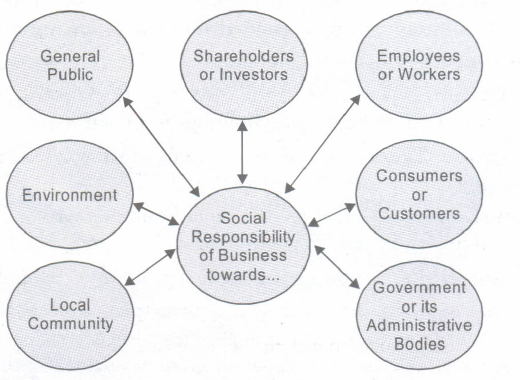
(a) Shareholders or investors who contribute funds for business.
(b) Employees and others that make up its personnel.
(c) Consumers or customers who consume and/or use its outputs (products and/or services).
(d) Government and local administrative bodies that regulate its commercial activities in their jurisdictions.
(e) Members of a local community who are either directly or indirectly influenced by its activities in their area.
(f) Surrounding environment of a location from where it operates.
(g) The general public that makes up a big part of society.
10.
(a) Air Pollution: This kind of pollution is caused by the emission of harmful gases into the atmosphere. Smoke and chemicals emitted by factories and vehicles degrade the air quality and causes air pollution.
(b) Water Pollution: Discharge of industrial and household wastes into rivers, streams or lakes causes degradation of the water quality. Over time, the increase in water pollution often results in the deaths of several animals and poses serious threats to human beings.
(c) Land Pollution: This is caused due to the dumping of toxic materials and wastes on land, which in turn damages the quality of land, making it unfit and unproductive for agriculture and crop plantation.
11.
Social Return on Investment (SROI) is a principle based method for measuring extra-financial value (i.e., environmental and social value not currently reflected in conventional financial accounts) relative to resources invested. It can be used by any entity to evaluate impact on stakeholders, identify ways to improve performance, and enhance the performance of investments.
A network was formed in 2006 to facilitate the continued evolution of the method. Over 570 practitioners globally are members of the SROI Network.
The SROI method as it has been standardized by the SROI Network provides a consistent quantitative approach to understanding and managing the impact of a project, business, organisation, fund or policy. It accounts for stakeholders' views of impact, and puts financial 'proxy' values on all those impacts identified by stakeholders which do not typically have market values. The aim is to include the values of people that are often excluded from markets in the same terms as used in markets, that is money, in order to give people a voice in resource allocation decisions.
Some SROI users employ a version of the method that does not require that all impacts be assigned a financial proxy. Instead the "numerator" includes monetized, quantitative but not monetized, qualitative, and narrative types of information about value.
Benefits that cannot be Monetized: There will be some benefits that are important to stakeholders but which cannot be monetized. An SROI analysis should not be restricted to one number, but seen as a framework for exploring an organization's social impact, in which monetization plays an important but not an exclusive role.
Focus on Monetization: One of the dangers of SROI is that people may focus on monetization without following the rest of the process, which is crucial to proving and improving. Moreover, an organisation must be clear about its mission and values and understand how its activities change the world - not only what it does but also what difference it makes. This clarity informs stakeholder engagement. Therefore, if an organisation seeks to monetize its impact without having considered its mission and stakeholders, then it risks choosing inappropriate indicators; and as a result the SROI calculations can be of limited use or even misconstrued.
Needs considerable Capacity: SROI is time and resource, intensive. It is most easily used when an organisation is already measuring the direct and longer term results of its work with people, groups, or the environment.
Some outcomes not easily associated with monetary value: Some outcomes and impacts (for example, increased self-esteem, improved family relationships) cannot be easily associated with a monetary value. In order to incorporate these benefits into the SROI ratio proxies for these values would be required. SROI analysis is a developing area and as SROI evolves it is possible that methods of monetizing more outcomes will become available and that there will be increasing number of people using the same proxies.
12.
It can be justified by considering case for and case against social responsibility:
The case in favour of taking up social responsibilities.
(a) Existence and growth: Business enterprises exist to make profits by providing goods and services to consumers. Thus, we can say that their long-term growth prospect depends not only on their profits but also on how efficiently they serve the society. Therefore, taking up social responsibilities supports the existence and growth of a business enterprise.
(b) Avoidance of government intervention: Business enterprises should always work in line with society's values and ethics. This would help them fulfill their social responsibilities, which in turn would make them less prone to government intervention.
(c) Better environment for doing business: Businesses make use of society's resource of human capital. Thus, by providing employment to people, they help solve the social problems of unemployment and poverty, thereby creating a favorable environment for business.
The case against taking up social responsibilities:
(a) Violation of profit maximization objectives: It is argued that a business enterprise exists to make a profit. Thus, if it engages itself in solving social problems, then it may not have enough resources to meet its primary objective of profit maximization.
(b) Burden on consumers: It is argued that when a business enterprise is engaged in solving social problems such as environment pollution and unemployment, its expenditures increase. This increased financial burden is ultimately passed on to the consumers in the form of higher prices of products.
(c) Lack of social skills: Business persons are basically trained to solve business-related problems such as minimizing cost, maximizing profits and increasing sales. However, they are not specialised in solving social problems. Thus, it is argued that social problems must be solved only by specialised agencies, which have the required training and skills.
13.
Business ethics can be defined as the code of conduct that a business must follow, such that it takes up only those activities that are desirable from the viewpoint of society. The purpose of business ethics is to guide managers and other employees in an organisation in performing their jobs in a manner that is socially acceptable.
Business ethics should be followed in the day-to-day working of a business enterprise. The following are some of the elements of business ethics.
(a) Commitment by top management: Top-level officers, such as the CEO's and other higher level managers, must sincerely follow the ethical code of conduct. They should also guide other employees in their organisation in adopting the code.
(b) Publication of a 'code': An enterprise must clearly define the ethical code of conduct to be followed in the organisation. The code should include quality standards for work, laws governing production and employee's health and safety standards.
(c) Establishment of compliance mechanism: In addition to setting performance standards, an enterprise must also devise a mechanism through which it can measure the actions of individual employees. This should be done in order to confirm whether the ethical standards are being met.
(d) Involvement of employees at all levels: The successful implementation of ethical standards depends to a large extent on the involvement of employees at different levels. This is because it is the employees who actually implement the ethical codes.
(e) Measurement of results: Although it is difficult to measure the end results of implementation of ethical standards, the top management should take steps to monitor compliance Also, it must take serious action against illy unethical behaviour in the organisation.
14.
(i) It is in long term interest of the business.
(ii) It is justified for growth and existence of business.
15.
Supply of right quality of goods and proper precaution against adulteration.
16.
Business ethics are principles derived from social values which guide and govern the conduct of businessmen.
17.
Ethics refer to the entire body of moral values which a society attaches to the actions of human beings.
18.
Corporate social responsibility is a comprehensive set of policies, practices and programmes which are integrated into business operations, supply claims, and decision making process throughout the company, wherever the company does business and includes responsibility for current actions as well as past and future actions.

11th Standard CBSE Syllabus & Materials
11th Standard CBSE
CBSE 11th Business Studies Forms of Business Organisation Sample Question Papers Study Material - QB365 Set A
NEW11th Standard CBSE
CBSE 11th Business Studies Business, Trade and Commerce Sample Question Papers Study Material - QB365 Set A
NEW11th Standard CBSE
CBSE 11th Physics Waves Sample Question Papers Study Material - QB365 Set A
NEW11th Standard CBSE
CBSE 11th Physics Kinetic Theory Sample Question Papers Study Material - QB365 Set A



CBSE 11th Standard CBSE Subjects
CBSE Standards









